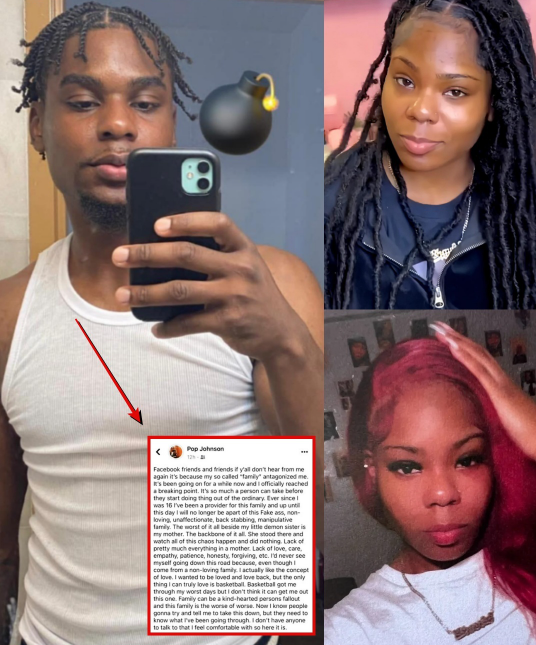
SHOCKING UPDATE: He warned Facebook.
He wrote it out.
And hours later… he murdered his own sister.
This story is not just violent.
It is prophetic.
It is the kind of nightmare that announces itself long before it arrives — and still arrives anyway.
Twenty-nine-year-old Rodney Johnson has now been sentenced to 25 years in prison, following his guilty plea for second-degree murder in the killing of his own 20-year-old sister, Shayla Johnson, the Manhattan District Attorney confirmed.

This wasn’t random.
This wasn’t sudden.
This wasn’t a man who “snapped” in a moment of uncontrollable rage.
This was a murder he announced.
A rage he typed out.
A warning the world ignored.
Five hours before he stabbed Shayla to death, Rodney wrote a long, unhinged rant on Facebook — a confession disguised as a complaint.
In that rant, he warned:
“If y’all don’t hear from me again it’s because my so-called ‘family’ antagonized me… I reached a breaking point… It’s so much a person can take before they start doing thing(s) out of the ordinary.”
He said it plainly.
He said it publicly.
He said it in daylight.
And then he carried it out.
On the morning of July 19, 2023, inside their East Harlem apartment, Shayla was preparing to shower when Rodney followed her into the bathroom.
No argument.
No buildup.
No pause.
Just violence.
He stabbed her again and again, driving her from room to room as she tried to escape, turning the apartment into a maze of terror she could not outrun.
It was a rampage that lasted minutes — but felt like hours to the woman fighting for her life and to the mother forced to witness one child slaughtering another.
Friends say the “final straw” was something painfully small.
Something almost unbelievable.

Shayla had put a pizza in the oven.
Just a pizza.
Just a few minutes of heat drifting into the kitchen near where Rodney slept.
But to him, it was the spark that ignited an explosion he had been brewing for months.
That tiny act — that harmless, ordinary act — collided with Rodney’s paranoia, resentment, and untreated fury, and the result was a murder that tore their family apart forever.
When police arrived at the apartment, they didn’t have to search for Rodney.
He wasn’t hiding.
He wasn’t running.
He wasn’t pretending.
He was standing outside, waiting.
He confessed immediately — to the officers and even to the 911 operator before they arrived.
Inside the apartment, they found the knife soaked in blood.
They found the rooms streaked with the signs of Shayla’s desperate fight.
They found the mother, shattered, having watched her daughter die at the hands of her own son.
But they also found something else — something far more disturbing than the weapon.
They found the Facebook post.
The digital fuse that Rodney himself lit.
In his rant, he blamed everyone around him.
He attacked his “little demon sister.”
He accused his mother of being part of a “fake, non-loving, manipulative family.”
He described the home as a place with “no love, no empathy, no forgiveness.”
He framed himself as the victim — pushed, pressured, cornered.

But prosecutors saw the post differently.
To them, it wasn’t the cry of a wounded man.
It was the blueprint of a killer.
A prelude to murder.
A document proving intent — and foresight.
They brought that post straight into court.
Not as speculation.
Not as emotion.
But as evidence.
“This wasn’t a snap,” the prosecution argued.
“This was a ticking time bomb — and he pulled the pin himself.”
And that’s the part that chills everyone who has followed the case.
Rodney didn’t try to stop himself.
He didn’t seek help.
He didn’t leave the apartment to cool down.
He didn’t walk away.
He planned it.
He posted it.
He executed it.

Against the one person he should never have harmed.
Against his own blood.
Shayla never saw the sunrise that day.
She never saw her next birthday.
She never saw another moment of a life she was still building.
Instead, she became the center of a tragedy that forces us to confront a terrifying truth:
Sometimes the signs are visible.
Sometimes the warnings are loud.
Sometimes the danger is written in plain sentences for the world to see.
But no one intervenes until it is too late.

Rodney’s sentencing closes the legal chapter — but opens a deeper, darker conversation about the failures that came before it.
How does a man announce a murder on Facebook and still carry it out hours later?
How does a family live with the knowledge that the warning was there — typed, posted, timestamped — and yet nothing prevented the outcome?
How many more tragedies hide in plain sight on social media, ignored until they become headlines?
Neighbors recall the screaming.
Police recall the silence before Rodney confessed.
Friends recall the tension that had been building for months.
And the city recalls yet another family destroyed by unchecked rage, untreated mental collapse, and a system that reacts after tragedy — not before.

Rodney’s story is now locked behind prison walls.
Shayla’s life is frozen in the moment it was stolen.
And the mother who lost a daughter and a son in the same morning is left to replay every warning sign she never realized was a warning at all.
He didn’t just lose control.
He didn’t just snap.
He didn’t just get angry.
He told the world what he was going to do.
He telegraphed it.
He posted it.
He prepared for it.
And then he carried it out — with a calm, brutal precision that leaves everyone asking the same haunting question:
What if someone had taken his words seriously?