The Kensington estate had never known chaos like this.
Crystal chandeliers blazed above a room worth more than most neighborhoods, their light reflecting off white coats that moved with frantic urgency. Eighteen of the most celebrated physicians on the planet crowded around a single crib. Machines screamed warnings into the air. Heart monitors shrieked. A ventilator hissed like an animal fighting to breathe.
Outside the nursery window, night pressed in cold and unforgiving.
Inside, Julian Kensington—three months old, heir to a forty-billion-dollar empire—was dying.
His skin had taken on the color of dusk. Blue lips. Blue fingertips. A rash bloomed across his tiny chest like an accusation no one in the room could answer. Blood tests returned inconclusive. Treatments failed one by one. Every expert reached deeper into theory, into complexity, into the comfort of their own brilliance—and found nothing.
No one noticed the boy at the window.
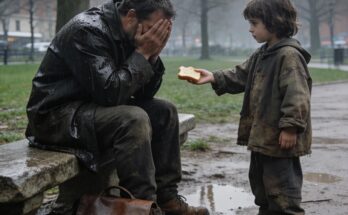
Leo Carter, fourteen, stood pressed against the glass, his breath fogging a pane that had never been meant for someone like him. His jacket was too thin, worn thin by three winters and too many apologies. His shoes were held together by faith more than leather. He was the son of the night maid, a child raised on the edges of wealth so vast it erased people like him by accident.
He had learned early how to move without being seen.
By the time he was six, he knew how to walk silently. No one taught him. Survival did. When you lived in a groundskeeper’s cottage so small it could fit inside the Kensington family’s walk-in closet, invisibility was not a skill—it was protection.
His mother, Grace Carter, had worked this estate for eleven years. She scrubbed floors while women in designer gowns stepped over her like furniture. She worked through illness, through miscarriages, through the slow erosion of her own dreams so her son could eat and attend school.
“We are blessed,” she told Leo every night. “Don’t ever forget that.”
Leo never argued.
But he never forgot the sign on the service entrance either:
STAFF MUST USE REAR ACCESS. VISIBLE PRESENCE ON MAIN GROUNDS PROHIBITED.
Blessed had always meant tolerated.
Yet tonight, as Leo stared at the nursery, something twisted violently inside his chest.
Because he knew what the doctors didn’t.
He wasn’t looking at the baby.
He was looking at the plant.
It sat on the windowsill, wrapped in a gold ribbon like a joke told by the devil himself. Dark, glossy leaves glistened beneath the medical lights. Pale bell-shaped flowers drooped innocently, white streaked with purple like bruises on porcelain.
Three days earlier, Leo had seen it arrive.
He remembered the moment with terrifying clarity. The delivery van. Old Mr. Harrison, the head gardener, signing for the package. Harrison’s gloved fingers brushing the leaves—and coming away slick with yellow residue. Harrison frowning. Laughing it off. Carrying the plant inside toward the nursery where expensive gifts were displayed like trophies.
Leo’s grandmother’s voice had echoed in his mind even then.
The devil’s most beautiful work is always wrapped in something lovely.
Miriam Carter had taught him plants the way other grandmothers taught baking. On a porch in Kingston, she showed him leaves that healed and flowers that killed. She had delivered babies with no electricity. She had saved lives with knowledge medical schools dismissed as superstition.
He recognized those leaves before he could read.
Digitalis.
Devil’s trumpet.
Angel killer.
Now, through the glass, he watched the greatest doctors in the world walk past it seventeen times without a glance.
Inside the nursery, panic sharpened. Someone prepared surgical equipment. Someone whispered words Leo didn’t need to hear to understand.
They were going to cut the baby open.
Leo’s hands trembled. He thought of his mother. Of what would happen if he was wrong. Of being fired. Evicted. Erased. He thought of how easy it would be to walk away, to return to the cottage and let wealth solve its own problems.
Then he thought of what would happen if he was right and did nothing.
Leo pulled his coat tighter, drew a breath that burned his lungs, and ran.
The service entrance was unlocked. Chaos makes gods forget locks. He burst through the kitchen, past frozen caterers and crashing copper pans, up the servant staircase hidden inside the mansion’s spine. Guards shouted. Radios crackled. Footsteps thundered behind him.
He did not stop.
At the nursery door, Leo did not knock.
He slammed it open.
Eighteen heads turned.
Outrage. Confusion. Dismissal.
“Security—”
Before they could finish the sentence, Leo screamed.
“The plant! It’s the plant! Digitalis—it’s poisoning him!”
Hands grabbed him. Lifted him. Dragged him backward.
“Please!” Leo fought like a cornered animal. “The oils—on the leaves—you’re breathing it—it slows the heart!”
Arthur Kensington’s voice cut through the room, cold and lethal.
“Remove him.”
Something snapped in Leo.
Not broke. Snapped.
He went limp. Slid free. Scrambled forward through white coats and cables and disbelief. He reached the crib as the room exploded into chaos, lifted Julian’s impossibly light body, and ran for the attached bathroom he knew existed because he’d memorized blueprints no one thought he’d ever see.
The door splintered as guards slammed into it.
Leo saw the jar on the counter.
Activated charcoal.
Charcoal pulls poison, his grandmother whispered from memory.
He mixed it with water in his palm. Tilted Julian’s head gently.
“I’m sorry,” Leo whispered. “I promise I’m trying to save you.”
The door burst open as he fed the mixture to the baby.
Hands tore him away.
Shouting. Threats. Accusations.
Then—
“Wait.”
Dr. Tanaka’s voice.
His oxygen levels were rising.
The rash was fading.
Silence fell like a held breath.
Arthur Kensington stared at his son.
Alive.
“Get off him,” Arthur said quietly.
The guards froze.
For the first time in his life, Leo Carter was seen.
What followed would dismantle empires, expose betrayal, and rewrite legacies—but in that moment, on a marble floor, with his knees shaking and his heart hammering, Leo understood one thing with absolute certainty.
He had stepped out of the shadows.
And nothing would ever be the same again.
Dawn did not bring relief. It arrived slowly and gray, as if even the light hesitated to enter the Kensington estate after what had unfolded during the night. Leo Carter sat upright in a leather chair outside the nursery corridor, his back straight, his hands clenched beneath a thin blanket someone had draped over his shoulders. He was not in handcuffs. No one was shouting at him. Somehow, that made everything more frightening.
Through the glass, he could see Julian sleeping peacefully. The baby’s small chest rose and fell in a steady rhythm. His color had returned. The monitors now beeped evenly, almost reassuringly. Each heartbeat was proof that Leo had not been wrong. Yet the fear in his gut did not loosen its grip. The truth had been spoken. The price of truth always came afterward.
The investigation began before the city fully woke. Arthur Kensington did not call the local police. He summoned people who did not appear in headlines—former federal investigators, independent forensic specialists, men and women accustomed to following trails where money and power tried to erase them. They sealed the nursery, removed the potted plant, collected gloves, curtains, and every surface that might have touched the toxin disguised as beauty.
Leo watched them work through the glass, struck by the bitter irony. When he had spoken up, he was an intruder. When he was proven right, an entire force appeared to protect that truth.
Arthur Kensington asked to see Leo just after sunrise. Leo walked through hallways he had once crossed only as a shadow. The family portraits lining the walls no longer felt cold; they seemed solemn, watchful. In the vast study, Arthur stood by the window, his back turned. He looked older than he had the night before, as if power had finally demanded its price.
“Sit down, Leo,” Arthur said, turning. It was the first time he had spoken Leo’s name.
Arthur did not soften the story. He spoke of the gift. Of Marcus Webb. Co-founder. Closest friend. Julian’s godfather. Each word cut like glass. Leo listened, realizing that betrayal was not merely a corporate scheme but the collapse of a decades-long trust. The poison was not only in the plant. It was in the human heart.
“He knew I wouldn’t question it,” Arthur said hoarsely. “He knew I trusted anything wrapped in elegance and congratulations.”
Leo said nothing. There were no words large enough for that kind of wound. He thought only of this: if Julian had died, the betrayal would never have been exposed. The world would have called it a tragedy. Money would have buried the truth.
Marcus Webb was arrested the following morning. Leo watched police cars roll through the gates from the nursery window. Cameras flashed. Reporters shouted. Leo felt no triumph. He understood something deeper—one man had fallen, but the system that made him believe he could get away with it still stood.
The days that followed passed in a strange suspension. Leo did not return to school or to the small cottage at the edge of the property. Arthur asked him to stay, not as charity, but as assurance that the story would not be twisted. Grace Carter was invited into meetings she had never imagined attending. She sat upright, hands trembling, learning to speak without lowering her eyes.
Arthur Kensington began tearing down walls—literally and figuratively. Fences came down. Prohibition signs disappeared. The estate opened, not as a public relations gesture, but as an overdue admission that isolation had bred blindness.
Yet legacy is not built on declarations. It is built on repeated actions.
Arthur founded the Miriam Carter Wellness Center. Not a luxury hospital, but a place that listened. A place where doctors asked, “What has changed in your environment?” before asking about insurance. A place where traditional knowledge was studied, tested, and respected—not romanticized, not dismissed.
Leo began to learn. Not just from books. He learned how to ask the right questions. How to translate his grandmother’s wisdom into the language of modern science. How to speak to people who once never saw him and not shrink.
Grace Carter changed in ways Leo barely recognized. She no longer asked permission to exist. She proposed, challenged, led. Years of invisibility had sharpened her insight, and now there was finally room for it.
A year later, at the opening of the Miriam Carter Wellness Center, Leo stood before the crowd without the urge to disappear. He spoke of his grandmother. Of knowledge without degrees but rich in history. Of poverty not as a lack of worth, but a lack of being heard.
When Julian—the child who had once hovered between life and death—toddled toward him and spoke his name, Leo understood that true legacy was not buildings or scholarships. It was a life saved, a bridge built between worlds long separated by silence.
Leo Carter was no longer a boy in the shadows. Nor was he a polished symbol. He became a reminder—that truth can come from the least expected places, that betrayal often wears a familiar face, and that the most enduring legacy teaches people to see one another.
The story did not end there. It began—quietly, steadily—in every child who walked through the doors of the Miriam Carter Wellness Center and was asked a question Leo had once longed to hear:
“What do you see that others have not?”
THE CONTINUATION: WHEN LEGACY MEETS RESISTANCE
The world did not change overnight. Leo learned that quickly.
The Miriam Carter Wellness Center opened its doors with applause and headlines, but behind the glass walls and ceremonial speeches, resistance began to take shape—quiet, organized, and dangerous in ways that did not announce themselves loudly.
It started with skepticism.
Medical journals published polite but cutting editorials. “Anecdotal success does not constitute replicable science.” Conferences debated whether “community-based traditional knowledge” belonged anywhere near peer-reviewed medicine. Panels of experts spoke about Leo without ever inviting him into the room.
Arthur Kensington warned him early.
“You didn’t just save my son,” Arthur said one evening as they stood overlooking the gardens. “You embarrassed an entire system. People don’t forgive that easily.”
Leo nodded. He had grown used to systems that preferred him silent.
But skepticism soon hardened into something sharper.
Funding applications were delayed without explanation. Supply contracts were suddenly canceled. A regulatory audit appeared—unannounced, aggressive, surgical in its precision. Inspectors combed through the wellness center as if hoping to find a crack they could widen into collapse.
Grace noticed first.
“They aren’t here to help,” she said quietly after the third inspection. “They’re here to prove we don’t belong.”
Leo felt the familiar tightening in his chest—the old instinct to retreat, to make himself smaller so the pressure would pass. But he remembered the nursery window. The plant. The cost of silence.
This time, he stayed visible.
Then came the article.
An investigative piece published by a prestigious outlet questioned the “true origins” of the plant poisoning. It suggested the possibility of exaggeration. Of misinterpretation. Of a well-intentioned but reckless boy who interfered in a medical emergency.
Leo read it twice, hands steady, heart not.
They didn’t call him a liar.
They called him mistaken.
Arthur reacted with fury. Lawyers were summoned. Statements drafted. Threats considered.
Leo stopped him.
“Let it stand,” Leo said.
Arthur stared at him. “They’re rewriting history.”
“No,” Leo replied calmly. “They’re revealing who’s afraid of it.”
Within days, former employees of Marcus Webb began to surface. Anonymous at first. Then braver. A lab technician confirmed the plant’s origin. A courier admitted to being paid in cash to avoid official channels. A paper trail emerged—not because power demanded it, but because truth attracts witnesses.
The article unraveled.
And something else happened.
Letters arrived.
From nurses who had ignored patients’ environments for years and now couldn’t stop noticing. From doctors trained to dismiss “folk knowledge” who remembered cases that suddenly made sense. From families who had lost someone and wondered—too late—if something simple had been overlooked.
Leo read every letter.
He answered many of them himself.
But resistance did not disappear. It adapted.
At a closed-door conference in Geneva, a senior figure in pharmaceutical research said what others only implied:
“If we validate this kind of knowledge, we undermine decades of authority.”
Leo was not in the room. But the words reached him anyway.
That was the moment he understood the real conflict was not science versus tradition.
It was control versus humility.
The breakthrough came unexpectedly—from a place Leo knew well.
A community clinic in Kingston, Jamaica, replicated the wellness center’s approach in a cardiac ward. They documented outcomes. They published data. The results were undeniable. When traditional observation was integrated—not romanticized, not isolated, but respected—outcomes improved.
The conversation changed.
Slowly. Reluctantly.
Arthur watched it unfold with a mixture of pride and unease.
“You’re changing the rules,” he told Leo one night. “And once rules change, power shifts.”
Leo looked at the lights beyond the estate, the city alive with people whose names would never appear in headlines.
“That’s the point,” he said.
The Miriam Carter Foundation expanded. Not aggressively. Intentionally. Each new center partnered with local elders, community healers, and formally trained clinicians. Knowledge flowed in both directions. Mistakes were admitted. Adjustments made.
Leo refused to let it become a brand.
“It’s not about me,” he said whenever journalists tried to frame it that way. “It’s about listening better.”
Years later, standing in a lecture hall filled with students from backgrounds as varied as his grandmother’s porch and Ivy League campuses, Leo told them the truth he had learned the hard way:
“Expertise doesn’t disappear when you take away a title. It just waits for someone brave enough to notice it.”
Some students would go on to challenge systems from the inside. Others would build new ones altogether.
As for Leo, he never forgot the cost of stepping out of the shadows.
But he also never forgot the alternative.
Because legacy, he learned, is not what you leave behind.
It is what you dare to confront while you are still here.
And somewhere, in a quiet room filled with sunlight and growing plants, a child would ask a question that changed everything again.
“What if we’ve been looking in the wrong place all along?”
The question did not stay in the classroom.
It followed Leo out into the world.
“What if we’ve been looking in the wrong place all along?”
Within months, that question began to unsettle institutions that had grown comfortable with their own certainty. Medical boards debated it in language that sounded cautious but felt defensive. Universities added elective courses on integrative observation, then quietly removed them after donors complained. Research grants were approved, then frozen, then redirected without explanation.
Leo watched all of it with a calm that surprised even him.
He had learned something essential the night he ran through the Kensington mansion: resistance is rarely loud at first. It prefers paperwork. Delays. Committees. Silence.
The first real blow came when a junior researcher at the Miriam Carter Wellness Center collapsed during a routine shift.
Her name was Elena Ruiz. Twenty-eight. Brilliant. Careful. She had been documenting interactions between environmental factors and pediatric cardiac stress—work that directly built on Leo’s grandmother’s principles.
The official diagnosis was exhaustion.
Leo knew better.
He visited her in the hospital, standing at the foot of the bed the same way he once stood outside Julian’s nursery.
“They told me to stop asking certain questions,” Elena admitted quietly. “They said my data was… inconvenient.”
“Inconvenient to who?” Leo asked.
She smiled weakly. “To people who already published their conclusions.”
The report Elena had been working on vanished from the system two days later.
Not deleted.
Reclassified.
Leo requested access through formal channels. He was denied.
Arthur wanted to intervene.
“Say the word,” Arthur told him. “I’ll apply pressure.”
Leo shook his head.
“That’s how they expect this to go,” he said. “Power against power. Noise against noise.”
“So what do you want to do?”
Leo looked out the window, watching nurses move through the corridor with practiced efficiency.
“I want to tell the story properly.”
The opportunity came from an unexpected place.
A whistleblower inside Marcus Webb’s former network reached out anonymously. The message was short, unpolished, and terrified.
You saved the baby. But the plant wasn’t the only attempt. Webb wasn’t working alone.
The file attached was incomplete—but explosive.
Emails. Funding transfers. A pattern of “natural complications” linked to hostile takeovers and boardroom wars. Health crises that conveniently destabilized families, companies, legacies.
Poison did not always come in a pot with a gold bow.
Sometimes it came as policy.
Leo spent nights reading, cross-referencing, confirming. He did not rush. He remembered his grandmother’s rule: If you hurry, you miss what matters.
What he uncovered pointed to something larger than revenge.
It was an industry.
The deliberate exploitation of blind spots—environmental, social, human—in systems that refused to see beyond their own frameworks.
Leo did not go to the press.
He went to the people.
He organized closed forums. Quiet meetings. Invitations sent not to the loudest voices, but to the most observant ones: nurses, midwives, lab techs, community doctors, sanitation workers, caregivers. People who noticed patterns because their jobs required attention, not authority.
He called it The Peripheral Project.
“The most important signals,” Leo told the first group, “never come from the center.”
Stories poured in.
Children sickened by decorative plants in hospital atriums. Elderly patients destabilized by cleaning agents no one thought to question. Infants reacting not to medicine—but to air, light, touch.
Each story alone was dismissible.
Together, they formed a map.
When Leo finally released the findings, he did so publicly, methodically, with data and testimony intertwined. Not as accusation—but as invitation.
The response was immediate.
Some praised the courage.
Others attacked the credibility.
And a few—very few—panicked.
Arthur recognized the signs.
“Someone is going to try to stop this,” he said.
Leo nodded. “I know.”
The attempt came quietly.
An offer.
A foundation position. Unlimited funding. Global platform.
One condition.
Distance yourself from the Peripheral Project.
“Why?” Leo asked the man across the table.
The man smiled thinly. “Because some knowledge destabilizes markets.”
Leo leaned back, studying him.
“My grandmother used to say,” Leo replied, “that when someone tells you not to look somewhere, that’s exactly where the truth is hiding.”
The offer was withdrawn.
The pressure increased.
Anonymous threats. Smear campaigns framed as concern. Editorials questioning Leo’s “objectivity” due to his background.
Grace saw the toll it took on him.
“You don’t have to carry this alone,” she said one night.
Leo smiled, tired but steady.
“I’m not,” he said. “That’s what scares them.”
The Peripheral Project spread anyway.
Not through headlines—but through practice.
Clinics adopted the framework quietly. Hospitals adjusted protocols without announcements. Medical schools began asking different questions in classrooms.
Change did not come as revolution.
It came as recognition.
Years later, when Leo stood once again in a hospital corridor—this time beside Elena Ruiz, now recovered, now leading her own research team—he felt the familiar division between before and after.
“Do you ever wish you’d stayed invisible?” Elena asked.
Leo thought of the plant. The nursery. The moment he chose to run.
“No,” he said. “Because invisibility was never safety. It was just delay.”
Elena nodded.
Down the hall, a child laughed. Clear. Strong.
Leo closed his eyes briefly.
The fight was not over.
But the legacy was no longer fragile.
And somewhere, someone else was about to notice something small.
Something overlooked.
Something that would change everything again.