I never planned to tell this story. It’s easier to let people think I came home a hero, that the hardest part of the war was adjusting to quiet streets and grocery stores with too many choices. The truth is that I didn’t start losing sleep until I landed back in the U.S. and realized someone who saved my life never got a seat on that plane.
This isn’t about medals. It’s about a dog no one wanted.
I met him outside a half-empty village that didn’t even have a name on our maps. The place was more dust than buildings, a stretch of tired land that felt forgotten long before we arrived. My unit had stopped there for a routine patrol. Nothing dramatic. Nothing you’d ever see in a movie trailer.
That’s where he appeared.
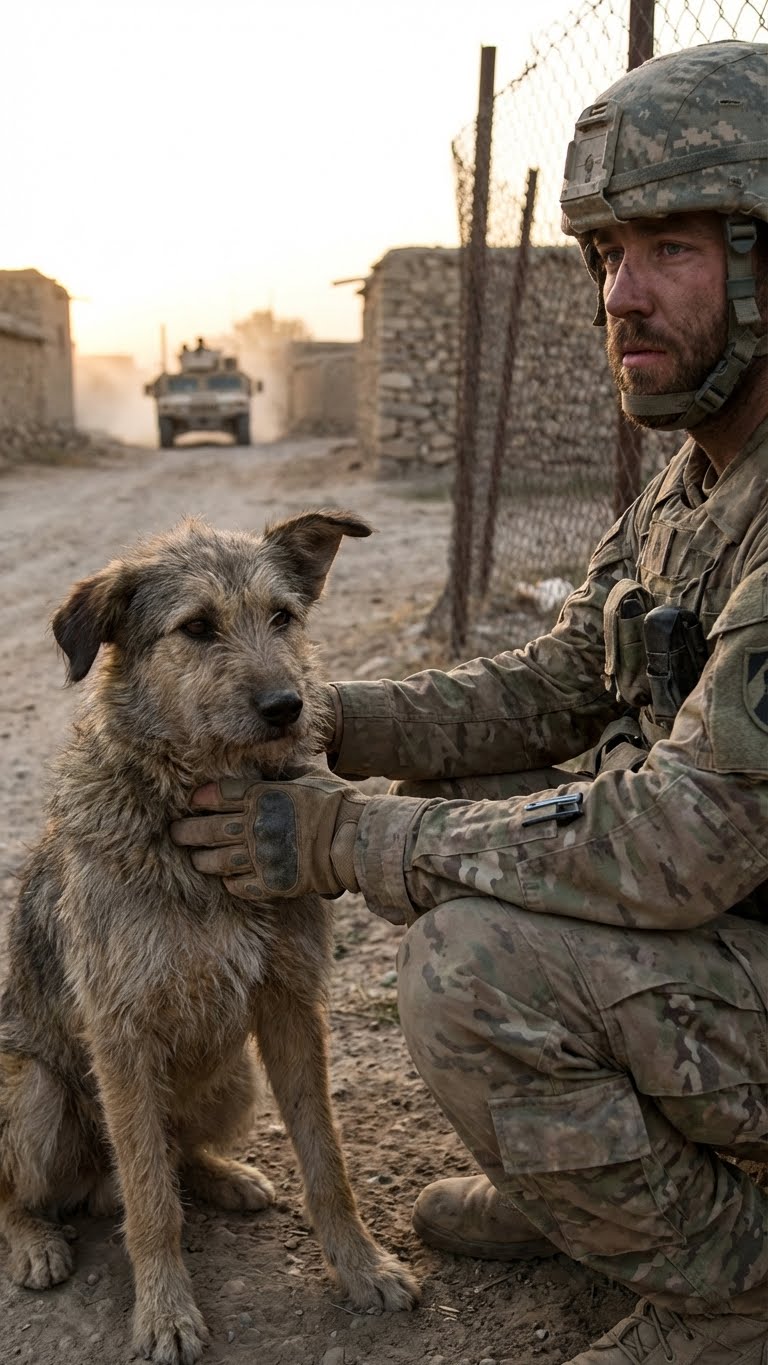
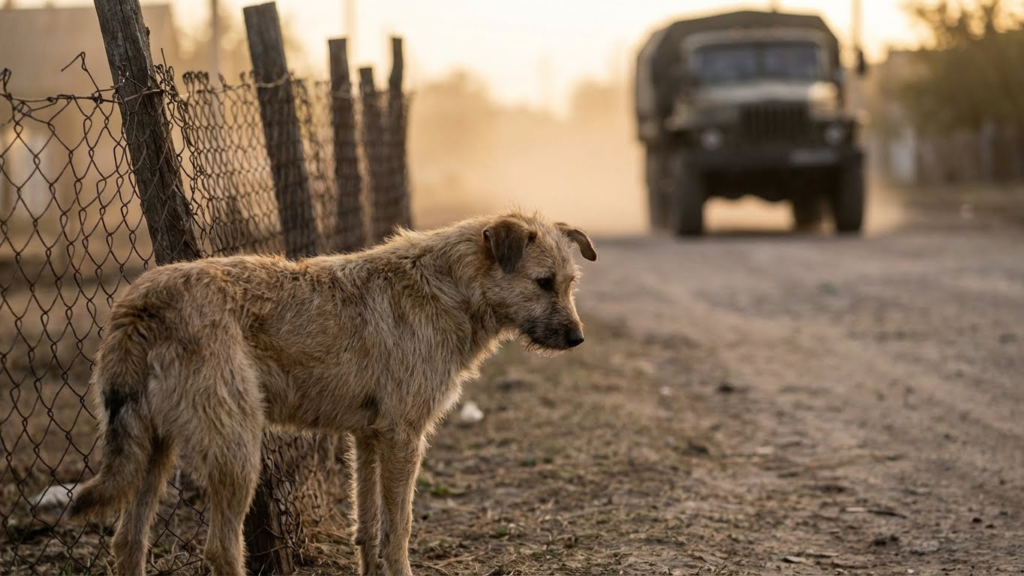
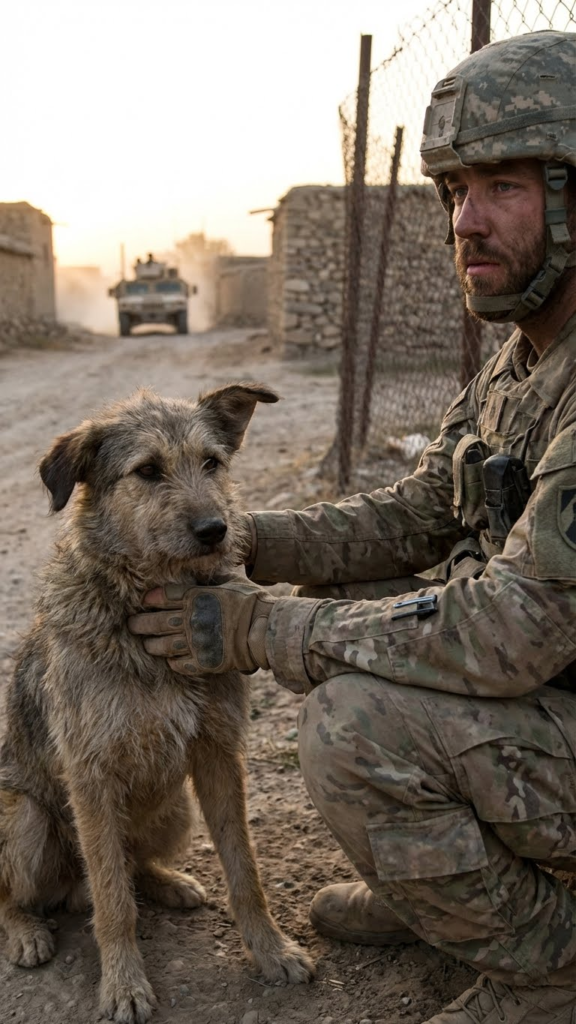
He was small for a working dog, all ribs and tangled fur, the color of burnt coffee. One ear bent sideways like it had been folded too long in the wrong direction. No collar. No tags. Just a pair of eyes that locked onto mine as if he had been waiting specifically for me.
One of the guys joked, “Looks like you found your new best friend.”
I laughed it off. We weren’t allowed to keep animals around base. Everyone knew that. Too many risks, too many rules.
But this dog didn’t care about our rules.
Every time we moved, he followed me.
I tried ignoring him. He padded behind my boots, always just close enough that I could hear his nails clicking on the broken pavement. When I stopped, he stopped. When I turned, he turned. Like a shadow I couldn’t shake.
I knelt and held out my hand. He sniffed it, then pressed his forehead into my palm.
I don’t believe in destiny, but something about that moment felt heavier than coincidence.
We called him Fence, because that’s where he slept at night — curled against the twisted wire near our temporary post. No one claimed him. No one chased him away either. He wasn’t a mascot; he was more like background noise. Until the day he wasn’t.
Two weeks later, our patrol changed routes because of construction debris blocking our usual path. We were tired, irritated, and ready to be done for the day. The radio crackled in and out. Dust stuck to the sweat on my face. All I could think about was a warm shower that didn’t exist.
Fence started acting strange.
He didn’t walk behind me this time. He moved in front, weaving back and forth like he was trying to herd me. When I tried to step past him, he blocked me with his body.
“Seriously?” I muttered.
I bent down to shoo him aside. That’s when he grabbed my sleeve in his teeth — not hard enough to hurt, but firm enough to stop me cold.
The guys behind me laughed. Someone said, “Your dog’s got issues, man.”
Then I heard it.
A faint click beneath my boot.
Not loud. Not dramatic. Just wrong.
The next few minutes are a blur of voices and movement. I remember someone pulling me backward. I remember dust filling the air. I remember Fence barking — frantic, high-pitched, nothing like the quiet dog who slept by a fence every night.
Later they told me what could have happened if I’d taken one more step. I don’t repeat that part. What matters is that Fence stopped me from taking it.
After that, he wasn’t background noise anymore.
The guys started sneaking him scraps. Someone found an old rope and turned it into a leash. He learned our routines, waited by the door at night, paced when anyone was late coming back. He wasn’t trained, but he watched everything. Like he had a job.
And I let myself believe that somehow, against all the rules and common sense, he was coming home with me.
That was the mistake.
I didn’t think about paperwork. I didn’t think about logistics. I thought about loyalty. I thought about how he’d pressed his body against mine during long nights when sleep refused to come. I thought about how he followed me even when others didn’t.
Then the orders came down: rotation complete. Flights scheduled. We were leaving.
I asked around quietly at first. What happens to the dog?
The answers were all the same, just worded differently.
“That’s not our call.”
“There’s a process.”
“It’s complicated.”
Complicated is what people say when they don’t want to say no.
I tried harder. Filled out forms I barely understood. Talked to people who outranked me. Waited in lines that went nowhere.
Fence followed me everywhere while I did it, tail wagging, unaware that his entire future was being decided by words on paper.
The night before we left, I sat with him by the fence where we first met. The sky was clear, the kind of quiet that only exists when nothing is trying to impress you.
“I won’t forget you,” I told him, because it felt like the right thing to say.
He licked my hand, then rested his head on my knee.
Morning came fast. Too fast.
They loaded us onto trucks before the sun fully rose. Fence ran beside us at first, confused but hopeful. He always ran with us. Why would this time be different?
Then the gate closed.
I watched him through the metal slats as the truck pulled away. He stood there for a second, ears up, tail wagging like he was waiting for me to step back down.
I didn’t.
I still see his face in the window sometimes — not in dreams, but in quiet moments when everything else finally shuts up.
People thank me for my service now. They shake my hand at airports, buy my coffee, call me brave. I smile and say the right things.
What I don’t tell them is that the bravest soul I ever met was small, bent-eared, slept beside broken wire — and never made it onto the plane.
And the hardest part of coming home wasn’t the noise or the crowds or the distance between who I was and who I am now.
It was knowing I left someone behind who never once left me.
Moral Reflection – Part 1
We like to tell stories where good deeds get rewarded neatly, where loyalty is always recognized, and where heroes are easy to identify. But real life isn’t that clean. Sometimes the ones who give the most receive the least recognition. And sometimes the systems meant to protect us forget the quiet souls who don’t have a voice.
Part 2 will explore what happened next — and the decision that still defines who I am today.