I never dreamed of the sky.
I dreamed of sleep.
The kind that lasts longer than four hours. The kind where you don’t jolt awake wondering if the electricity bill was paid or whether your kids ate enough that day. I didn’t want luxury. I wanted quiet. Safety. A life where my sons didn’t learn fear before they learned how to read.
But dreams don’t care what you want.
They show you what you must do.
The Night Shift
The first time I cleaned an airplane, I cried in the bathroom afterward.
It wasn’t the work — scrubbing tray tables, vacuuming crumbs, wiping sticky fingerprints off tiny windows. It was the silence. Thousands of people had just been here, flying home to families, vacations, futures. And I was alone in a metal tube with a mop and a clock ticking louder than my heartbeat.
My boys were asleep in the car.
I couldn’t afford a babysitter, and I couldn’t leave them home alone. So I parked in the far corner of the employee lot, cracked the windows, locked the doors, and tucked blankets around them like they were camping instead of waiting for their mother to finish another graveyard shift.
Marcus was nine. Caleb was seven.
They thought my job was glamorous.
“Mom cleans airplanes,” they told their teachers proudly.
They didn’t know that I wiped gum off seatbelts and prayed the security guard wouldn’t notice my kids curled up in the backseat of a rusty sedan.
I told myself it was temporary.
Everything hard is supposed to be temporary.
How We Landed There
Their father left when Marcus was four and Caleb was barely walking. No note. No goodbye. Just a voicemail that said he “needed space.”
I had been a receptionist at a dental office. It paid just enough to keep the lights on, not enough to keep the fridge full. When the office closed suddenly, I applied everywhere: grocery stores, diners, warehouses.
The airport cleaning company was the only one that called back.
“You’re okay with nights?” the manager asked.
I was okay with anything that paid.
The Fence
Some nights, when I finished early, I would drive the boys to the far side of the runway where an old chain-link fence leaned like it was tired of standing.
We’d sit on the hood of the car, wrapped in thrift-store blankets, watching planes take off.
They roared so loud the ground trembled.
Marcus would pretend to steer with his hands.
Caleb would count the lights as they disappeared into the dark.
“I’m going to fly one of those,” Marcus said once, with the confidence only a child can have.
I laughed, because what else could I do?
We lived in a one-bedroom apartment above a laundromat. The walls shook every time someone ran the industrial dryer. We owned exactly one suitcase, and it had a broken wheel.
But my boys were planning futures in the clouds.
The First Warning
When Marcus brought home a note from his school counselor suggesting “alternative career planning,” I didn’t show it to him.
He had written an essay titled Why I Will Be a Pilot. He described cockpits with more detail than most adults could manage. He talked about responsibility, about protecting passengers, about how flying meant bringing people safely to where they were needed.
The counselor circled his goal in red ink and wrote: Be realistic.
I folded the paper and put it at the bottom of the trash.
Realistic had never paid our bills.
Nights in the Car
Winter was the hardest.
I kept the engine running for heat until I was afraid the gas would run out. I’d turn it off and let the boys burrow into each other, their breath fogging the windows.
Sometimes I sat there watching them sleep, thinking how unfair it was that children this young already knew the language of sacrifice.
I didn’t want them to remember their childhood as cold seats and vending machine dinners.
So I told stories.
I told them about imaginary airports where the pilots were brothers who never left anyone behind. Where a mother could watch her sons take off knowing they would always come back.
I told them we were just between chapters.
A Secret Between Us
I never told anyone about the car.
Not my coworkers. Not my friends from church. Not my sister who lived two states away and thought I was “doing fine.”
Shame is quiet, but it’s heavy.
What I did tell my boys was that everything we were doing mattered.
Every hour. Every sore muscle. Every night they fell asleep to the sound of jet engines instead of lullabies.
One night, after I finished a plane behind schedule, I found Marcus awake in the backseat.
He had drawn a cockpit on the back of a grocery receipt.
“Look, Mom,” he said. “This is where you sit when you’re in charge.”
I stared at that crooked little drawing longer than I should have.
I wanted to believe him.
The First Flight
Years later, when Marcus was accepted into a small aviation program through a community college, I was cleaning the interior of a commuter jet when I got the call.
I leaned against the galley wall and slid to the floor, crying into my gloves so no one would hear.
Caleb followed a year later.
Two sons. Two scholarships. Two boys who used to sleep in the backseat of a car now studying flight manuals at the kitchen table.
The table still wobbled. The apartment was still small.
But the sky was suddenly closer than it had ever been.
And Yet…
Success does not erase memory.
I still wake up some nights convinced I forgot to crack the windows.
I still flinch when I smell industrial cleaner.
I still carry the weight of all those silent shifts when no one clapped for effort.
My boys are grown now. They don’t know every detail of those years. They know I worked nights. They don’t know I counted quarters to buy their school pictures. They don’t know how many times I almost quit because I was afraid of failing them.
They think strength is something you’re born with.
They don’t see that it’s something you borrow from your children when you’re out of your own.
Part 1 ends here.
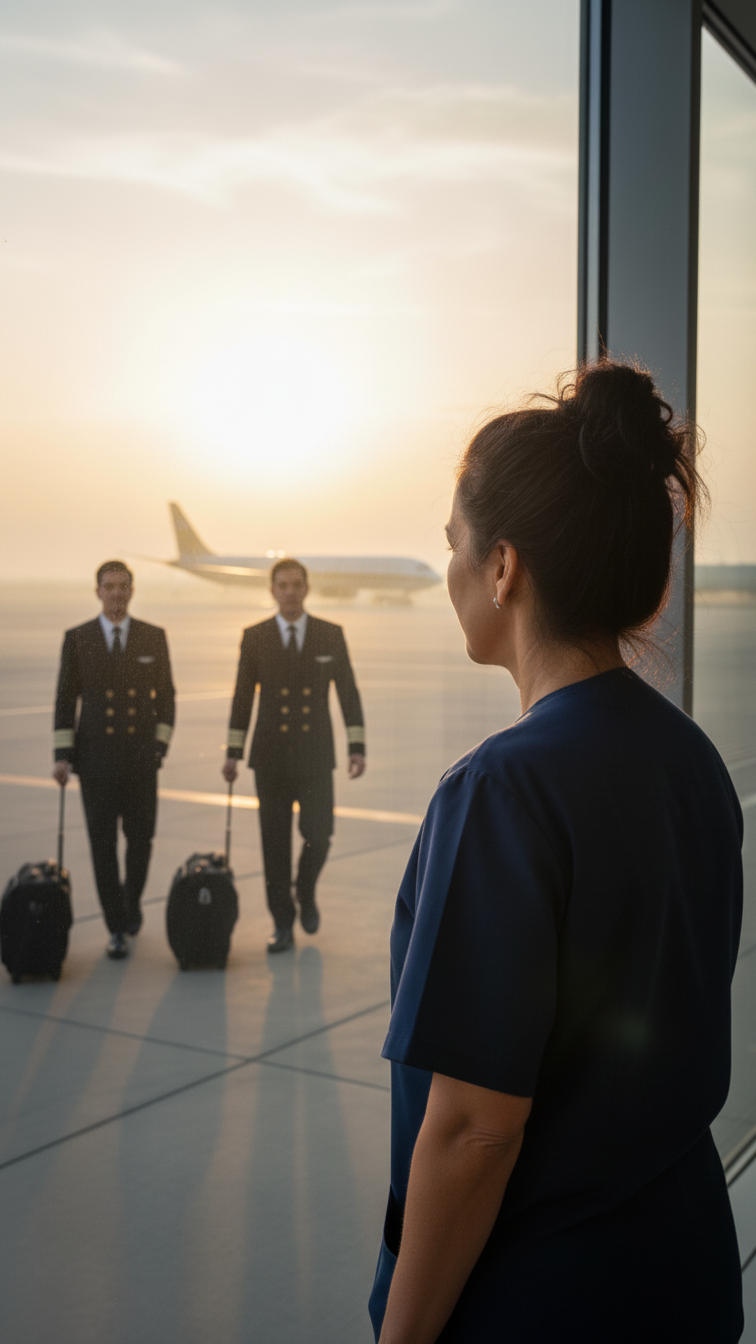
In Part 2, I’ll tell you what happened the day both my sons wore their pilot uniforms for the first time — and the moment that finally made all those nights in the car feel like more than survival.
Morality So Far
Sometimes love looks like heroics.
Sometimes it looks like wiping crumbs off tray tables at midnight while your children sleep in a parked car.
The story isn’t about airplanes.
It’s about showing up when no one is watching — and trusting that someday, someone will fly because you did.