The nurse didn’t even ask my name. She looked at the chart in her hand, then at my face, and said, “Your wife was brought in forty minutes ago. She didn’t make it.”
I was still holding my phone, the screen open to a text she had sent me from the highway ten minutes earlier: Running late. Traffic is bad. Don’t start dinner without me.
I stood there staring at the nurse while the world around me kept moving like nothing had happened. People walked past us pushing carts. A man laughed too loudly at something on his phone. A kid cried somewhere down the hall. No one stopped.
I said, “That’s not possible.”
The nurse didn’t argue. She just nodded once, like she’d seen this exact reaction a thousand times, and pointed down the corridor. “You can wait in there.”
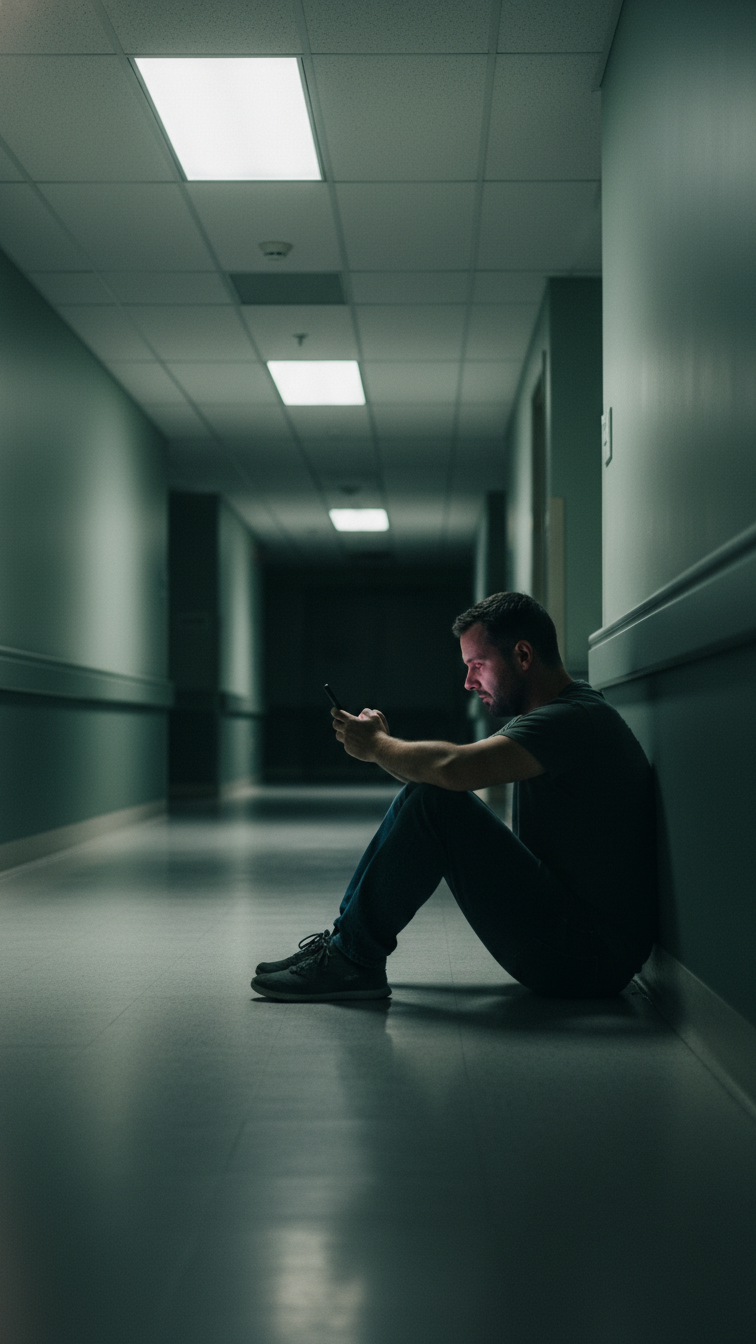
The room was painted a tired green. Two chairs, a box of tissues on the table, a framed photo of a beach that looked like it had been taken in the 90s. I sat down because my legs didn’t feel like they were mine anymore.
I called her phone.
Straight to voicemail.
I called again. And again. I left a message that didn’t make sense. I said her name too many times. I said, “Please,” like that word had any power.
After a few minutes, a man in scrubs came in. He closed the door behind him slowly, which I immediately hated. He said her name out loud, mispronounced the last syllable, and then apologized.
He explained things. Words like “massive trauma,” “multiple vehicles,” “no suffering.” I stopped listening after the first sentence. I kept thinking about the text. The traffic. The way she had typed “don’t start dinner without me,” like it was a joke.
I asked if I could see her.
He hesitated just long enough for me to notice. “I’ll check,” he said, and left.
That was the first time I felt anger. Not at him, not at the hospital. At the hesitation. At the idea that something might be wrong enough that they didn’t want me to see it.
The police showed up before they let me into the room.
Two officers. A man and a woman. They asked me to confirm her full name, her birthday, her address, what car she drove. I answered everything like I was taking a test I hadn’t studied for.
The female officer asked, “Do you know why she was on that stretch of road tonight?”
I said, “She was coming home from work.”
She wrote something down and didn’t look at me when she said, “Had she mentioned meeting anyone?”
“No.”
They exchanged a glance so fast I almost missed it.
“Did she have any enemies?” the male officer asked, like this was a normal question.
I laughed once, short and loud, then stopped because it sounded wrong in that room. “She’s an accountant,” I said. “She barely even likes confrontation.”
They thanked me. The man handed me a card and said to call if I remembered anything.
That’s when I knew this wasn’t just a car accident.
They let me see her an hour later.
I won’t describe her. Not because it was too painful, but because it didn’t feel like her anymore. It felt like a shell someone else was responsible for. I touched her hand and it was colder than it should have been.
I said, “You’re late,” because I didn’t know what else to say.
No one rushed me. That somehow made it worse.
The house was dark when I got home. I unlocked the door like I did every night and said her name automatically. Then I stood there, waiting for her to answer from the kitchen or the bedroom or the shower.
She didn’t.
There was a bag of groceries on the counter. Milk already warm. Frozen peas leaking onto the granite. She must have stopped on the way home like she always did, even when she was tired.
I put everything in the fridge. I don’t know why. It felt like something I could still control.
Her phone was charging on the nightstand.
That didn’t make sense.
I picked it up. It was unlocked. She never left it unlocked. I scrolled through the messages. Her last text was to me. The one about traffic.
No missed calls. No emergency alerts. No unanswered messages from anyone else.
I sat on the edge of the bed holding her phone until my hands went numb.
The funeral was four days later. Her parents flew in from Ohio. My sister stayed on the couch and cooked food neither of us touched. People kept telling me I was “holding up well,” which made me want to scream.
The police didn’t come to the funeral.
That felt intentional.
Two weeks passed before anyone contacted me again. I was back at work, technically, though I don’t remember doing much besides staring at my computer and closing the door when I couldn’t breathe.
The female officer called and asked if she could stop by the house.
I said yes before I thought about it.
She walked through the front door and immediately looked at the family photo on the wall, the one from our trip to San Diego last summer. She stared at it longer than was polite.
“She seemed happy,” she said.
I nodded.
“Did your wife ever mention a man named Eric?”
I said no.
She pulled out her phone and showed me a photo of a man in his late thirties, brown hair, baseball cap pulled low. “Do you recognize him?”
I didn’t. But the way my stomach dropped told me I was about to.
“He was in the area of the accident,” she said. “We’re still trying to figure out why.”
“Was he involved?” I asked.
She hesitated. Just like the doctor had. “We’re still gathering information.”
She left without giving me anything solid. No explanation. No comfort. Just another name I couldn’t attach to anything real.
I started sleeping on the couch. The bedroom felt wrong. Every night I listened to the house settle and wondered what else I didn’t know about my own life.
Her laptop was still in her bag. I didn’t open it for almost a month. It felt invasive. Like I was breaking a rule we never had to make out loud.
When I finally did, it was because the bank called about a charge on her credit card from a place I’d never heard of. I told them it must be a mistake.
I opened her email. Just to find the receipt.
It wasn’t in her inbox.
But there were a lot of deleted messages.
I restored them.
Most were junk. Newsletters she never read. Promotions. Then I saw one from an address I didn’t recognize.
Subject line: Tonight.
No body text.
Just the subject.
I sat there staring at the screen until my vision blurred.
The police called again two days later. They said they had identified the other driver involved in the crash. They said his family had lawyered up. They said the case was “complex.”
I asked if it was still being treated as an accident.
There was a pause. “We’re exploring all possibilities.”
I hung up before they could say anything else.
People stopped checking on me after the first month. My sister went back home. Her parents called less often. The world didn’t stop just because mine had.
But every night I dreamed about her being late.
Sometimes she was stuck in traffic. Sometimes she was lost. Sometimes she was standing right outside the door and I couldn’t open it fast enough.
I started driving the route she took home from work. Over and over. I memorized every intersection, every gas station, every stretch of road with no streetlights.
The crash site had been cleared. Fresh asphalt like nothing had ever happened there.
I pulled over the first time I went. Just stood on the shoulder and tried to imagine what forty minutes before the hospital looked like.
It felt like trespassing.
Another email showed up three months after she died.
Different address. Same subject line: Tonight.
This time there was a sentence in the body.
I didn’t mean for this to happen.
I read it so many times I started to hate the words.
I forwarded it to the detective. She replied the next morning: We’ll add it to the file.
That was it.
No questions. No urgency.
The man named Eric finally got a last name.
I found it myself. A Google search from her laptop history that she had never cleared. Just his name and the city we lived in.
He had a LinkedIn profile. Sales manager. Married. Two kids.
There was a photo of him at a company picnic, arm around a woman who wasn’t my wife.
I didn’t message him. I didn’t even click his profile. I closed the browser and threw up in the sink.
Six months in, I stopped waiting for the police to explain things.
I stopped expecting anyone to tell me what really happened.
But then her phone buzzed in the middle of the night.
It was a calendar reminder she had set months before. I don’t know what it was for because the title was blank.
Just a date. And a time.
And the word: Tonight.
I sat in the dark holding her phone, listening to the vibration fade, realizing there were still parts of her life I had never been invited into.
And somewhere between the crash report, the emails, and that single word repeating over and over, I understood one thing clearly:
The night she died was not just an accident.
And whatever she was going to tell me…
She never got the chance.
Part 1 ends.