The Moment Everything Changed
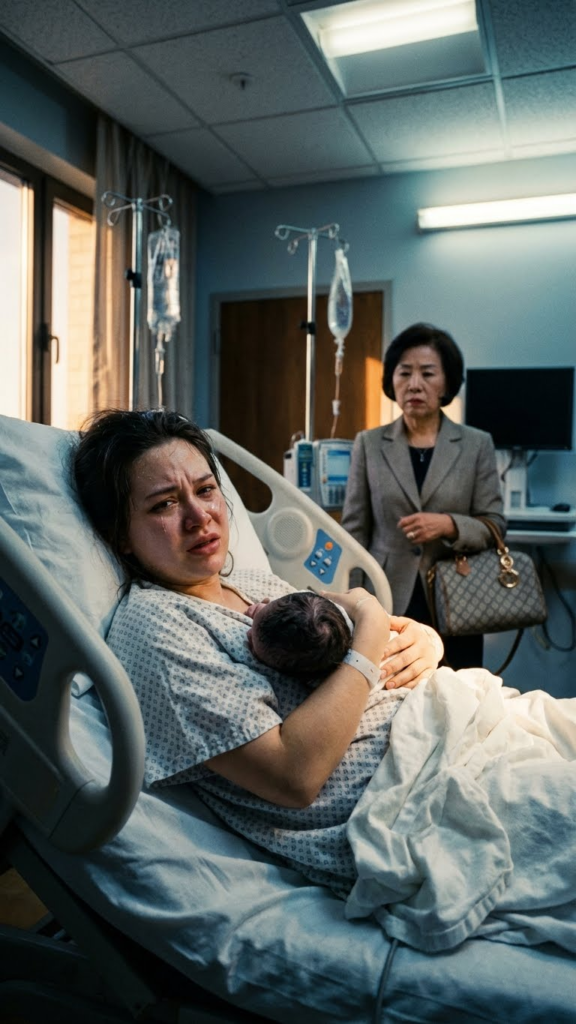
I was still bleeding from giving birth when my mother-in-law’s voice cut through the delivery room like a knife. “This baby is too dark. Are you sure it’s even my son’s?”
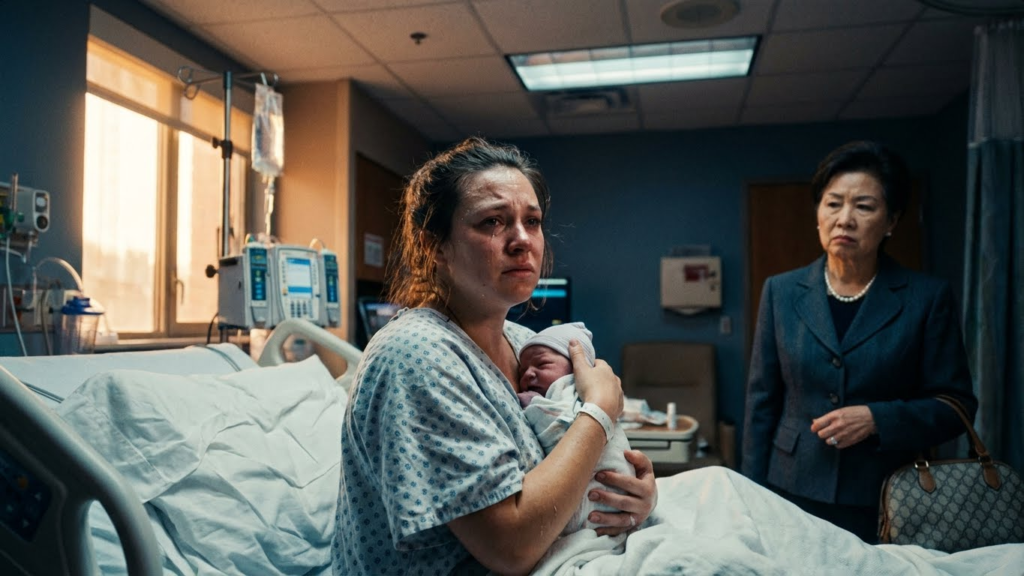
Twelve hours of labor. Twelve hours of my husband Jake holding my hand, whispering that everything would be okay. And now, thirty seconds after our daughter entered the world, his mother Patricia Chen was standing at the foot of my hospital bed, staring at our newborn with pure disgust contorting her carefully Botoxed face.
“Mom, what the hell?” Jake’s voice was sharp, but I could already hear it—the uncertainty creeping in. That doubt. That poison his mother had been planting for nine months was finally taking root.
I looked down at my daughter, still slick and new against my chest. She was perfect. Tiny fingers wrapped around mine, eyes squeezed shut, skin a beautiful warm brown that matched my Brazilian mother’s complexion exactly. She had her father’s blue eyes—I’d seen them flash open once already. She was gorgeous. She was ours. And Patricia was destroying the most sacred moment of my life.
“I’m just saying what everyone’s thinking,” Patricia continued, her voice dripping with that fake maternal concern she’d perfected over the years. “Maya’s family is… well, you know. Very mixed. And this baby doesn’t look like any Chen I’ve ever seen. Maybe we should do a test. Just to be sure we’re not being deceived.”
The nurse’s hand froze on my IV line. Dr. Richardson looked up from his charts, his face tight with barely contained anger. And Jake—my husband, the man who’d sworn to love me through everything, the man who’d promised to stand by me against his family—he didn’t immediately defend me. He just stood there, looking between his mother and our daughter, his face twisted with confusion and something that looked horribly like suspicion.
That’s when I saw it. Patricia’s perfectly manicured hand was in her Chanel handbag, pulling out what looked like a folded document. Her smile was triumphant, cruel, like a hunter who’d finally cornered her prey. Like she’d been waiting for this moment since the day Jake brought me home to meet the family three years ago.
“Since you won’t ask for a paternity test, Jacob,” she said slowly, savoring each word, “I took the liberty of doing some research. I found some very interesting information about your wife’s past. About who she really is.”
Let me take you back, because this story doesn’t start in a delivery room. It starts three years earlier, at a tech conference in San Francisco where I met Jake Chen.
I was there representing my marketing firm. He was there as a software engineer for his family’s company, Chen Technologies. We connected over terrible conference coffee and a shared hatred of networking events. He was funny, smart, kind—everything I’d been told Asian men raised by traditional families wouldn’t be.
“My family’s pretty conservative,” he warned me on our third date. “My mom especially. She has… expectations.”
I should have paid more attention to that warning. But I was in love, and Jake seemed different from his family. He’d gone to Berkeley, lived in the Bay Area, dated women of all backgrounds before me. I thought he’d broken free from whatever traditions bound his family.
I was wrong.
The first time I met Patricia, she looked me up and down like I was something stuck to her shoe. We were at the Chen family mansion in Pacific Heights—all marble and cold elegance and old money that screamed “you don’t belong here.”
“So, Maya Oliveira,” she said, pronouncing my last name with exaggerated emphasis. “Jake tells me your family is from Brazil?”
“My mother’s side, yes. My father’s American.”
“How… exotic.” The word dripped with contempt. “And what do your parents do?”
“My mother’s a nurse. My father’s a teacher.”
The silence that followed told me everything I needed to know. In Patricia’s world, nurses and teachers weren’t real professionals. They were the help.
Over the next two years, Patricia made her feelings crystal clear. She “accidentally” left me off family dinner invitations. She asked pointed questions about my education, my salary, my “background.” She showed Jake pictures of suitable Chinese-American women from good families. She told anyone who would listen that Jake was “going through a phase.”
But Jake loved me. Or so I thought. He proposed on a beach in Carmel, and despite his mother’s protests, we got married in a small ceremony. Patricia wore black. Literally wore black to our wedding like she was in mourning.
When I got pregnant six months into our marriage, I was terrified to tell Patricia. Jake insisted we tell the family in person at Sunday dinner.
Her reaction was worse than I imagined.
“A baby?” she repeated, her voice cold. “Already? Don’t you think you should have waited? Established yourself more?”
“We’re excited, Mom,” Jake said firmly. “We want you to be excited too.”
But Patricia wasn’t excited. Over the next nine months, she launched a subtle campaign to poison my pregnancy. She sent Jake articles about paternity fraud. She made comments about how “dark” I’d gotten during pregnancy. She asked intrusive questions about my ex-boyfriends. She even suggested we do a prenatal paternity test “just to have peace of mind.”
“She’s just worried,” Jake would say, defending her. “She wants to protect me.”
“From what?” I’d ask. “From your own wife?”
But the seeds of doubt were planted. I could see it in the way Jake started asking casual questions. “Did you ever date anyone seriously before me?” “How many relationships have you had?” Once, I caught him looking through my phone while I was in the shower.
Patricia was winning. She was turning my husband against me, and there was nothing I could do except wait for our daughter to be born and prove, with her blue Chen eyes, that she was Jake’s child.
Back in the delivery room, Patricia unfolded the document with theatrical flair. I was still holding my newborn daughter, still shaking from labor, still bleeding and vulnerable and exhausted beyond measure.
“This,” Patricia announced, “is a background check I had done on Maya. Very thorough. Very expensive. And very revealing.”
Jake took the paper from his mother’s hand. I watched his face as he read, watched confusion turn to shock turn to something that looked like betrayal.
“Maya,” he said slowly. “Is this true?”
“Is what true?” I demanded, my voice stronger than I felt. “I don’t even know what she’s accusing me of.”
“It says here that you worked as a hostess at a nightclub when you were in college. Midnight Blue in Miami. That’s… that’s essentially a strip club.”
I almost laughed. Almost. Because in that moment, lying in a hospital bed holding our newborn child while my mother-in-law tried to destroy me, the absurdity was overwhelming.
“I was a hostess,” I said clearly, my voice carrying through the suddenly silent room. “I seated people and checked IDs. I was twenty years old and putting myself through college because unlike some people, I didn’t have trust funds and family companies. I worked three jobs to graduate debt-free.”
“But you never told me,” Jake said, and there was accusation in his voice.
“Because it wasn’t shameful!” My voice rose, waking the baby. “I worked an honest job. What I’m ashamed of is that you’re standing there, in this moment, believing your mother over me.”
Patricia’s smile was victorious. “There’s more. She worked there for two years. TWO YEARS. Who knows what else she did? Who knows who the father of that baby really is?”
That’s when Dr. Richardson stepped forward. He was a Black man in his fifties, with kind eyes that had seen too much of this kind of racism.
“Mrs. Chen,” he said firmly, “I’m going to have to ask you to leave. Now.”
“Excuse me?” Patricia drew herself up. “I’m family.”
“You’re disrupting my patient’s recovery and making racist accusations about her newborn child. This ends now, or I’ll have security remove you.”
But Patricia wasn’t done. She turned to Jake, her voice sweet and concerned. “Darling, I’m only trying to protect you. Don’t you think you should at least get a paternity test? Just to be absolutely sure?”
And that’s when I snapped. Exhaustion, pain, hormones, and nine months of accumulated rage finally exploded.
“GET OUT!” I screamed, and the force of it shocked everyone. “GET OUT OF MY ROOM! GET OUT OF MY HOSPITAL! GET AWAY FROM MY DAUGHTER!”
The baby started crying. Jake looked stricken. Patricia looked shocked that I’d dared to raise my voice to her. And I kept screaming.
“You want to know who my daughter’s father is? LOOK AT HER EYES! They’re the same blue as Jake’s! The same blue as your husband’s! She has your family’s eyes and my family’s skin, and she is BEAUTIFUL and PERFECT and if you can’t see that, then you’re not fit to be her grandmother!”
Dr. Richardson was already at the door, speaking into the hallway. Within seconds, two security guards appeared.
“I need this woman removed immediately,” he said calmly.
Patricia sputtered. “You can’t—I’m family—”
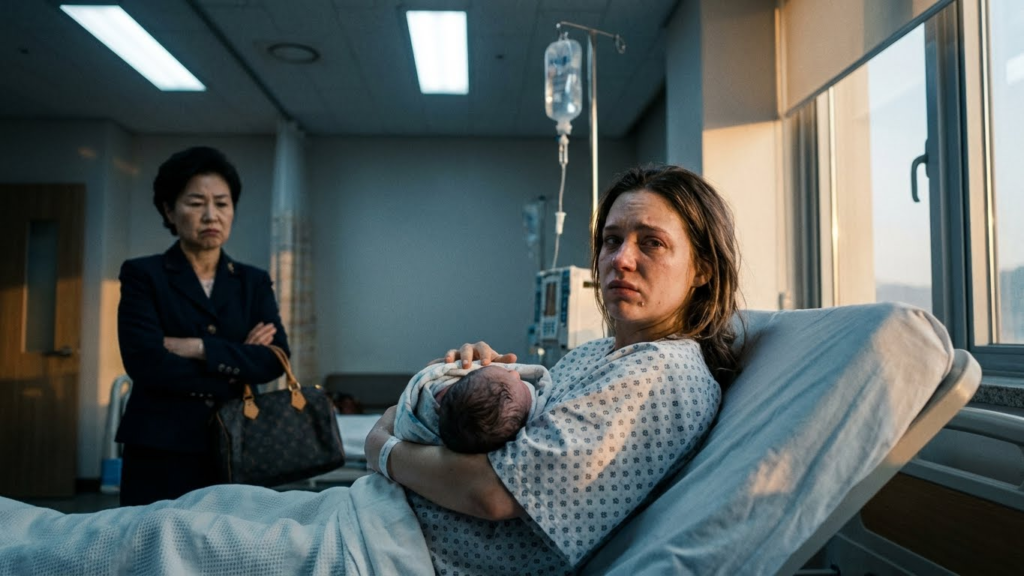
“You’re trespassing,” I said, my voice steady now despite the tears streaming down my face. “And if you ever speak about my daughter like that again, I’ll sue you for defamation so fast your Chanel bag will spin.”
As security escorted Patricia out—her face red with fury and humiliation—I turned to Jake. My husband. The father of my child. The man who’d stood silent while his mother attacked me at my most vulnerable.
“You have a choice to make,” I said quietly. “Right now. You either believe your mother’s racist conspiracy theories, or you believe me. You either trust that this is your daughter, or you leave with your mother and we’ll discuss custody arrangements through lawyers.”
Jake looked at the baby in my arms. Really looked. And I saw the moment his mother’s poison started to lose its grip. Our daughter opened her eyes—those unmistakable Chen blue eyes—and stared directly at her father.
“She has my eyes,” he whispered.
“Yes,” I said. “She does.”
“God, Maya, I’m so sorry.” He sank into the chair beside my bed, his head in his hands. “I don’t know what happened. My mother, she got in my head, and I just—”
“She’s been in your head for nine months,” I interrupted. “And you let her. You let her plant doubts about your own wife, about your own child. Do you understand how much that hurt?”
He did cry then. Not pretty tears, but ugly, heaving sobs of a man realizing he’d almost destroyed his family. “I’ll fix this. I swear I’ll fix this.”
“You can’t fix this with apologies,” I said. “You fix this by choosing. Every day. You choose your wife and daughter over your mother’s racism. You set boundaries. Real boundaries. Or we don’t make it.”
The next morning, Jake’s father David showed up. Without Patricia. He looked at his granddaughter and cried.
“She’s beautiful,” he said simply. “She looks just like Jake did as a baby. I’m so sorry for what Patricia said. There’s no excuse.”
“No,” I agreed. “There isn’t.”
David sat down heavily. “Patricia and I are going to therapy. She either addresses her prejudices, or I’m filing for divorce. I won’t lose my son and granddaughter over her inability to accept that love comes in all colors.”
I wanted to feel vindicated, but I was too exhausted. Too drained. I just held my daughter and let Jake hold us both.
Patricia tried to apologize three days later. Jake met her at a coffee shop—not at our home, not near our daughter—and recorded the conversation. She claimed she was “just being protective.” That she “didn’t mean it to sound racist.” That I was “too sensitive.”
Jake stood up and left. “Get help, Mom. Real help. Or you’ll never meet your granddaughter.”
I’m writing this from our new house in Oakland. We moved out of San Francisco, away from the Chen family mansion and Patricia’s sphere of influence. Jake found a new job—not at his family’s company. We’re building our own life, our own family traditions.
Patricia is in therapy. She sent a letter last month—a real apology, acknowledging her racism, her fear of losing control over Jake, her internalized prejudices. She asked if she could meet her granddaughter, with a therapist present.
We’re considering it. But on our terms. In our home. With clear boundaries.
My daughter is six months old now. She has Jake’s blue eyes and my mother’s warm brown skin and her own personality emerging every day. She’s starting to laugh. She grabs at everything. She’s perfect.
And she’s teaching all of us—me, Jake, even Patricia—that love doesn’t fit into neat boxes. That families come in all shades. That the only thing that matters is choosing each other, every single day.
Sometimes I think about that moment in the delivery room. The worst moment of my life, when I thought I might lose everything. And I realize it was also the moment that saved my marriage. Because Jake finally saw what his mother’s racism was doing. He finally chose us.
Not every story has a happy ending. But this one might. We’re working on it. Every single day, we’re choosing love over prejudice. Our daughter over fear. Each other over the easy path.
And for now, that’s enough.