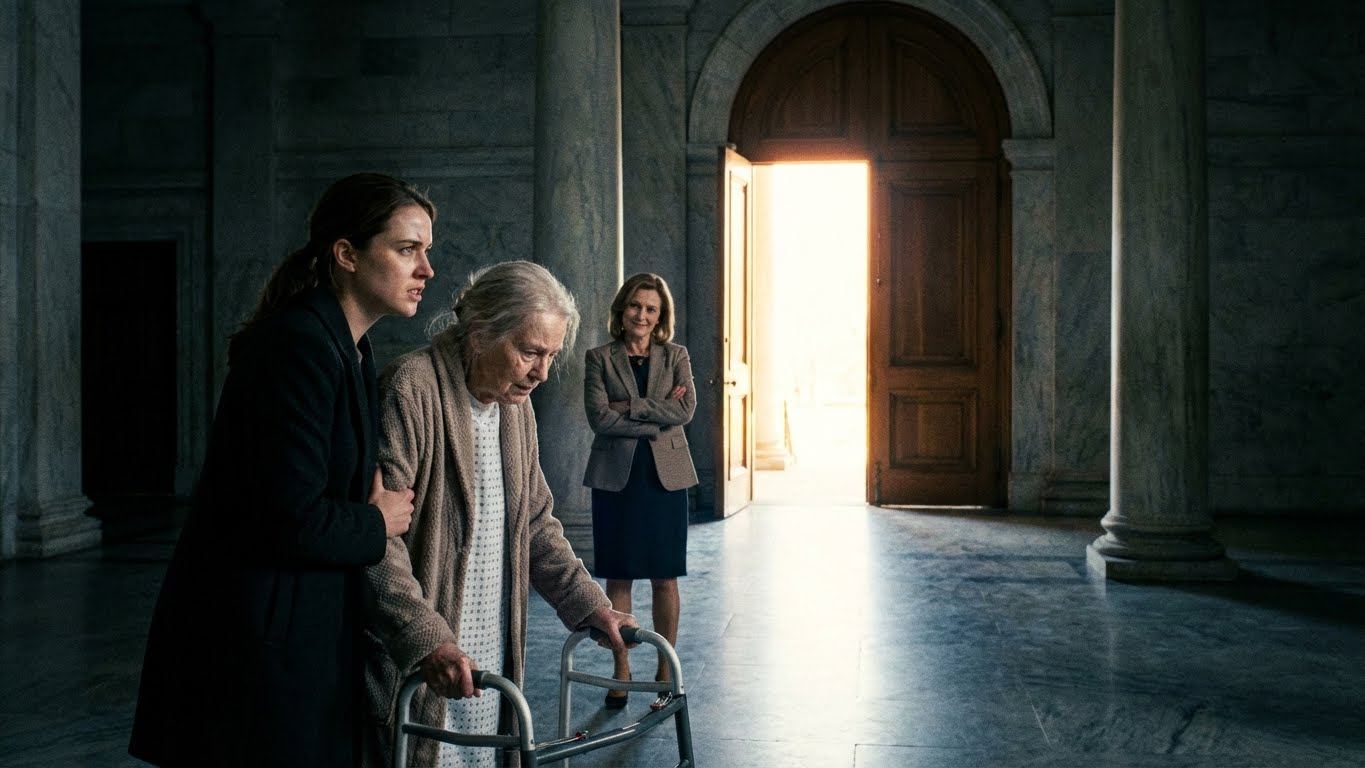
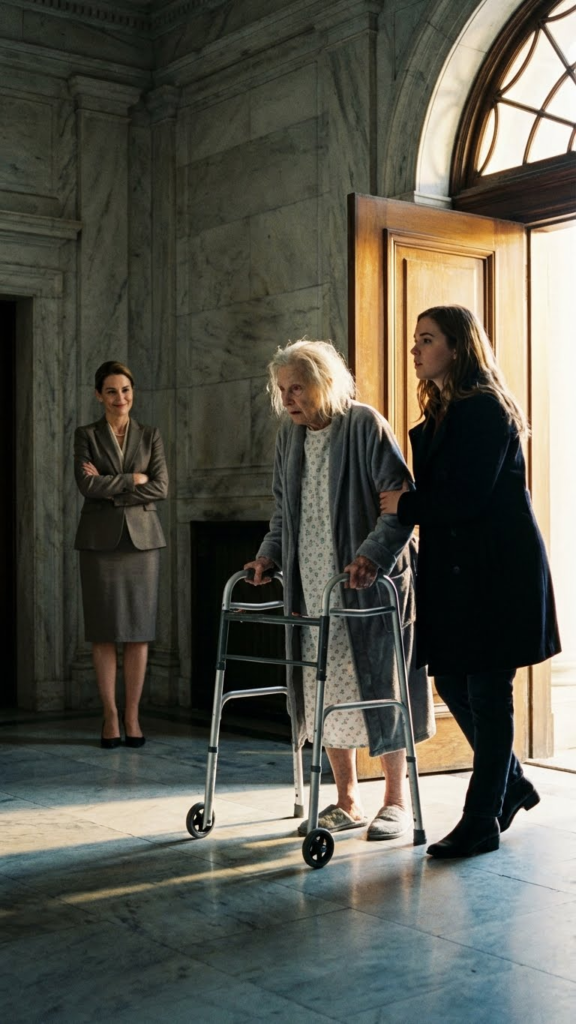
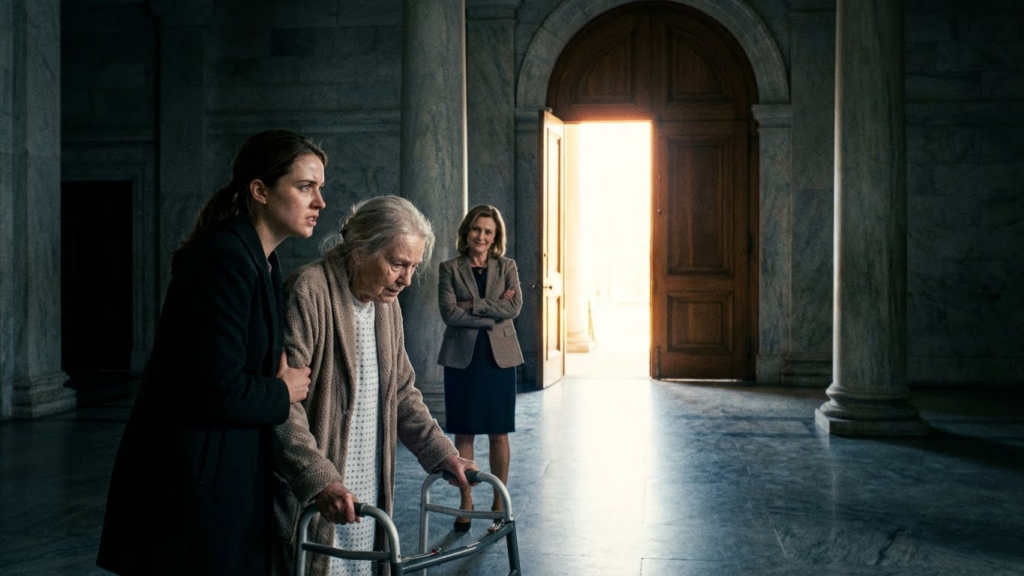
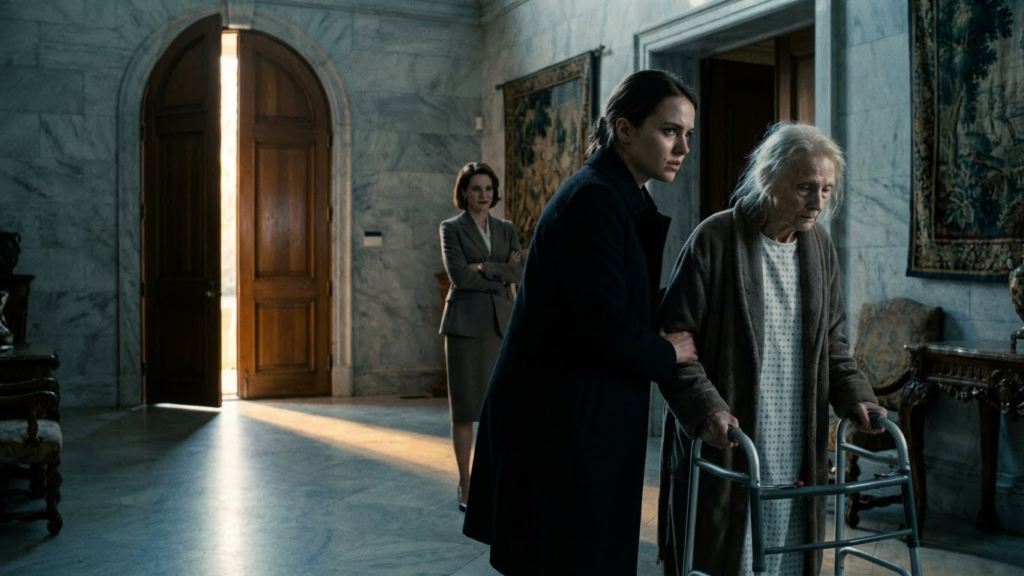
Grandma’s walker scraped against the marble floor as I helped her toward the front door. Each step was agony for her—I could see it in the way she winced, in the shallow breaths she took between movements, in the way her frail seventy-eight-year-old hands gripped my arm so tight her knuckles turned white. Stage four pancreatic cancer. The doctors had given her three weeks, maybe four. Every movement was borrowed time.
And my mother, Jennifer Hartley, stood in the foyer of what used to be Grandma Margaret’s house—the house Grandma had lived in for fifty years—arms crossed, watching us leave with a smile on her face.
Not a sad smile. Not a concerned, worried-daughter smile. A satisfied smile. The smile of someone who’d finally won a game they’d been playing for years.
“You’re making a mistake, Lily,” Mom said, her voice dripping with fake concern. “She needs professional care. Round-the-clock monitoring. She needs to stay here where she’s comfortable, where everything’s familiar.”
Comfortable. In the house my mother had moved into three months ago, claiming she needed to “take care of Mom full-time.” The house where I’d found Grandma yesterday afternoon, alone in a dark bedroom, lying in her own waste because no one had checked on her in six hours. The house where Mom had “accidentally” given Grandma the wrong medications twice in one week—once she’d mixed up the dosages, once she’d “forgotten” the pain meds entirely. The house that, according to the revised will I’d discovered hidden in Mom’s home office, would become my mother’s sole property the moment Grandma died.
“She’s coming home with me,” I said, my voice shaking but firm as I helped Grandma take another painful step.
Mom’s smile never wavered. She stepped sideways, partially blocking the door. “Without medical power of attorney? Without any legal authority? You can’t just take her, Lily. I could call the police for elder kidnapping. For interference with medical care.”
That’s when Grandma squeezed my arm hard. When I looked down at her, she mouthed two words with cracked, dry lips: “The safe.”
I froze. The safe. The hidden safe in Grandma’s old bedroom closet, behind the loose panel. The one Mom didn’t know existed. The one that held thirty years of documents, photos, and records—including, I suddenly realized, the original will that left everything divided equally among me and my two siblings, not the forged version Mom had filed with her lawyer.
Mom saw my expression change. Saw the recognition flash across my face. Her smile faltered for just a second. “What did she tell you?”
To understand how we got here, you need to understand my family. Or more specifically, you need to understand my mother.
Jennifer Hartley was the middle child of three, and she’d spent her entire life feeling overlooked. Her older brother David was the golden child—successful lawyer, perfect family. Her younger sister Amy was the free spirit everyone loved—artist, traveler, living her best life. And Mom? Mom was just… there. Working a middle-management job she hated, married to my father for twenty-three years before he left her for someone younger, raising three kids who grew up and moved away.
She was bitter. God, was she bitter. About everything. About her job, her divorce, her siblings’ success, her children’s independence. And most of all, about my grandmother.
Grandma Margaret had always been the matriarch. Strong, independent, kind to everyone. She’d worked as a nurse for forty years, raised three kids on her own after my grandfather died young, bought her house with her own money, and built a comfortable retirement through smart investments. She was everything my mother wasn’t—self-sufficient, content, beloved.
And Mom resented every bit of it.
“She acts like she’s so perfect,” Mom would say during her wine-fueled rant sessions. “Like she did everything right and I did everything wrong. She judges me. Always has.”
Grandma didn’t judge her. Grandma just refused to enable her. When Mom asked to “borrow” money, Grandma said no. When Mom complained about her life, Grandma suggested therapy. When Mom tried to manipulate family situations, Grandma called her out. Kindly, but firmly.
So when Grandma got diagnosed with pancreatic cancer eighteen months ago, I saw something shift in my mother’s eyes. Something dark.
“She’ll need help,” Mom had said at that first family meeting. “I should move in with her. It only makes sense.”
“I can hire care,” Grandma had protested weakly. The diagnosis had hit her hard, made her tired. “You have your own life, Jennifer.”
“Don’t be silly, Mom. Family takes care of family.”
Mom moved in within two weeks. At first, it seemed fine. She took Grandma to appointments, managed medications, handled the house. My brother Marcus and I visited weekly, and everything appeared under control.
But then the isolation started. Subtle at first. Mom would “forget” to tell us about family dinners. She’d answer Grandma’s phone and say Grandma was sleeping. She’d schedule medical appointments without telling anyone. Visits became monitored—Mom always present, always controlling the conversation.
“Your grandmother’s very tired,” she’d say, cutting visits short. “She needs rest.”
Then came the financial changes. Mom convinced Grandma to give her access to bank accounts “to help with bills.” She had Grandma sign papers “for insurance purposes.” She brought in a lawyer—her lawyer, not Grandma’s longtime attorney—to “update estate documents.”
My sister Amy smelled something wrong first. “Have you noticed Mom’s wearing expensive clothes lately? New jewelry? She bought a BMW last month.”
“Maybe she got a raise,” I’d said, naive and hopeful.
“She got fired six months ago, Lily. She hasn’t worked since she moved in with Grandma.”
That’s when we started digging. That’s when Marcus discovered thousands of dollars being withdrawn from Grandma’s accounts monthly. That’s when I found the credit cards in Grandma’s name, maxed out with charges Mom had made. That’s when Amy discovered Mom had refinanced Grandma’s paid-off house and pocketed the money.
We confronted her. All three of us, united for once.
Mom’s response? “I’m taking care of her. Do you know how much work it is? How exhausting? I deserve compensation. She agreed to it.”
“She has cancer and pain medication,” Marcus said. “She doesn’t know what she’s signing.”
“Get out of my house,” Mom said. Her house. Not Grandma’s. Hers.
Three weeks ago, Grandma called me. Her voice was weak, slurred from medication, but desperate.
“Lily… come… when Jennifer’s gone…”
“Grandma, are you okay?”
“Please… just come…”
I drove there the next day during Mom’s “spa day”—which Grandma’s money was paying for. What I found made me physically ill.
Grandma was in her bedroom, but not her master suite. Mom had moved her to a small guest room at the back of the house. The room was dark, stuffy, smelled of urine and unwashed sheets. Grandma was lying in bed, clearly not bathed in days, her medication bottles scattered and mislabeled on the nightstand.
“How long have you been like this?” I asked, fighting back tears.
“She… doesn’t come… unless I call… call for her…”
“Where’s your call button?”
Grandma gestured weakly to the nightstand across the room. Six feet away. She couldn’t reach it from bed.
I spent three hours that day cleaning Grandma, changing her sheets, organizing her medications. And I listened as she told me everything. How Mom withheld pain medication as punishment for “being difficult.” How she’d been “accidentally” given overdoses of sedatives when family tried to visit. How Mom had forced her to sign papers, threatening to “put her in a state facility” if she refused.
“The will…” Grandma whispered. “Changed it… didn’t want to… she said nursing home…”
“Where’s your original will?”
“Safe… bedroom closet… behind…”
She couldn’t finish the sentence before passing out from exhaustion. But I knew. I’d played in that closet as a child. I knew about the false panel, the small safe behind it. Grandma had shown it to me when I was ten, made me memorize the combination for “emergencies.”
I couldn’t get to it that day—Mom came home early. But I took photos of everything. The conditions. The medications. The bruises on Grandma’s arms from rough handling. Evidence.
Yesterday, I came back with Marcus and Amy. Mom tried to stop us at the door, but we pushed past her. We found Grandma exactly as I’d left her—alone, neglected, dying in that dark room.
“We’re calling Adult Protective Services,” Marcus said.
“You’re calling no one,” Mom snapped. “I’m her caregiver. I have power of attorney.”
“Fraudulently obtained,” Amy said. “We’ve already talked to a lawyer.”
That’s when I saw it. On Mom’s face. Not denial. Not shame. Rage. Pure, undiluted rage that we’d dared to interfere with her plans.
“Get out,” she said quietly. “Get out of my house or I’ll call the police and have you arrested for trespassing.”
“It’s not your house,” I said. “It’s Grandma’s.”
“Not for long.”
She said it so casually. So matter-of-factly. Like she was just waiting for Grandma to die so she could claim her prize.
That’s when I made my decision. We couldn’t wait for APS investigations or legal proceedings. Grandma was dying. She had days, maybe hours. She deserved to die with dignity, surrounded by people who loved her, not alone in this prison.
“I’m taking her,” I said. “Right now.”
“You have no legal right—”
“Neither do you. That power of attorney was signed under duress, and we’re prepared to prove it.”
I went to Grandma’s room, gently woke her, and started gathering her essentials. Marcus called an ambulance and explained the situation—elder abuse, hospice needed immediately. Amy started documenting everything with photos and video.
Mom stood in the hallway, seething. But she didn’t stop us. She couldn’t. Not with three witnesses, not with documentation, not with an ambulance on the way.
That’s how we got to this moment. Me helping Grandma toward the door, Mom blocking our path, that terrible smile on her face. And Grandma whispering about the safe.
“Wait here,” I told Marcus, and I went back to Grandma’s old bedroom—the master suite Mom had claimed for herself.
The closet was enormous, walk-in, now filled with Mom’s designer clothes. I pushed through the hanging garments to the back wall, found the panel that looked solid but wasn’t, and pressed the corner just right. It popped open.
The safe was still there. I entered the combination with shaking hands: 4-17-53. Grandma’s wedding date.
It opened.
Inside: folders stuffed with documents. The original will, leaving the house and assets divided equally among her three children. Letters from Grandma’s longtime lawyer, explaining estate planning. Bank statements showing the real state of Grandma’s finances before Mom took over. Medical directives stating Grandma wanted hospice at home, not aggressive treatment. And photos—dozens of photos of bruises, of the neglected room, of medication bottles, all dated and annotated in Grandma’s shaky handwriting.
She’d been documenting everything. Even while dying, even while being abused, Grandma had been gathering evidence.
I took it all. Every single page. And I walked back to the foyer where Mom was still arguing with Marcus and Amy about “legal rights.”
“Looking for these?” I said, holding up the folders.
Mom’s face went white. “Those are private documents. You can’t—”
“I can. And I will. This is the real will, Mom. The one you forged a new version of. And these are medical records, financial statements, and photos documenting eighteen months of elder abuse and financial exploitation.”
“You can’t prove—”
“Grandma documented everything. Every bruise. Every medication error. Every time you withheld care. It’s all here, in her handwriting, with dates and details.”
The ambulance arrived then. Paramedics came in, assessed Grandma, and carefully loaded her onto a stretcher. We’d arranged emergency hospice care at my house—a beautiful room overlooking my garden, with round-the-clock nursing care that I’d pay for myself.
As they wheeled Grandma out, she looked up at Mom one last time. And she smiled. Not a sad smile. A triumphant one.
Mom stood there, frozen, as we all walked out. As her plans crumbled. As she realized she’d spent eighteen months abusing a dying woman for an inheritance she was never going to get.
Grandma died six days later. Not alone in a dark room, but in my guest bedroom surrounded by family. Me, Marcus, Amy, her old friends from church, her longtime neighbors. We told stories, played her favorite music, held her hands. She was on proper pain management—comfortable, lucid enough to say goodbye to everyone.
In her final hours, she squeezed my hand. “Thank you,” she whispered. “For not… leaving me there…”
“Never,” I told her. “Never again.”
She died peacefully that evening, with all of us around her bed, singing hymns.
Mom didn’t come. We didn’t invite her.
The legal fallout was swift. The real will was executed—the house and estate divided equally among David, Jennifer, and Amy. But Mom’s third? It went to paying restitution for the money she’d stolen, the fraud she’d committed, the abuse she’d inflicted.
Adult Protective Services investigated. Criminal charges were filed—financial exploitation of a vulnerable adult, forgery, fraud. Mom pled guilty to avoid trial and got eighteen months in prison plus probation.
She lost everything. Her share of the inheritance went to legal fees and restitution. Her siblings won’t speak to her. Her children—me, Marcus, and Amy—have cut all contact. She’s alone now, exactly like she left Grandma.
I kept Grandma’s safe. It sits in my home office now, holding her wedding photo, her original will, and a letter she wrote to me three years ago, before the cancer.
“Lily,” it reads, “you’ve always been the strong one. The one who stands up for what’s right even when it’s hard. If anything ever happens to me, if I ever can’t speak for myself, I trust you to be my voice. Don’t let anyone—not even family—take that away. Love, Grandma.”
I read it sometimes when I doubt the choices I made. When I wonder if I did the right thing, taking her from that house, exposing my own mother, tearing apart what was left of our family.
Then I remember that smile on Mom’s face. That satisfied, cruel smile as she watched me help a dying woman out of her own home. And I remember that some people don’t deserve forgiveness. They deserve consequences.
Grandma’s buried next to my grandfather now, in a plot she’d chosen years ago. Her real will was honored. Her final days were filled with love instead of neglect. And she died knowing that I kept my promise—I was her voice when she couldn’t speak for herself.
That’s all any of us can ask for in the end. Someone to see us. Someone to fight for us. Someone to make sure we don’t die alone in the dark.
I was that someone for Grandma. And I’d do it again a thousand times.