The lawyer’s monotone voice filled Dad’s modest living room as he read from the will my stepmother Linda had presented just three days after we buried him. “I, Thomas Richardson, being of sound mind and body, hereby leave my entire estate to my beloved wife Linda Richardson, in gratitude for her devoted care during my final years.”
My sister Emma’s hand tightened around mine. We sat on the worn couch Dad had built in 1995, surrounded by forty years of memories, and listened to our inheritance disappear into Linda’s perfectly manicured hands.
Everything. The house Dad had literally built with his own hands over three summers in 1982. The workshop where he’d spent forty years crafting furniture for clients who could barely afford to pay. The truck he’d maintained meticulously for twenty years. The small savings account we’d naively assumed would at least cover the funeral costs we’d just paid out of our own pockets.
All of it going to Linda—the woman who’d swooped into our “poor” father’s life five years ago when pancreatic cancer had already started its cruel work.
Linda sat across from us in Dad’s favorite chair—the one he’d upholstered himself—dabbing at her eyes with a monogrammed handkerchief. She was the picture of a grieving widow: black designer dress, understated jewelry, trembling lip. But I caught it—that flash of victory in her eyes when the lawyer said “entire estate.”
She’d played her part perfectly. The devoted younger wife sacrificing her best years to care for a dying old man. And now she was cashing in.
“This can’t be right,” I managed to say, my voice cracking. “Dad wouldn’t cut us out completely. He wouldn’t—”
“Your father made his wishes very clear to me and to his attorney,” Linda interrupted, her voice honey-sweet but with steel underneath. “He wanted me taken care of. After all, I was the one here for him at the end. Where were you two?”
The accusation hit like a physical blow because Linda had made damn sure we couldn’t be there. Over the past eighteen months, as Dad’s condition deteriorated, our access to him had been systematically restricted.
Visits limited to thirty minutes, always supervised. Phone calls that went straight to voicemail or were answered by Linda with excuses: “He’s sleeping.” “The doctor said no stress.” “He’s having a bad day.” “He specifically said he didn’t want visitors.”
We’d tried. God knows we’d tried. Emma had driven six hours from Boston every other weekend only to be turned away at the door. I’d taken personal days from work, shown up unannounced, only to have Linda call the police and claim we were “harassing” a sick man who needed rest.
The few times we did see Dad, he seemed confused, distant, heavily medicated. Linda was always there, monitoring every word, cutting visits short if we asked too many questions about his care or his finances.
“Dad seemed so out of it,” Emma whispered to me now, tears streaming down her face. “Did he even understand what he was signing?”
But the lawyer was already packing up his briefcase, clearly eager to leave this depressing scene. “The will was properly witnessed and notarized. I’m very sorry for your loss, ladies.”
Linda stood, smoothing her dress. “I’ll need you girls to clear out your childhood things within the week. I’m planning some renovations. This place needs updating.”
Renovations. She was going to gut the house our father built. Erase forty years of memories. Probably sell it for ten times what Dad paid for the land.
I couldn’t sit there another second. I stood abruptly and walked out the back door toward Dad’s workshop—the detached garage he’d converted into his carpentry space in 1980, before Emma and I were even born.
Linda never went out there. She’d called it “dusty and full of junk” the first time she saw it, wrinkling her nose at the sawdust and wood shavings and the smell of varnish that clung to everything.
But to Emma and me, this was the heart of Dad’s world. This was where Thomas Richardson had spent forty years building furniture for clients who sometimes paid in vegetables from their garden because they couldn’t afford cash. Where he’d taught us to measure twice and cut once, to respect the wood, to build things that would last.
This was where he’d told us stories about our mother—how they’d met at a church social, how she’d laughed at his terrible jokes, how losing her to cancer when I was seven had nearly broken him. “But I had you girls,” he’d always say. “And that kept me going.”
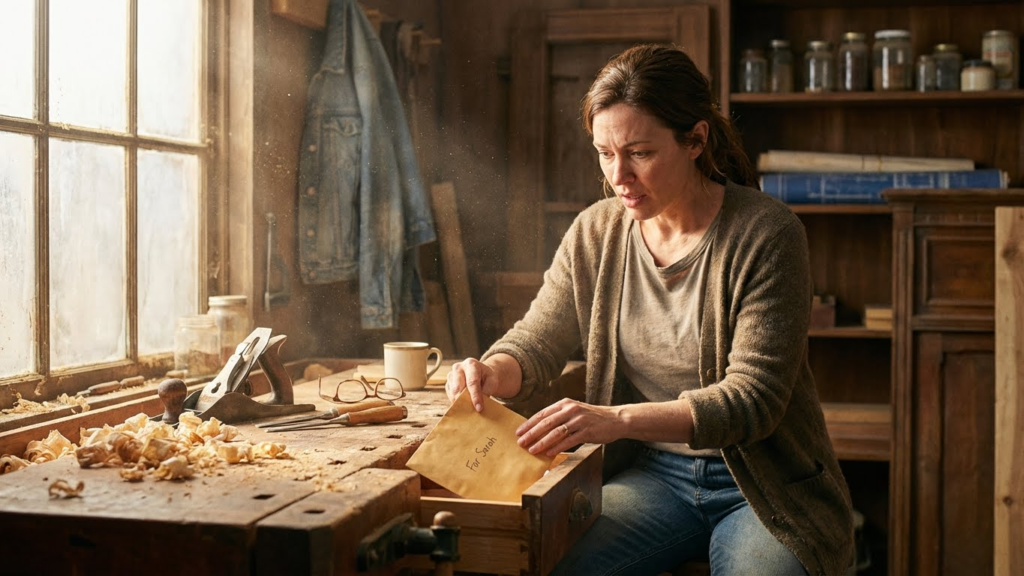
I ran my hand along his workbench, tears finally falling. The tools were all neatly organized, just as he’d left them. Dad’s reading glasses sat next to a half-finished jewelry box he’d been making for Emma’s birthday—a birthday he didn’t live to see.
That’s when I felt it. A slight seam in the wood of the workbench that shouldn’t be there. My carpenter father didn’t make mistakes like uneven seams.
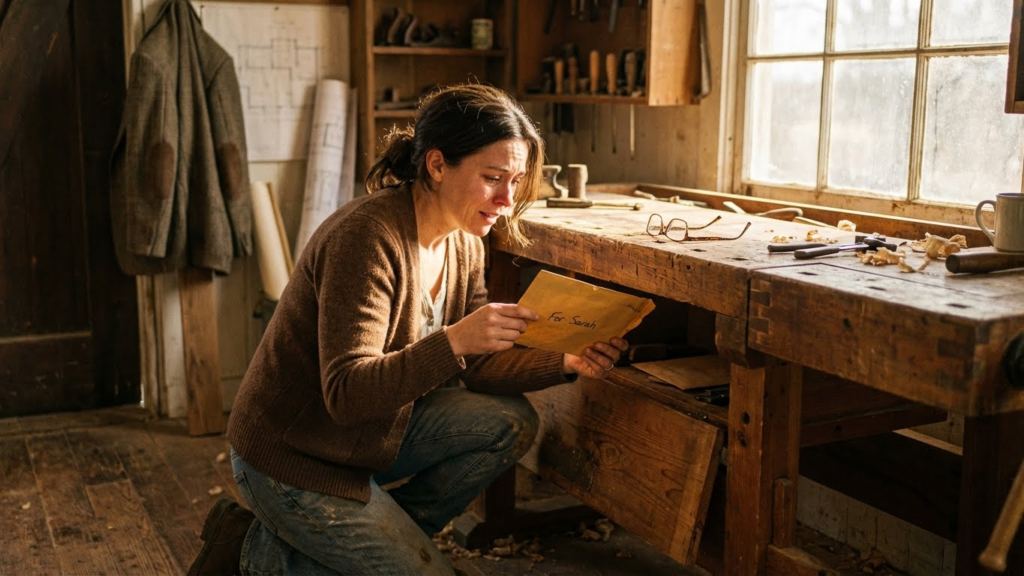
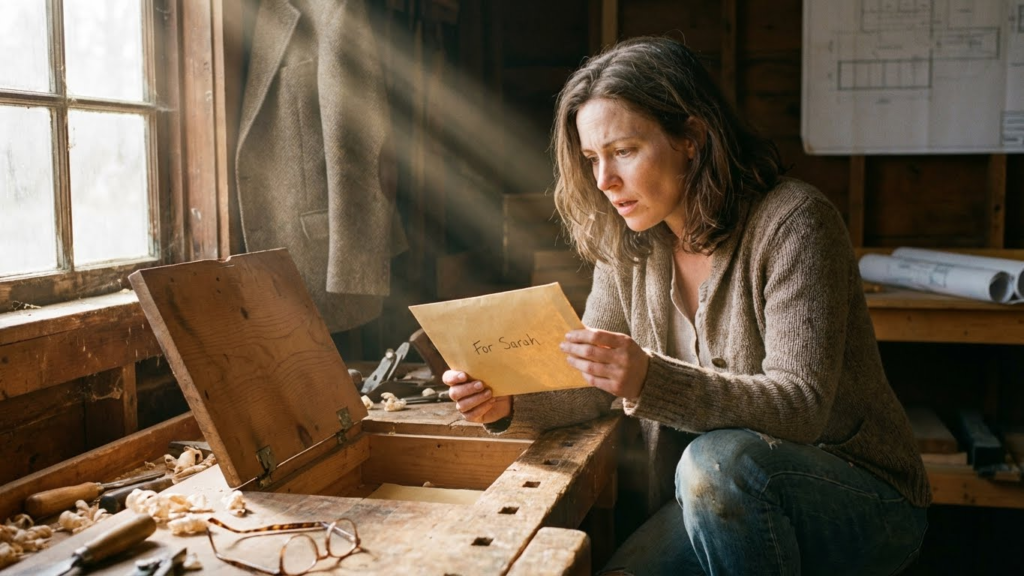
I pressed experimentally, and a small section of the bench front popped open—a hidden compartment I’d never known existed.
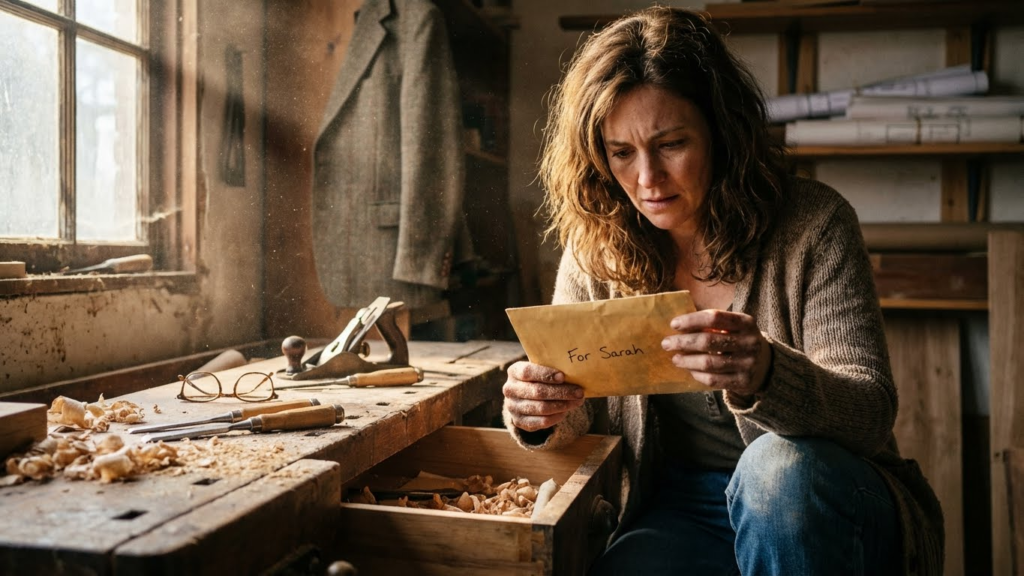
Inside was a manila envelope, slightly dusty, with my name written in Dad’s distinctive slanted handwriting: “For Sarah – Open when you need to understand.”
My hands shook as I pulled it out. The envelope was sealed, dated six months ago—right around the time Dad’s condition had taken a turn and Linda had started really restricting our access.
I opened it carefully. Inside were three documents: a handwritten letter, a legal-looking document labeled “Last Will and Testament of Thomas Richardson,” and a stack of photographs.
The letter was dated April 15th, six months before Dad died:
My dearest Sarah,
If you’re reading this, then I’m gone, and Linda has probably presented a will leaving everything to her. I need you to know that’s not what I wanted, and it’s not what I intended.
I’m writing this while I still have my full faculties, before the medications make me too foggy to think straight. I’ve hidden this here because Linda never comes to the workshop—she thinks my life’s work is junk.
The truth is, I made a terrible mistake marrying Linda. I was lonely after being alone for so long. She seemed kind at first. But about a year ago, I realized what she really wanted. She started talking about selling the house, about how much everything was worth. She asked about life insurance. She got upset when I told her most of my money went to keeping the house and helping you girls.
Then I got sicker, and things changed. She started controlling my medications, deciding who I could see. She brought in a lawyer—her lawyer—and pressured me to sign papers when I was barely conscious. I don’t even remember signing some of them, sweetheart. But I do remember her voice saying “This will make everything so much easier.”
I had my real lawyer draw up this will three months before Linda isolated me completely. It’s witnessed, notarized, and legally binding. The house and everything in it goes to you and Emma equally. Linda gets $10,000 for her “care”—which is more than she deserves.
I also documented what I could. The photographs show some of Linda’s behavior. I heard her on the phone several times planning what she’d do with “the money” after I died. I recorded one conversation—the recording device is in the bottom drawer of this workbench.
I’m sorry I wasn’t strong enough to stop her myself. I’m sorry you girls had to watch me slip away without being able to help. But I made sure she wouldn’t win in the end.
The workshop is yours. The house is yours. Build something beautiful with it.
Love always,
Dad
I couldn’t breathe. My hands trembled so violently I nearly dropped the papers. Dad had known. He’d known what Linda was doing and he’d tried to protect us.
Emma burst into the workshop. “Sarah, Linda is already calling estate sale companies—” She stopped when she saw my face. “What is it?”
I handed her the letter. Watched her face transform from grief to shock to blazing fury as she read.
“That witch,” Emma breathed. “She manipulated him. She—” She looked at the legal document. “Is this real? Is this actually Dad’s will?”
We called the lawyer whose name was on the real will—Martin Kowalski, Dad’s attorney for twenty-five years. The man Linda’s lawyer had supposedly replaced.
“Mr. Richardson did come to me six months ago,” Martin confirmed over the phone. “He was very clear-minded, very specific. He told me his wife was trying to isolate him and he needed to ensure his daughters were protected. We drew up a new will, properly witnessed and notarized. He said he was hiding it somewhere his wife would never look.”
“Why didn’t you come forward?” I demanded.
“Because I didn’t know he’d died until you just called,” Martin said grimly. “Linda never notified me. She used her own lawyer to present what I’m now certain is a fraudulent will. I’ll need you to bring me the document immediately.”
Three hours later, we were back in Dad’s living room. This time with Martin Kowalski, a different kind of attorney, and two police officers.
Linda’s face went from confused to panicked when she saw our entourage. “What is this? You have no right—”
“This,” Martin said, placing Dad’s real will on the coffee table, “is the actual Last Will and Testament of Thomas Richardson, properly executed six months ago. The document you presented was either forged or obtained through coercion of a man who was heavily medicated and not of sound mind.”
Linda’s lawyer—some slick guy in an expensive suit—stepped forward. “That’s a serious accusation—”
“We also have recordings,” I said, holding up the small digital recorder Dad had hidden. “Of Linda discussing her plans for Dad’s estate. Before he died. Including some very specific comments about ‘not having to pretend much longer’ and ‘dealing with the daughters once the old man is gone.'”
The color drained from Linda’s face.
What followed was a nightmare for Linda and vindication for us. The police launched an investigation into Dad’s care. The recordings revealed Linda discussing with a friend how she was managing Dad’s medications to keep him “compliant.” Medical records showed periods where his prescriptions didn’t match what he should have been taking.
The will Linda had presented was found to have been signed during a period when Dad’s medical records showed he was under heavy sedation—something that raised serious questions about his capacity to understand what he was signing.
Her lawyer backed away fast once the fraud implications became clear. Turns out he was Linda’s divorce attorney from her previous marriage, not an estate lawyer, and he’d never properly verified the witnesses on the will.
The photographs Dad had taken showed Linda going through his files, copying financial documents, even showing real estate agents around the house while Dad was asleep. Building her case for what she’d claim once he was gone.
The courts moved surprisingly quickly once the evidence was presented. Dad’s real will was validated. The fraudulent will Linda had presented was thrown out. Linda was ordered to vacate the property within 30 days.
She left in the middle of the night three weeks later, taking only what she’d brought into the marriage. Turns out she’d been married twice before—both times to older widowers. Both previous husbands had died within a few years of marriage. Both times she’d inherited everything.
The authorities are looking into those deaths now.
Emma and I inherited everything Dad wanted us to have. The house. The workshop. His tools. His truck. And something we didn’t expect—a small life insurance policy that Linda didn’t know about, set up years ago with Emma and me as beneficiaries. Dad had been more prepared than we knew.
We’re keeping the house. Emma’s moving back from Boston—she’s going to turn Dad’s workshop into a community carpentry space, teaching woodworking to kids who can’t afford classes. Dad would have loved that.
I’m living in the house, slowly going through forty years of memories. I found more notes from Dad hidden in random places—in his favorite books, tucked into tool drawers, under floorboards. Little messages of love and wisdom he left for us to find.
One note, hidden in his old Bible, said: “Girls, I know I wasn’t rich. But I built things that lasted. I raised daughters who know right from wrong. And I loved your mother until the day I died. That’s wealth enough for any man.”
Linda faced charges of elder abuse, fraud, and attempted theft by deception. She took a plea deal and served two years. Her previous marriages are still under investigation.
People sometimes ask if I’m angry that Dad didn’t protect himself better, didn’t see through Linda sooner. But he was a sixty-eight-year-old widower who’d been alone for decades, dying of cancer, and lonely enough to take a chance on someone who seemed kind.
The anger I feel is toward predators like Linda who see vulnerable elderly people as targets. Who isolate them from family, manipulate their medications, and forge their final wishes to steal what should go to the people who actually loved them.
But mostly I’m grateful. Grateful Dad had the clarity in his final months to protect us. Grateful he left us that letter so we’d understand what happened. Grateful he taught us to measure twice and cut once—to think carefully and act decisively.
The workshop still smells like sawdust and varnish. Dad’s reading glasses still sit on the workbench. And every time I walk in there, I can hear his voice: “Build something that lasts, sweetheart. Build something that matters.”
We did, Dad. We built justice. And we’re building something beautiful from what you left us.
That’s the inheritance that really mattered.