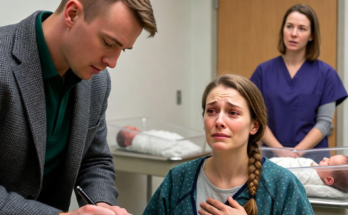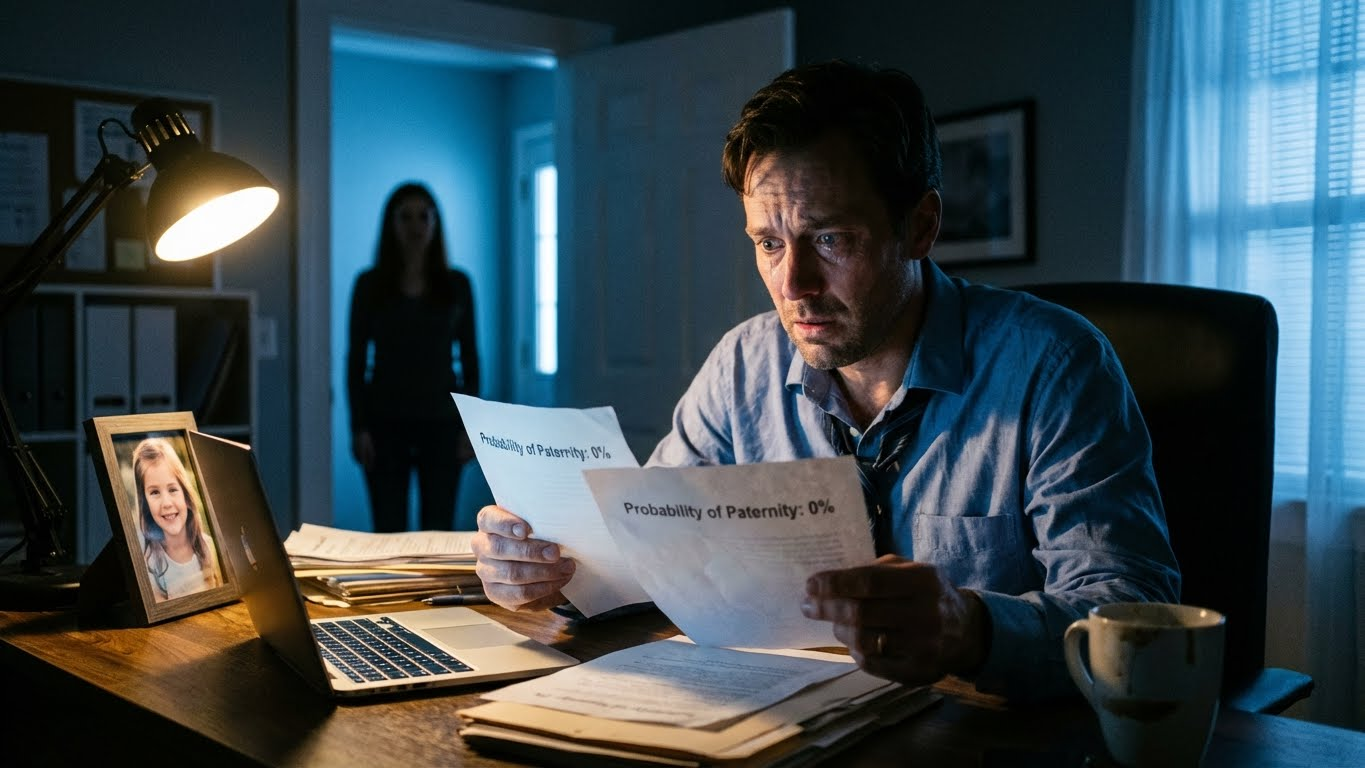
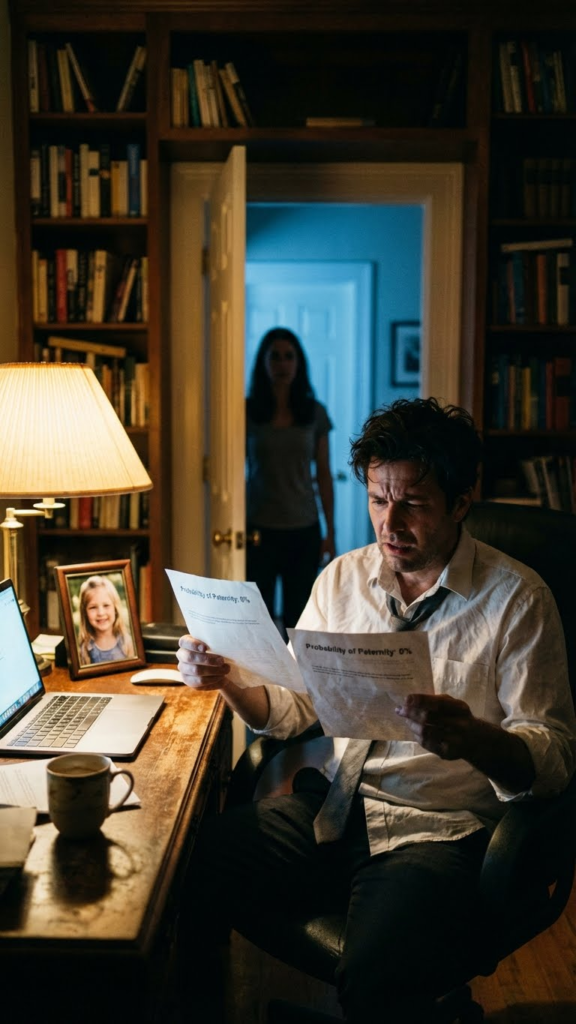
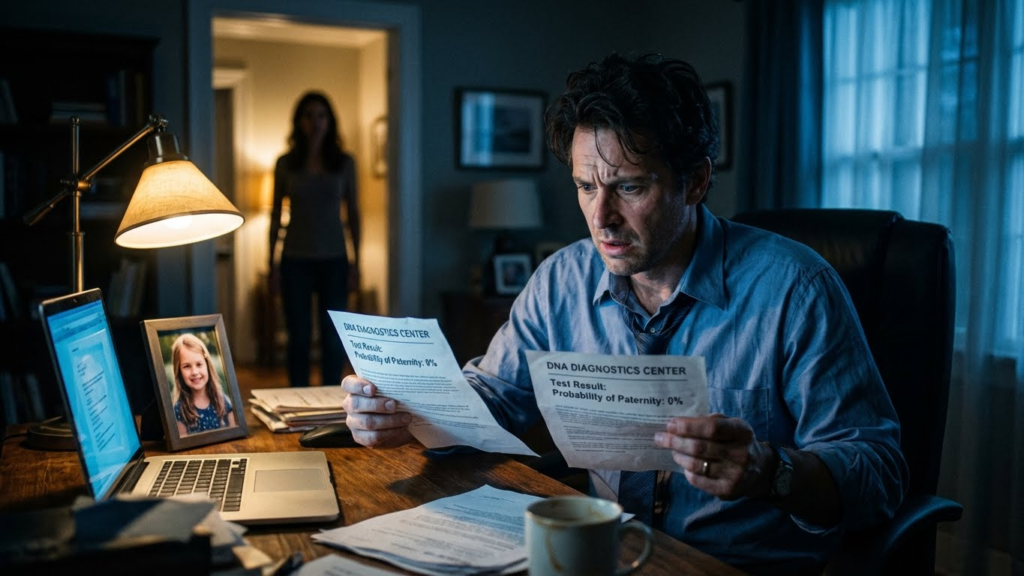
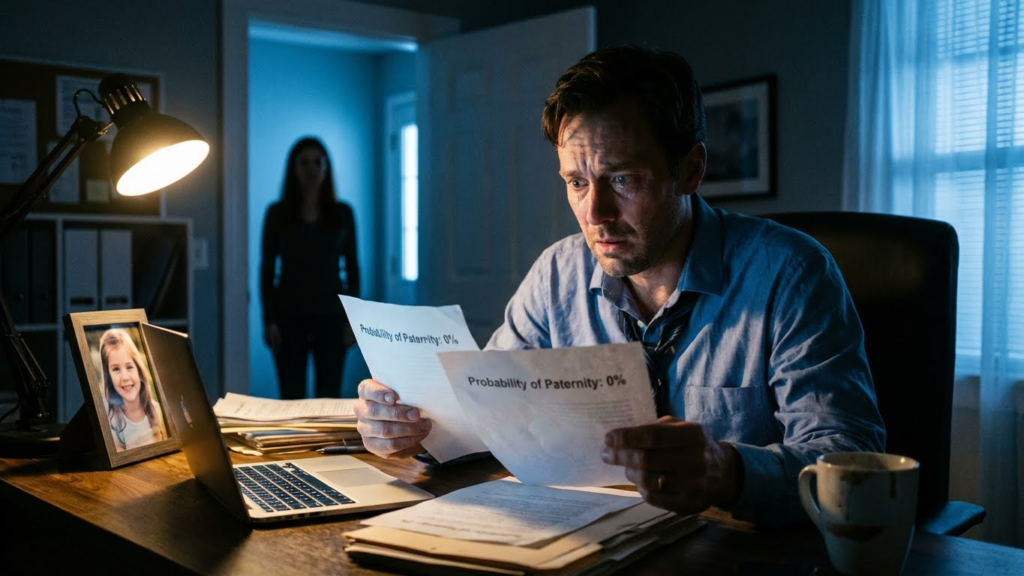
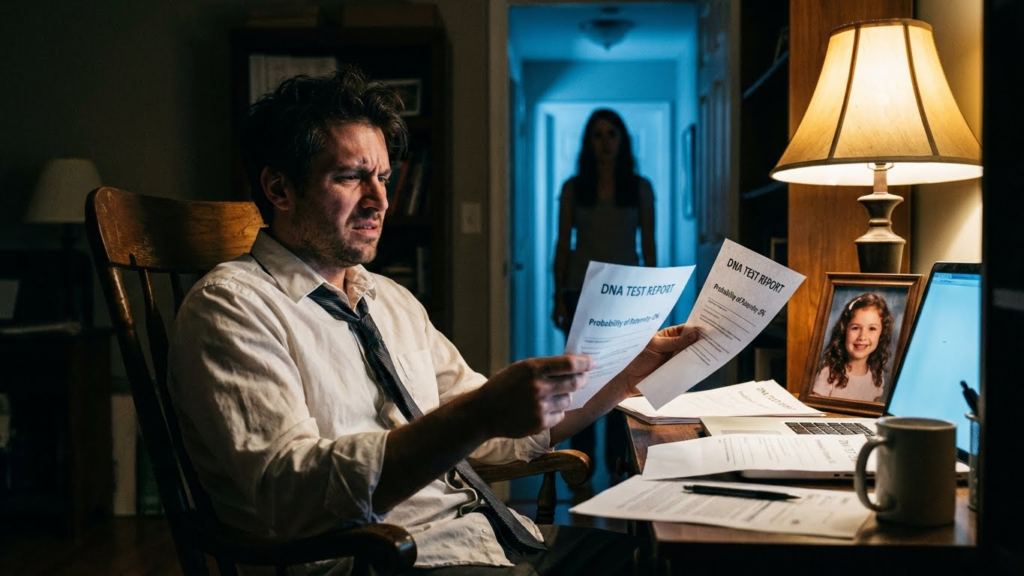
I stared at the DNA test results until the numbers blurred together. “Probability of Paternity: 0%.” The words were clinical, definitive, devastating. My five-year-old daughter Emma wasn’t biologically mine. Five years of bedtime stories, kissing scraped knees, celebrating first words and first steps—all built on a foundation of lies.
My wife Jessica found me in our home office at 2 AM, still dressed in my work clothes, surrounded by papers I’d printed out and read a dozen times hoping the results would somehow change. “Mark, what are you doing still up?” Then her eyes fell on the test results spread across my desk like evidence at a crime scene. The color drained from her face so fast I thought she might faint.
“When exactly were you planning to tell me?” My voice sounded hollow, dead even to my own ears.
“I can explain—”
“Explain what?” I stood up, and she took a step back. “Explain that you’ve been lying to me for six years? That the child I’ve raised, the daughter I love more than my own life, isn’t actually mine? What part of that needs explaining, Jessica?”
The tears started then, but I was past feeling sympathy. Past feeling anything except a cold, spreading numbness. “It was one time. One mistake. I swear it was only once. I was going to tell you, but then I got pregnant and—”
“Who?” I cut her off. “Who is her father?”
Jessica couldn’t meet my eyes. She looked at the floor, at the walls, at her trembling hands—anywhere but at me. And that’s when my blood turned to ice. Because I knew my wife. I knew she only acted this guilty, this evasive, around one specific person.
“No,” I whispered. “Tell me it’s not him.”
Her silence was confirmation enough.
My brother. My own brother Ryan was Emma’s biological father.
But here’s what Jessica didn’t know: I’d had my suspicions for months. It started small—noticing that five-year-old Emma didn’t look like me at all. Every parent gets told their kid is their “mini-me,” but Emma had none of my features. Not my brown eyes, not my dark hair, not my build. She had distinctive green eyes that seemed to come from nowhere.
Except they didn’t come from nowhere. My brother Ryan had those exact same rare green eyes.
Then there were the visits. Ryan had always been close to us, but after Emma was born, he became obsessed with spending time with “his niece.” He’d drive three hours from Portland every other weekend. He’d insist on taking her to the park, reading her bedtime stories when he visited, buying her extravagant gifts we couldn’t afford ourselves.
When Emma started preschool last year, Ryan had offered—no, insisted—on paying the fifteen-thousand-dollar annual tuition. “She’s my only niece,” he’d said. “Let me do this.” At the time, I’d been grateful. Now it made sickening sense.
The final straw came two months ago at Emma’s fifth birthday party. I watched Ryan and Emma together, saw how his face lit up when she called his name, noticed how he touched her hair with this look of wonder. And I saw my wife watching them with an expression I’d never seen before—fear mixed with something else. Guilt, maybe. Or regret.
That night, I ordered the DNA test.
But I’d done something else too. Something Jessica didn’t know about. Because if my suspicions were right, I needed to know the complete truth.
I’d convinced Ryan to take a DNA test as well. Told him I was putting together a family ancestry project, wanted to compare our genetic backgrounds, make a family tree for Emma. He’d been enthusiastic, spit in the tube right away.
Ryan’s results had come back the same day as mine. I’d been sitting there with both envelopes, working up the courage to open them, when I’d started with mine and had my world collapse.
Now, with Jessica standing in front of me confirming my worst fear, I picked up the second envelope. “There’s something you should know,” I said quietly.
“Mark, please, we can work through this—”
“I had Ryan tested too.” I opened his envelope with shaking hands. Jessica’s face went from guilty to confused. “I told him it was for a family tree project. And his results came back today.”
I pulled out Ryan’s paternity test—because yes, I’d tested him against Emma too, using samples from her toothbrush. The results were clear.
“Probability of Paternity: 0%”
Ryan wasn’t Emma’s father either.
Jessica stared at the paper like it was written in a foreign language. “That’s impossible. He’s the only—” She stopped mid-sentence, realizing what she’d just admitted.
“The only one?” I said coldly. “The only one you were with besides me? So you’re saying you had an affair with my brother, got pregnant, assumed the baby was his, and have been living with that lie for six years?”
“It has to be wrong,” Jessica stammered. “The test must be wrong. He’s the only other possibility—”
“Unless he’s not,” I said. “Unless there’s someone else you haven’t told me about.”
Let me take you back seven years, because this story starts long before a DNA test. Jessica and I had been married for three years and trying to get pregnant for eighteen months. The fertility issues were on my side—low motility, the doctors said. Not impossible, just difficult.
Ryan had been staying with us that month six years ago, supposedly “between apartments” after a breakup. Looking back, I realize he was there for nearly three weeks. Jessica and I weren’t in a great place—the fertility struggles had created distance, tension. We were barely intimate anymore.
Then Ryan moved out, Jessica and I had one good week of reconnection, and three weeks later she told me she was pregnant. We were thrilled. Shocked, but thrilled. Emma was our miracle baby, conceived despite the odds.
Except she wasn’t conceived despite the odds. She was conceived because I wasn’t the father.
What I didn’t know—what I’m only piecing together now—is that Jessica and Ryan had a history before she and I even met. They’d dated briefly in college, ended badly. When I introduced them years later as my girlfriend and my brother, they both pretended they’d never met. I didn’t learn about their past until after Jessica and I were engaged, and by then it seemed like ancient history.
Apparently it wasn’t.
“I need to know who Emma’s real father is,” I said, my voice deadly calm. “And I need to know right now, Jessica. Because if there’s someone else, if there’s another man you’ve been lying about—”
“There’s no one else!” she shouted. “It was Ryan. It had to be Ryan. We were drunk one night, you were working late, and we—” She broke down completely. “It was a mistake. One terrible mistake. But it had to be him. I wasn’t with anyone else.”
I pulled up my phone and called Ryan. 3 AM be damned. He answered on the fifth ring, voice thick with sleep. “Mark? What’s wrong?”
“I need you to come over. Now.”
“It’s three in the morning—”
“NOW.”
Something in my voice must have told him this wasn’t negotiable. “I’ll be there in twenty minutes.”
When Ryan arrived, disheveled and confused, he found Jessica and me sitting at opposite ends of the living room like opposing attorneys. I handed him both DNA test results without preamble.
I watched his face as he read. Watched confusion become shock become something else—relief? “I’m not her father?” he said quietly. “I thought… all these years I thought…”
“You KNEW?” I was on my feet. “You knew you slept with my wife and you thought Emma might be yours, and you never said anything?”
“I was going to!” Ryan’s voice broke. “The guilt has been eating me alive for six years. Every time I look at Emma, every time I visit, I see her eyes—my eyes—and I think about how I betrayed you. I’ve been trying to find the courage to confess, but—”
“But she has your eyes because you’re my brother!” I shouted. “Green eyes run in our family! Emma has green eyes because genetics are weird and random, not because you’re her father!”
The three of us stared at each other in the wreckage of our relationships. Then Ryan said the thing that changed everything: “Jessica, if it wasn’t me… who was it?”
Jessica’s breakdown was complete. Through sobs and broken sentences, the truth came out. There was another man. Someone she’d had a brief affair with right around the same time as her mistake with Ryan. Someone she’d met at a work conference and hooked up with twice before cutting it off.
She’d convinced herself Emma had to be Ryan’s because the timing was closer. Because admitting to two affairs was somehow worse than admitting to one. Because Ryan was family, and maybe there was a sick logic to keeping it in the family rather than involving a stranger.
“Who is he?” I demanded.
She pulled out her phone with shaking hands and showed me a social media profile. David Martinez. A project manager from Denver she’d worked with six years ago. Looking at his photo, I saw it immediately—Emma’s face shape, her smile, her dimples.
“We need to test her against him,” Ryan said quietly.
“No.” I stood up. “We don’t. Because I don’t care.”
They both looked at me in shock. “What?” Jessica whispered.
“I don’t care if Emma is genetically mine, Ryan’s, or this David person’s. I’ve been her father for five years. I’m the one who walks her to kindergarten. I’m the one she calls when she has nightmares. I’m the one she made that card for that says ‘Best Daddy in the World.'”
I looked at Jessica, and something in me hardened. “But I do care that my wife has been lying to me for six years. That my brother—my own brother—betrayed me and then pretended nothing happened. That you both let me raise a child believing she was mine when you suspected otherwise.”
I filed for divorce the following week. Not because Emma wasn’t biologically mine—that truth had shocked me, but it didn’t change how I felt about her. I filed because Jessica had built our entire marriage on lies. Two affairs, six years of deception, and when caught, her first instinct had been to lie more.
The divorce was brutal. Jessica wanted to use my “rejection of Emma” as leverage in custody negotiations. Except I wasn’t rejecting Emma. I wanted joint custody, wanted to remain her father in every way that mattered.
The courts agreed. Paternity, they ruled, was about more than DNA. I’d acted as Emma’s father since birth. I was on her birth certificate. I’d raised her, provided for her, formed an undeniable parent-child bond. Biology didn’t erase five years of fatherhood.
We got fifty-fifty custody. Emma calls me Daddy. She doesn’t know about the DNA tests, and she won’t until she’s old enough to understand.
As for Ryan? I haven’t spoken to my brother in a year. Maybe someday I’ll be able to forgive him, but not yet. The betrayal goes too deep.
We never did test Emma against David Martinez. Jessica reached out to him, told him he might have a daughter. He wanted nothing to do with it—was married with two kids of his own and didn’t want to blow up his life with a child from a one-night stand years ago.
So Emma has three possible biological fathers: me (ruled out), Ryan (ruled out), and David (most likely but unconfirmed). And one actual father: me.
Emma just turned six. For her birthday, she asked if we could go camping, just the two of us. So we packed up my car and drove to the state park where I’d camped with my dad as a kid.
On the second night, sitting by the campfire, Emma looked up at me with those distinctive green eyes—the eyes that had started this whole investigation—and said, “Daddy, I’m glad you’re my dad.”
“Me too, sweetpea.”
“Sarah at school says her dad isn’t her real dad because he adopted her. But you’re my real dad, right?”
I pulled her close. “I’m your real dad. I’ve been your dad since the day you were born, and I’ll be your dad until the day I die. That’s what makes someone a real parent—not blood, but love.”
She seemed satisfied with that answer. And honestly? So was I.
The DNA test said I wasn’t Emma’s biological father. My brother’s test revealed he wasn’t either. And somewhere out there is a man named David who contributed chromosomes but nothing else.
But fatherhood isn’t DNA. It’s showing up. It’s loving unconditionally. It’s choosing, every single day, to be present in a child’s life.
Jessica’s lies destroyed our marriage. Ryan’s betrayal shattered our brotherhood. But neither of those things changed the fundamental truth: I’m Emma’s father. Not because of genetics, but because when it mattered most, I chose her.
And I’d make that choice again a thousand times over.