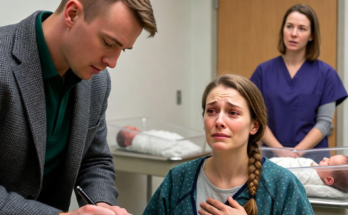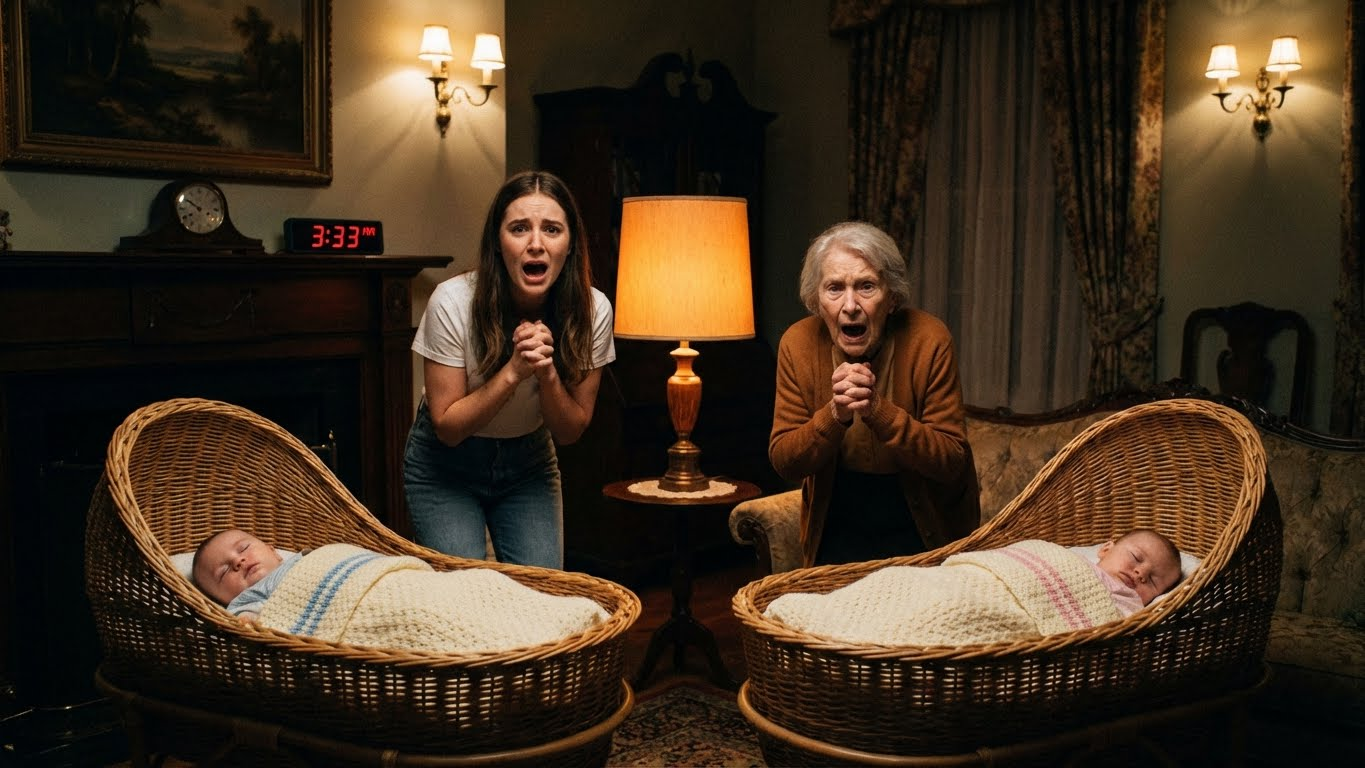
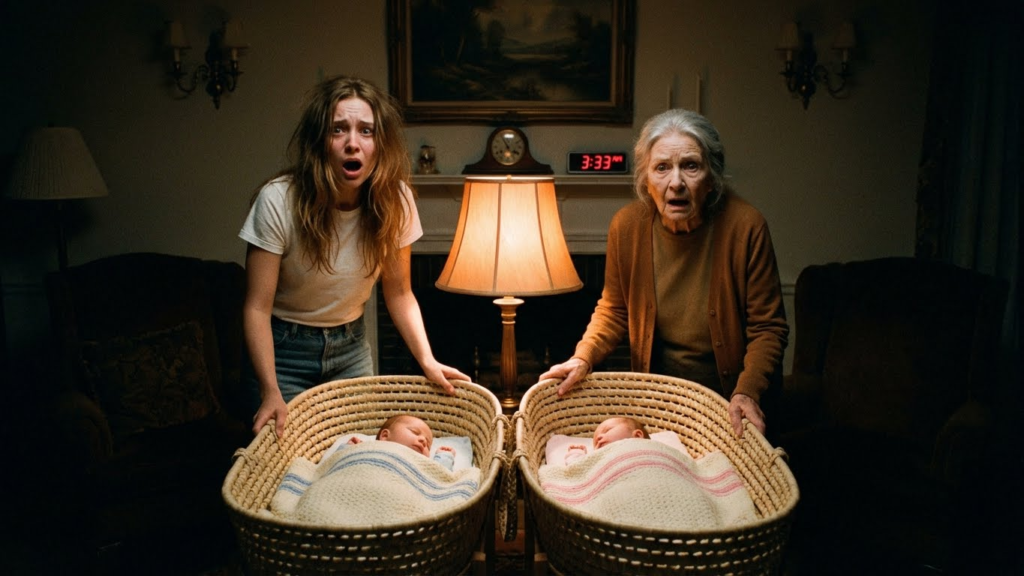
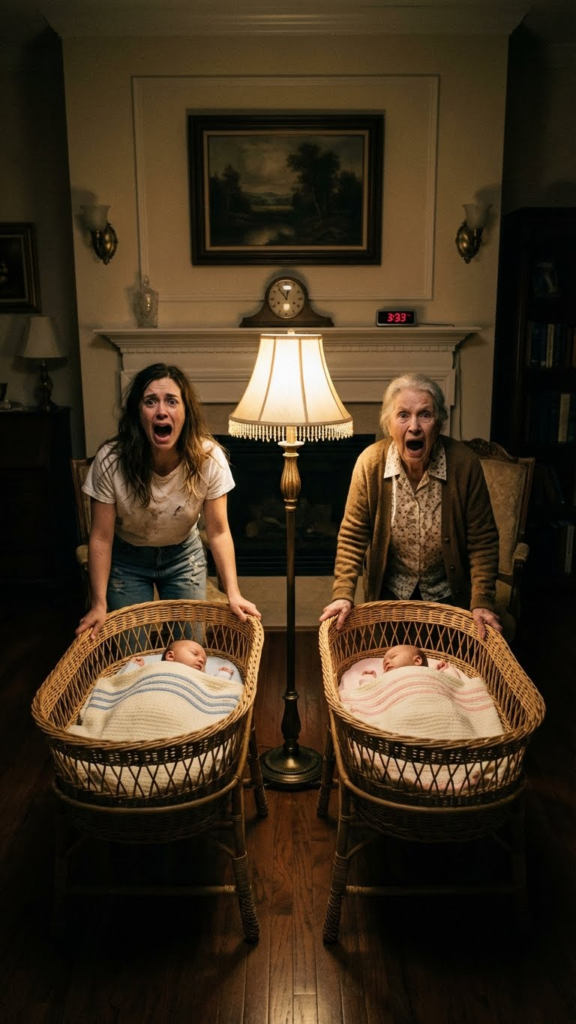
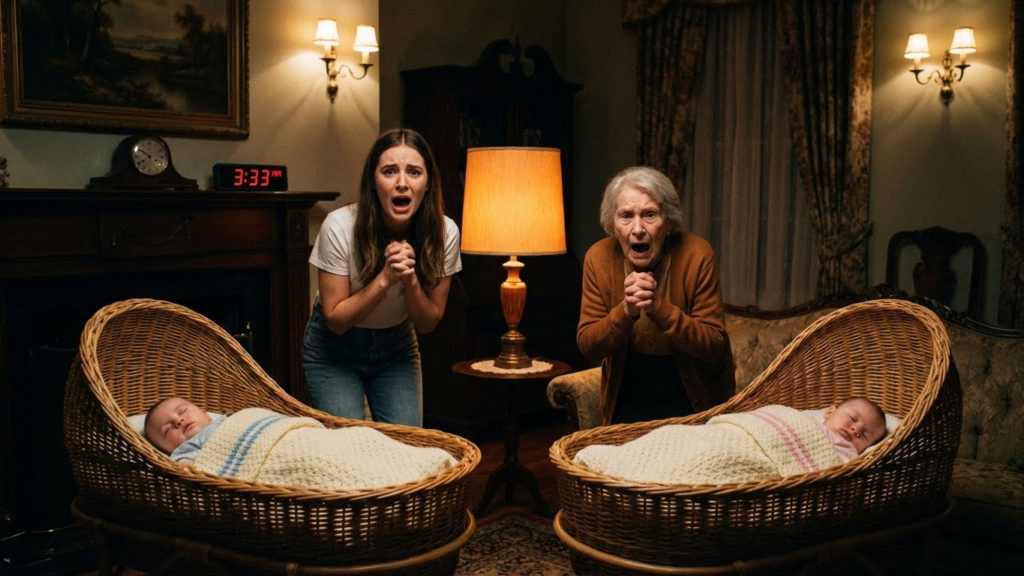
My phone buzzed on the hotel nightstand at exactly 3:33 AM. Half-asleep at a medical conference in Chicago, I reached for it expecting an emergency. Instead, it was a photo from Stacy, our babysitter—two sleeping babies in their matching wicker bassinets, wrapped in the cream-colored blankets I’d hand-knitted during my third trimester. Blue stripes for Liam, pink stripes for Emma.
The image was dimly lit by a table lamp between the bassinets, casting warm shadows across their peaceful faces. They looked angelic. Safe. Perfect.
I smiled, sent back a heart emoji, and fell back asleep.
Three hours later, everything changed.
My grandmother’s call came at 6:47 AM, while I was getting ready for the conference’s morning session. The moment I heard her voice—shaking, urgent, terrified—I knew something was catastrophically wrong.
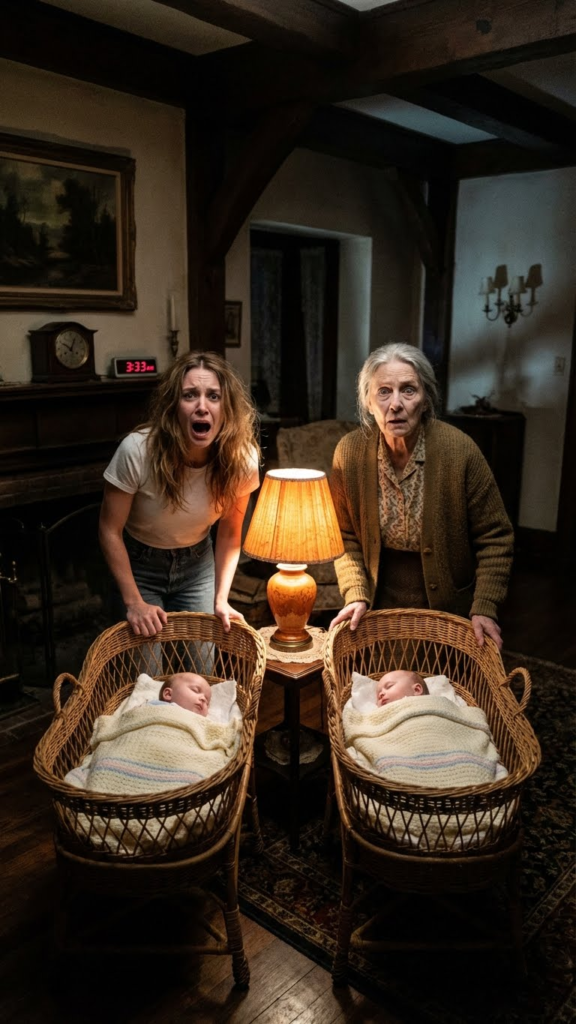
“Emily, whose babies are those?” She didn’t even say hello. “I saw the photo you posted on Facebook. Whose babies are in your house right now?”
“What are you talking about, Grandma?” I sat down on the hotel bed, confused. “Those are my twins. Liam and Emma. You came to visit us in the hospital when they were born. You’ve held them—”
“That baby in the blue blanket,” she interrupted, her seventy-six-year-old voice cracking with emotion. “That is NOT your child, Emily. I’ve seen that face before. I know exactly whose baby that is. And I know how he ended up in your house.”
My blood turned to ice. “Grandma, you’re not making sense. You’re scaring me—”
“The birthmark,” she whispered, and I could hear tears in her voice. “On his left shoulder. The strawberry mark shaped like a crescent moon. I changed that baby’s diapers for six months, fifty-three years ago, before they made me give him up for adoption. Before the hospital told me he died during the night.”
The room spun. “What are you talking about?”
“Your husband’s mother,” Grandma said, her voice turning to steel. “Margaret Thompson. She was the nurse at St. Mary’s Hospital in Hartford in 1973. She was there the day they took my baby. She was the one who told me he didn’t survive the night. But I knew she was lying, Emily. A mother knows. And now I’ve seen that birthmark again. On the baby sleeping in your house.”
I couldn’t breathe. “That’s impossible. That’s—Grandma, you’re saying Mark’s mother stole your baby? Fifty-three years ago?”
“I’m saying your husband WAS my baby,” Grandma said. “And I’m saying the child you think is your son—the one in that blue blanket—isn’t yours at all. Check the hospital records from when you gave birth three months ago, Emily. Check who was on duty. Because if Margaret Thompson was anywhere near that delivery room, she’s done it again.”
I pulled up the photo again, my hands shaking. Two sleeping babies, side by side in matching bassinets. I’d been so exhausted since their birth—three months of sleepless nights, endless feedings, postpartum recovery—that I hadn’t really LOOKED at them together in good lighting lately.
But now, staring at the image, I saw what I should have seen immediately.
They looked completely different.
The baby on the right—Emma, in the pink-striped blanket—had my round face, my light brown hair, my skin tone. She looked like my baby photos. She looked like me.
The baby on the left—who I thought was Liam—had sharp features, strawberry blonde hair, lighter skin. He looked nothing like me. Nothing like my husband Mark. Nothing like anyone in either of our families.
“Oh my God,” I whispered.
“Check his left shoulder,” Grandma said. “Check for the birthmark.”
I opened my photos, frantically scrolling through hundreds of twin pictures. There—from last week’s pediatrician appointment. A photo I’d taken of “Liam” during his diaper change.
And there it was. A crescent-shaped strawberry birthmark on his left shoulder. Exactly as Grandma had described.
“Emily, listen to me very carefully,” Grandma said. “Call the hospital where you delivered. Get your records. Find out who was in that delivery room. And whatever you do, don’t tell Margaret Thompson that you know.”
“But Mark—I have to tell Mark—”
“Your husband doesn’t know he was stolen,” Grandma said gently. “He thinks Margaret and Gerald Thompson are his biological parents who adopted him legally. He has no idea. You need proof before you tell him anything. Do you understand?”
I nodded, then realized she couldn’t see me. “Yes. I understand.”
“I’ve waited fifty-three years for this moment,” Grandma said, her voice breaking. “Don’t let them cover it up again.”
Let me take you back eighteen months, because this story starts long before that 3:33 AM photo.
I met Mark Thompson two years ago at a legal conference—I was a medical malpractice attorney, he was a defense attorney for hospitals. We clicked immediately, married quickly, and got pregnant with twins six months later.
Mark’s parents, Margaret and Gerald Thompson, seemed like the perfect in-laws. Margaret was a retired NICU nurse who’d worked at major hospitals across Connecticut for forty years. Gerald was a retired insurance executive. They lived in a beautiful colonial house in Hartford, attended church every Sunday, and welcomed me into their family with open arms.
When I got pregnant, Margaret was overjoyed. “My first grandchildren!” she’d exclaimed, already knitting blankets and setting up a nursery in their house for visits.
Everything seemed perfect. Until my grandmother met Margaret.
It happened at our baby shower. My maternal grandmother, Dorothy Chen, had driven up from New York. The moment she walked into the room and saw Margaret Thompson across the crowd, she froze.
“Emily,” she’d pulled me aside urgently. “That woman. Margaret Thompson. Where do I know her from?”
“She’s Mark’s mom,” I’d said. “She was a NICU nurse for years—”
“What hospital?” Grandma’s face had gone pale.
“St. Mary’s in Hartford, mostly. Why?”
Grandma had stared at Margaret across the room. “I need to leave. I’m sorry, sweetheart. I’m not feeling well.”
She’d left abruptly, and I’d chalked it up to her age and the long drive. But now, staring at that photo of two babies who looked nothing alike, I understood.
She’d recognized the woman who’d stolen her baby fifty-three years ago.
From my Chicago hotel room, I started making calls. First, to the hospital where I’d delivered three months ago—Greenwich Hospital in Connecticut.
“I need records of everyone present during my delivery,” I told the medical records department. “December 10th, Emily Thompson, twin delivery.”
“That information is part of your medical record, Mrs. Thompson. We’ll need a formal request form—”
“I’m an attorney specializing in medical malpractice,” I said, my voice harder than I intended. “I know my rights under HIPAA. I’m requesting my own medical records. Have them ready by this afternoon.”
I hung up and called my grandmother. “Tell me everything. From the beginning.”
What she told me made me physically sick.
In 1973, my grandmother—then Dorothy Chen, a 23-year-old unmarried Chinese-American woman—had given birth to a baby boy at St. Mary’s Hospital. Unmarried pregnancy was still heavily stigmatized, especially for Asian women. Her family had pressured her to give the baby up for adoption.
But Dorothy had wanted to keep him. She’d named him James and spent six months bonding with him while living in a home for unwed mothers, trying to save money to keep him.
Then, one night, the baby was taken to the hospital nursery for routine care. Margaret Thompson—a nurse at the hospital—had been on duty. Hours later, Dorothy was told her baby had died unexpectedly. SIDS, they said. It happened sometimes.
“They wouldn’t let me see his body,” Grandma said, crying. “They said it was better if I didn’t. They processed the death certificate and cremation so fast. I never even got to say goodbye. But I knew, Emily. I knew in my heart he hadn’t died. The day before, he was healthy, strong, perfect.”
“Why didn’t you fight it?” I asked gently.
“I was twenty-three, unmarried, Asian, no money, no family support,” Grandma said. “Who would have believed me? They told me I was experiencing postpartum psychosis. They threatened to commit me if I didn’t stop making accusations. So I buried my grief and tried to move on.”
But she’d never forgotten. And when she’d seen Margaret Thompson at my baby shower—fifty-three years later—the memories had come flooding back.
“And now you’re telling me that Mark—my husband—is your son? The baby they told you died?”
“The ages match,” Grandma said. “Margaret Thompson adopted a baby boy in 1973—the same year I ‘lost’ mine. She was the nurse on duty the night he ‘died.’ And he has the birthmark, Emily. The exact same crescent moon birthmark my James had.”
I flew home from Chicago immediately, skipping the rest of the conference. By the time I landed at JFK, the hospital records were waiting at Greenwich Hospital’s medical records office.
What I found confirmed my worst fears.
The delivery had been complicated—emergency C-section, both twins in distress, all hands on deck. In the chaos, there had been multiple nurses rotating through. And there, listed as “auxiliary nursing support during post-delivery recovery,” was Margaret Thompson.
My mother-in-law. Who was supposed to be retired. Who’d said she was “just visiting to see the babies” when she’d shown up at the hospital.
She’d been in the recovery room with my twins.
I called the hospital’s head of obstetrics, Dr. Rachel Kim, who’d delivered my babies.
“I need to know something,” I said carefully. “Were there any irregularities during my delivery? Any babies swapped or misidentified?”
There was a long pause. “Mrs. Thompson, what are you asking?”
“I’m asking if Margaret Thompson, RN, had access to my babies unsupervised during my recovery. And if there were any other births that night.”
Another pause. “There was one other birth. A single baby boy, premature, mother was a Jane Doe. She disappeared from the hospital before paperwork was processed. Left the baby behind. He went into state custody immediately.”
My heart stopped. “What did that baby look like?”
“Mrs. Thompson, I can’t share information about other patients—”
“Did he have any distinguishing marks? A birthmark, maybe?”
Dr. Kim’s silence told me everything.
“I need to DNA test my children,” I said. “Both of them. Today.”
I arrived home at 4 PM. Mark was in his office on a conference call. The babysitter was playing with the twins in the living room. I sent Stacy home with a generous tip and locked the door.
Then I looked at my babies—really looked at them—for the first time with clear eyes.
Emma, my daughter, reached for me with her tiny hands. She had my features, my coloring, my expressions. When I picked her up, she nuzzled into my neck exactly the way she always did. She knew me. She was mine.
The baby I’d been calling Liam looked up at me with wide eyes—beautiful eyes, sweet expression, but unfamiliar. When I picked him up, he didn’t settle the way Emma did. He didn’t have that instant mother-baby recognition.
Because he wasn’t my baby.
I checked his left shoulder. The crescent-moon birthmark was clear and distinct.
Mark found me in the living room at 6 PM, both babies in my arms, tears streaming down my face.
“Em? What’s wrong? Did something happen at the conference?”
“We need to DNA test the twins,” I said. “Right now. Both of them.”
“What? Why? Emily, you’re scaring me—”
“Mark, sit down. I need to tell you something about your mother. And about these babies. And about what happened fifty-three years ago.”
The DNA tests took three days to come back. Three days of Mark refusing to believe what I was telling him. Three days of his mother Margaret calling repeatedly, asking why we weren’t answering. Three days of waiting for confirmation of what I already knew in my heart.
The results arrived via email at 8:47 AM on a Tuesday.
Baby Girl (Emma Thompson): 99.99% probability of maternity to Emily Thompson. 99.98% probability of paternity to Mark Thompson.
Baby Boy (identified as Liam Thompson): 0% probability of maternity to Emily Thompson. 0% probability of paternity to Mark Thompson.
The baby I’d been raising for three months wasn’t mine.
The second test—the one I’d ordered comparing “Liam” to my grandmother Dorothy Chen—came back with different news:
99.97% probability of genetic grandchild relationship.
The baby in my house was my grandmother’s biological grandson. Which meant Mark—my husband—was her biological son.
Margaret Thompson had stolen my grandmother’s baby in 1973 and raised him as her own adopted son.
And fifty-three years later, she’d done it again. She’d swapped my biological son with an abandoned baby, giving me her grandson—the child of the son she’d stolen decades ago.
Mark’s face when I showed him the results was something I’ll never forget. Shock. Denial. Horror. Grief.
“This can’t be real,” he whispered. “She’s my mother. She wouldn’t—”
“She did,” I said. “She stole you from your biological mother in 1973. And she stole our son three months ago.”
“Where’s our real son?” Mark’s voice cracked. “Where’s Liam?”
That’s when I called the police.
What followed was a nightmare investigation that made national headlines. “Retired Nurse Accused of Decade-Long Baby-Swapping Scheme.”
When police raided Margaret and Gerald Thompson’s home, they found him. My real son. Living in a nursery Margaret had set up, being cared for by a rotation of home health aides Margaret had hired. She’d been telling Gerald the baby was a foster placement she was helping with.
Gerald had no idea. He genuinely thought Mark was their legally adopted son from 1973. He had no knowledge of any stolen babies.
But Margaret confessed to everything.
She’d been unable to have biological children. So in 1973, she’d taken my grandmother’s baby—told Dorothy he died, falsified death certificates, and processed her own fraudulent adoption through a corrupt attorney who’d since passed away.
And when her son Mark’s wife—me—gave birth to twins, she saw an opportunity. There’d been another baby born that night. An abandoned baby from a Jane Doe patient. Margaret had swapped my healthy son for the abandoned newborn, telling herself she was “giving the abandoned baby a good home” while keeping her biological grandson for herself.
In her mind, she wasn’t stealing. She was “fixing” the situation. The abandoned baby got a family. Her real grandson stayed with her, where he “belonged.”
She was arrested and charged with kidnapping, child endangerment, falsifying medical records, and fraud. The case reopened investigations into other “SIDS” deaths at hospitals where she’d worked over forty years.
They found three other families with eerily similar stories.
I’m writing this from our home in Connecticut, where both of my children are finally where they belong. My biological son—who we still call Liam—came home four months ago. Emma never left.
The adjustment has been brutal. Liam didn’t know me. He knew Margaret. The first month was screaming and rejection and heartbreak. But slowly, with help from attachment therapists, he’s bonding with us.
The baby we’d been raising—my grandmother’s genetic grandson through Mark—was placed with Dorothy. At seventy-six, she’d never expected to raise her grandchild, but she’d never stopped mourning her stolen son. Now she has his son. The grandson she never knew existed.
Mark is in intensive therapy. Learning that your entire existence is based on a kidnapping—that your mother is a criminal who stole you—breaks something fundamental. He’s filed for legal separation from the Thompson name, reclaiming his birth name: James Chen.
We visit Dorothy and the baby—his half-brother—every week. The boys will know each other. They’ll know their story.
Margaret Thompson is awaiting trial. She’s shown no remorse, insisting she was “helping” everyone. Gerald divorced her immediately and is cooperating with authorities.
The abandoned baby’s biological mother was eventually found—a nineteen-year-old girl from Massachusetts who’d been trafficked and escaped, giving birth in a hospital before fleeing again. She’s now in recovery and working with social services to potentially reunite with her son.
The babysitter sent a photo of twins at 3:33 AM. My grandmother saw it and recognized a birthmark she’d last seen fifty-three years ago.
That recognition cracked open a fifty-three-year-old crime. It brought home my stolen son. It revealed my husband’s true identity. It exposed a serial child trafficker who’d hidden behind a nursing license for decades.
If Stacy hadn’t sent that photo. If my grandmother hadn’t been on Facebook at 6 AM. If she hadn’t seen that birthmark…
I would never have known. I would have raised someone else’s child while mine lived three towns away. Margaret Thompson would have gotten away with it again.
Sometimes justice comes from the smallest moments. A photo. A birthmark. A grandmother who never forgot.
My children are home now. My real son knows his real family. And the woman who stole him—who stole my husband fifty-three years before him—is finally facing justice.
But I’ll never forget the moment I realized the baby in the blue blanket wasn’t mine. That somewhere, my real son was missing. That the grandmother I’d dismissed as “confused” had been right all along.
Listen to the old women. They remember things everyone else has forgotten. And sometimes, those memories save lives.