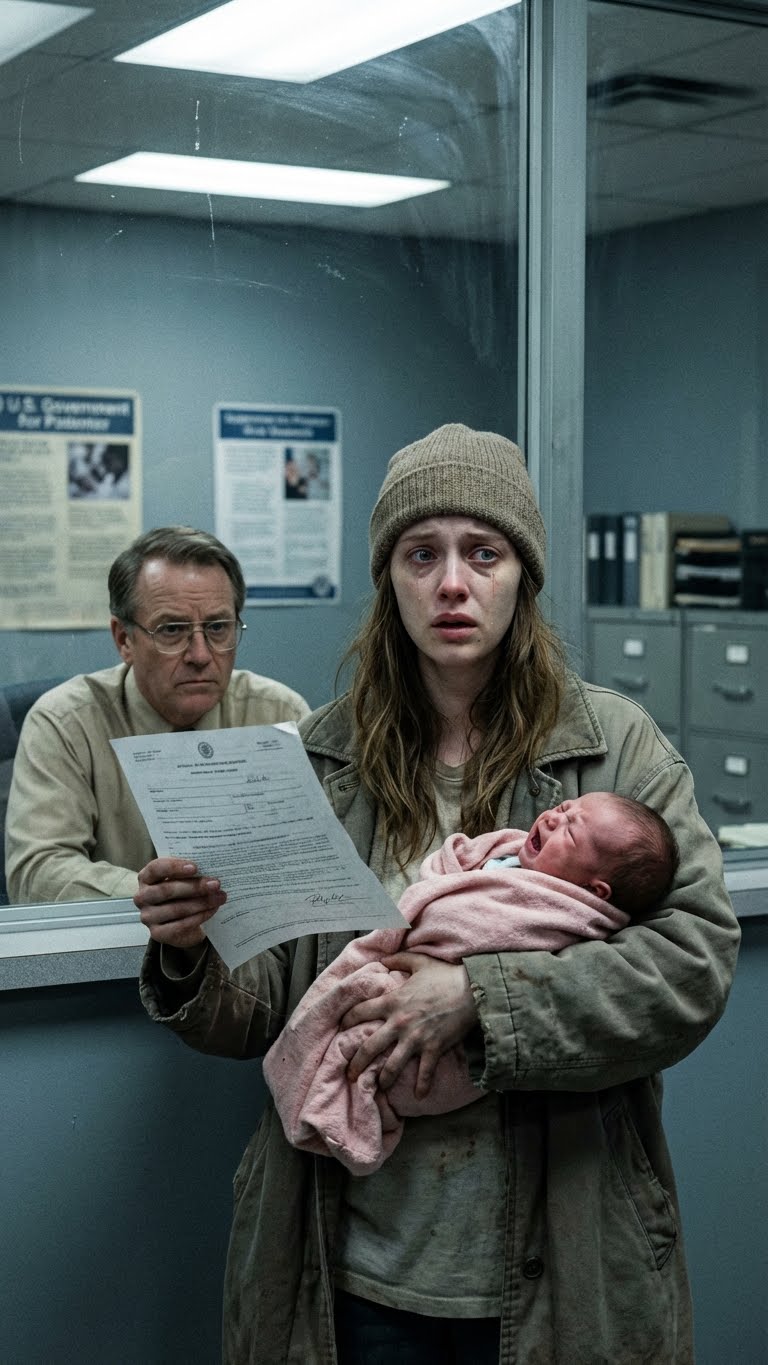
I stood in the Social Security office holding my three-week-old daughter, and the woman behind the counter looked at me like I’d just confessed to a crime.
“Ma’am, this number is already active. It’s been in use since 1987.”
My arms went numb. The baby started crying, but I couldn’t move. “That’s impossible. She was born three weeks ago.”
The woman lowered her voice, glancing at her colleague. “I need you to step aside. Someone will be with you shortly.”
I stepped away from the counter, my daughter wailing against my chest. The fluorescent lights felt too bright. Everything felt wrong. I’d come here for something routine—just another checkbox on the endless list of things new parents do. Get the birth certificate. Apply for the social security number. Set up the college fund. Normal things.
Two men in suits appeared within minutes. They weren’t from Social Security. They were federal agents.
“Mrs. Patterson? We need to ask you some questions. Please come with us.”
They took me to a back room with no windows. One of them offered to hold Emma while they questioned me, but I refused. I held her tighter, like she might disappear if I let go.
“Where did you get this social security number?” the older agent asked.
“I didn’t get it anywhere. The hospital submitted the paperwork when she was born. This is what they gave me.”
“And your husband? Where is he right now?”
“At work. He’s an accountant. Why? What does he have to do with this?”
The agents exchanged looks. “Ma’am, this social security number has been active since 1987. Someone has been using it for 38 years. They have credit cards, a mortgage, a car loan. They’ve filed taxes every year. And according to our records, this person lives in Arizona.”
The room tilted. “That’s impossible.”
“We need your husband’s contact information. We need to speak with him immediately.”
The Unraveling
They questioned David for six hours. I sat in our living room with Emma, watching the sun go down, my phone exploding with messages I couldn’t bring myself to read. When he finally came home that night, his face was gray.
“They think I’m involved in identity theft,” he said, collapsing onto the couch. “They think we stole someone’s identity for Emma.”
“That’s insane. We didn’t do anything.”
“I know. But they’ve frozen our accounts, Claire. Everything. They said it could take months to sort out.”
The next morning, my mother-in-law called. “What have you done to my son? The FBI came to my house. My neighbors saw everything.”
“We haven’t done anything, Margaret. It’s a mistake.”
“Mistakes don’t involve federal agents.” She hung up on me.
My sister stopped answering my calls. My best friend from college sent a text: I just need some space right now. This is a lot.
Everyone assumed we were guilty. It was easier to believe we were criminals than to believe the system had failed.
David became obsessed. He spent every evening after work digging through documents, making spreadsheets, calling lawyers we couldn’t afford. He stopped sleeping. He stopped eating. He snapped at me when Emma cried at night.
“Can’t you keep her quiet? I’m trying to save our lives here.”
“She’s three weeks old, David. She cries. That’s what babies do.”
“Well maybe if you’d double-checked the paperwork at the hospital, we wouldn’t be in this mess.”
I stared at him. “You’re blaming me?”
He didn’t answer. He just went back to his laptop.
The Discovery
Three days into the investigation, I went looking for our tax returns. The agents wanted copies from the last seven years. David kept everything organized in the home office, filed neatly in boxes on the shelf.
I found the tax returns easily enough. But behind them, pushed to the very back of the shelf, was another box I’d never seen before. It was taped shut, covered in dust.
I almost left it there. Almost. But something made me pull it down.
Inside were documents I didn’t recognize. Birth certificates—three of them—with different names. Social security cards that didn’t match. A Colorado driver’s license with David’s photo but a name I’d never heard: Marcus Webb.
My hands started shaking. I pulled out more papers. Bank statements from 1999, addressed to someone named Robert Chen. An old passport with David’s face and another false name. And at the very bottom, a spiral notebook filled with handwritten numbers and dates.
I opened the notebook. The first page showed social security numbers paired with birthdates. Dozens of them. The second page showed purchase dates and dollar amounts. The third page made my stomach drop.
It was a list of newborns from various hospitals in Arizona, dated 1987. Each one had their full name, birthdate, hospital, and social security number. Someone had circled one entry in red pen: “Jessica Marie Torres, Born April 15, 1987. SSN: XXX-XX-XXXX.”
Emma’s social security number.
The number David had “obtained from the hospital” for our daughter was the same number someone had stolen from a baby in Phoenix 38 years ago. And based on everything in this box, that someone was my husband.
I heard his car in the driveway.
My heart was hammering so hard I could hear it in my ears. I shoved the documents back in the box, but I kept the notebook. I slipped it under the couch cushion just as the front door opened.
“Claire? You home?”
His voice sounded normal. Tired, stressed, but normal. Like he hadn’t been running a decades-long identity theft operation. Like he hadn’t put our newborn daughter at the center of a federal investigation. Like he hadn’t destroyed our lives.
“In here,” I called, my voice steadier than I felt.
He walked into the living room and kissed the top of my head. “How’s Emma?”
“Sleeping. How was work?”
“Terrible. I couldn’t concentrate. I kept thinking about the meeting with the lawyer tomorrow.” He sat down heavily on the couch, right above where I’d hidden the notebook. “I’m going to make this right, Claire. I promise. Whatever it takes.”
I looked at him. This man I’d married four years ago. This man who’d held my hand through 36 hours of labor. This man who’d cried when Emma was born. This man who was a complete stranger.
“David,” I said carefully. “Is there anything you need to tell me?”
His face changed for just a second. Something flickered behind his eyes—panic, maybe, or calculation. Then it was gone.
“What do you mean?”
“About the investigation. About the social security number. Is there anything you know that you haven’t told the agents?”
“No. Nothing. Why would you ask that?”
I wanted to scream. I wanted to throw the box at him. Instead, I smiled. “Just checking. I’m going to put Emma down in her crib.”
I took my daughter upstairs, and I called the federal agent whose card was stuck to our refrigerator.
The Confrontation
They came at 6 AM the next morning. Eight agents with a search warrant. David was making coffee when they knocked.
I answered the door in my bathrobe, Emma crying in my arms. “Come in. Everything you need is in the home office.”
David appeared in the hallway. “Claire? What’s happening?”
“They have a warrant,” I said. “I called them.”
His face went white. “You what?”
“I found the box, David. I know everything.”
The agents moved past him like water around a stone. They knew exactly where to look because I’d told them everything on the phone. The false identities. The birth certificate list. The decades of theft.
“Claire, I can explain—”
“Don’t.” I was surprised by how calm I sounded. “Don’t say anything to me. Save it for your lawyer.”
They found everything within an hour. The documents, the notebook, a laptop hidden in the garage with encrypted files containing hundreds of stolen identities. David had been buying and selling social security numbers since 1998. He’d stolen Emma’s number from his own database—a baby born the same month and day as our daughter, just 38 years earlier.
He’d never expected anyone to notice. He’d never expected me to need to apply for Emma’s number because he thought he’d already done it. But he’d gotten the dates mixed up in his panic after her birth. He’d submitted the wrong paperwork to the hospital. And the whole thing had fallen apart.
As they led him out in handcuffs, he looked back at me. “I did it for us. For our future. The money—”
“You did it for yourself,” I said. “You always have.”
The Aftermath
The investigation took fourteen months. They identified 347 victims whose identities David had stolen or sold over 26 years. Jessica Marie Torres—the woman whose infant social security number David had given to Emma—was found in Phoenix. She’d spent years fighting credit problems she couldn’t explain, applying for jobs that mysteriously rejected her, dealing with tax issues that made no sense.
When the investigation cleared me, the media came calling. Everyone wanted the story of the wife who turned in her husband. The woman who chose her daughter’s future over her marriage.
The real Jessica Torres and I met for the first time at David’s sentencing. She was 38 years old, a high school teacher, mother of two. She hugged me in the courthouse hallway and thanked me for ending her nightmare.
David got 23 years in federal prison. His mother blamed me until the day she died. My sister called to apologize eight months too late. My former best friend sent flowers.
Emma got a new social security number. A real one, that belonged only to her. We moved to a different state. I changed our last name back to my maiden name. We started over.
On Emma’s second birthday, a letter arrived from the Bureau of Prisons. David wanted me to bring Emma to visit him. He wanted to “be part of her life.” He wanted forgiveness.
I threw the letter away.
Sometimes Emma asks about her daddy. She’s five now, and she knows other kids have fathers. I tell her the truth in ways she can understand: “Your father made choices that hurt people. And when we hurt people, there are consequences.”
“Did he hurt us?” she asked once.
“He tried to. But we got away.”
Last month, I got a notification that David’s parole hearing was scheduled for 2041. He’ll be 62 years old. Emma will be 27. I’ll be 53.
I don’t know if I’ll go to that hearing. I don’t know if Emma will want to. But I know one thing: we survived. We rebuilt. And we did it without him.
The woman at the Social Security office who first caught the discrepancy sent me a card when Emma turned one. It said: “You did the right thing. Your daughter is lucky to have you.”
I keep it in Emma’s baby book, right next to her real birth certificate and her legitimate social security card. Evidence that sometimes the system works. That sometimes the good guys win.
That sometimes a mother’s love is stronger than a lifetime of lies.
And every time I look at Emma—healthy, happy, safe—I know I made the right choice. Even when the world was burning down around us. Even when everyone turned away. Even when it would have been easier to pretend I’d never opened that box.
Because she deserved better than a father who would steal her identity before she’d even learned her own name.
She deserved a mother who would fight for her.
And that’s exactly what she got.