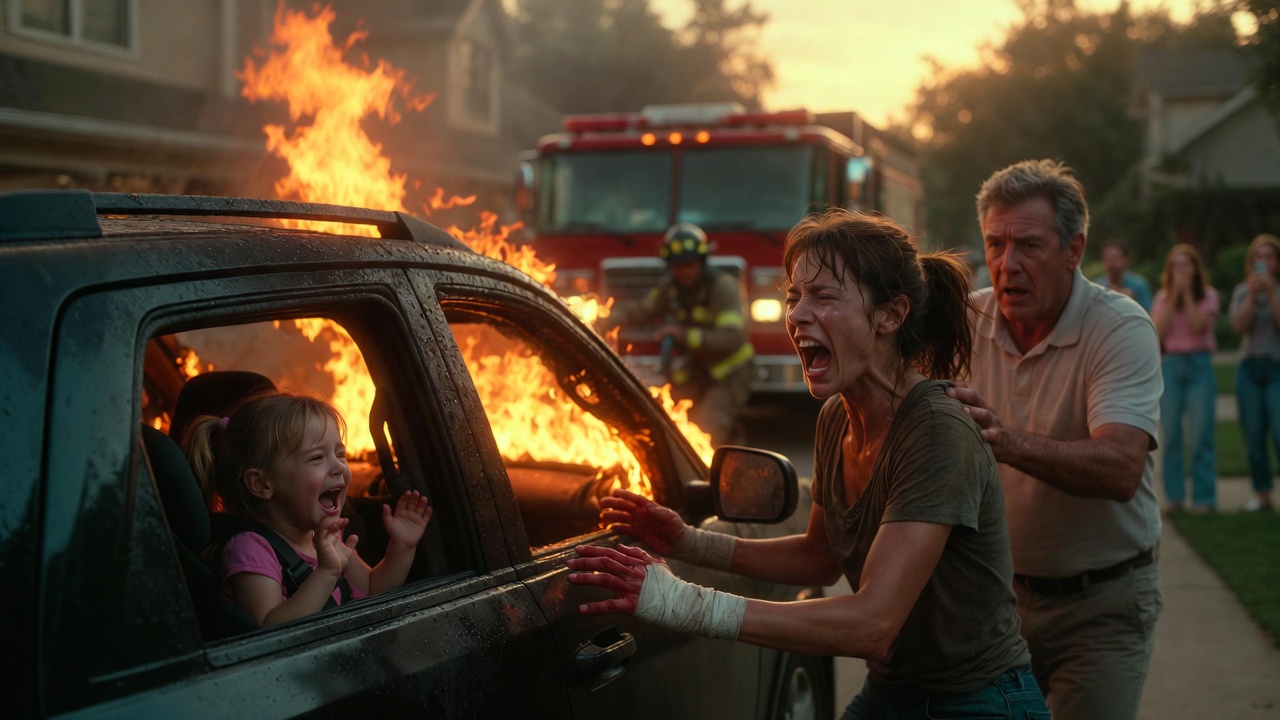
I used to think the phrase “my life flashed before my eyes” was just something people said.
Turns out, it’s very literal when your child is trapped inside a burning car.
It was a Sunday afternoon in a nice, boring American suburb. My father-in-law’s kind of suburb. Perfect lawns, HOA newsletters, the same three cars rotated on every driveway: an SUV, a sedan, and something “fun” for the weekends.
We were at his house for “family dinner,” because in his words, “real families show up on Sundays.” Missing a Sunday was a moral crime. Being late was a character flaw.
I was already ten minutes late.
My husband, Daniel, had gone ahead in his own car because his dad needed “help in the garage” earlier. That phrase always meant: talk business, talk money, talk about what I was doing wrong as a wife and a mother. I’d learned not to ask.
I arrived alone with Lily. She had fallen asleep in her car seat on the way over—head tilted, curls stuck to her sweaty forehead, clutching her stuffed bunny by one ear. I parked in front of my father-in-law’s house, stepped out, and did the mental juggling every mom does:
- Casserole dish in one hand
- Diaper bag looped over my shoulder
- My phone in my back pocket
- Mental note to come back immediately for Lily so I didn’t wake her too soon
It was supposed to be thirty seconds.
Drop the food on the porch, unlock the front door, call back to my father-in-law that we’d arrived, and go straight back for her.
I was halfway to the door when the universe decided to answer a different question: How fast can everything go wrong?
I heard it before I saw it: a strange, popping crackle behind me, like someone crunching cellophane near a microphone. Then the faintest whiff of smoke—chemical, sharp, wrong.
Someone shouted from across the street, “HEY! HEY, YOUR CAR!”
I turned.
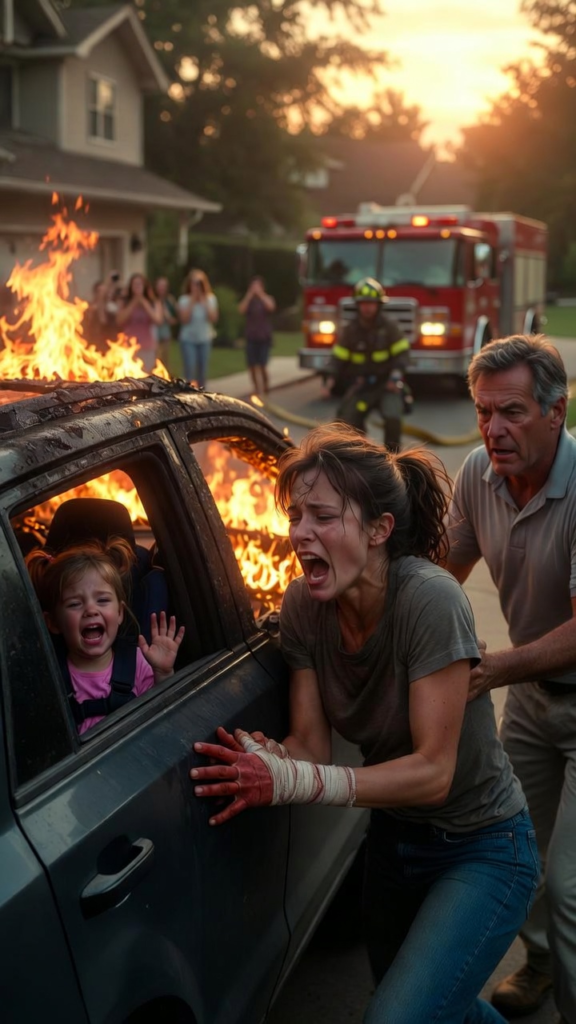
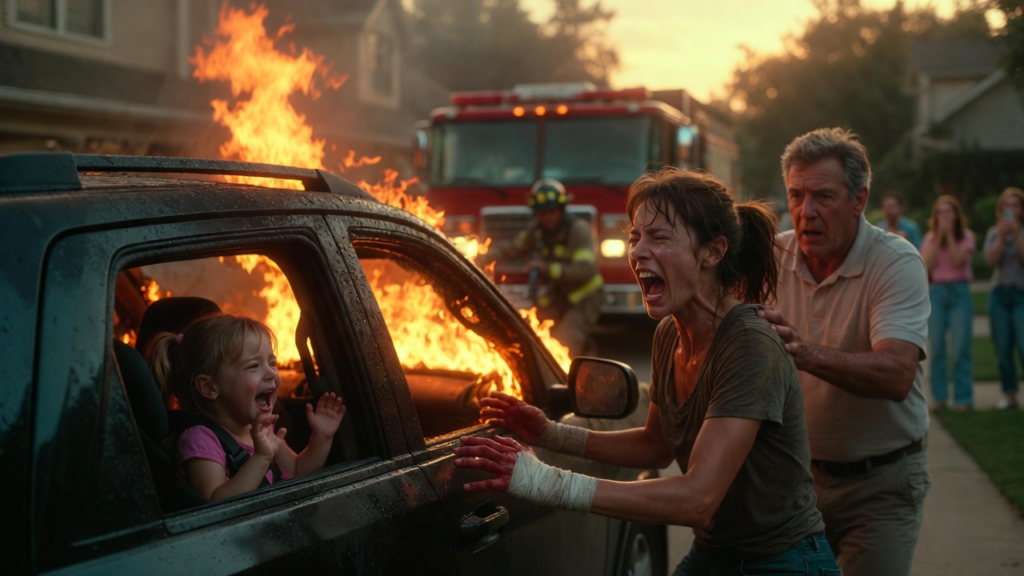
Flames. Small, at first. A flash of orange inside the SUV, near the front console. Then a line of fire racing along the dashboard like it had been waiting for oxygen. Smoke curled up, thick and black.
My brain refused the image. My body didn’t.
The casserole hit the driveway. Glass exploded. I ran.
“LILY!” I screamed, voice tearing out of me, already knowing she was still inside, strapped in, trusting me.
Her face was there, behind the glass of the back passenger window. Confused. Then terrified. Her little hands beat against the straps.
“MOMMY!”
I didn’t feel my feet on the ground. I just reached the door, grabbed the handle, and yanked. The metal seared my palm. I screamed, pulled anyway.
It didn’t open.
Behind me, somewhere distant, someone was yelling to call 911. I heard the words “fire” and “child” and “back seat.” The world narrowed to the handle that wouldn’t move and the child I couldn’t reach.
The front interior went up faster than any movie I’d ever seen. Later, they’d explain about electrical fires, about accelerants and air flow and all the science of why my car became an inferno in under a minute.
In the moment, all I knew was that my daughter was in a box that was turning into an oven.
Then he appeared at my shoulder.
My father-in-law.
Always pressed, always composed, always in control.
“Emily, STOP,” he snapped, grabbing my arm like I was a child touching a hot stove. “You’re going to hurt yourself!”
“She’s in there!” I shrieked. “LILY IS IN THERE!”
“Fire department is on the way.” His voice was flat. Annoyed. “Daniel already called. You’re making it worse. Step back. You are overreacting.”
Overreacting.
The word hit something deep and rotten inside me. Because it wasn’t the first time he’d used it. It was his favorite weapon.
But in that second, with my skin burning and my baby screaming and flames blossoming brighter by the second, the word stopped being a weapon. It became a confession.
He wasn’t seeing a burning car.
He was seeing a woman refusing to stay in the box he’d spent years building for her.
And that’s where the story really begins.
I met Daniel when I was twenty-four and still believed “difficult” was the worst thing a woman could be.
He was everything my mother told me to look for:
- Steady job in insurance
- Nice smile
- Close to his family
- “Good with kids” in that performative way men are at barbecues
He also came with a father.
From the beginning, my father-in-law, Walter, treated me like a probationary employee his son had hired without permission. Every compliment came with a condition.
“You’re pretty,” he’d say, “for someone who doesn’t really know how to dress for her body type.”
“You’re good with Lily,” he’d observe later, “for someone who didn’t grow up with a proper stay-at-home mom.”
“He could have done worse,” he told my mother the night before our wedding, loud enough for me to hear.
Walter believed in hierarchy. His name on top, his son beneath, and everyone else — wives, grandchildren, neighbors — orbiting around their needs.
I grew up lower-middle-class. My parents worked two jobs each just to keep the lights on. Walter loved that about my background. Not because it made me resilient, but because it made me grateful.
“You’re lucky,” he would say, clapping me on the shoulder. “You married up. Daniel will make sure you never go back to where you came from, as long as you don’t screw it up.”
Screw it up meant:
- Question his opinions
- Push back on his demands
- Choose my own boundaries over his comfort
When Lily was born, the scrutiny intensified.
“You’re breastfeeding again?”
“You’re not breastfeeding enough.”
“You shouldn’t go back to work, a good mother stays home.”
“You’re selfish if you don’t go back to work, my son can’t carry everything alone.”
No matter what I did, he found the angle where I was wrong.
Any time I got emotional—about exhaustion, about finances, about Daniel coming home late and smelling like beer—Walter swooped in.
“Calm down, Emily. You’re overreacting. Hormones. Women always blow things out of proportion.”
Daniel absorbed those words like doctrine. If Walter said I was overreacting, then I was. End of discussion.
When I pointed out that the “loan” Walter had given us for our down payment came with a spreadsheet of rules about holidays, babysitting, and how often we had to show up for dinner, Daniel shrugged.
“That’s just how he is,” he’d say. “He means well. Don’t overreact.”
Overreacting became my shadow. I second-guessed everything:
- Was I really upset, or just being dramatic?
- Was it normal for my father-in-law to insist he was “on the title too because I helped you”?
- Was it controlling for him to keep a spare key to our house “in case of emergency”?
I told myself this was what a “tight-knit family” looked like. That’s what they called themselves. Tight-knit.
The first time Walter criticized my driving, Lily was six months old. I’d taken a corner too slowly, in his opinion.
“You handle that car like you’re steering a ship,” he scoffed. “If anything happens, Emily, you won’t react fast enough. That baby needs someone competent behind the wheel.”
My cheek burned with shame. I drove extra carefully from then on, holding my breath at every intersection.
The irony is not lost on me now.
Back to the driveway. Back to the fire.
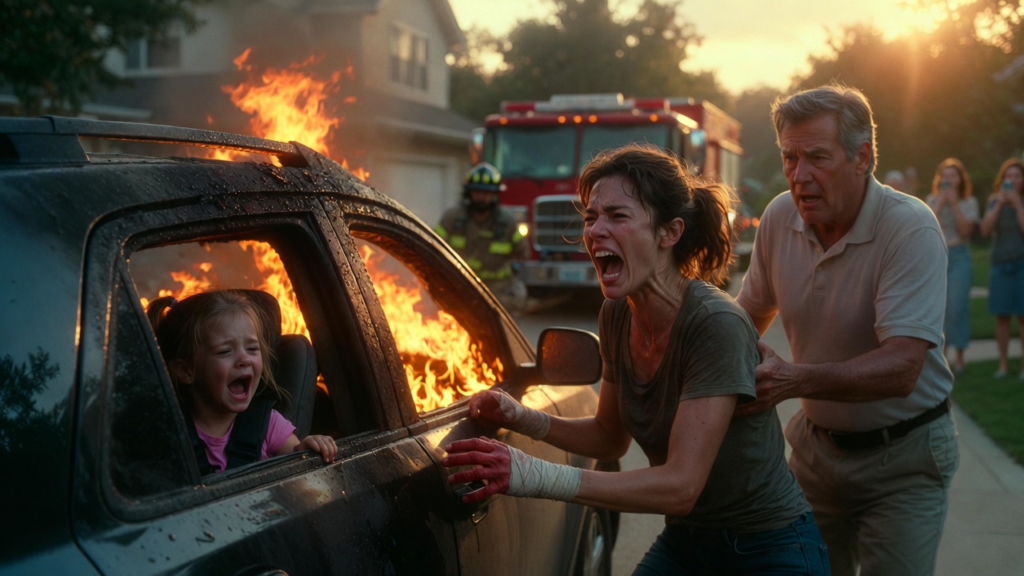
The flames were roaring now, a living animal eating the interior of my car. Heat blasted my face, my arms. My eyes watered, but I could still see my daughter’s silhouette, shrinking back from the fire, struggling against the car seat straps.
“EMILY!” Daniel’s voice finally cut through the noise. I hadn’t seen him and Walter together earlier; now I realized they’d been in the garage when I arrived. Daniel came running from the side of the house, eyes wide, phone in his hand. “They’re on their way! Don’t go near it, it might explode!”
“She’s in there!” I screamed again, pointing. Why did I have to keep saying it? Why wasn’t everyone already moving?
“Dad, get the hose!” Daniel yelled.
Walter didn’t move.
“I told you that car was a pile of junk,” Walter muttered instead, eyes fixed on the flames. “Should’ve listened to me and let me get you something decent instead of that used garbage you insisted on.”
Used garbage. The car I’d picked, negotiated for, and paid off, because I didn’t want to owe him even more.
“She’s in the back seat,” I said, voice shaking. “Walter, please, PLEASE—”
His gaze slid to me, then back to the growing crowd of neighbors on their lawns. Phones were out. Recordings had started. His jaw tightened.
“Daniel has called 911,” he said coldly. “You screaming isn’t helping. You’re scaring everyone. Step back.”
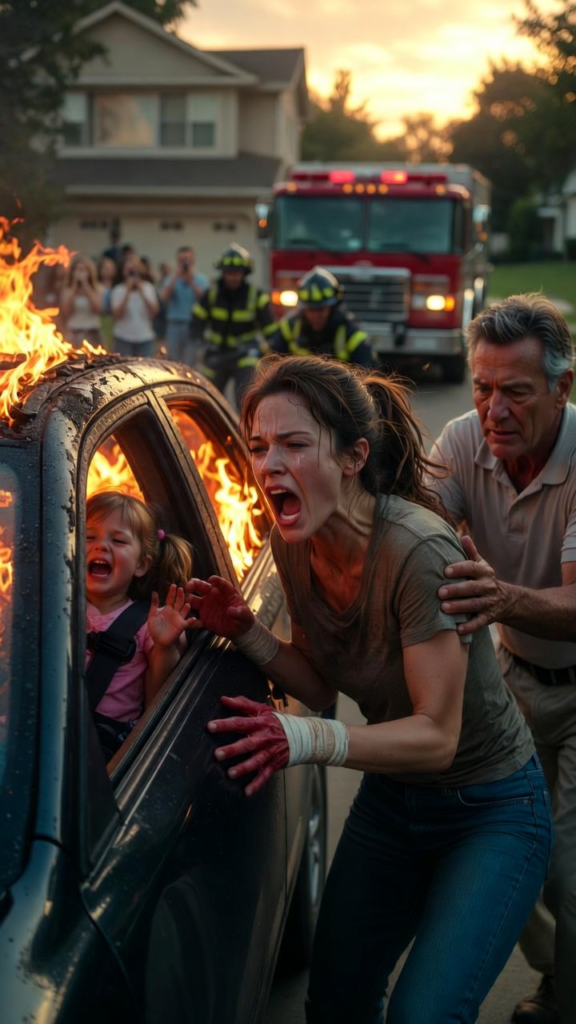
My hands were blistered now, skin angry red. I could barely feel them. I reached for the door again anyway.
He grabbed me harder this time, fingers biting into my arm. “I said STOP.”
I wrenched away. For a fraction of a second, our eyes locked.
In his, I saw annoyance, calculation, and—God help me—not nearly enough fear.
In mine, something else surfaced. Something that had been buried under years of being told I was too much, too loud, too emotional.
Rage.
If the firefighters hadn’t arrived when they did, I don’t know what I would have done.
The truck screeched to a halt. Two firefighters jumped out, already pulling gear—hoses, axes, extinguishers. One shouted for everyone to get back. The other saw me at the car, saw where I was looking, and his eyes widened.
“Is there someone in there?”
“My daughter!” I choked. “Four years old—back seat—passenger side—”
He didn’t tell me I was overreacting. He didn’t question my perception. He simply moved.
It took them seconds to knock out the window, seconds to cut through the seatbelt, seconds to pull Lily out and douse the flames enough to wrap her in a blanket and carry her away. Seconds that felt like hours.
She was conscious. Coughing. Crying. Alive.
I collapsed on the pavement sobbing, my whole body shaking so violently I thought I’d shatter.
I heard one firefighter say to another, “Lucky we were this close. Thirty seconds more and—”
I covered my ears. I didn’t want the sentence.
An EMT checked my hands, my breathing, my heart rate. Daniel hovered, pale and frantic, repeating, “Oh my God, oh my God,” like a mantra.
And then Walter spoke.
“Well,” he said loudly, adjusting his belt as if he had just finished mowing the lawn, “this is exactly what I’ve been warning everyone about. Emily is not responsible. This is why I don’t trust her with expensive things.”
The EMT actually froze.
Daniel’s head snapped toward his father. “Dad, what the hell? The car caught fire, this isn’t—”
“I told you that car was trouble from the start,” Walter continued, unfazed. “Cheap, used junk. I said she’d put that girl in danger. But no, everyone said I was being controlling, I was overreacting.” He looked pointedly at me. “Yet here we are.”
Something inside me stilled. The shaking narrowed into a hard, cold point.
I turned to look at him.
He met my gaze, misreading the silence as weakness. As always.
“You should have left her with us, Emily,” he said. “You know you’re not good in emergencies. Running at a burning vehicle? You could have made it explode. You nearly made everything worse.”
My daughter was coughing in the ambulance. My skin was burned. I could still hear myself screaming her name in my head.
And this man—this man who had dragged me away from my child to protect his lawn and his ego—was blaming me.
That was the moment the fear died.
Not the fear of fire, or loss, or grief. Those stayed. But the fear of him. Of their judgment. Of being called “dramatic” one more time.
It all went quiet.
Revenge stories online make it sound like the “big moment” is always dramatic and loud. Mine started quietly.
In the ER, they treated Lily for smoke inhalation and minor burns. “A miracle,” they kept saying. “You got her out just in time.”
A paramedic, a woman with a tight bun and kind eyes, gently wrapped my hands in gauze. “You did good, Mom,” she said. “You kept trying. That matters.”
It was the first time in years a stranger had validated my instincts instead of questioning them.
Walter didn’t come to the hospital.
He texted Daniel instead: Call me when she’s stable. We need to discuss the insurance situation. Also, tell Emily to think before she acts next time.
Think before she acts. Overreacting. Hysterical.
The words that had kept me quiet, compliant, small… now read like confessions of who he really was.
Over the next week, the pieces started to fall into place.
First, the fire investigator’s report.
The cause of the fire wasn’t “cheap used junk.” It wasn’t random bad luck. It was deliberate tampering with the electrical system near the front console. Wires stripped. Fuses swapped. Someone had done it on purpose.
“Any recent work on the car?” the investigator asked. “Mechanics, family members, anyone ‘helping’ you with it?”
My mind flashed back to two weeks earlier, when Daniel and Walter had spent a Saturday in our driveway “checking the fluids” and “fixing the squeak in the dash” of my SUV.
“They insisted I didn’t need to take it to a shop,” I said slowly. “Said they could handle it. I wasn’t allowed to touch anything; they told me I’d ‘mess it up.’”
The investigator’s expression tightened. “We’ll need names.”
Then there was the security footage.
Our neighbor across the street had a doorbell camera that caught everything. The arrival. The fire. The reaction.
She stopped by with a USB drive and an apology for not having noticed sooner. “You were only inside for a few seconds,” she said. “By the time I realized there was smoke, you were already running.”
We watched the footage at our kitchen table.
We watched me arrive. Park. Stand at the door for all of eight seconds. Turn back.
We watched the first puff of smoke. The flash. My sprint toward the car.
We watched Walter walk out of his garage after the first flames, glance at the smoke, and walk—not run—toward us.
We watched him grab me. Hold me. Turn me away from the car. We watched him restrain me while our daughter screamed.
There was no explosion risk visible. No imminent danger to him. Only to her.
By the time the firefighters came into frame, I was still fighting his grip.
When the video ended, my lawyer—because yes, I got one—let out a slow breath. “If he ever tries to say you ‘overreacted,’” she said, “play that.”
My lawyer had been my coworker’s recommendation. A woman who specialized in family law and liability. I hadn’t even finished describing what happened before she said, “You need to document everything. And stop going over there alone.”
Daniel, to his credit, was shaken. For the first few days, he looked like a man who’d seen his world crack.
“I had no idea the fire was deliberate,” he said. “I swear, Em. I would never—”
“I know you wouldn’t,” I said. “But did he?”
Daniel didn’t answer.
He didn’t have to.
Walter showed his hand himself at the “family meeting” he insisted we have once Lily was home.
He hosted it at his house, of course. Same spotless living room. Same framed photos of Daniel as a child. No evidence that just days before, a child had nearly died on his driveway.
He opened the conversation with, “Well, I’m glad we’re all over the dramatics now.”
The dramatics.
I let him talk. For once, I didn’t interrupt. Daniel sat next to me, shoulders tense. Lily was at my sister’s house, safe.
Walter laid out his version:
- My car was “unsafe.”
- I’d “panicked and made things worse.”
- He’d “held me back to protect me.”
- The fire department had things “under control, like professionals.”
He finished with, “The important thing is, Lily is fine. We move on. I don’t want this to become gossip on the street. It reflects badly on all of us.”
That’s when I pulled out the printed fire report and the USB drive.
“No,” I said. “The important thing is that someone tampered with my car. And we’re not moving on until we know who.”
He scoffed. “Oh, come on. You’re going to start a witch hunt because your car happened to catch fire? This is exactly the hysterical behavior I’m talking about, Emily.”
I slid the report across the table. “The investigator used the words ‘deliberately damaged wiring.’ That’s not hysterical. That’s criminal.”
His jaw twitched.
“And this,” I added, tapping the USB, “shows how you ‘protected’ me. By holding me back from my child so you wouldn’t look bad.”
“You watch your tone,” he snapped. “You’re in my house.”
“Not for long,” I said. “Because here’s what’s going to happen next.”
I’d rehearsed this speech in my head for days. Still, my voice shook at the edges. That was okay. Shaking didn’t mean I was wrong.
“You’re going to give us a written statement of everything you and Daniel did to that car two weeks before the fire,” I said. “Every part you touched. Every wire. Every fuse. You’re going to sign it.”
“Absolutely not.” His face turned red. “I will not be spoken to like this. Daniel, control your wife.”
Daniel didn’t move.
“Or,” I continued, “we will hand the investigator your name, your history of controlling behavior, every text where you called my car ‘a deathtrap’ and insisted on ‘fixing’ it yourself. And we will let them subpoena your garage security footage for that day you two worked on it. They can connect the dots.”
Silence.
Walter stared at me, nostrils flaring. “You wouldn’t dare drag this family’s name through the mud.”
“This family dragged my daughter through smoke and fire,” I said. “I’ll survive some mud.”
It wasn’t clean. It wasn’t neat. Things rarely are.
Daniel had to choose. Me, or the man who had been telling him how to think since he was born.
He hesitated. He faltered. But in the end, he said, quietly, “Dad… I’m backing Emily on this.”
Walter looked like someone had slapped him.
“You ungrateful boy,” he hissed. “After everything—”
“After everything,” Daniel said, voice shaking, “I watched my child almost die. I’m done pretending your way is always right.”
That was the real explosion.
In the months that followed, the truth oozed out like sap from a broken tree.
It turned out the tampering had happened in our driveway that Saturday. The fire investigators, once given dates and names, retrieved footage from multiple neighbors’ cameras. They pieced together Walter’s pattern: opening the hood, gesturing to specific areas, discarding something small and unidentifiable into a trash bin.
We’ll never know his exact intention. Whether he meant to scare me, to “prove” I was irresponsible, to engineer a minor breakdown he could blame on my “cheap car.”
What we do know is that he touched what he shouldn’t have touched. He altered what he shouldn’t have altered. And a car with a perfectly clean service record turned into a mobile fire hazard.
Liability lawyers got involved—ours and the insurance company’s. That, more than morality, was what finally forced consequences.
Walter settled. Quietly. Expensively. He admitted, in legal language, that he “performed unauthorized alterations” to my vehicle.
He did everything he could to keep it sealed. NDAs. Threats. “Think of Daniel’s career,” he warned. “Think of Lily’s future.”
But here’s the thing: Lily’s future was the entire point.
Her future depended on me not letting this pattern continue.
So I did three things that, a year earlier, I wouldn’t have believed I was capable of:
- I cut him off from us completely.
No more Sunday dinners. No more “pop-ins.” No more unsupervised time with Lily. A court order eventually backed that up after my lawyer laid out the fire, the tampering, the pattern of emotional abuse. - I insisted Daniel go to therapy—or go alone.
He was part of the system, even if he hadn’t meant harm. He’d learned to see me through his father’s warped lens. If he wanted to stay married, that lens had to go. Slowly, painfully, he started to realize how much of his personality was just fear of disappointing his dad. - I told the story—on my terms.
Not with names, not with locations, but with details. Online, anonymously at first. Then, when I saw how many other women wrote, “This is my father-in-law,” “This is my boss,” “This is my husband,” I realized staying silent only protected people like Walter.
The internet called it what it was: abuse. Not just the car, but the years of gaslighting, minimizing, “you’re overreacting” used as a muzzle.
My favorite comment was one that said, “The fire just exposed what was already true: he never saw you or your child as more important than his own control.”
That’s what justice looked like, in the end.
Not just legal consequences—though seeing his signature on that settlement agreement felt like a small slice of karma.
Justice was:
- Lily growing up with a mother who trusts her instincts.
- A husband slowly learning that “Dad said so” is not a moral law.
- A family system cracking open so something healthier could grow.
Walter still lives on that perfect street with his perfect lawn. He tells anyone who will listen that his daughter-in-law “went crazy” and “tore the family apart over a car fire.”
He’s wrong.
The fire didn’t tear us apart.
It lit up the truth so brightly we couldn’t ignore it anymore.
He used to say I was “overreacting” whenever I was scared.
Now, when my gut twists and I raise my voice to protect my daughter, I know exactly what I’m doing.
I’m reacting just enough.
And I will never, ever apologize for that again.