The Moment Everything Changed
I stood in my father’s mahogany-paneled law office, staring at a 47-page document that would make me worth $800 million—if I was willing to destroy my soul to get it.
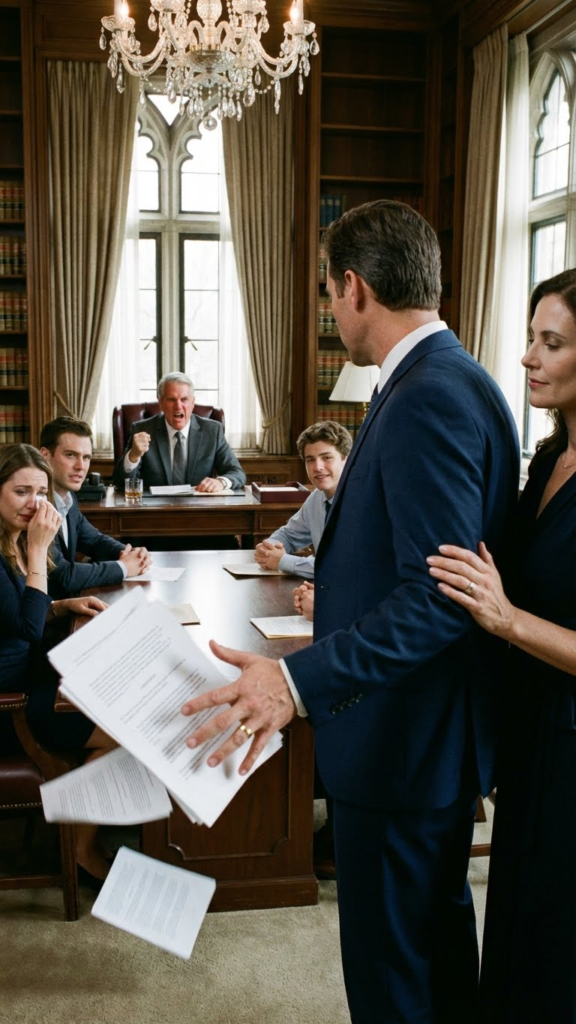
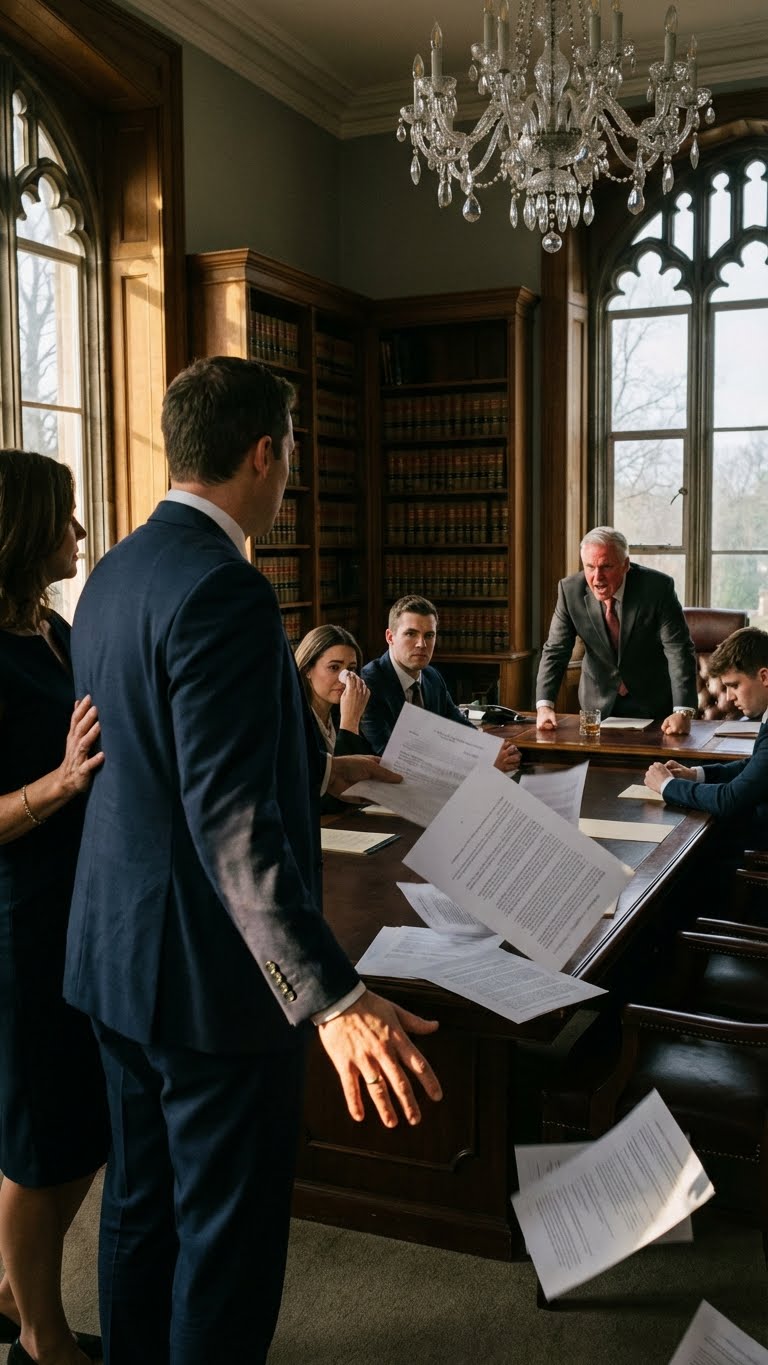
My hands were shaking so badly I could barely hold the inheritance contract. My three siblings sat frozen around the conference table, their faces pale under the crystal chandelier. Our father, Richard Castellano, self-made billionaire and world-class manipulator, sat at the head of the table with that smug smile I’d seen my entire life.
“It’s quite generous, really,” he said, gesturing at the papers like he was offering us candy instead of chains. “Eight hundred million, split four ways. All you have to do is follow a few simple conditions.”
Simple. Right.
I scanned the document again, my lawyer training kicking in even though my heart was pounding out of my chest. Page 12 made my stomach turn. Page 23 made me want to vomit. By page 31, I understood exactly what my father had done.
He hadn’t written an inheritance. He’d written a prison sentence.
“You have 48 hours to sign,” Dad continued, swirling his 30-year-old scotch. “After that, the entire estate goes to the Castellano Foundation, and you four get nothing. Not a penny.”
My sister Claire was crying silently, mascara running down her cheeks. My brother Marcus looked like he’d been punched. My youngest brother Daniel just stared at the table, seventeen years old and already learning that our father’s love always came with strings attached.
I flipped to page 19 again. Read the clause that would require me to divorce my wife of five years. The clause that would force Marcus to give up custody of his daughter. The clause that would make Claire quit her job and move back into Dad’s mansion to “care for him in his old age.” The clause that would control Daniel’s entire future—his college, his career, even who he could date.
“This is insane,” I said quietly.
Dad’s smile widened. “This is business, son. Money talks, everything else walks. You’ve always known that.”
I looked at my wife Rebecca sitting in the corner of the room—the woman Dad called “that gold-digging waitress” even though she had her PhD in environmental science. The woman he’d tried to pay off before our wedding. The woman he’d spent five years trying to separate me from.
She met my eyes and gave me the smallest nod. We’d talked about this possibility. We’d prepared for this moment. But I never actually thought he’d go this far.
“Well?” Dad asked, drumming his fingers on the table. “What’s it going to be? Are you a Castellano, or are you just another dreamer who thinks love pays the bills?”
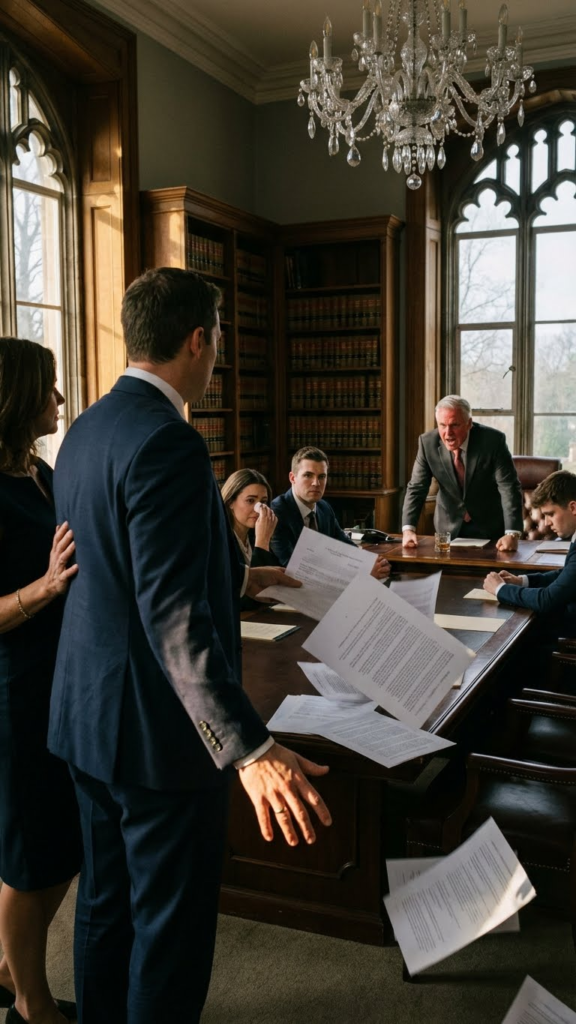
I stood up slowly. The document fell from my hands and scattered across the Persian rug. My siblings looked at me with desperate, terrified eyes.
The Life We’d Lived
To understand why my father thought he could buy our souls, you need to understand who Richard Castellano really is.
He started with nothing—that part of his story is true. Son of Italian immigrants, grew up in Brooklyn, built a real estate empire from a single apartment building in Queens. By the time I was born, he owned half of Manhattan’s commercial real estate. By the time I was ten, he’d expanded into tech, pharmaceuticals, and international shipping.
Forbes put him at $2.1 billion. That was probably underestimating.
But money wasn’t enough for Dad. Control was his real currency.
My mother left when I was eight, Claire was six, Marcus was four, and Mom was pregnant with Daniel. Dad made sure she left with nothing—prenup drafted by the best lawyers money could buy. She moved to Oregon, tried to start over, died of cancer when Daniel was three. Dad wouldn’t pay for her treatment. Said she’d made her choice.
That’s when I learned what my father really was.
He raised us in a 20,000-square-foot mansion in Greenwich, Connecticut. We had everything money could buy—private schools, luxury cars, exotic vacations. But every single thing came with conditions. Good grades meant approval. Bad grades meant consequences. Question his decisions? Lose privileges. Show weakness? Become a target.
“You think the world owes you something?” he’d say, usually after making one of us cry. “The world doesn’t owe you anything. You take what you can, and you hold onto it with everything you’ve got.”
Claire tried to become an artist. Dad said art was for poor people with no ambition. He bought her into Harvard Business School instead. She had a nervous breakdown her second year. Dad called her weak. She recovered and became a hospital administrator—”acceptable,” according to him, but he never stopped reminding her of her failure.
Marcus wanted to be a teacher. Dad laughed in his face. “You want to make $50,000 a year babysitting other people’s brats?” Marcus became an investment banker instead. Makes seven figures. Hates every second of it. Got divorced three years ago, has a six-year-old daughter he barely sees because Dad convinced him that custody would “interfere with business.”
Daniel, the baby, is the only one still living at home. Seventeen and terrified. Dad’s already planning his life—Yale for undergrad, Harvard Law, then into the family business. Daniel wants to study music. He plays piano like an angel. Dad won’t even let him take lessons anymore. “Waste of time,” he says.
And me? I’m the oldest. The one who was supposed to carry on the legacy. I went to Yale. Went to Harvard Law. Joined Dad’s company. Did everything right.
Then I met Rebecca.
The Woman Who Changed Everything
I met Rebecca five years ago at a coffee shop near the office. She was working as a barista while finishing her PhD, researching renewable energy solutions. She accidentally gave me someone else’s order—an oat milk latte instead of my usual black coffee.
“I’m so sorry!” she’d said, laughing. “I’m terrible at this job. I’m way better at molecular biology, I promise.”
I’d laughed too. Told her to keep the coffee. Asked if I could buy her lunch to hear about her research.
Three months later, I was in love. Six months later, I proposed. Dad lost his mind.
“She’s after your money,” he said the first time I brought her home for dinner. Rebecca sat across from him, perfectly polite, while he interrogated her like a hostile witness.
“What does your father do, Rebecca?”
“He’s retired. He was a mechanic.”
Dad’s smile was all teeth. “And your mother?”
“She’s a teacher. Elementary school.”
“I see.” He turned to me. “Michael, can I speak with you privately?”
In his study, he laid it out clearly. “She’s not suitable. She comes from nothing. She wants your money. I’ll give her $500,000 to go away.”
“She doesn’t want your money,” I said. “She wants me.”
“Everyone wants money,” Dad insisted. “She’s just smart enough to play the long game.”
I married Rebecca anyway. Small ceremony, just immediate family and close friends. Dad didn’t come. Sent a card that said “Your funeral.”
For five years, he’s tried to break us up. Offered Rebecca money to leave—she told him where he could put it. Tried to get me fired from jobs by calling in favors. Spread rumors about Rebecca’s family. Called her trash to her face at a family dinner last Christmas.
Rebecca took it all with grace I couldn’t comprehend. “He can’t touch what we have,” she’d say. “He’s just scared because he knows that.”
The Inheritance Trap
Back in Dad’s office, I picked up the scattered papers from the floor. Read through them one more time to make absolutely sure I understood what he was demanding.
The conditions were worse than I’d initially thought.
For me: Divorce Rebecca within 90 days. Marry someone from Dad’s pre-approved list of “suitable” women—all daughters of business partners or socialites. Produce an heir within three years. Work exclusively for Castellano Enterprises for the rest of my career. Live within 20 miles of Greenwich. Report my finances to Dad quarterly.
For Claire: Move back into the mansion. Provide “companionship and care” for Dad indefinitely. Quit her job. Cease all contact with her girlfriend Sarah—yes, he’d found out she was gay and was using it as leverage. Attend all social functions as the “perfect daughter.”
For Marcus: Give up custody of his daughter Emma to his ex-wife. Work 80-hour weeks at Castellano Enterprises. Remarry within two years to someone Dad approved. Cut off contact with his new girlfriend Jen, who Dad deemed “lower class.”
For Daniel: Attend Yale. Study business. No music. No art. No deviation from the plan. His choice of friends, romantic partners, and even hobbies would be subject to Dad’s approval until he turned 35.
All of this in exchange for $200 million each.
“This isn’t an inheritance,” I said, looking up at Dad. “This is indentured servitude.”
“This is ensuring my legacy,” Dad corrected. “I didn’t build this empire so you four could squander it on feelings and foolish choices. You’ll thank me when you’re sitting on private islands, flying on private jets, and making the kind of money that changes the world.”
“What if we don’t sign?” Marcus asked quietly.
Dad’s expression hardened. “Then you get nothing. And I mean nothing. I’ve already changed my will. The Castellano Foundation gets everything. A foundation I control, by the way, so even in death, I’ll be making sure my money does what I want it to do.”
“You’re using charity as a threat,” Claire said, her voice breaking. “That’s how twisted this is.”
“I’m using reality as a teacher,” Dad snapped. “You want to know what love gets you? Ask your mother. Oh wait—you can’t, because she’s dead and poor. Money talks, everything else walks. It’s the only truth in this world.”
Daniel spoke for the first time, his voice small. “I don’t want the money.”
Dad turned on him like a shark scenting blood. “You’re seventeen. You don’t know what you want.”
“I want to play piano,” Daniel said, tears streaming down his face. “I want to compose music. I want to live my own life.”
“And you’ll do all of that after you’ve secured your future,” Dad said dismissively. “Sign the papers, Daniel.”
The Decision
I looked at Rebecca again. She was standing now, her arms crossed, watching the whole scene with a sadness I’d never seen in her eyes before. Not sadness for herself—sadness for my father, for what he’d become.
“Can I speak with my wife?” I asked.
“You have 48 hours,” Dad said. “But I wouldn’t wait too long. The longer you think about it, the stupider you’ll convince yourself to be.”
Rebecca and I walked out into the hallway. My siblings followed. We found an empty conference room and closed the door.
“Tell me you’re not considering this,” Rebecca said immediately.
“It’s $200 million,” Marcus said, his voice desperate. “Michael, that’s generational wealth. Our kids’ kids would never have to worry.”
“At what cost?” I shot back. “Your daughter? My marriage? Claire’s entire life? Daniel’s soul?”
“He’s bluffing,” Claire said, but she didn’t sound convinced. “He has to be bluffing.”
“He’s not,” I said. “I’ve seen the will. I’ve seen the foundation paperwork. It’s all real. If we don’t sign, he actually will give away everything.”
Daniel was curled up in a chair, hugging his knees. “I don’t care about the money. I never have. I just want him to leave me alone.”
Rebecca knelt in front of him. “Daniel, look at me. You’re going to be okay. No matter what happens in that room, you’re going to be okay.”
“How?” he whispered. “How can you say that?”
“Because money isn’t everything,” she said simply. “I know your father thinks it is. I know the world sometimes acts like it is. But it’s not. You know what is everything? Being able to look at yourself in the mirror. Being able to live with your choices. Being able to sleep at night.”
Marcus stood abruptly. “That’s easy for you to say. You didn’t grow up with nothing. You don’t know what it’s like to—”
“I grew up with a father who made $40,000 a year and was the happiest man I knew,” Rebecca interrupted quietly. “I grew up in a 900-square-foot house where we shared rooms and drove cars that broke down and worried about bills. And you know what? We had more love in that little house than this entire mansion has ever seen. So don’t tell me I don’t understand.”
The room fell silent.
“What do we do?” Claire finally asked, looking at me. “You’re the oldest. You’re the lawyer. What do we do?”
I thought about my father’s phrase. Money talks, everything else walks.
I thought about my mother, dying alone in Oregon because Dad wouldn’t help her.
I thought about Rebecca, who’d turned down half a million dollars because she loved me.
I thought about Emma, Marcus’s daughter, who deserved a father who actually showed up.
I thought about the kind of man I wanted to be versus the kind of man my father had tried to make me.
“We walk,” I said.
The Confrontation
We walked back into Dad’s office together, all five of us. Dad looked up from his phone, eyebrows raised.
“That was fast,” he said. “I assume you’ve come to your senses?”
“We’re not signing,” I said.
The room went so quiet I could hear the antique clock on the mantle ticking.
“Excuse me?” Dad said, his voice dangerously soft.
“We’re not signing your contract,” I repeated. “None of us.”
Marcus looked at me with panic in his eyes, but he didn’t contradict me. Claire grabbed Sarah’s hand—when had Sarah arrived?—and stood a little straighter. Daniel just looked relieved.
Dad stood slowly, his face reddening. “You ungrateful, stupid children. Do you have any idea what you’re throwing away?”
“Yes,” I said calmly. “We’re throwing away your control. Your manipulation. Your belief that money is the only thing that matters.”
“Without money, you’re NOTHING!” Dad roared. “You think your little teacher’s salary and your wife’s research grant will keep you warm at night? You think your daughter won’t resent you, Marcus, when she grows up and realizes you chose poverty over giving her opportunities?”
“I chose being her father over being your puppet,” Marcus said, and I’d never been prouder of my brother.
“Claire, you really want to keep playing hospital administrator on your pathetic salary when you could be living like royalty?” Dad turned on her.
“I want to be with Sarah,” Claire said. “I want to wake up every day knowing I’m living my truth, not your fantasy.”
“And you,” Dad said, turning to Daniel. “You’re seventeen. You’ll end up a starving artist, and you’ll come crawling back begging me to save you.”
“Maybe,” Daniel said quietly. “But at least I’ll have tried. At least I’ll know what my own life feels like.”
Dad’s face was purple now. I’d never seen him this angry. “You’re all making the biggest mistake of your lives. You’ll regret this. Every single one of you will regret this.”
“Probably,” I admitted. “There will be hard times. There will be moments when we wonder what if. But you know what we won’t regret? We won’t regret choosing love over money. We won’t regret choosing freedom over control. And we won’t regret walking away from a man who thinks people are just assets to be managed.”
I set the unsigned contract on his desk.
“You were wrong about one thing, Dad,” I said. “You said money talks and everything else walks. But we’re walking, and we’re taking everything that actually matters with us.”
The Aftermath
Dad disinherited us that day. Made it official. Went on CNBC and told the world that his ungrateful children had rejected his generosity. The story went viral—”Billionaire’s Children Refuse $800M Inheritance.”
The headlines were brutal. Half the internet called us idiots. The other half called us heroes. Neither description felt quite right.
The first year was hard. I mean really, truly hard.
I left Castellano Enterprises and started my own small law practice specializing in family law—helping people escape the kind of control Dad had tried to exert over us. Rebecca finished her PhD and got a position at a research institute. We moved into a modest house in suburban New Jersey. It was 2,000 square feet, about a tenth the size of the mansion I grew up in, and it felt like paradise.
Marcus quit investment banking and became a high school math teacher. His salary dropped by 90%. His happiness increased by about a thousand percent. He got joint custody of Emma, and I got to watch him become the father he’d always wanted to be. Emma started calling him again instead of avoiding his calls. That was worth more than any trust fund.
Claire and Sarah got married in a small ceremony in Vermont. Claire kept her job at the hospital and started a nonprofit on the side helping LGBTQ+ youth whose families had rejected them. She said every kid she helped was another middle finger to Dad’s legacy of control. I loved her for that.
Daniel moved in with me and Rebecca while he finished high school. Watching him blossom was like watching a plant finally get sunlight after years in the dark. He applied to Juilliard and Berkeley’s music program. Got into both. Chose Berkeley. Dad sent him a letter saying he was wasting his potential. Daniel burned it and used the ashes as inspiration for a composition he titled “Freedom Symphony.”
The second year was easier. We found our rhythm. Learned to live on less. Discovered that happiness doesn’t scale with your bank account.
Year three, something unexpected happened.
The Unexpected Victory
I got a call from Mitchell Richardson, the managing partner at Dad’s biggest competitor firm. “Michael, I’ve been following your story,” he said. “I like what you did. Takes guts. I want to hire you.”
“As what?” I asked, genuinely confused.
“General Counsel. Head of our ethics and compliance division. Seven-figure salary, full benefits, and the explicit directive to do things the right way—no Richard Castellano shortcuts.”
I took the job. Not because I needed to prove anything to Dad, but because it felt right. Because I could use my legal skills and my experience growing up in his world to make sure other companies didn’t operate the way his did.
Marcus started a tutoring program for underprivileged kids. It got featured in the New York Times. A philanthropist who’d made his fortune in tech read the article and donated $5 million to expand the program nationwide. Marcus became the executive director, running a nonprofit that actually changed lives instead of just managing money.
Claire’s organization grew. Her hospital promoted her to COO. Sarah’s architecture firm landed a major contract. They bought a beautiful brownstone in Brooklyn. Not a mansion, but home.
Daniel’s symphony premiered at Berkeley. It got reviewed in the San Francisco Chronicle. The reviewer called it “a haunting meditation on the cost of freedom and the weight of expectations.” Dad probably read that review. I hoped it burned.
Rebecca and I had our first child—a daughter we named Grace. When she was born, Rebecca looked at me and said, “Your father will never meet her.”
“I know,” I said.
“Good,” she said. “Let’s make sure she grows up knowing what unconditional love looks like.”
The Final Reckoning
Five years after we walked away from $800 million, Dad had a stroke.
Not a major one—just enough to scare him. His assistant called me. “Your father is asking for you,” she said. “All of you.”
We met at the hospital. All four siblings, plus Rebecca, Sarah, and little Emma. We stood in the hallway outside his room, none of us quite ready to go in.
“We don’t have to do this,” Claire said.
“Yes we do,” Daniel said. “Not for him. For us. So we can close this chapter.”
We walked in together.
Dad looked small in the hospital bed. Smaller than I’d ever seen him. The machines beeped steadily. An IV dripped clear fluid into his arm. He’d always seemed invincible, larger than life. Now he just looked old.
“You came,” he said, his voice weak.
“We came,” I agreed.
“I wanted to tell you—” he started, then stopped. Struggled with something. “I wanted to tell you that I’m not changing my will. The foundation gets everything. Even after this scare. Even after—” He gestured weakly at the machines. “Even after all this.”
I almost laughed. Here he was, possibly facing his mortality, and he was still trying to punish us.
“Okay,” I said simply.
“Okay?” Dad looked confused. “That’s it? No begging? No apologies?”
“Dad,” I said gently, “we stopped caring about your money five years ago. We came because you’re our father and you’re sick. But we’re not here for an inheritance. We’re here because despite everything, we’re better people than you taught us to be.”
Something shifted in his expression. Pain, maybe. Or recognition.
“I built all of this,” he said, his voice cracking. “The buildings, the businesses, the empire. And what does it matter? None of you want it. The foundation will probably squander it. Everything I worked for, just—gone.”
“Not gone,” Marcus said. “Just not yours to control anymore.”
“I wanted you to be successful,” Dad said. “I wanted you to have everything.”
“You wanted us to be you,” Claire corrected. “That’s not the same thing.”
We stayed for twenty minutes. Made awkward small talk about our lives—though we edited heavily, not giving him ammunition. Told him Daniel had won a composition award. Mentioned Emma’s good grades. Kept it surface level.
As we were leaving, Dad called out, “Michael.”
I turned back.
“That thing I always said. About money and walking.” He paused. “You all walked. And you’re happy. I don’t understand it, but I can see it. You’re actually happy.”
“Yes,” I said. “We are.”
“I think—” He stopped. Started again. “I think maybe I was wrong.”
It wasn’t an apology. Wasn’t even close. But it was the nearest thing to vulnerability I’d ever seen from Richard Castellano.
“Maybe you were,” I said. Then I walked out.
The True Inheritance
Dad recovered from his stroke. Went back to work. The foundation is still getting everything—$2.1 billion that will go to various causes he deemed acceptable. He’ll probably live another twenty years, ruling his empire from his Greenwich mansion, surrounded by employees and sycophants but not family.
We see him twice a year at most. Obligatory visits. Christmas and Thanksgiving if we’re feeling generous. The relationship is cordial but cold. We’re not waiting for him to change. We’re not holding out for reconciliation. We’ve made our peace with having a father who values control over connection.
But here’s what we did inherit, even though it’s not in any will:
We inherited the knowledge that we could stand up to the most powerful person in our lives and survive. We inherited the courage to choose our own paths. We inherited the understanding that love and integrity aren’t just platitudes—they’re actual values worth sacrificing for.
My practice is thriving. I help families navigate the exact kind of manipulation Dad tried to use on us. Rebecca’s research team just published a breakthrough paper on carbon capture. Grace is three years old and calls me “Daddy” in a way that makes my heart explode every single time.
Marcus watches Emma’s soccer games every Saturday. He knows every kid on her team by name. He helps them with math homework after practice. He’s making $80,000 a year and living a richer life than Dad ever will.
Claire and Sarah just adopted a baby boy. Claire said the adoption process made her realize how many kids need homes and love. She’s already talking about adopting more. “I want a house full of kids who know they’re chosen,” she told me. “Who know that family isn’t about DNA or money—it’s about showing up.”
Daniel released his first album last month. It’s called “The Price of Everything, The Value of Nothing.” It’s beautiful and raw and honest. He dedicated it to “everyone who ever walked away from something toxic and toward something true.”
The Moral of the Story
People ask me all the time if I regret it. If there are moments when I think about that $200 million and wonder what if.
Honestly? Sure. Sometimes I see a friend buy their dream house or take an incredible vacation, and I think briefly about the financial freedom we gave up. Sometimes I worry about Grace’s college fund or retirement or what happens if Rebecca or I get seriously ill.
But then I come home to a house filled with laughter. I have dinner with my wife who loves me for who I am, not what I’m worth. I watch my daughter play without a care in the world, growing up with parents who choose each other every single day. I get calls from my siblings sharing good news, bad news, and everything in between—actual relationships, not performative family theater.
And I realize something Dad never understood: wealth isn’t measured in dollars. It’s measured in moments. In choices. In the ability to look at yourself in the mirror and like what you see.
Dad was right about one thing, though. Money does talk. It talks constantly, loudly, seductively. It promises security and power and comfort. It’s not a quiet voice.
But love? Freedom? Integrity? Self-respect?
Those things don’t just walk. They run. They soar. They build lives worth living.
We chose to walk away from $800 million in conditional money. But we ran toward something far more valuable: unconditional lives.
And I’d make that choice again in a heartbeat.