The Moment Everything Changed
I surfaced from the dark Caribbean water gasping, choking, arms flailing in pure animal panic as the cruise ship’s massive hull moved steadily away from me.
Salt water burned my throat and nose. My lungs screamed for air. I couldn’t keep my head above water—kept going under, thrashing, drowning in the middle of the ocean while my husband’s family watched from the deck above.
I can’t swim. Everyone on that boat knew I can’t swim.
Especially my mother-in-law Patricia, who’d been standing right behind me on the observation deck thirty seconds ago. Who’d “accidentally” bumped into me while I was leaning over the rail taking a photo. Who’d gasped “Oh my God!” with theatrical horror as I tumbled over the side.
But in that split second before I hit the water, I’d seen her face. Seen the satisfaction in her eyes. Seen the tiny smile she couldn’t quite suppress.
She’d pushed me. Deliberately. Watched me fall into the ocean knowing I’d drown.
Now I was dying. Water filling my lungs. Body exhausted from fighting. The ship getting smaller. My husband’s voice somewhere above, screaming my name, but he was too far away and I was too heavy and the ocean was winning.
This was it. Four years of Patricia’s passive-aggressive torture, of her constant undermining, of her transparent hatred of the woman who’d “stolen” her precious son—it was all ending with me drowning in international waters while she played the devastated mother-in-law who’d witnessed a tragic accident.
Except I wasn’t alone in the water.
Through my panic, through the salt water and terror, I felt arms grab me. Strong arms. A life preserver shoved into my grip. A voice in my ear: “I’ve got you. Stop fighting. I’ve got you.”
I grabbed the life preserver like a drowning person grabs salvation—desperately, completely. Let whoever was holding me pull me through the water toward a bright orange rescue boat that was speeding toward us.
Coast Guard. They’d been doing training exercises nearby, the officer would tell me later. Pure luck that they’d been close enough to respond within three minutes. Pure luck that I was alive.
But it wasn’t luck that I’d fallen. And it wasn’t luck what happened next.
They hauled me into the rescue boat, wrapped me in thermal blankets, checked my vitals. I was hypothermic, traumatized, coughing up seawater. But alive.
The cruise ship had stopped, was turning around to meet us. I could see people lining the deck. Could see my husband’s face, pale even from this distance. Could see Patricia standing beside him, one hand pressed to her chest in that gesture of concern she did so well.
The Coast Guard officer—a woman in her forties with kind eyes and an air of authority—knelt beside me. “Ma’am, I need to ask you something important. Did you fall, or were you pushed?”
I looked at her. At this stranger who’d pulled me from death. And I made a decision that would change everything.
“I was pushed,” I said clearly, despite my chattering teeth and water-logged lungs. “My mother-in-law pushed me. She knew I couldn’t swim. She tried to kill me.”
The officer’s expression hardened. She turned to her colleague. “Radio the ship. Nobody disembarks. This is now a crime scene.”
The Four Years of Hell
To understand why Patricia pushed me off that boat, you need to understand our relationship from the beginning.
I met my husband Jake four years ago at a coffee shop in Seattle. He was charming, successful, kind—everything I’d been looking for. We fell in love fast. Got engaged after eight months. I thought I’d found my person.
Then I met his mother.
Patricia Wellington was the kind of woman who never raised her voice but could cut you to ribbons with a smile. Wealthy, beautiful for her age, socially connected, and completely devoted to her only son. Her golden boy who could do no wrong.
I, apparently, was very wrong.
Our first meeting was at a family dinner. I’d dressed carefully, brought wine, prepared conversation topics. Patricia looked me up and down like I was a stain on her designer couch.
“So you’re a teacher,” she said, making it sound like I’d said I collected garbage for a living. “How… quaint. Jake’s father was hoping he’d marry someone more established. A lawyer, perhaps. Or a doctor.”
Jake had laughed it off. “Mom, stop. Emma’s wonderful.”
“I’m sure she is,” Patricia said with a smile that didn’t reach her eyes. “For someone.”
It only got worse from there.
She questioned my family background constantly. “Where did you say your people were from? Ohio? How… rustic.” She criticized my appearance. “You know, dear, Jake’s ex-girlfriend Jennifer was always so polished. Have you considered highlights?”
She undermined me at every opportunity. When Jake and I announced our engagement, Patricia’s response was: “Well, I suppose every mother has to accept disappointment eventually. When’s the wedding?”
When I suggested wedding ideas, she dismissed them. “That’s very… budget. Let me handle the planning. I have taste.”
She planned a wedding that had nothing to do with me. When I protested, Jake said, “Just let her have this. It makes her happy. Pick your battles.”
I picked too few battles. Let too much slide. Thought if I was patient, if I was kind, if I proved myself, Patricia would accept me.
I was wrong.
After the wedding, it got worse. Patricia had a key to our apartment—Jake’s idea, for emergencies. She’d show up unannounced. Criticize my cooking, my decorating, my housekeeping. “Jake’s father would have never tolerated such a messy kitchen. But I suppose you’re learning.”
She’d call Jake constantly. Daily. Sometimes multiple times a day. If he didn’t answer, she’d guilt trip him. “I guess I’m not a priority anymore now that you have a wife.”
She sabotaged holidays, made every family gathering about her discomfort with me. Threw her birthday party on our first anniversary and guilt-tripped Jake into going. “It’s my birthday. I only have one son. Surely Emma can understand family comes first.”
I tried talking to Jake about it. He’d say, “That’s just how she is. She means well. She’s adjusting.”
Adjusting to what? I wanted to scream. To your adult son being married? To me existing?
But I stayed quiet. Stayed patient. Stayed hopeful that eventually, she’d see I loved her son and meant no harm.
Then came the cruise.
The “Family” Vacation
The cruise was Patricia’s idea. “A family vacation to reconnect! Jake’s been so distant lately. This will bring us all together.”
The “us” included Jake’s sister Lauren and her husband, Patricia’s sister Diane, and Patricia’s best friend Carolyn. All people who’d spent four years making clear I wasn’t family. I was an interloper. A mistake Jake had made that they were all too polite to correct directly.
I didn’t want to go. Told Jake a week on a boat with his mother sounded like torture.
“Please,” he’d said. “She’s been talking about this for months. She even paid for our cabin. It’s a peace offering. She wants to get to know you better.”
A peace offering. I actually believed that.
The first three days of the cruise, Patricia was on her best behavior. Almost pleasant. Complimented my outfit once. Included me in conversations. I started to relax. Started to think maybe Jake was right. Maybe she was adjusting.
Day four, I found out why she was being nice.
I overheard her talking to Carolyn in the spa. Didn’t mean to eavesdrop—I’d gone to use the restroom, they were in the relaxation room, they didn’t know I was there.
“I give it another year,” Patricia was saying. “Maybe less. Jake’s already getting tired of her. Did you see how he snapped at her at dinner last night?”
“You’ve been very patient,” Carolyn said. “Most mothers would have demanded a divorce by now.”
“I can’t demand anything. That will push him away. But I can help him see what a mistake he made. Little things. Pointing out her flaws. Reminding him what he gave up when he married down. Eventually, he’ll realize on his own.”
“And if he doesn’t?”
Patricia’s laugh was cold. “Well, accidents happen. Especially on cruises. People fall overboard. It’s tragic. But these things happen.”
I’d frozen in that bathroom stall. Surely she didn’t mean—surely that was just dark humor—surely—
But something in her tone made my blood run cold.
I’d told Jake about it that night. He’d been furious—at me. “You’re paranoid. You’re twisting innocent comments into threats. My mother would never—”
“She said accidents happen! That people fall overboard!”
“She was joking! God, Emma, you’ve been trying to turn me against her for years. I’m sick of it.”
We’d fought for hours. He’d slept in the other bed in our cabin. I’d laid awake, wondering if I was crazy. If I was imagining threats where there were none.
Then, the next morning, Patricia pushed me off the boat.
The Security Footage
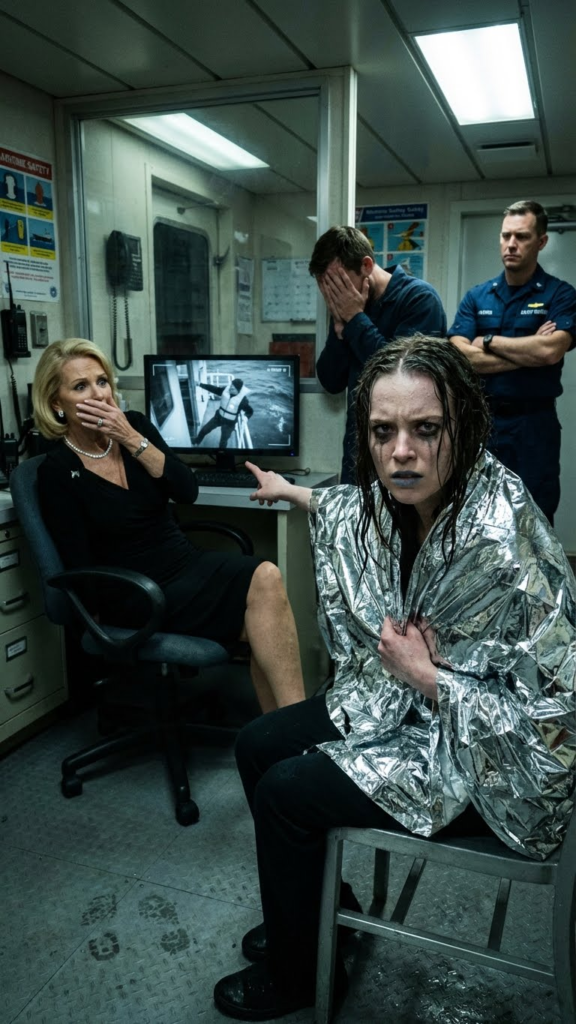
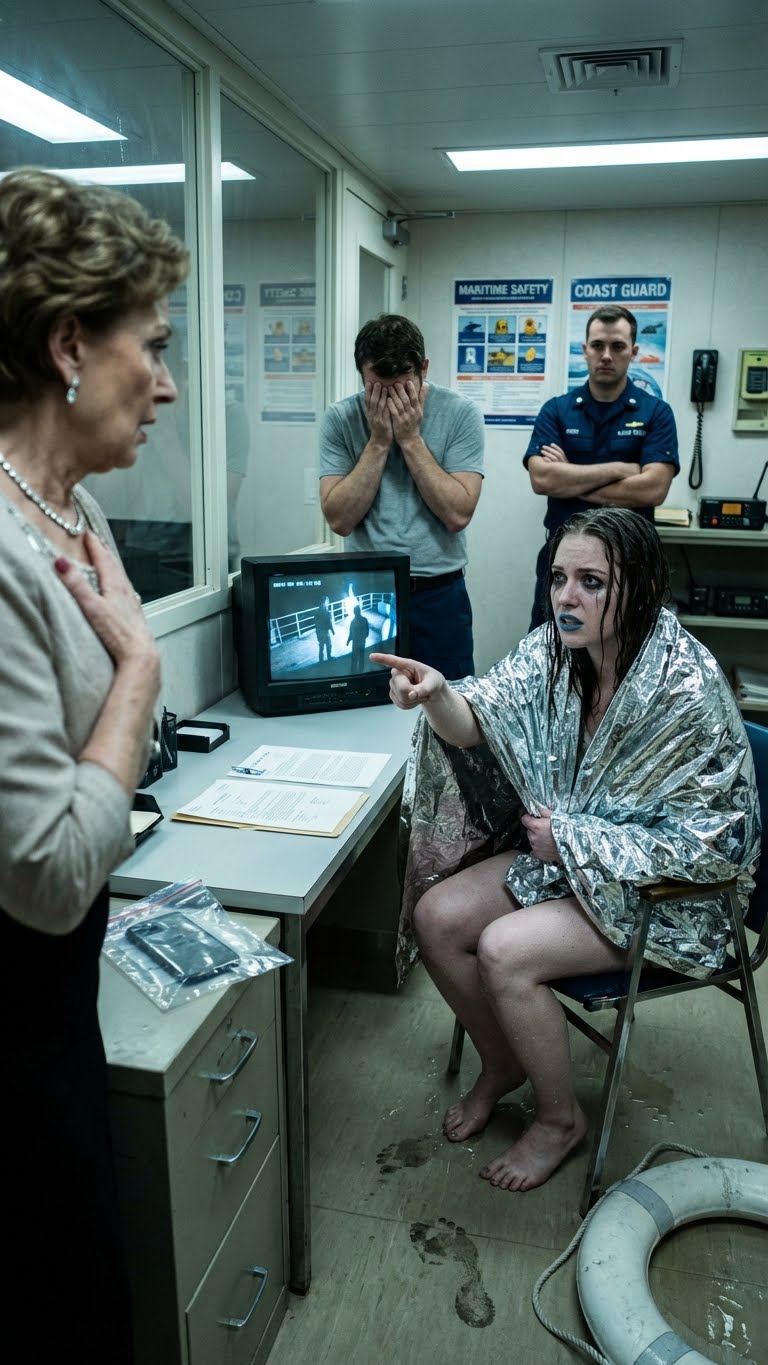
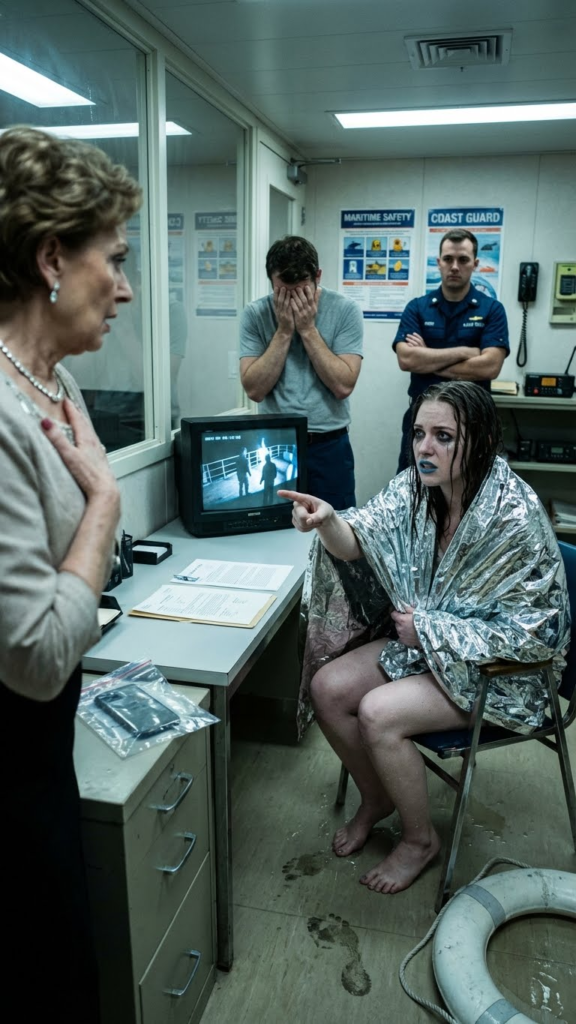
We sat in the ship’s security office—me still in thermal blankets, Jake pale and shaking, Patricia perfectly composed except for the terror in her eyes, and various crew members and security personnel crowded around a monitor.
The security officer played the footage. Once. Twice. Three times.
It was damning. Crystal clear. Patricia looking around to ensure no one was watching. Patricia stepping close behind me. Patricia’s hands on my back. The deliberate push. My arms windmilling as I fell. Patricia stepping back and covering her mouth, then screaming.
“I lost my balance,” Patricia said, her voice shaking now. “I reached out to steady myself and accidentally—”
“Mrs. Wellington,” the security officer interrupted. “This footage clearly shows you looking around first. That’s not the behavior of someone who’s about to lose balance. That’s the behavior of someone checking for witnesses.”
“I was looking at the ocean! I was—”
“You pushed her,” the Coast Guard officer said flatly. She’d come aboard with me, was now standing with arms crossed, face hard. “And you knew she couldn’t swim. Because I heard you say it. When I pulled her from the water, before you knew I was close enough to hear, you said to your son: ‘It’s terrible, but at least it was quick. She couldn’t swim, so she wouldn’t have suffered long.’ You knew. You meant for her to die.”
Jake made a sound like he’d been punched. “Mom. Tell me they’re wrong. Tell me this is a misunderstanding.”
Patricia looked at her son. At the golden boy she’d raised, the precious child she’d protected his whole life, the man who’d chosen another woman over her. And something cracked in her perfect facade.
“She doesn’t deserve you,” Patricia said, her voice breaking. “I gave you everything. Sacrificed everything. Raised you alone after your father died. Poured my entire life into making you successful. And you chose her. Some nobody from nowhere with no breeding, no class, no understanding of the life I built for you.”
“So you tried to kill her?” Jake whispered.
“I tried to save you from the biggest mistake of your life!” Patricia snapped, composure shattering. “You think I wanted to do this? You think I enjoyed watching you throw away your potential on someone so beneath you? I waited four years for you to come to your senses. Four years of watching you settle. I couldn’t wait anymore.”
The room went dead silent.
“Mrs. Wellington,” the security officer said quietly. “I’m detaining you pending arrival at the next port, where you’ll be turned over to FBI jurisdiction. Attempted murder in international waters is a federal crime.”
Patricia’s face went white. “You can’t—I’m his mother—”
“You’re an attempted murderer,” I said, finding my voice. It came out stronger than I expected. Harder. “You tried to kill me because you couldn’t control your adult son’s choices. Because you’d rather see me dead than accept that Jake chose me.”
I looked at Jake. At my husband who’d defended her for four years. Who’d told me I was paranoid, oversensitive, dramatic. Who’d picked his mother over his wife every single time it mattered.
“I want a divorce,” I said.
The Aftermath
Patricia was arrested when we reached port in Grand Cayman. Charged with attempted murder. The case was airtight—the video footage, the Coast Guard officer’s testimony about Patricia’s comment, my statement, even Jake’s reluctant confirmation that his mother had a history of hostility toward me.
She tried to plead it down. Her lawyers argued temporary insanity, extreme emotional disturbance, anything to avoid prison time. The prosecutor wasn’t having it. This was premeditated. She’d waited for the perfect opportunity—a crowded observation deck where she could claim it was an accident, international waters where jurisdiction was murky, a victim who couldn’t swim.
She got fifteen years. She’ll be eighty when she gets out.
Jake was devastated. Tried to convince me to stay, to work through it. “She’s sick. She needs help. But we can survive this.”
“She tried to murder me,” I said. “And you spent four years telling me I was imagining her cruelty. You chose her over me every single time. This marriage is over.”
The divorce was finalized six months later. I kept my maiden name—I’d never changed it anyway, another thing Patricia had hated. Jake tried to give me alimony, guilt money. I refused. Didn’t want anything that connected me to that family.
But I did take something else.
The Truth About Patricia
While preparing for Patricia’s trial, the FBI did a deep investigation into her background. What they found was disturbing.
Patricia’s first husband—Jake’s father—hadn’t died of a heart attack like the family believed. He’d died of poisoning. Antifreeze mixed into his evening cocktails over several months. The original coroner had missed it, attributed his death to natural causes. But modern forensic analysis on exhumed remains proved murder.
Jake’s father had been planning to leave Patricia. Had been having an affair. Had told his lawyer he wanted a divorce. He died three weeks later.
Patricia had gotten away with one murder. Had tried to get away with another.
The prosecution used this evidence to argue for a longer sentence. Showed a pattern of violence against people who threatened her control. Jake’s father had threatened to leave. I’d threatened her relationship with her son.
Jake was shattered by the revelation. “My whole life has been a lie. My father didn’t have a heart attack. She murdered him. She murdered him and raised me and I never knew.”
I felt sorry for him. Despite everything, he was a victim too. Had been raised by a woman who’d killed his father and tried to kill his wife. Who’d manipulated him his entire life.
But I couldn’t be the one to help him heal. That bridge was burned.
The Letter
A year after the trial, I received a letter from prison. From Patricia. My first instinct was to burn it without reading. But curiosity won.
“Dear Emma—I know you’ll never forgive me. I don’t expect forgiveness. But I need you to understand. Jake was all I had. After his father died, after I lost everything I’d built with him, Jake was my purpose. My reason for existing. I poured everything into him. Every dream, every hope, every ounce of my love.
When he chose you, it felt like dying again. Like losing everything that mattered. I couldn’t accept it. Couldn’t accept that I’d raised this perfect son just to watch him choose a life that didn’t include me at the center.
I should have gotten therapy. Should have dealt with my issues. Instead, I let them consume me until I became the kind of person who could push someone off a boat.
I don’t expect sympathy. I just need you to know that it wasn’t really about you. It was about me. About my inability to let go. About my sickness that I refused to acknowledge.
You seem happy now. I’ve seen your photos—Jake still follows you on social media, can’t let go. You’re engaged to someone new. Someone who looks at you the way Jake used to before I poisoned that too.
I hope he’s good to you. I hope his mother welcomes you with open arms. I hope you have the life I tried to steal from you.
I’m sorry. For whatever it’s worth, I’m sorry.
Patricia”
I read it once. Then put it in a drawer. Not forgiveness—I’d never forgive her. But understanding, maybe. Understanding that hurt people hurt people. That Patricia’s toxicity came from her own pain.
It didn’t excuse what she did. But it explained it.
The New Life
Two years after Patricia pushed me off that boat, I’m engaged to Marcus. He’s a marine biologist I met at a support group for people who’d survived drowning incidents. He taught me to swim—patient, gentle, understanding that every time I looked at water, I saw death.
Now I see possibility. Growth. Overcoming.
His mother is wonderful. Warm, welcoming, the kind of mother-in-law I’d fantasized about. She doesn’t compete for Marcus’s attention. Doesn’t undermine me. Doesn’t make me feel like I’m stealing her son.
She treats me like family. Actual family.
I’m still a teacher. Marcus loves that about me—says my passion for helping kids is one of the things that drew him to me. His mother volunteers in my classroom sometimes. The contrast with Patricia is stark.
Jake reached out a few months ago. Said he was in therapy, working through everything. Said he was sorry. Said he finally understood what I’d been trying to tell him for years.
“I chose her over you repeatedly,” he said. “I gaslit you. Made you think you were the problem. I’m so sorry.”
I appreciated the apology. But I didn’t take him back. Some things can’t be fixed. Some relationships, once broken, stay broken.
He’s dating someone new now. I hope he treats her better. Hope he learned something from watching his mother try to murder his wife.
The Full Circle
Last week, I testified at Patricia’s parole hearing. She’d served three years of her fifteen-year sentence and was asking for early release based on good behavior.
I stood before the parole board and told them everything. The four years of psychological torture. The deliberate attempt on my life. The murder of Jake’s father that had gone unpunished for thirty years until my near-death exposed her patterns.
“Patricia Wellington is a murderer who’s gotten away with her crimes for decades,” I said. “She killed her husband. She tried to kill me. She’s manipulative, calculating, and dangerous. She doesn’t deserve parole. She deserves to serve every day of her sentence.”
The board agreed. Parole denied.
As I left the hearing, I saw Patricia through the glass partition. She looked older. Smaller. Broken in a way that would have made me feel sorry for her if I hadn’t nearly died because of her.
Our eyes met. She mouthed something. Maybe “sorry.” Maybe something else. I didn’t care enough to figure it out.
I walked out of that prison into bright sunshine where Marcus was waiting, holding flowers, smiling at me with pride and love and all the things I deserved but Patricia had tried to steal.
“How do you feel?” he asked.
“Free,” I said. And I meant it.
The Lesson
People ask me sometimes if I hate Patricia. If I’m angry. If I want revenge beyond what the legal system provided.
The truth is simpler: I’m grateful.
Not grateful she pushed me off the boat—that trauma still wakes me up some nights in a cold sweat. But grateful that she showed me who she was. Grateful that her mask slipped. Grateful that her attempt on my life failed and her true nature was exposed.
Because if she hadn’t pushed me, I might still be in that marriage. Still enduring psychological warfare. Still being gaslit by Jake and tortured by Patricia. Still accepting crumbs of respect while they convinced me I should be grateful for them.
Her violence freed me. Her crime gave me evidence I could never have otherwise gathered. Her attempted murder paradoxically saved my life—because the life I was living with that family was a slow death anyway.
Now I swim. Literally and metaphorically. Marcus and I go to the ocean regularly. I dive under waves. I float on my back looking at the sky. I challenge the water that almost killed me and I win.
And every time I do, I think about Patricia in her prison cell, serving time for trying to destroy me, while I’m out here living my best life with a man who loves me and a family that accepts me.
She tried to drown me. Instead, she drowned herself.
That’s not revenge. That’s just justice with a poetic edge.
And every day I swim in the ocean that almost killed me is a day I prove that I survived her. That she failed. That love and truth and courage won against manipulation and violence and hate.
Patricia Wellington pushed me off a boat because she couldn’t control her son’s life. Now she’s in prison, and I’m free, and Jake is learning to live without her toxicity, and the truth she tried to murder is the truth that saved us all.
Some people shouldn’t be mothers-in-law. Some people shouldn’t be mothers at all.
And some people, when pushed into the ocean, discover they’re stronger than anyone—including themselves—ever imagined.
I’m one of those people.
And I’m never going under again.