The Truth Revealed
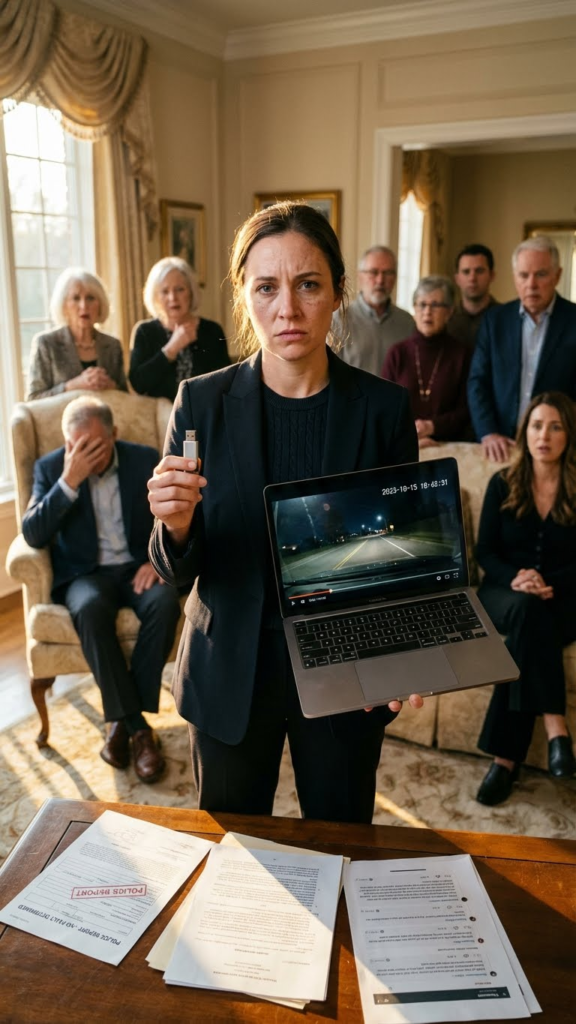
I stood in my lawyer’s office holding a USB drive that contained footage proving I didn’t cause the accident that ended my sister-in-law’s life—footage my husband’s family had tried to destroy six months ago.
My hands were shaking so badly I nearly dropped it. Six months of being blamed. Six months of my husband’s family treating me like a criminal. Six months of whispers at the grocery store, of former friends crossing the street to avoid me, of complete strangers sending me hate messages online calling me names I can’t even repeat.
Six months of my husband Mark standing silently while his family destroyed me at every family gathering, every holiday, every moment they got the chance.
“You were driving,” my mother-in-law had said at the funeral, her voice cold and clear in front of two hundred people. “You were behind the wheel when my daughter passed. This is your fault.”
I’d tried to explain. Tried to tell them what really happened on that mountain road in Colorado. But grief doesn’t listen to logic. And my husband’s family needed someone to blame.
So they chose me.
The accident happened during our family vacation last summer. Eight of us crammed into two rental SUVs driving through the Rockies. My sister-in-law Jessica was in my vehicle along with Mark’s brother Tom and their two kids. We were following Mark’s SUV on a winding mountain road when everything went wrong.
A truck crossed into our lane. I swerved. The roads were wet from rain. We spun out. Hit the guardrail. Jessica, who’d unbuckled her seatbelt to reach back and grab her daughter’s dropped tablet, was thrown from the vehicle.
She didn’t make it.
The police investigated. Found no evidence of wrongdoing. Ruled it an unavoidable accident caused by the truck driver who’d fled the scene. But Mark’s family didn’t care about police reports. They needed someone present to blame, and I was the easiest target.
“If you’d been paying attention—”
“If you’d been driving slower—”
“If you’d been a better driver—”
The accusations never stopped. Mark defended me at first. Then, slowly, he stopped. Started questioning me himself. “Were you distracted? Were you on your phone? Were you really going the speed limit?”
His doubt hurt worse than his family’s accusations.
I’d begged them to check the rental company’s dashcam. Begged them to request the footage. They refused. “We don’t need footage to know what happened. You were driving. She’s gone. That’s all that matters.”
What they didn’t know was that I’d requested the footage myself three months ago. And the rental company, after significant legal pressure and a subpoena from my lawyer, had finally released it.
I’d watched it alone last night in my lawyer’s office. Watched the truck swerve into our lane. Watched my split-second decision to avoid a head-on collision. Watched Jessica unbuckle her seatbelt at the worst possible moment. Watched the impact that had nothing to do with my driving and everything to do with circumstances beyond anyone’s control.
The footage proved everything I’d been saying for six months. Proved I’d done nothing wrong. Proved the truck driver was at fault. Proved Jessica’s decision to unbuckle—while understandable as a mother trying to help her child—was the factor that cost her life, not my driving.
Now I stood in my lawyer’s office, preparing to show this footage to Mark’s family at a meeting they’d called to discuss “moving forward” and “finding closure”—which I knew meant pressuring me to admit fault I didn’t bear.
My lawyer, Patricia, looked at me with concern. “Are you sure you want to do this? We can handle this through legal channels. You don’t have to face them.”
“Yes, I do,” I said. “They need to see the truth. They need to hear it from me. And they need to apologize.”
“They might not,” Patricia warned. “Some people would rather hold onto their narrative than accept the truth.”
“Then I’ll know who Mark really is,” I said. “Whether he believes evidence or his family’s version of events.”
The Six Months of Torment
To understand what that footage meant, you need to understand what the six months since Jessica’s passing had been like.
The funeral was the worst day of my life, and I’m including the day of the accident. Standing there in black while two hundred people stared at me like I was a criminal. My mother-in-law’s public accusation. The way people physically moved away from me like I was contagious with tragedy.
Mark had stood next to me, silent. Not defending me. Not correcting his mother. Just… silent.
After the funeral, the harassment began. Someone leaked my name and phone number to a local Facebook grief support group. I started getting messages. Hundreds of them.
“How do you sleep at night?”
“You took a mother from her children.”
“I hope you feel her loss every day for the rest of your life.”
People found my work email. I’m a graphic designer who works remotely—used to work remotely. My clients started dropping me after anonymous messages told them I was “responsible” for someone’s passing. That I was “negligent.” That I couldn’t be trusted.
I lost 70% of my income in two months.
Mark’s family made sure I was excluded from everything. Tom’s kids’ birthday parties. Family dinners. Holiday gatherings. They’d post photos on social media of “family time”—photos that included Mark but not me.
Mark went. Without me. Said he needed to be there for his family during this difficult time. Said I should understand.
I tried to understand. Tried to be patient. Tried to give them space to grieve.
But the accusations never stopped. Every time Mark came back from a family event, he’d tell me what they’d said. “Mom thinks you were speeding.” “Tom says you weren’t paying attention.” “Dad wants to know why you won’t just admit what happened.”
“I’ve told you what happened,” I’d say. “The police report confirms what happened. Why don’t they believe me?”
“Because Jessica’s gone,” Mark would say. “And someone has to be responsible.”
“The truck driver is responsible,” I’d argue. “The one who fled the scene. The one the police are still looking for.”
“But you were there,” Mark would say. “And she wasn’t in your car before. She is now. That’s what they can’t get past.”
What he meant was: that’s what he couldn’t get past.
Our marriage was dying. We barely spoke. Barely touched. Lived like roommates who shared a tragedy instead of a life. I suggested therapy. He said we didn’t need it. Said time would heal things.
But time wasn’t healing anything. It was making it worse.
Three months after the accident, Mark’s mother called me. “I think you should move out,” she said. “Give Mark some space. Let him heal with his family. You being there is just a reminder of what he’s lost.”
“What we’ve all lost,” I corrected. “I cared about Jessica too. I’m grieving too.”
“It’s not the same,” she said coldly. “You weren’t her family. And after what you did—”
“I didn’t do anything!” I finally exploded. “I swerved to avoid a head-on collision that would have ended all of us! I saved three lives that day, including your grandchildren! But you’d rather blame me than accept that sometimes terrible things happen and no one’s at fault!”
She hung up on me.
Mark heard the conversation. Asked what his mother had said. I told him. Expected him to be angry on my behalf. To defend me. To call his mother and tell her she was out of line.
Instead he said: “Maybe she has a point. Maybe some space would be good.”
That’s when I knew I needed the footage. Because if I couldn’t prove what happened, I was going to lose everything—my marriage, my reputation, my life as I’d known it.
The Investigation
Getting the footage was harder than I’d expected. The rental company initially refused, citing privacy policies. My lawyer Patricia had to issue a subpoena. Even then, they dragged their feet.
“They’re worried about liability,” Patricia explained. “If the footage shows their vehicle had any mechanical issues, they could be sued. So they’re hoping you’ll give up and go away.”
“I’m not giving up,” I said.
It took three months and $15,000 in legal fees. But finally, we got it.
Patricia and I watched it together in her office on a Tuesday afternoon. She’d warned me it might be traumatic to watch. She was right.
But it was also vindicating.
The footage was crystal clear. Time-stamped. Showed the road conditions, the speed (I was going 45 in a 50 mph zone), the truck swerving into our lane without warning, my immediate reaction, the unavoidable spin.
It showed Jessica unbuckling her seatbelt ten seconds before impact. Showed her leaning back to grab something from her daughter. Showed her being thrown during the collision because she wasn’t restrained.
“This proves everything,” Patricia said quietly. “You did nothing wrong. You actually prevented a worse accident—if you’d hit that truck head-on at those speeds, everyone in your vehicle would likely have perished.”
“Will Mark’s family see it that way?” I asked.
“They should,” Patricia said. “But grief makes people irrational. Be prepared for them to try to find other reasons to blame you.”
She was right. But I had to try.
The Confrontation
We drove to Mark’s parents’ house on a Saturday afternoon. The whole family was there—Mark’s parents, his brother Tom and Tom’s wife, his other sister Michelle, various aunts and uncles. All of them looking at me with expressions ranging from pity to contempt.
“Thank you for coming,” my father-in-law said stiffly. “We thought it was time to discuss how we move forward as a family after this tragedy.”
“By ‘move forward,’ you mean get me to confess to something I didn’t do,” I said calmly. “But before we discuss that, I have something to show you.”
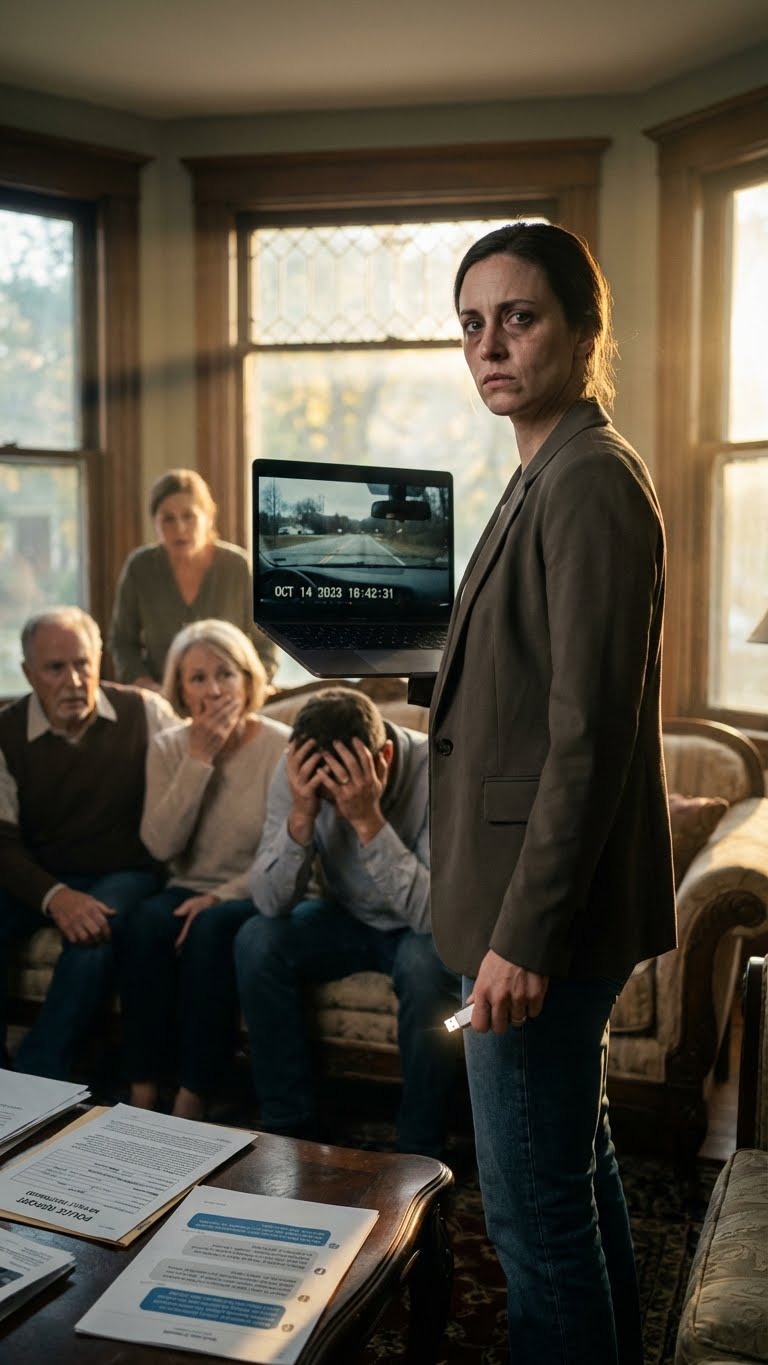
I pulled out my laptop and the USB drive. “This is the dashcam footage from the rental car. The footage you refused to request. The footage that shows exactly what happened that day.”
My mother-in-law’s face went white. “We don’t need to see—”
“Yes, you do,” I said firmly. “Because you’ve spent six months blaming me for something that wasn’t my fault. And you’re going to watch the truth before you say another word.”
I pressed play.
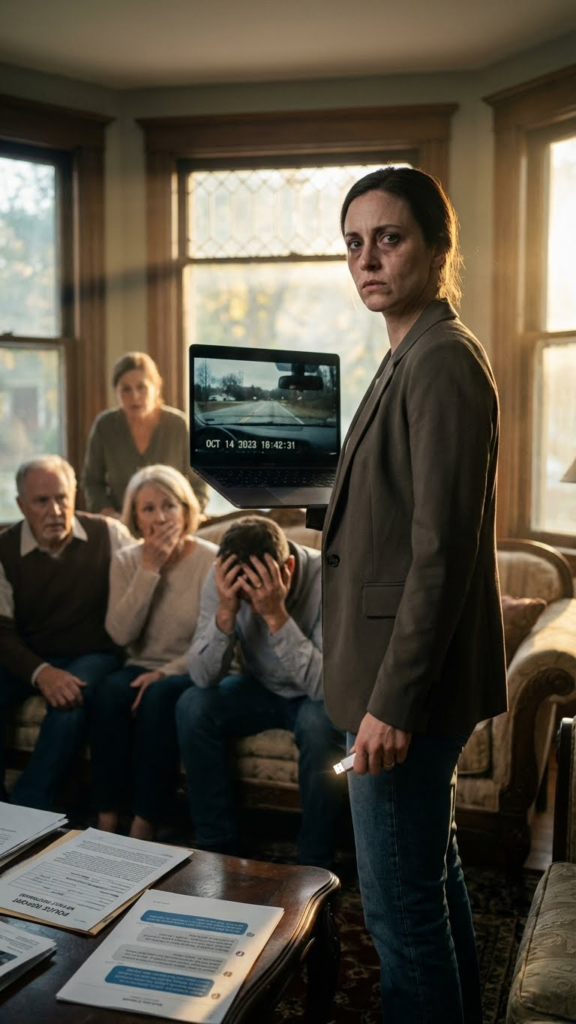
The room went completely silent as they watched. I’d seen it before, but watching their faces as they saw it for the first time was its own kind of experience. Tom’s wife started crying. Michelle covered her mouth. My father-in-law’s jaw clenched.
The footage showed everything. The truck swerving without warning. My reaction time—fast, appropriate, exactly what any driver would do. The wet roads making the spin unavoidable. And Jessica, beloved Jessica, unbuckling at the worst possible moment.
When it ended, no one spoke for a long moment.
Then my mother-in-law said something that made my blood boil. “This doesn’t change anything. You were still driving. If you’d been more prepared, if you’d anticipated—”
“Stop,” Mark said suddenly. His voice was quiet but firm. “Mom, stop.”
Everyone turned to look at him.
“She saved our lives,” Mark said, staring at the frozen footage on the screen. “That truck would have hit us head-on if she hadn’t swerved. We’d all be gone. Tom, your kids would be gone. Instead, they have a scratch and some nightmares. Because my wife made a split-second decision that saved them.”
“But Jessica—” his mother started.
“Jessica unbuckled her seatbelt,” Mark said, his voice breaking. “We can see it right there. She made a choice—a choice any parent would make to help their child—and it had consequences none of us could have predicted. But that’s not Sarah’s fault.”
He turned to me. To my husband who’d doubted me for six months. Who’d let his family destroy me. Who’d chosen their narrative over the truth.
“I’m sorry,” he said. “I’m so sorry. I should have believed you. I should have gotten this footage months ago. I should have defended you. I was weak and I was wrong and I don’t know if you can forgive me.”
I looked at him. At this man I’d married. This man I’d thought I knew.
“You’re right,” I said quietly. “You should have believed me. You should have defended me. And I don’t know if I can forgive you either.”
The Aftermath
The family meeting dissolved into chaos after that. Tom stood up and apologized, tears streaming down his face. “You saved my kids. You saved my family. And we blamed you. I’m so sorry.”
Michelle approached me hesitantly. “I didn’t want to believe you’d done anything wrong. But everyone was so certain—I’m sorry I didn’t trust my own judgment.”
But Mark’s parents were different. His mother stood up and left the room without a word. His father followed, though he paused at the door. “I’m glad there’s proof,” he said stiffly. “But it doesn’t bring her back.”
“No,” I agreed. “It doesn’t. Nothing will. But it does prove I didn’t cause what happened. And you owe me six months of apologies you’ll never be able to adequately give.”
He left without responding.
Mark and I drove home in silence. When we got there, he tried to talk. To apologize again. To explain.
“I was grieving,” he said. “I wasn’t thinking clearly. My family needed someone to blame and—”
“And you let them blame me,” I finished. “You chose them over me. Over the truth. Over your marriage.”
“I was wrong,” he said. “I know I was wrong. How do I fix this?”
I looked at my husband. Really looked at him. At the man who’d promised to stand by me through everything. Who’d broken that promise when it actually mattered.
“I don’t know if you can,” I said honestly.
The Decision
I moved out two weeks later. Not because his mother had asked me to months ago. But because I needed space to figure out who I was without the weight of false blame crushing me.
Mark didn’t fight it. I think he knew he’d lost the right to ask me to stay.
The footage went public. My lawyer released it to the media after the local news ran a “update” story about Jessica’s passing that once again implied I’d been at fault. Within 24 hours, the narrative completely shifted.
People apologized. Former clients reached out. The hate messages stopped and were replaced by messages of support. Some from people who’d sent the hate in the first place, shamefacedly admitting they’d judged without evidence.
I didn’t forgive them all. Couldn’t. Some bridges, once burned, stay burned.
But I rebuilt. Got new clients. Rebuilt my business. Rebuilt my reputation. Rebuilt myself into someone stronger, harder, less willing to accept blame that wasn’t mine.
Mark begged me to come back. Went to therapy alone when I refused to go with him. Sent flowers. Wrote letters. Promised he’d changed.
Maybe he had. But I’d changed too.
Six months after I moved out, I filed for divorce. Not out of anger anymore. Out of clarity. I’d married someone who I thought would stand beside me through anything. The accident had proven that wasn’t true. He’d stand beside me through good times. Through easy times. But when things got hard, when his family pressured him, when grief made truth inconvenient—he’d chosen comfort over loyalty.
I deserved better than that.
The Unexpected Justice
Eight months after the accident, the police found the truck driver. He’d fled to Nevada, where he was eventually pulled over for another traffic violation. The license plate led them to identify him as the driver from our accident.
He was charged with leaving the scene of a fatality. Reckless driving. Vehicular manslaughter.
The case went to trial. I testified. So did Tom. So did the kids, brave despite their trauma. And the dashcam footage was the star witness.
The driver was convicted. Got five years in prison. It didn’t bring Jessica back. But it meant someone was held accountable. The right someone.
At the sentencing, the judge made a point of addressing me directly. “Mrs. Henderson, the evidence is clear that you acted appropriately given impossible circumstances. You prevented a greater tragedy through quick thinking and skilled driving. The blame placed on you by some was not only incorrect but cruel. I hope this verdict provides some measure of justice for the ordeal you’ve endured.”
Mark’s mother was in the courtroom. She heard the judge say it. Heard the official validation of what I’d been saying for months.
She approached me after. I thought she might apologize. Might acknowledge the harm she’d caused.
Instead she said: “I still lost my daughter. Whether it was your fault or not doesn’t change that.”
“No,” I agreed. “It doesn’t. But it changes whether you had the right to destroy me for it. And you didn’t.”
I walked away. Didn’t look back.
The New Life
A year after the accident, I’m engaged to someone new. Alex is a software engineer I met through a client project. He knows the whole story. Knows what I went through. Knows the scars I carry.
He’s never once doubted me. Never asked me to prove myself. Never suggested I should have handled things differently.
“You survived something terrible,” he said when I told him about the accident. “Both the crash and the aftermath. That tells me everything I need to know about who you are.”
Mark found out about the engagement through social media. Called me crying. Begging for another chance. Saying he’d spent the year becoming the man I deserved.
“I’m happy for you,” I said. Not to be cruel. But because it was true. “I hope you’ve grown. I hope you’ve learned. I hope your next relationship benefits from the lessons this one taught you.”
“There won’t be a next relationship,” he said. “You were it for me.”
“Then I’m sorry,” I said. “But that’s not my responsibility anymore.”
I hung up and blocked his number. Some conversations don’t need to continue.
The Lesson Learned
People ask me sometimes if I forgive Mark’s family. If I’ve let go of the anger and hurt.
The truth is complicated. I understand they were grieving. I understand grief makes people irrational. I understand they needed someone to blame because accepting that Jessica’s passing was just a terrible accident was too painful.
But understanding doesn’t erase harm. Their grief doesn’t excuse their cruelty. Their pain doesn’t justify the way they destroyed me for six months before the truth came out.
So no, I haven’t forgiven them. Maybe someday I will. Maybe not. Either way, I’ve moved forward.
I’ve learned that the truth matters. That evidence matters. That some people will believe what they want to believe regardless of facts. That loyalty means standing by someone when it’s hard, not just when it’s easy.
I’ve learned that marriage vows about “for better or worse” should come with an asterisk: unless my family doesn’t like you, in which case all bets are off.
I’ve learned that you can survive being falsely blamed. That you can rebuild from having your reputation destroyed. That you can come out the other side stronger and clearer about what you will and won’t accept.
Most importantly, I’ve learned that some accidents are truly accidents. That sometimes terrible things happen and there’s no villain, just circumstances and timing and split-second decisions that can’t be undone.
Jessica’s passing was a tragedy. The way Mark’s family treated me afterward was a choice.
The footage proved what happened in the accident. But the aftermath proved what kind of people they were. And what kind of man I’d married.
In the end, maybe the accident gave me a gift—painful, terrible, but ultimately clarifying. It showed me the truth about the people in my life. Who stood with me. Who abandoned me. Who chose comfort over loyalty.
And it gave me the courage to walk away from people who would blame me for tragedy instead of supporting me through it.
That’s not revenge. That’s just choosing yourself when no one else will.
And sometimes, that’s the most powerful choice you can make.