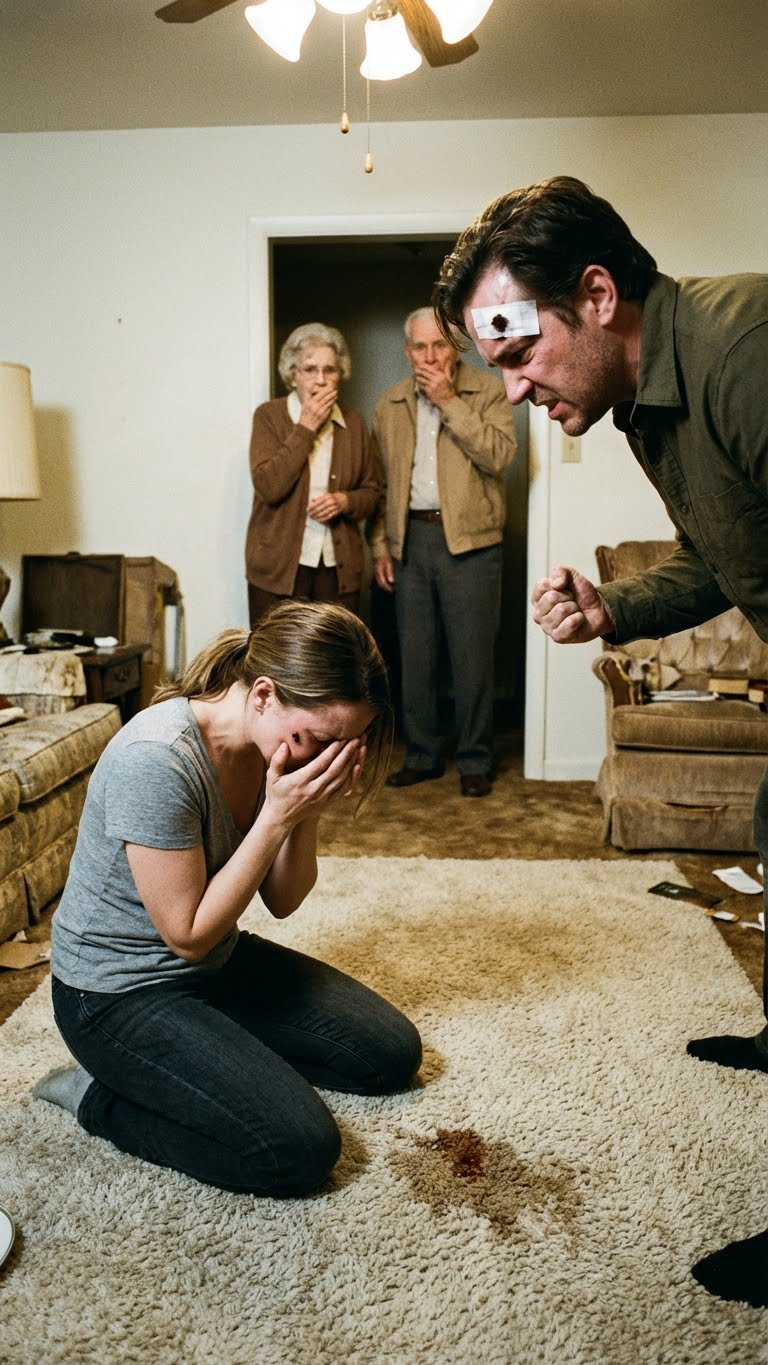
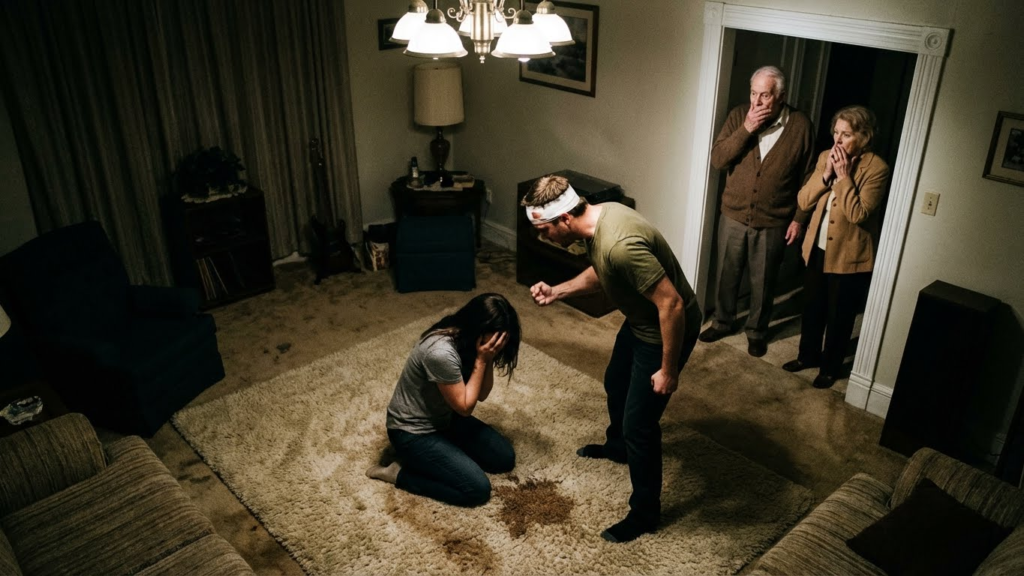
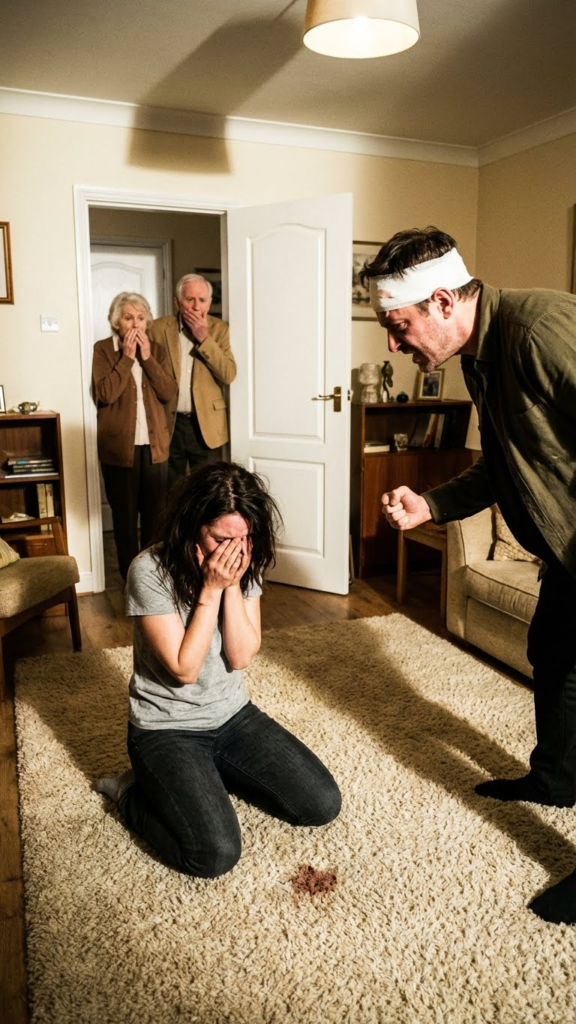
I was on my knees in the living room, hands pressed against my face, when I heard the doorbell ring.
My husband Ryan froze mid-shout, the rage still burning in his eyes like hot coals. The white bandage wrapped around his forehead—from where he’d “accidentally” hit the open cabinet door last night, or so the story would go—was stained dark red in the center where the wound kept seeping.
The doorbell rang again. Longer this time. Insistent.
“Don’t answer it,” Ryan hissed, his fist still clenched at his side from where he’d been threatening me just moments before. “Don’t you dare.”
I stayed frozen on the carpet, my cheek throbbing from where he’d shoved me and I’d hit the sharp corner of our glass coffee table. I could feel something wet on my face—blood or tears, I wasn’t sure anymore. The beige carpet beneath me showed a dark stain where my nose had bled minutes earlier.
But it was too late. Before either of us could move, I heard the unmistakable sound of a key turning in our front door lock.
Ryan’s parents had a spare key. For emergencies, Margaret had said when she gave it to us as a housewarming gift five years ago. But they’d never used it. They were respectful of boundaries, always called before visiting, always gave us notice.
Until today.
The door swung open and there they stood—Margaret and Thomas Bennett, Ryan’s perfectly respectable retired parents. Margaret in her neat cardigan and pressed slacks. Thomas in his usual brown sweater vest over a collared shirt.
Their faces transformed from pleasant surprise to absolute horror in the span of a single heartbeat.
They saw me first. Their daughter-in-law of five years, kneeling on the floor in an old t-shirt and jeans, hands pressed to my face, a visible mark darkening on my cheek. The stain on the carpet. The fear in my eyes.
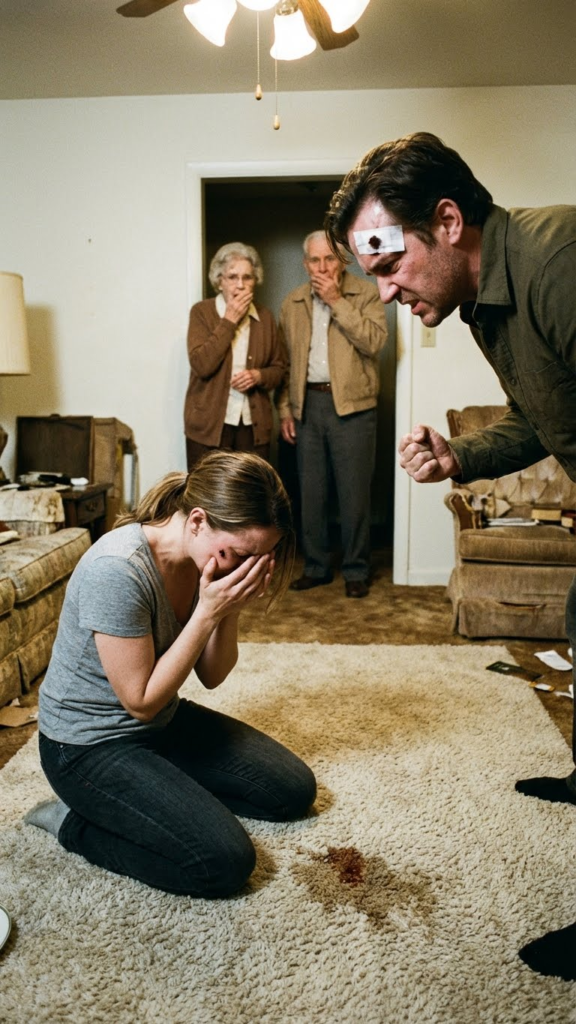
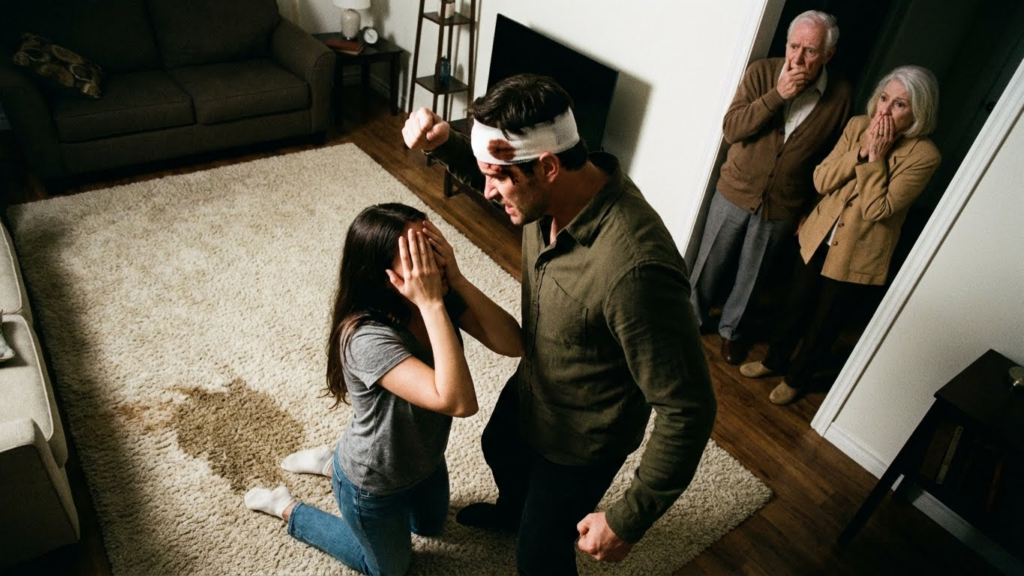
Then they saw their son. Standing over me. Fist still raised. Face contorted with rage—not the charming, successful attorney they thought they knew, but something darker. Something dangerous.
The tableau held for what felt like an eternity but was probably only three seconds.
Margaret’s hand flew to her mouth, her eyes filling with immediate tears. Thomas’s expression shifted from shock to something else—something that looked almost like grim recognition, as if he’d suspected but never wanted to confirm.
“Ryan,” Thomas said quietly, but his voice carried a weight I’d never heard before. “Step away from her. Right now.”
Ryan’s face shifted instantly. The rage vanished like a mask being removed, replaced by his public face—confused, concerned, the picture of a worried husband.
“Dad, Mom, you don’t understand—she fell, and I was just trying to help her up, and she started—”
“I said NOW.” Thomas’s voice cut through Ryan’s explanation like a blade through silk.
For three years, I’d hidden the truth. I’d worn long sleeves in summer to cover fingerprint bruises. I’d perfected the art of makeup to hide marks on my face. I’d created elaborate stories about my “clumsiness”—walking into doors, tripping down stairs, dropping things on myself.
I’d protected Ryan’s reputation. Protected his career as a rising attorney at a prestigious firm. Protected his relationship with his parents because he’d convinced me that no one would ever believe me anyway. That his parents would take his side. That I’d be the one blamed.
But they’d seen it now. With their own eyes. There was no explaining this away.
I met Ryan Bennett six years ago at a charity fundraiser. He was charming, successful, attentive. He brought me flowers on our second date and remembered everything I told him. Within six months, we were engaged. Within a year, married.
The first time it happened was three months after our wedding.
We’d been arguing about something trivial—I’d forgotten to pick up his dry cleaning. The argument escalated. He grabbed my arm hard enough to leave marks and shoved me against the wall.
Afterward, he cried. He apologized profusely. He said the stress from a big case had gotten to him. He promised it would never happen again. He was so remorseful, so broken, that I believed him.
But it did happen again. And again.
The pattern became predictable. An argument would start over something small. Ryan’s anger would escalate disproportionately. Things would get physical. Then would come the apologies, the promises, the gifts, the honeymoon period where he was the man I’d fallen in love with.
Then the cycle would start again.
I became an expert at hiding it. I learned which colors and styles of clothing concealed marks best. I stopped seeing friends who might ask questions. I isolated myself from my family, who lived three states away. Ryan encouraged this isolation, always having a reason why we couldn’t visit them or why they shouldn’t visit us.
His parents adored him. Margaret often told me how lucky I was to have married such a wonderful man. Thomas praised Ryan’s career success constantly. They saw the charming attorney, the dutiful son, the man who always called his mother on Sundays.
They didn’t see the man who punched walls beside my head. Who controlled every dollar I spent. Who checked my phone and email daily. Who convinced me that I was worthless, that no one else would ever want me, that I deserved everything that happened to me.
I’d tried to leave twice. Both times, Ryan found me. The second time, he’d threatened that if I ever tried to leave again, he’d make sure I never saw my family alive. I believed him. By then, I knew what he was capable of.
So I stayed. I survived. I became a ghost in my own life.
The incident that led to Ryan’s forehead injury—the real story, not the one about the cabinet—had happened the night before his parents’ surprise visit.
We’d been arguing about dinner. I’d made chicken instead of the steak he’d wanted. It was such a small thing, but with Ryan, everything became ammunition.
The argument escalated. He backed me into the kitchen. I was trapped between the counter and his advancing rage. When he grabbed for me, survival instinct finally kicked in. I ducked and shoved past him.
Ryan wasn’t expecting resistance. He stumbled backward into the open cabinet door, hitting his forehead on the corner. Hard enough to split the skin and bleed heavily.
For a moment, I thought he might actually hurt me seriously this time. His expression was murderous. But then something changed—he saw an opportunity.
“You did this,” he said, touching the blood on his forehead. “You attacked me. If I go to the hospital, I’m telling them you hit me.”
The accusation was so absurd it almost made me laugh—except Ryan was serious. He drove himself to urgent care and came back with stitches and a story about hitting the cabinet while reaching for something.
But I knew the truth, and so did he. That night, his anger was worse than usual. He blamed me for his injury, for embarrassing him, for making him look clumsy.
This morning, the rage had still been simmering. It had exploded again over coffee that was apparently too weak.
That’s when his parents arrived.
Thomas stepped fully into our living room, moving with surprising speed for a man in his seventies. He positioned himself between Ryan and me.
“Margaret, help her up,” he said, never taking his eyes off his son.
Margaret rushed to my side, kneeling on the carpet beside me. Her hands were gentle as she helped me stand, supporting me when my legs felt weak.
“Oh honey,” she whispered, tears streaming down her face as she saw my injuries up close. “Oh my dear girl.”
Ryan’s lawyer brain was working overtime. “Dad, this is a misunderstanding. She fell, and I was upset because she hurt herself, and—”
“Stop.” Thomas’s voice was cold. “Just stop, Ryan. I saw what I saw. Your mother saw what we saw.”
“You saw a moment out of context—”
“I saw my son standing over his wife with his fist raised while she was on the floor bleeding.” Thomas’s voice broke slightly. “I saw exactly what I hoped I’d never see.”
That last sentence hung in the air. Hoped I’d never see. Not “I can’t believe” or “I’m shocked.” But hoped I’d never see.
As if he’d suspected. As if he’d been watching for signs.
Margaret was examining my face gently, her tears falling freely now. She pulled tissues from her purse, carefully dabbing at the cut on my cheek.
“How long?” Thomas asked me directly, his eyes filled with pain and guilt. “How long has this been happening?”
I couldn’t speak. Three years of silence had frozen my voice.
“She’s lying if she tells you I’ve hurt her,” Ryan said quickly. “She’s clumsy, and she’s unstable, and—”
“The carpet has blood on it,” Margaret said quietly, her voice shaking. “There are marks on her face and arms. And we saw you, Ryan. We saw you.”
Ryan’s expression shifted again—this time to something calculating. “You’re going to believe her over me? Your own son?”
“Yes,” Thomas said simply. “Because I saw it with my own eyes. And because…” He paused, closing his eyes briefly. “Because your grandfather did the same thing to your grandmother. I grew up watching it. I swore I’d never let that legacy continue.”
The room went silent. Margaret’s hands stilled on my face. Even Ryan looked shocked.
“I’ve been watching for signs,” Thomas continued, his voice heavy with regret. “I hoped I was wrong. I hoped you’d be different. But the way she flinches sometimes when you move too fast. The excuses for injuries. The isolation from her family. I recognized it all.”
“Then why didn’t you say something?” Ryan’s voice held an edge of accusation.
“Because I was a coward,” Thomas said bluntly. “Because I wanted to believe my son was better than his grandfather. Because I didn’t want to see what was right in front of me.” He looked at me with profound sadness. “I’m sorry. I’m so sorry I didn’t act sooner.”
Something broke inside me in that moment. Not broke—broke open. Three years of silence, of protecting Ryan, of protecting his reputation, of surviving day by day suddenly felt unbearable.
“Three years,” I said, my voice barely a whisper at first, then growing stronger. “It’s been happening for three years.”
Ryan’s face went pale. “Don’t—”
“He controls everything,” I continued, the words pouring out now. “My phone, my email, my spending. I haven’t seen my family in two years because he always has a reason we can’t go. I can’t work because he says we don’t need the money, but really it’s because he wants me dependent.”
Margaret’s arm tightened around me, supporting me.
“He threatened my family,” I said, my voice breaking. “The second time I tried to leave, he said if I ever tried again, he’d make sure I never saw them alive. I believed him.”
“You’re making me sound like a monster—” Ryan started.
“You ARE a monster,” Margaret said, her voice sharp as glass. It was the first time I’d ever heard her speak harshly to her son. “You’re exactly what I feared you might become.”
Thomas pulled out his phone. “I’m calling the police.”
“No!” Ryan lunged forward.
Thomas held up his hand, stopping his son with just a gesture. “If you take one more step toward any of us, I will physically restrain you. And son, despite your age, I still can.”
There was something in Thomas’s voice that made Ryan freeze.
“You have a choice,” Thomas continued. “You can wait here calmly while the police come and we sort this out properly. Or you can make this worse. Your decision.”
For a long moment, Ryan stood there, his face cycling through emotions—rage, calculation, disbelief, and finally something like resignation.
“You’re ruining my career,” he said flatly. “My life.”
“No,” I said, finding my voice again. “You did that yourself.”
The police came. They took photos of my injuries, of the blood on the carpet, of Ryan’s own injury and the inconsistency of his story about how it happened. They took statements from Margaret and Thomas about what they’d witnessed.
They arrested Ryan. Not just for assault, but for making threats against me. I told them everything—three years of incidents, the controlling behavior, the threats against my family.
Thomas and Margaret took me to the hospital. The doctor who examined me documented every injury—recent and healing. The fingerprint bruises on my arms that were a week old. The partially healed rib that I’d claimed was from a fall. The evidence of long-term physical trauma.
I stayed with Ryan’s parents that night. Margaret held me while I cried—three years of tears I’d held back. Thomas called my family, told them everything, arranged for them to fly in the next day.
“I’m so sorry,” Margaret kept saying. “I should have seen it. I should have known.”
“He’s very good at hiding it,” I told her. “Even from himself, I think.”
Over the following weeks, the truth emerged. Ryan’s colleagues at his law firm hadn’t been entirely surprised—there had been incidents of rage, of inappropriate behavior, that had been quietly managed. His ex-girlfriend from college, when contacted by my attorney, revealed she’d left him after he’d shoved her down stairs.
The pattern had been there all along. Everyone had just been looking away.
The divorce was straightforward. The criminal case less so, but with witnesses, evidence, and eventually testimony from his ex, Ryan pleaded guilty to reduced charges. He lost his law license. Lost his prestigious job. Lost his reputation.
His parents never wavered in their support of me. “You’re still our daughter,” Margaret told me. “What he did doesn’t change that.”
I’m 34 now, living in a small apartment across town from where Margaret and Thomas live. I see them weekly for dinner. They’ve become the parents I needed—supportive, loving, present.
I’m back in touch with my real family. My sister flew out and stayed with me for two months while I rebuilt my life. My parents visit every few months.
I started therapy immediately after leaving. It’s been hard work—unlearning the patterns of survival, rebuilding my sense of self, learning to trust again. But I’m doing it.
I went back to school to finish my degree. I got a job at a nonprofit that helps domestic violence survivors. I use my experience to help others recognize the signs I missed for so long.
Ryan tried to contact me a few times from prison. I never responded. His parents, to their credit, never asked me to. Thomas told Ryan he was disappointed in him and that he needed to take full responsibility for his actions before they’d consider reconciliation.
The day Thomas and Margaret arrived unannounced changed everything. Their unexpected visit, the timing of their spare key decision, felt like divine intervention. Thomas later told me they’d decided that morning to drop by with groceries because Margaret had a feeling something was wrong.
“Call it a mother’s intuition,” she said. “Or maybe just wishful thinking that I’d finally have the courage to act on my suspicions.”
I learned that abuse thrives in silence and isolation. The moment witnesses saw what Ryan was doing, the power structure collapsed. He couldn’t gaslight his own parents. He couldn’t convince them they were seeing something other than what was right in front of them.
I learned that asking for help isn’t weakness—it’s survival. I’d spent three years convinced I had to handle it alone, that no one would believe me. I was wrong. People believed me. People helped me.
I learned that breaking generational cycles takes courage. Thomas’s willingness to confront the truth about his son, despite the pain it caused him, likely saved my life. His refusal to let the pattern his father established continue through another generation gave me hope that change is possible.
Most importantly, I learned that I deserved better. That no one deserves to live in fear. That love should never hurt. That I was never the problem—the abuse was.
If you’re living what I lived, please know: it’s not your fault. You’re not crazy. You’re not imagining it. And you’re not alone.
The abuse will not stop on its own. It will escalate. Please reach out—to family, to friends, to professionals, to hotlines. Document everything. Take photos of injuries. Keep a journal. Tell someone you trust what’s happening.
You deserve safety. You deserve respect. You deserve a life without fear.
And to the families of people in abusive situations: if you suspect something is wrong, don’t look away. Don’t make excuses. Don’t prioritize your relationship with the person hurting someone over the safety of the victim.
Thomas and Margaret could have walked back out that door and pretended they hadn’t seen what they saw. They could have believed Ryan’s explanation. They could have prioritized protecting their son’s reputation.
Instead, they chose to protect me. They chose truth over comfort. They chose to break a generational cycle of violence.
That choice saved my life.