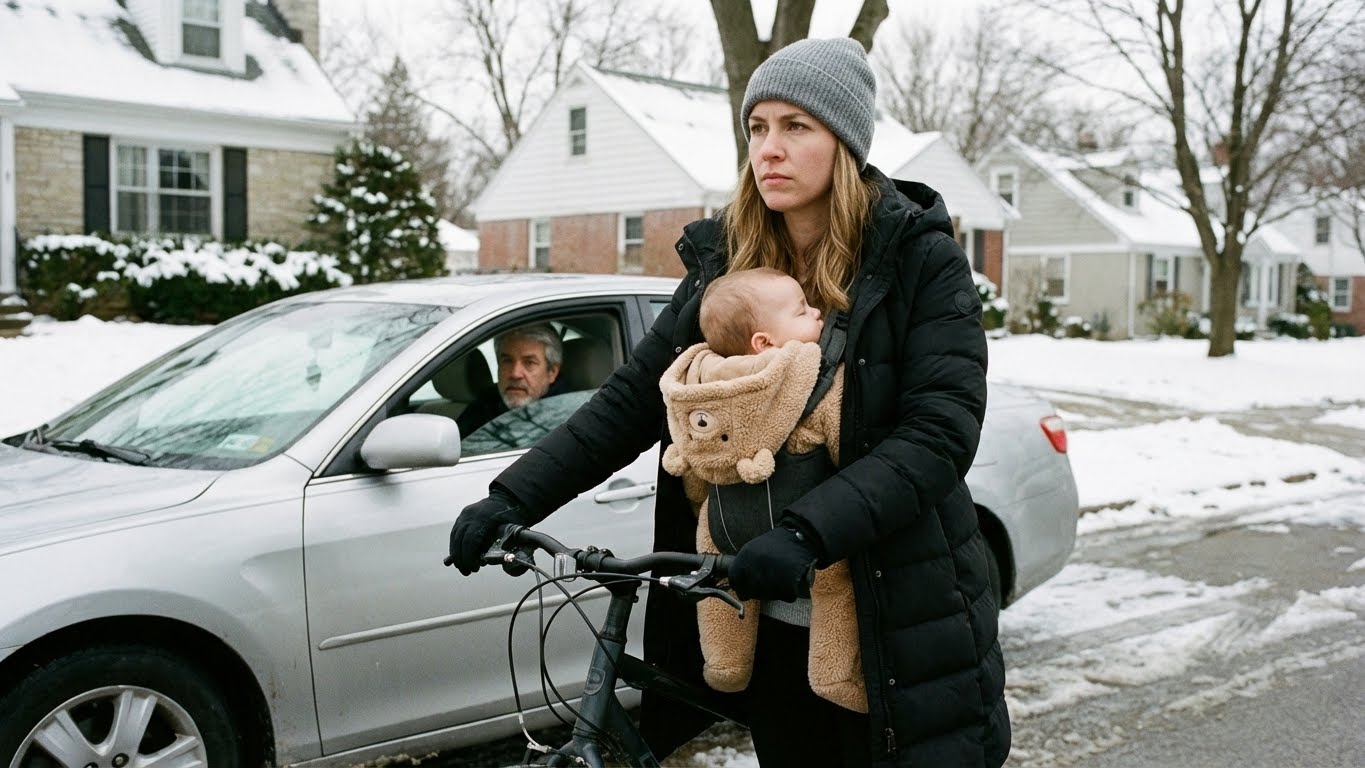
The silver sedan was parked three houses down from the playground. Again.
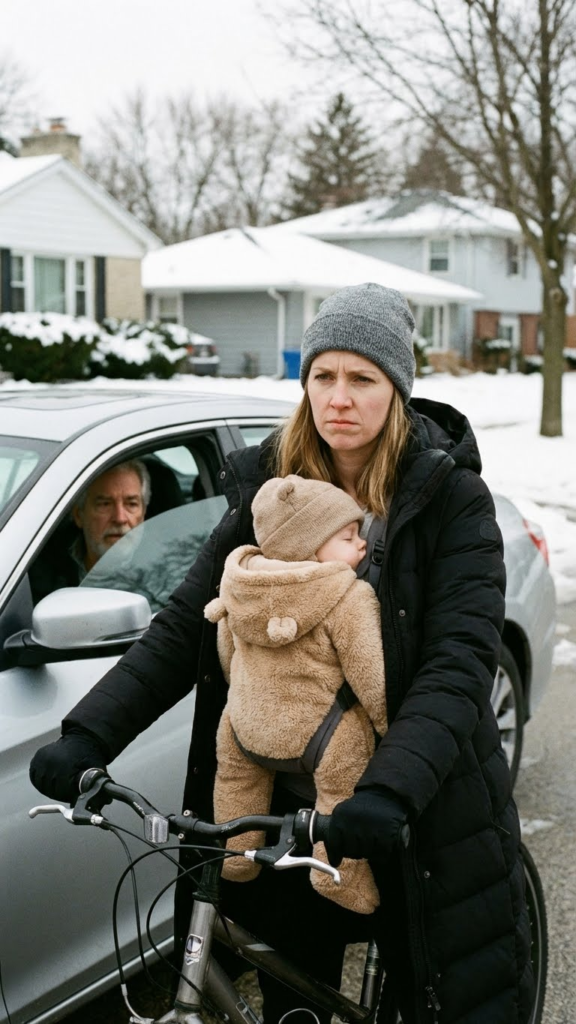
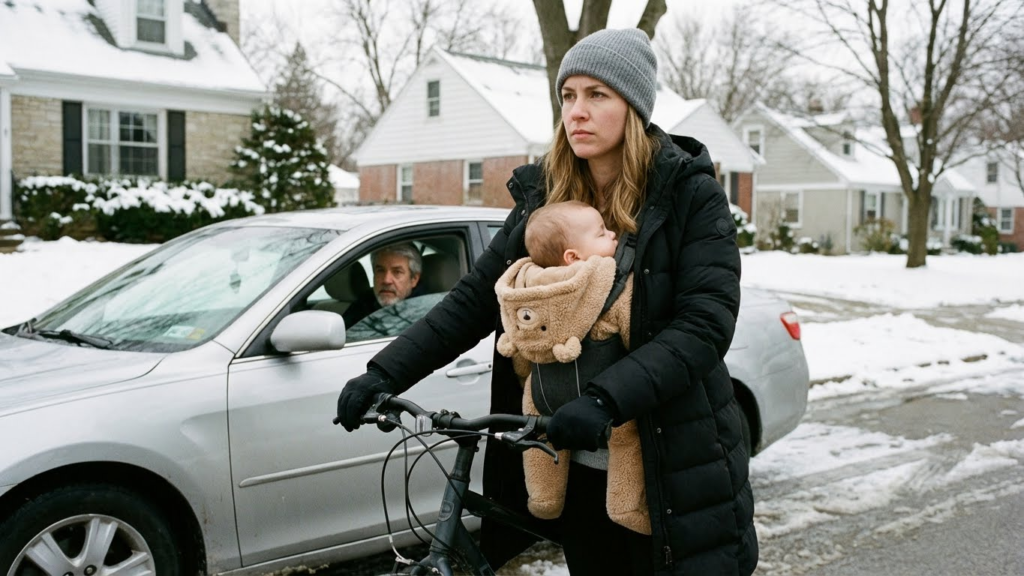
I stood on the snowy street at 6:47 PM on a Tuesday in February, one hand gripping my bicycle handlebars, the other instinctively pressed against Mia’s back where she slept peacefully in her carrier against my chest. My breath came out in visible clouds in the Minnesota cold—seventeen degrees, according to my phone—but I wasn’t shaking from the temperature.
I was shaking because I’d seen that car seventeen times in the past three weeks.
At the Target parking lot where I bought diapers. Outside Dr. Morrison’s pediatric office after Mia’s six-month checkup. Idling at the corner of Maple and Fifth when I left for my 7 AM shift at the hospital. Parked outside the library where I took Mia for story time. And now here, on this quiet residential street, watching me walk my seven-month-old daughter home because I couldn’t afford to fix my Honda and the bus didn’t run this route after 6 PM.
I’d told myself I was being paranoid. Post-divorce anxiety. New mom hypervigilance. Sleep deprivation making me see patterns where there were none. But then I’d started documenting it—photos with timestamps, locations on a map, notes about what I’d been doing when I spotted the car. A pattern emerged that made my blood run cold.
Whoever was following me knew my schedule better than I did.
I pulled out my phone with numb fingers and zoomed in on the license plate: Minnesota tags, WHV-2847. Then I took a photo of the driver’s profile through the windshield. An older man, maybe sixty-five or seventy, with gray hair and a neatly trimmed beard, wearing what looked like an expensive North Face jacket.
He turned his head. Our eyes met across fifty feet of snow-covered pavement.
And that’s when I recognized him.
Richard Holloway. My ex-husband’s father. The man who’d told the family court judge I was “emotionally unstable” and “financially irresponsible.” The man who’d testified under oath that his son deserved primary custody because I couldn’t provide a “stable home environment.”
The man who’d smiled at me across the courtroom while his lawyer tore apart every choice I’d ever made—my student loans, my salary, the fact that I rented an apartment instead of owning a home, the bike I used for transportation when my car broke down.
He was still staring at me. Not even trying to hide it now. His phone was in his hand, pointed directly at me through his driver’s side window. Recording.
Documenting me struggling. Collecting evidence. Building a case to take my daughter away.
Mia stirred against my chest, her tiny hand curling into a fist against the tan bear suit she was wearing—a secondhand find from the Goodwill that kept her warm when we had to bike in the cold. My beautiful, perfect daughter who I’d fought so hard to keep. Who I’d given up everything for.
And her grandfather—the man who’d sworn in court he only wanted “what’s best for the child”—was stalking us in the winter cold, filming us, waiting for me to fail.
I pulled Mia closer, adjusted my grip on the bike, and started walking directly toward his car.

I met James Holloway at a hospital fundraiser. I was a nurse in the pediatric ward. He was a pharmaceutical sales rep with perfect hair, a charming smile, and a family with old Minnesota money.
We got married too fast. I got pregnant faster. And by the time Mia was born, I’d already realized I’d made a terrible mistake.
James wasn’t abusive in the traditional sense. He never hit me. Never yelled. But he controlled everything—our finances, our social calendar, where we lived, what I wore, who I could see. It was subtle, insidious, wrapped in phrases like “I’m just trying to help” and “I know what’s best for us.”
When I told him I wanted a divorce, he didn’t fight me. He just smiled and said, “Good luck affording a lawyer.”
He was right. I couldn’t afford one. Not the kind he could. His father—Richard Holloway, successful investment banker and chairman of three corporate boards—hired him the best family law attorney in the Twin Cities.
I represented myself with the help of a free legal aid clinic.
The custody battle was brutal. James’s lawyer painted me as irresponsible, immature, incapable of providing stability. They pointed to my student debt, my apartment, my reliance on public transportation. They made it sound like being middle-class was a form of child neglect.
Richard took the stand and testified that he’d “observed concerning behavior”—that I seemed “overwhelmed” and “struggled to cope with basic parenting tasks.” He said this with a straight face while knowing he’d never spent more than fifteen minutes alone with his granddaughter.
The judge awarded joint custody, but James got primary physical placement. I got Mia every other weekend and Wednesday evenings.
I’d cried for three days straight. Then I filed an appeal, got a better lawyer through a nonprofit that helped low-income mothers, and after four months of additional court hearings, got the custody arrangement reversed. The judge had reviewed new evidence—text messages from James showing he’d planned to use Mia as leverage to control me, testimony from my supervisor at the hospital about my excellent work ethic, statements from Mia’s daycare provider about my consistent, loving care.
I won. Barely. Mia lived with me full-time. James got every other weekend.
And Richard Holloway started following me.
I walked right up to his car and knocked on the driver’s side window.
He rolled it down slowly, his expression calm, almost amused. Like this was all perfectly normal.
“Can I help you?” he asked.
“You can stop stalking me.”
“I’m parked on a public street.” His voice was measured, reasonable. The same voice he’d used in court. “I have every right to be here.”
“You’ve been following me for weeks. I have photos. Timestamps. Seventeen different locations.”
“Coincidence.” He shrugged. “We live in the same city.”
“You live in Edina. This is Northeast Minneapolis. Twenty miles from your house.” I held up my phone, showing him the map I’d created with every sighting marked. “You’ve been outside my apartment. Outside my work. Outside her daycare. That’s not coincidence. That’s surveillance.”
His expression didn’t change. “I’m concerned about my granddaughter’s welfare.”
“You’re building a case.”
“I’m documenting the environment she’s living in.” He gestured at my bike. “You’re transporting an infant on a bicycle in seventeen-degree weather. That’s child endangerment.”
“She’s in a proper carrier. She’s bundled. We’re going six blocks.”
“To an apartment you can barely afford. To a life you can barely maintain.” He leaned back in his seat. “My son should have full custody. You’re proving it every day.”
Something inside me snapped. The fear, the exhaustion, the months of feeling like I was being watched—it all crystallized into fury.
“I’m a good mother,” I said, my voice shaking but clear. “I work full-time. I pay my bills. I take care of my daughter. The only reason I’m on a bike right now is because I spent my savings on lawyers to fight your son in court. To fight you in court.”
“And look where it got you.” He smiled. “Struggling. Alone. One emergency away from losing everything.”
“Get away from me and my daughter, or I’m filing a restraining order.”
“On what grounds?” He was still so calm. So sure of himself. “I haven’t threatened you. I haven’t approached you. I’m just… observing.”
“You’re stalking.”
“Prove it.” He started rolling up his window. “Good luck with that bike ride home, Nicole. It looks cold.”
I did prove it.
I went home that night and compiled everything. Every photo. Every timestamp. Every location. I created a detailed timeline showing seventeen instances of surveillance over three weeks. I pulled security footage from my apartment building showing his car parked across the street at odd hours. I got statements from my neighbors who’d noticed the same silver sedan appearing repeatedly.
Then I filed for a harassment restraining order.
The hearing was set for two weeks later. In the meantime, Richard’s surveillance stopped. No more silver sedan. No more “coincidental” appearances. His lawyer had probably told him to back off while the case was pending.
But I knew he hadn’t given up. Men like Richard Holloway don’t give up. They just change tactics.
The restraining order hearing fell on a Thursday morning. I took the day off work, arranged childcare for Mia, and showed up to court with a folder three inches thick containing all my evidence.
Richard showed up with his lawyer and an expression of wounded innocence.
“Your Honor,” his lawyer began, “my client is a concerned grandfather who has witnessed troubling behavior from his former daughter-in-law. He has every right to be concerned about his grandchild’s welfare—”
“He followed me seventeen times in three weeks,” I interrupted. The judge gave me a look, but let me continue. “He parked outside my home, my workplace, my daughter’s daycare. He filmed me without my consent. He told me directly he was building a case to take my daughter away.”
“Did he threaten you physically?” the judge asked.
“No, but—”
“Did he attempt to contact you directly prior to your confrontation with him?”
“No, Your Honor, but the pattern of surveillance—”
“Is concerning, yes. But it may not meet the legal threshold for harassment.” The judge looked at my evidence. Looked at Richard. Sighed. “Mr. Holloway, what do you have to say for yourself?”
Richard stood. Calm. Dignified. Grandfatherly. “Your Honor, I admit I may have been… overzealous in my concern for my granddaughter. As you know from prior proceedings, I testified in my son’s custody case. I believed—and still believe—that the child would be better served in my son’s care. When I happened to see Ms. Carter transporting the infant by bicycle in freezing weather, I became alarmed. Perhaps I should have handled my concerns differently.”
“Perhaps?” I couldn’t help myself. “You followed me for weeks—”
“Ms. Carter.” The judge’s voice was firm. “I understand your frustration. And Mr. Holloway, your behavior—while not illegal—was inappropriate and intrusive. I’m granting a limited restraining order. You are to stay at least 300 feet away from Ms. Carter and the minor child except during court-ordered visitation exchanges. You are not to follow her, film her, or surveil her in any capacity. Violation will result in contempt charges. Is that clear?”
“Perfectly clear, Your Honor.” Richard nodded solemnly.
He’d gotten a slap on the wrist.
But I wasn’t done.
After the hearing, I went straight to a private investigator—one I’d been saving money to hire for weeks. I gave her everything I had: Richard’s pattern of surveillance, his testimony in the original custody case, his son’s controlling behavior during our marriage.
“What exactly are you looking for?” she asked.
“Anything that proves this wasn’t about Mia’s welfare. This was about control.”
It took her eight days.
She found emails between Richard and James—dozens of them, exchanged during the custody battle and after. They’d been coordinating strategy. Richard had been advising James on how to make me look unstable, how to document my “failings,” how to build a case.
But more damning was what she found in Richard’s financial records. He’d paid a private investigator $15,000 to follow me during the original custody proceedings—gathering evidence of my “inadequate lifestyle” to use in court. That investigator’s reports had been submitted anonymously to James’s lawyer.
And most damning of all: text messages between Richard and his wife discussing how they’d “get custody eventually” and how “Nicole will crack under pressure.”
This wasn’t grandparental concern. This was a coordinated campaign to break me and take my daughter.
I took it all back to court. Filed a motion to modify custody based on harassment and alienation. Submitted every email, every text message, every receipt from the PI Richard had hired.
James’s lawyer tried to dismiss it. Richard claimed the communications were “taken out of context.”
But the judge read them. All of them.
And her expression changed.
“Mr. Holloway,” she said quietly, “you testified in the original proceeding that you were concerned about the child’s welfare. But these communications suggest your motivation was less about the child and more about… punishing Ms. Carter for leaving your son.”
“That’s not—”
“You paid $15,000 to have her followed. You coordinated with your son to document her ‘failures.’ You texted your wife that you’d ‘get custody eventually.’ This isn’t concern. This is harassment with the explicit goal of separating a mother from her child.”
The courtroom was silent.
“I’m not only upholding the restraining order, I’m extending it to include James Holloway. Both of you are prohibited from any form of surveillance, documentation, or harassment of Ms. Carter. Your visitation with the minor child will be supervised for the next six months, and you’ll be required to complete a co-parenting course before unsupervised visits resume.”
Richard’s face went red. James looked like he’d been struck.
“Furthermore,” the judge continued, “I’m referring this matter to the state bar for investigation into whether James Holloway’s attorney violated ethics rules by accepting and using evidence obtained through paid surveillance without proper disclosure.”
I sat there, shaking, trying to process what had just happened.
I’d won. Actually won.
It’s been eight months since that hearing. Richard’s silver sedan hasn’t appeared once. James barely speaks to me during custody exchanges, which now happen at a neutral location with a supervisor present.
Mia is fourteen months old now. She’s walking, babbling, laughing. She has no idea what her mother went through to keep her safe.
I fixed my car—finally. But I still bike sometimes, because I like it. Because I can. Because I’m not doing it out of desperation anymore.
Last month, I got a promotion at work. Better pay, better hours. I moved to a nicer apartment with a second bedroom. I’m not struggling anymore. I’m thriving.
And that’s the thing Richard and James never understood: their surveillance, their control, their attempts to break me—they just made me stronger.
They wanted to prove I was unstable. Instead, they proved I was unbreakable.
The silver car is gone. But I still check my mirrors. Still document my life, my parenting, my victories.
Not because I’m paranoid.
Because I’m prepared.
And if they ever try again—if they ever think about coming after my daughter—they’ll find out exactly what a mother is capable of when she’s had enough.
I’m not the struggling woman on a bike anymore.
I’m the woman who fought back.
And I won.