The Test That Changed Everything
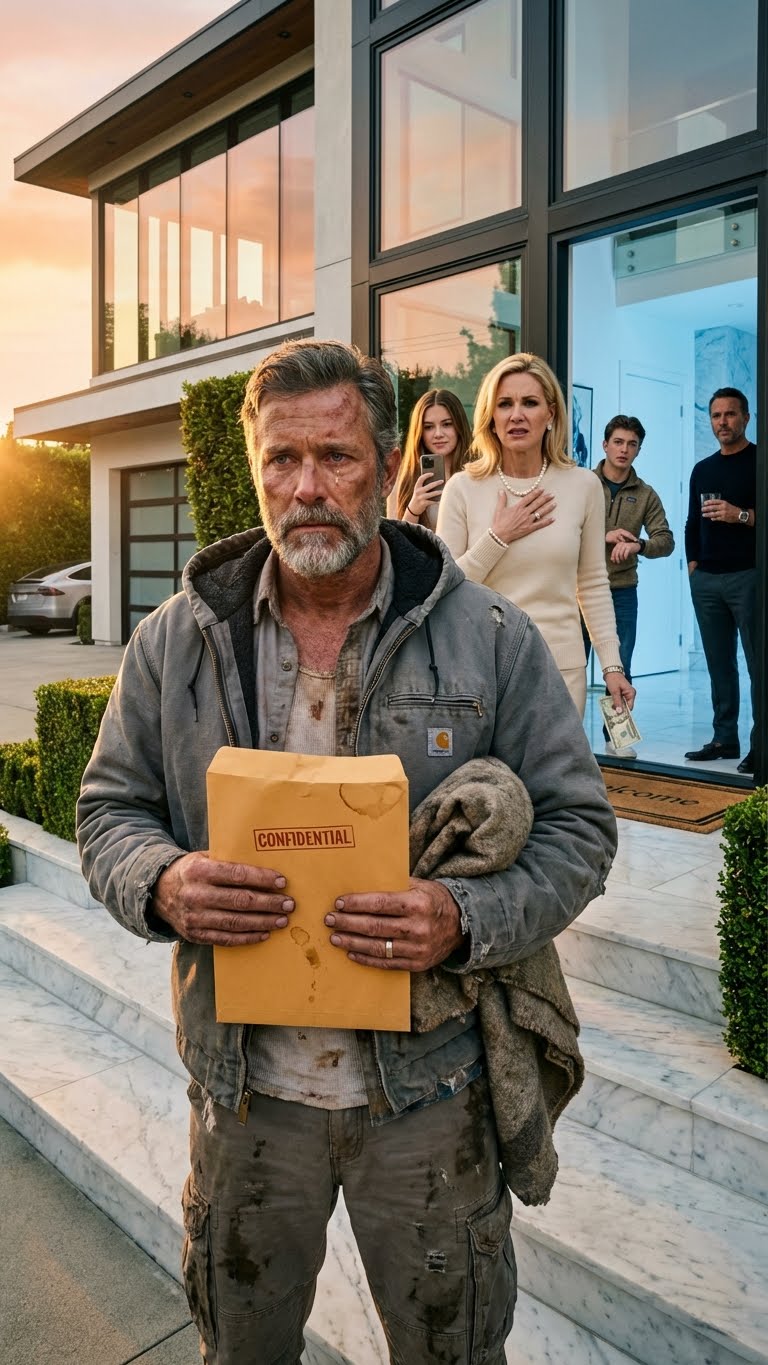
I stood in front of my own mansion, dressed in torn clothes that reeked of the street, my hands shaking as I rang the doorbell. Three months ago, I was William Chen, tech millionaire, loving father, devoted husband. Today, I was testing whether any of that was real.
The door swung open. My wife Rebecca’s face twisted in disgust before she even looked up. “We don’t give handouts. Leave before I call—” She stopped. Her eyes met mine for a fraction of a second, and I held my breath. Twenty-two years of marriage. Would she recognize me under the beard, the grime, the deliberately hunched posture?
Nothing. Not even a flicker.
“Security!” she screamed, stepping back like I carried a disease. “There’s a homeless man at the door!”
My daughter Emma appeared behind her, phone already out. Not to help. To film. “Oh my God, Mom, this is going viral,” she laughed, angling for the perfect shot of her mother’s disgust. My daughter. The girl I’d raised, whose college I’d funded, whose every whim I’d indulged.
Then I heard it. A man’s voice from inside. “Babe, who’s at the door?” Footsteps. Designer shoes on my marble floor. A man I’d never seen before walked up behind my wife and casually wrapped his arm around her waist. In my house. Wearing my watch.
“Just some bum,” Rebecca said, leaning into him. “Can you believe the nerve?”
My son Marcus pushed past them all. For a moment, hope flared in my chest. But he didn’t look at my face. He looked at my feet, at the dirty blanket I carried, and pulled out his wallet. “Here’s twenty bucks. Just… go away, okay? You’re upsetting my mom.”
Twenty dollars. From the son I’d given everything.
The man—this stranger in my home—stepped forward. “I’ll handle this, honey.” He started to close the door, but not before I saw it: him kissing my wife’s temple, her melting into him, my daughter smiling at them like they were the perfect family.
I pulled the envelope from inside my jacket. The one containing proof of everything. The hidden camera footage. The private investigator’s report. The new will I’d signed yesterday. My hand trembled so badly I could barely hold it.
But let me back up. You need to understand how I got here.

Three Months Earlier: The Warning Signs
The cracks started small, the way they always do. A text message on Rebecca’s phone that disappeared too quickly. Hushed phone calls that ended when I entered the room. Business trips that suddenly required weekend extensions.
I told myself I was paranoid. Twenty-two years of marriage doesn’t dissolve overnight. We’d built a life together—a tech empire I’d grown from a garage startup to a company worth $847 million. Rebecca had been there from the beginning, back when we ate ramen and dreamed big.
Or so I thought.
The real wake-up call came from my lawyer, David Morrison, during what I thought was a routine estate planning meeting. “William,” he said carefully, sliding a folder across his desk. “I need to show you something. My investigator found these while doing the standard asset verification.”
Credit card statements. Hotel rooms charged to our joint account while I was supposedly in San Francisco for board meetings. Jewelry purchases I’d never seen Rebecca wear. Payments to a luxury apartment in downtown—a property I didn’t own.
“How long?” I asked, my voice hollow.
“Based on these records? At least eighteen months. Probably longer.”
Eighteen months. A year and a half of lies, of coming home to kisses that meant nothing, of family dinners that were pure performance.
But here’s what broke me: my kids knew.
David showed me the social media evidence. Emma had posted photos with “Mom’s friend Derek” months ago—Derek holding champagne glasses with Rebecca, Derek at family dinners I hadn’t attended because of work, Derek playing golf with Marcus at the country club.
They’d welcomed him. Accepted him. While I worked eighty-hour weeks to give them everything they’d ever wanted.
The Plan
That night, I sat in my study until 3 AM, staring at my reflection in the dark window. The man looking back was a stranger—exhausted, graying, successful on paper but hollow inside.
I could confront them. I could file for divorce, fight it out in court, watch my family implode in public. Or I could do something different. Something that would show me the truth beyond any doubt.
I called David back at sunrise. “I want to test them. All of them.”
“Test them how?”
“I’m going to disappear. Make them think I’ve lost everything. And I want to see if any of them care about me—the person, not the bank account.”
David was silent for a long moment. “William, that’s… extreme.”
“Is it? My wife is sleeping with another man in my house. My kids treat me like an ATM machine. I need to know if there’s anything left worth fighting for.”
He sighed. “What do you need?”
Over the next two weeks, we crafted the perfect plan. I would stage a business catastrophe—leaked emails suggesting SEC violations, frozen assets, bankruptcy rumors. I’d disappear from public view, let the news cycle do its work. And after enough time had passed for them to believe I’d lost everything, I’d return home disguised as a homeless man.
One final test: Would they help a stranger in need? Would they see me—really see me—when I had nothing to offer?
The Transformation
I spent three months living like a ghost. I moved into a modest apartment across town, grew a beard, let my hair go gray and unkempt. I worked with a makeup artist who specialized in Hollywood prosthetics to age my face, add weathering to my skin, create the look of someone who’d been sleeping rough.
During those months, I watched my family from afar. Private investigators filed daily reports. Security cameras I’d secretly installed years ago in our home (for security purposes, or so I’d told myself) now served a darker purpose.
Rebecca didn’t skip a beat. The day after my “disappearance,” Derek moved in. Not subtly, not quietly. He parked his Tesla in my spot in the garage, held parties with my liquor, slept in my bed.
Emma posted Instagram stories celebrating her “new family dynamic.” Marcus started introducing Derek as his stepfather to friends, even though Rebecca and I were still legally married.
The detective’s most damning report came six weeks in: Rebecca had already contacted a divorce attorney, claiming abandonment. She was positioning herself to claim the house, the accounts, everything. The attorney’s notes, obtained through legal discovery, outlined a strategy to paint me as mentally unstable, a flight risk, potentially dangerous.
She wasn’t just moving on. She was erasing me.
The Return
Which brings us back to that doorstep, to my wife’s disgust, my children’s indifference, and the stranger wearing my watch.
I stood there, holding that envelope, watching them all stare at me with contempt. And something inside me shattered and reformed simultaneously.
“I said leave,” Derek stepped forward, his voice carrying the casual authority of someone who believes he belongs. “Or I’m calling the cops.”
I lowered the envelope. Slowly, I reached up and pulled at the prosthetic around my jawline. The appliance came away in strips, revealing my real skin underneath. I pulled off the beard. Straightened my posture.
Rebecca’s face went white. “William?”
“Hello, honey,” I said quietly. “I’m home.”
Emma’s phone clattered to the ground. Marcus actually stumbled backward. Derek froze, his hand still on my doorframe.
“What… what is this?” Rebecca’s voice climbed an octave. “What kind of sick joke—”
“Joke?” I held up the envelope. “You want to know what’s funny? I’ve been gone three months. Three months. And not one of you called. Not one of you looked for me. Not one of you cared.”
“That’s not fair,” Marcus started. “We thought—”
“You thought I’d lost everything, so I wasn’t worth your time.” I opened the envelope, pulled out the first photograph. “That’s Derek moving into our bedroom, Rebecca. Date-stamped two days after I disappeared. Two days.”
Rebecca’s mouth opened and closed. No words came out.
I pulled out the next photo. “That’s you, Emma, posting on Instagram about how ‘some people aren’t meant to handle wealth.’ Your own father, and you turned me into a meme.”
Emma’s face flushed red. “I didn’t mean—”
“And Marcus.” I looked at my son, the boy I’d taught to ride a bike, to code, to be a man. “You introduced Derek as your stepfather. At the club. While I was still alive.”
“Dad, we can explain—”
“No.” My voice cut through the air like glass. “You can’t. Because there is no explanation that makes this okay. I stood on this doorstep, dressed as a homeless man, hoping—praying—that one of you would show an ounce of basic human decency. That you’d see someone in need and help. Even if you didn’t recognize me. Especially if you didn’t recognize me.”
I turned to Derek. “And you. Take off my watch.”
“Listen, man—”
“It’s a Patek Philippe, purchased in 2008 to celebrate my first major acquisition. Serial number engraved on the back. Take it off, or I’ll have security remove it from your wrist after they arrest you for trespassing.”
Derek’s face went pale. He fumbled with the clasp, handed it over.
The Revelation
“Here’s what’s going to happen,” I said, pulling out the second envelope—the thick one. “These are divorce papers, Rebecca. Already filed. You’ll notice they cite abandonment, but not by me. Eighteen months of documented infidelity, financial fraud, and alienation of affection. My lawyers are very thorough.”
Rebecca’s knees actually buckled. Derek caught her.
“The house? It’s in a trust that names me as the sole beneficiary with termination clauses for exactly this situation. You have thirty days to vacate. Derek, you have until tomorrow morning, or I’m filing criminal trespassing charges.”
“You can’t do this,” Rebecca whispered. “Everything we built—”
“Everything I built. While you were building a relationship with Derek.” I turned to my children. “Emma, Marcus. Your trust funds are frozen pending a character review board I’ve established. You’ll receive a modest monthly stipend—enough to live on, but not enough to maintain your current lifestyle. If you want access to the full funds, you’ll need to demonstrate genuine change. Volunteer work. Therapy. Actual contributions to society.”
“That’s not legal!” Emma shrieked.
“It absolutely is. The trusts were always discretionary, pending my approval. You just never bothered to read the paperwork you signed when you turned eighteen.”
I looked at all of them—these people I’d loved, provided for, built my entire life around. And felt nothing but a distant sadness.
“I gave you everything. Everything. And when you thought I had nothing, you couldn’t even give me a moment of basic human kindness.” I stepped back from the doorway. “I tested you. You all failed.”
The Aftermath
The next weeks were a blur of legal proceedings, news coverage, and social media firestorm. Emma’s influencer career imploded when screenshots of her mocking posts about “failed entrepreneurs” resurfaced alongside the story of what she’d done to her own father. Marcus lost his board position at a nonprofit when they learned he’d turned away a “homeless” man from his own home.
Rebecca and Derek’s relationship didn’t survive the public scrutiny. Turns out, he was less interested in her when she wasn’t wealthy by association.
But here’s the thing—the test revealed something I needed to see. Not just about them, but about myself. I’d built an empire but failed to build a family. I’d provided everything material but nothing substantial. I’d confused wealth with love, transactions with relationships.
The homeless disguise showed me how people truly see the world—how quickly we judge based on appearance, how easily we dismiss those we consider beneath us, how conditional our compassion really is.
Six Months Later
I’m writing this from a different place now. Literally and figuratively.
I sold the mansion. Too many ghosts. Downsized to a penthouse downtown—beautiful, but human-sized. I cut my work hours by sixty percent and started actually living.
I reconnected with my brother, who I’d neglected for years. Started volunteering at a homeless shelter, where nobody knows I’m wealthy, and nobody cares. I’m just Bill, the guy who serves soup on Thursdays and listens to people’s stories.
Marcus reached out three months ago. He’d been working at the shelter too—we didn’t know until we ran into each other. He’s changed. Really changed. Therapist, volunteer work, genuine humility. We meet for coffee now, once a week. It’s awkward, but it’s real.
Emma’s still radio silent. Some people need more time. Maybe one day.
Rebecca sends legal threats occasionally, but they’re hollow. The divorce is final. She got a fair settlement—more than fair, actually. Just not what she thought she deserved.
The most unexpected change? I started teaching business classes at the community college. Students who remind me why I started this journey in the first place—hungry, eager, full of dreams. They don’t care that I’m worth millions. They care that I’m willing to share what I’ve learned.
The Lesson
People ask me if I regret the test. If it was cruel, manipulative, extreme.
Here’s my answer: I regret that it was necessary. I regret that my relationships had deteriorated so completely that I needed to disguise myself to find the truth. I regret that I enabled the behavior that led to that moment on my doorstep.
But do I regret learning the truth? Never.
That homeless disguise saved my life. It showed me that the empire I’d built was hollow, that the family I thought I had was a performance, and that I’d been living a lie for years.
It also showed me something else: who we are when we think nobody important is watching is who we really are. My family saw a homeless man and felt disgust. I hope they see that differently now. I hope they’ve learned what I learned.
That every person matters. That kindness isn’t conditional. That wealth can disappear overnight, but character—that’s forever.
I stood on my own doorstep, dressed in rags, and discovered I’d been spiritually homeless for years. The test didn’t just reveal my family’s true nature. It revealed mine.
And now? Now I’m building something different. Something real. Not a fortune—I already have that. But a life worth living, with relationships that matter, where I’m valued for who I am, not what I provide.
Sometimes you have to lose everything to find out what truly matters.
I lost my family the day I disguised myself as a homeless man. But I found myself.
And that’s worth more than any mansion, any empire, any amount of money in the world.
The man in the torn clothes taught me more in one afternoon than twenty years of success ever did.
Sometimes the richest people are the poorest in the ways that matter most.
I won’t make that mistake again.