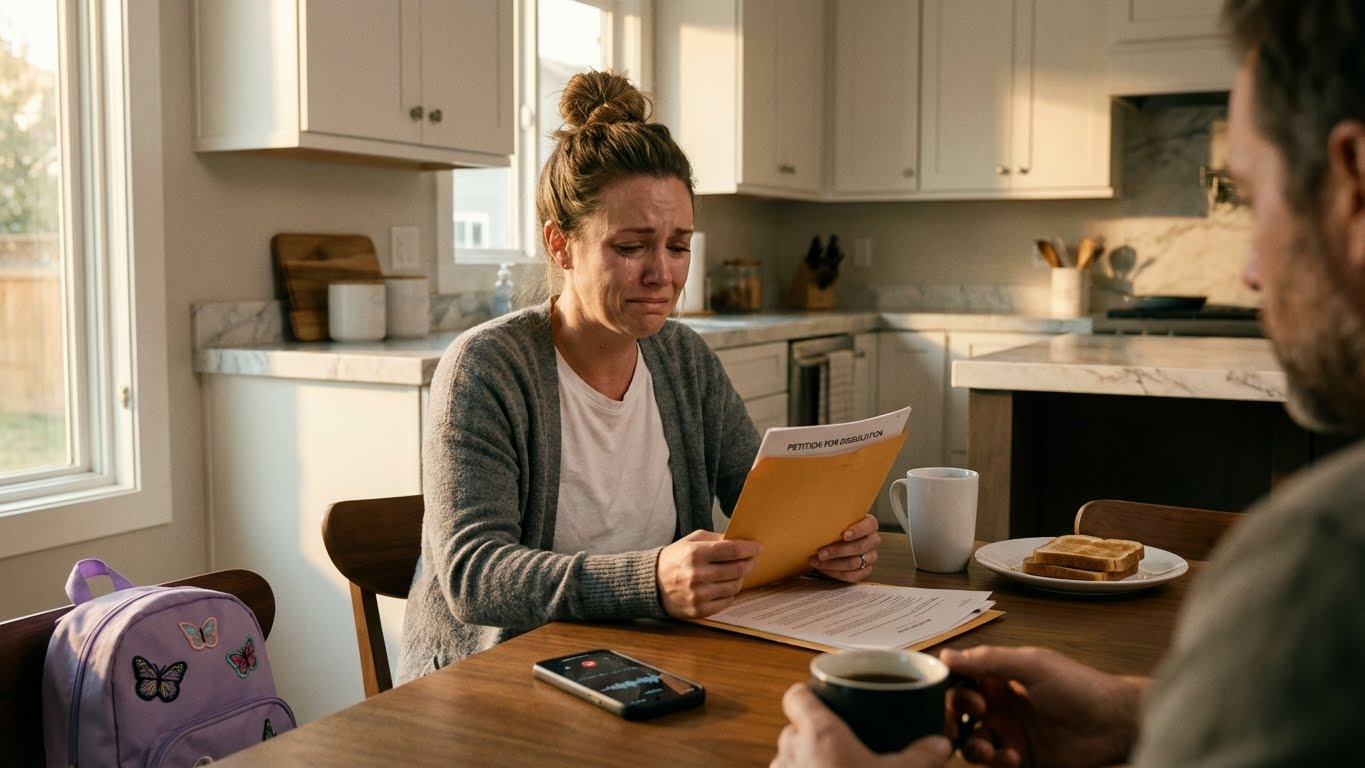
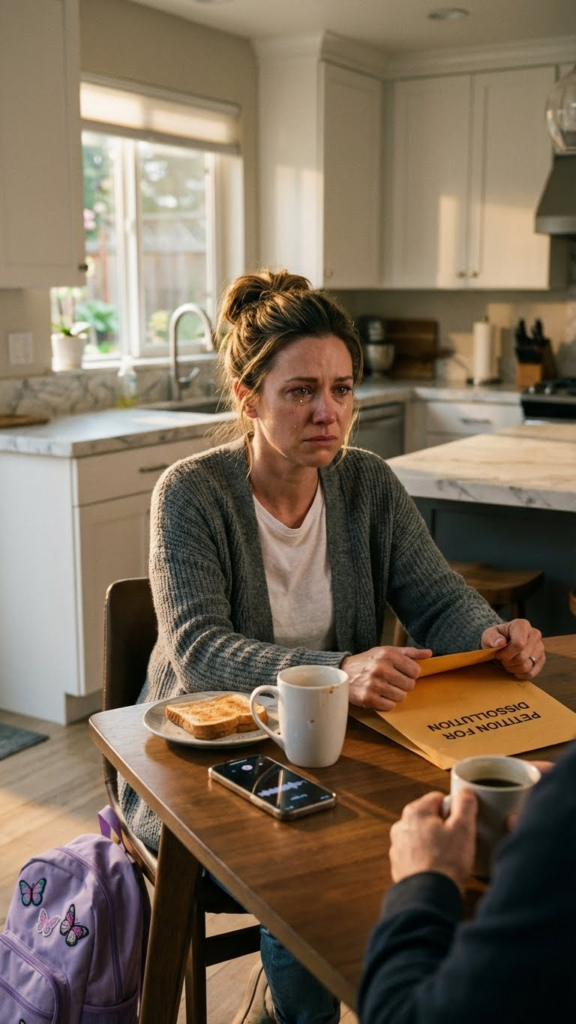
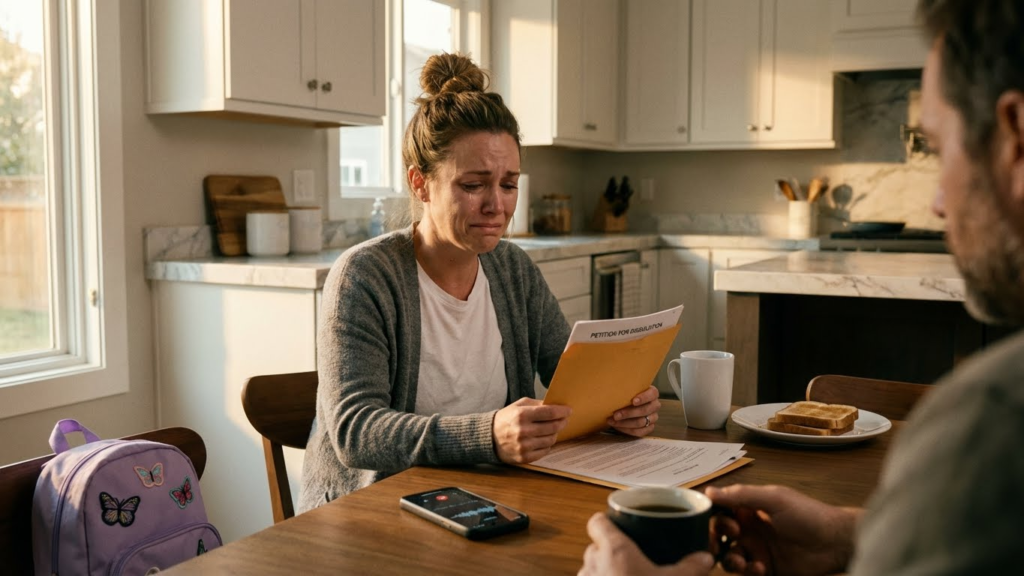
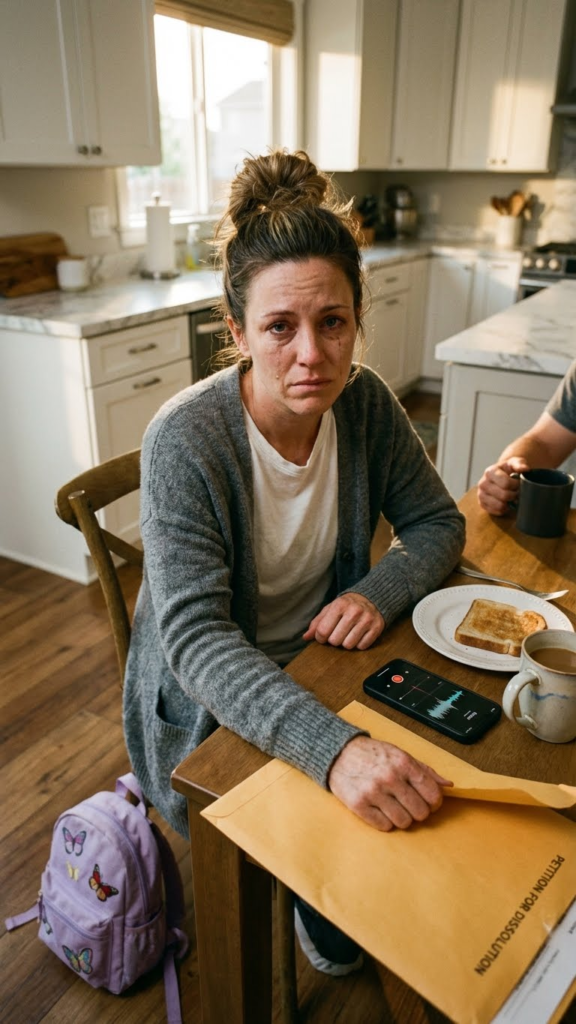
The divorce papers sat on our kitchen table between the cold coffee and my daughter’s untouched breakfast.
“You’ve lost your mind, Sarah,” my husband Mark said, his voice eerily calm. “You pulled Lily out of one of the best schools in the district because she had a bad day.”
“A bad day?” My hands shook as I held up my phone. “Mark, look at this. Look at what I recorded yesterday.”
I pressed play. My seven-year-old daughter’s voice filled our kitchen—small, broken, terrified.
“Please, Mrs. Henderson, I didn’t mean to… I’m sorry… Please don’t call me stupid again…”
Mark’s jaw tightened, but he didn’t look at the screen. “You’re not supposed to record teachers. That’s probably illegal.”
“She called our daughter stupid. In front of thirty kids. For the eighth time this month.”
“Kids exaggerate—”
“I WAS THERE!” My voice cracked. “I volunteered in the classroom. I saw it with my own eyes. I watched that woman destroy Lily piece by piece for three months while you told me I was overreacting.”
Mark stood up, his chair scraping against the floor. “Lily needs to learn resilience. The real world isn’t soft. You’re turning her into a victim.”
I stared at the man I’d been married to for nine years. The man who used to cry watching Lily take her first steps. The man who’d promised to protect our family no matter what.
“Who are you?” I whispered.
He picked up the envelope from his briefcase—the one I’d been pretending not to notice. “I’m someone who’s tired of being married to a helicopter parent who makes impulsive decisions that affect our entire family.”
“Impulsive? Mark, Lily was having panic attacks every morning. She was wetting the bed again. She begged me not to make her go back to that classroom—”
“So you enrolled her in some hippie homeschool co-op without consulting me. You quit your job to teach her yourself. You made unilateral decisions about OUR child’s future.”
“Because you wouldn’t listen! You kept saying she needed to ‘toughen up’ while she was falling apart!”
Mark slid the envelope across the table. His wedding ring caught the morning light—the same ring I’d placed on his finger promising forever.
“I can’t do this anymore, Sarah. I won’t be married to someone who doesn’t respect my input as a parent. Sign these, or I’ll file for emergency custody. I’ll prove you’re unstable. I’ll put Lily back in that school where she belongs.”
The world tilted. Everything I thought I knew about my husband, my marriage, my life—it all shattered in that moment.
But then I heard it. The soft creak of a floorboard upstairs. Lily’s door opening. Small footsteps on the stairs.
My daughter had heard everything.
September began with such hope.
Lily had been so excited for second grade. She’d picked out her first-day outfit two weeks early—a purple dress with butterflies. She’d practiced writing her name in cursive all summer. She’d talked endlessly about making new friends and learning multiplication.
Mark and I had felt like we were finally hitting our stride as parents. Our careers were stable—him as a corporate attorney, me as a marketing consultant working from home. We’d just paid off my student loans. We were talking about maybe having another baby.
Life felt… complete.
The first sign something was wrong came on Day Three.
I picked Lily up from school and she was unusually quiet. Her eyes were red-rimmed.
“How was school, baby?”
“Fine.”
“Just fine? What did you learn today?”
“Nothing.”
That night, she barely ate dinner. Mark was working late, so it was just us. I tried to draw her out, but she kept saying everything was “fine.”
At bedtime, she finally broke. “Mommy, what does ‘slow’ mean?”
My heart clenched. “Slow means not fast. Why?”
“Mrs. Henderson said I’m slow at math. She said it in front of everyone. Trevor laughed at me.”
I pulled her into my lap. “Everyone learns at different speeds, sweetheart. That doesn’t mean you’re slow—it means you’re learning.”
“But Mrs. Henderson sounded mad. Like I did something wrong.”
I should have known then. I should have acted immediately.
Instead, I told Mark about it that night. He was reviewing case files in bed, barely looking up.
“Teachers have to push kids sometimes,” he said absently. “It builds character. You remember Mrs. Brennan in fourth grade? She was tough on me, but I turned out fine.”
“Mark, Lily’s seven. She doesn’t need to be ‘pushed’—she needs encouragement.”
“Don’t coddle her, Sarah. The world’s competitive. Better she learns now than struggles later.”
I let it go. I shouldn’t have, but I did.
Over the next six weeks, things got progressively worse.
Lily started complaining of stomachaches every morning. She’d cry during breakfast, begging to stay home. Mark would tell her to “buck up” while I tried to comfort her.
Her grades plummeted. Math tests came back with red marks everywhere. Her usually neat handwriting became shaky and rushed. Teacher comments on her work said things like “Needs to focus” and “Not trying hard enough.”
But when I’d sit with her doing homework, Lily would get every problem right. She understood the concepts. So why was she failing at school?
I started volunteering in her classroom twice a week as a reading helper. That’s when I saw the truth.
Mrs. Henderson was a nightmare.
She was a veteran teacher—twenty-three years in the district, beloved by parents who valued “discipline” and “high standards.” She ran her classroom like a military boot camp.
But with Lily, she was especially cruel.
I watched her call on Lily during math, then sigh dramatically when Lily hesitated before answering. “Anyone else? Someone who actually prepared?”
I watched her hold up Lily’s art project—a beautiful watercolor of our cat—and say, “This is why we follow directions, class. Lily decided to do her own thing instead of the assignment. That’s what happens when you don’t listen.”
The assignment had been to paint an animal. Lily had followed directions perfectly. Mrs. Henderson just didn’t like her interpretation.
I watched her make Lily stay in during recess to “redo” assignments that were already correct. When I asked about it, Mrs. Henderson smiled tightly and said, “Lily has potential, but she needs to learn that good enough isn’t excellent. I’m sure you want excellence for your daughter.”
The way she said it made me feel like a bad parent for questioning her.
But the worst moment—the one that broke me—came on a Tuesday morning in October.
I’d arrived early to set up for reading groups. The classroom was empty except for Mrs. Henderson at her desk and Lily, who’d been dropped off by Mark on his way to court.
Lily was at her desk, trying to solve a math worksheet. I could see her struggling, erasing and rewriting, her little face scrunched in concentration.
Mrs. Henderson walked over. I was in the back of the room organizing books, and neither of them saw me.
“Lily, this is unacceptable,” Mrs. Henderson said coldly. “This is basic addition. A second-grader should not struggle this much.”
“I’m trying, Mrs. Henderson. I just—”
“Trying isn’t good enough. Do you know what I think? I think you’re lazy. I think you don’t actually want to learn. I think you’d rather waste everyone’s time being stupid.”
Lily’s bottom lip trembled. “I’m not stupid.”
“Then prove it. Redo this entire sheet, and if it’s not perfect, you’ll miss recess again.”
Lily started crying. Soft, broken sobs that shattered my heart.
Mrs. Henderson rolled her eyes. “And now we’re crying like a baby. This is exactly what I’m talking about—no resilience.”
I dropped the books I was holding. The crash made them both jump.
“What did you just say to my daughter?”
Mrs. Henderson’s face went pale, then red. “Mrs. Morrison, I was just—”
“You called her stupid. You called her lazy. You made her cry.” My voice was shaking with rage. “What the hell is wrong with you?”
“I think you misheard—”
“I heard perfectly.” I walked over to Lily and knelt beside her desk. “Baby, get your backpack. We’re leaving.”
“Mrs. Morrison, you can’t just—”
“Watch me.” I helped Lily pack her things, my hands trembling. “Come on, sweetheart. You’re never coming back to this classroom.”
As we walked out, Mrs. Henderson called after me. “You’re making a mistake! Lily needs structure! You’re going to ruin her by coddling her!”
I didn’t turn around. I just held my daughter’s hand and kept walking.
I thought Mark would understand when I told him what happened. I was wrong.
“You pulled her out of school? Without talking to me?” He was furious, pacing our living room while Lily watched TV upstairs.
“Mark, she called our daughter stupid and lazy. To her face. I recorded it.”
“That’s probably illegal—”
“I don’t care! She’s destroying Lily’s confidence!”
“So your solution is to pull her out and what—homeschool her? You’re not a teacher, Sarah.”
“I have a master’s degree and I worked in education before marketing. I’m perfectly capable—”
“This is insane. Westfield Elementary is one of the best schools in the state. You’re going to throw that away because Lily got her feelings hurt?”
I stared at him. “Got her feelings hurt? Mark, she was having panic attacks. She’s seven years old wetting the bed because she’s so stressed about school. This isn’t normal!”
“Kids need to learn to handle pressure. You’re teaching her to run away from problems.”
“No, I’m teaching her that her safety and mental health matter more than reputation or convenience.”
Mark’s face hardened. “I’m calling the school tomorrow. I’m getting Lily re-enrolled, and she’s going back to Mrs. Henderson’s class. We’re going to apologize for your behavior, and Lily is going to learn to push through challenges.”
“Absolutely not.”
“I’m her father, Sarah. I have equal say.”
“Then I guess we disagree.”
We argued for three more hours. It was the worst fight of our marriage. Mark accused me of being overprotective, irrational, and undermining his authority as a parent. I accused him of being cold, dismissive, and caring more about appearances than our daughter’s wellbeing.
We didn’t speak for two days.
During that time, I enrolled Lily in a small homeschool co-op that met three days a week. The other two days, I’d teach her at home using a curriculum I researched obsessively. I also gave notice at my job—I couldn’t work full-time and homeschool.
When I told Mark, he said four words: “I want a divorce.”
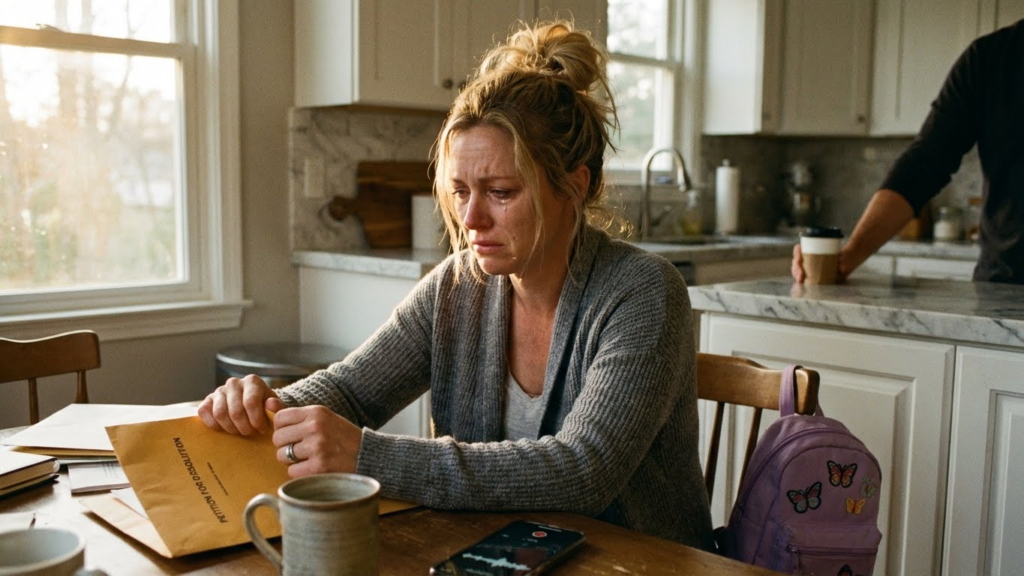
The divorce papers Mark slid across the table that morning weren’t just about ending our marriage. They included a motion for emergency custody.
He was claiming I was mentally unstable. That I’d made reckless decisions endangering our daughter’s education and future. That I needed psychological evaluation before being allowed unsupervised time with Lily.
“You can’t be serious,” I whispered, staring at the documents.
“I’ve already spoken to my attorney. We have witnesses—Mrs. Henderson, the principal, the school counselor. They’ll all testify that you overreacted, made false accusations, and pulled Lily out of school against professional advice.”
“Professional advice? Mark, she was being abused—”
“She was being taught discipline. There’s a difference, and a judge will see that.”
That’s when I heard it. The creak upstairs. The small footsteps.
Lily appeared in the doorway, still in her pajamas, her stuffed rabbit clutched to her chest. Her face was pale, her eyes huge.
“Daddy?” Her voice was so small. “You want to make me go back to Mrs. Henderson?”
Mark’s face softened slightly. “Lily, honey, go back to bed—”
“I heard you. You said Mommy is crazy for taking me out of school. You said I need to go back.”
“Lily, you don’t understand. Adults are talking—”
“I understand.” Tears rolled down her cheeks. “You think Mommy’s wrong. You think Mrs. Henderson was right to call me stupid.”
“That’s not what I—”
“She did call me stupid, Daddy. Lots of times. She said I was lazy and slow and that I waste everyone’s time. She made me cry every single day. And Mommy tried to tell you, but you wouldn’t listen.”
Mark looked stricken. “Lily, I just want what’s best—”
“No, you want what’s easy. You don’t want to believe Mrs. Henderson is mean because then you’d have to admit Mommy was right and you were wrong.”
The silence that followed was deafening.
My seven-year-old daughter had just articulated what I’d been trying to say for months.
Mark opened his mouth, then closed it. He looked at Lily, really looked at her, and I saw something crack in his expression.
“Baby, I—” His voice broke. “I didn’t know it was that bad.”
“Because you didn’t ask me. You only asked Mommy, and you didn’t believe her.”
What happened next, I didn’t expect.
Mark sat down at the table, his hands shaking. “Lily, can you tell Daddy exactly what Mrs. Henderson did? All of it?”
For the next thirty minutes, my daughter—my brave, articulate, amazing daughter—told her father everything. The daily criticisms. The public humiliations. The way Mrs. Henderson would mark correct answers wrong and claim Lily had “changed them.” The isolation during recess. The constant message that she wasn’t good enough, smart enough, fast enough.
Mark listened with tears streaming down his face.
When Lily finished, she looked at him with devastating clarity. “Daddy, if you make me go back there, I’ll know you don’t love me. Because people who love you don’t make you go places where people hurt you.”
Mark broke. Completely, utterly broke.
He pulled Lily into his arms and sobbed. “I’m so sorry, baby. I’m so, so sorry. You’re right. Mommy was right. I was wrong. I was so wrong.”
I stood frozen, watching my husband shatter.
“I thought,” he gasped between sobs, “I thought I was teaching you to be strong. My dad was hard on me, and I turned out successful, so I thought… I thought that’s what fathers do. I thought being soft meant being weak.”
“You’re not weak when you protect people you love,” Lily said quietly. “That’s what Mommy taught me. She protected me even when everyone said she was wrong. That’s strong.”
Mark looked at me over Lily’s head. His face was destroyed—guilt, shame, grief, all of it written in the lines around his eyes.
“Sarah, I am so sorry. I failed both of you. I was so focused on what I thought parenting should look like that I didn’t see what was actually happening. I didn’t listen. I didn’t believe you. I threatened to take our daughter away from the one person who actually protected her.”
I couldn’t speak. Couldn’t move.
“I don’t deserve your forgiveness,” he continued. “But please, please let me make this right. Let me be the father Lily deserves. The husband you deserved all along.”
I didn’t answer him right away. I couldn’t.
Instead, I took Lily upstairs to her room. I held her while she cried—releasing months of fear and stress and pain. I told her she was brave and strong and perfect exactly as she was. I promised her she’d never have to go back to that classroom.
Then I called a lawyer—not for divorce, but for something else entirely.
By the end of the week, I’d filed a formal complaint against Mrs. Henderson with the school district. I submitted all my recordings, documentation, and Lily’s testimony. I demanded an investigation.
Mark came with me to every meeting. He backed me up completely, using his legal expertise to ensure the school took us seriously.
The investigation took six weeks. During that time, three other parents came forward with similar stories about Mrs. Henderson. Apparently, Lily wasn’t her only victim—just the first one whose parent actually fought back.
Mrs. Henderson was placed on administrative leave. She ultimately took early retirement rather than face termination proceedings.
The school issued a formal apology. They implemented new policies around classroom observations and emotional safety. They offered Lily a place in any classroom she wanted if we chose to return.
We didn’t. Lily was thriving in her homeschool co-op. She was happy, confident, making friends, and actually enjoying learning again. Why would we change that?
Mark and I didn’t divorce. But our marriage changed fundamentally.
We went to counseling—both couples therapy and individual sessions for Mark to work through his childhood issues around “toughness” and emotional expression.
It was hard. There were setbacks. There were nights I wasn’t sure we’d make it.
But slowly, painfully, we rebuilt trust.
Mark learned to listen—really listen—without dismissing concerns as overreactions. He learned that protecting our daughter’s emotional wellbeing wasn’t coddling, it was parenting. He learned that admitting mistakes doesn’t make you weak, it makes you human.
And he became the father Lily deserved. The one who attended homeschool events and bragged about her art projects and told her every day that she was brilliant and kind and enough exactly as she was.
One evening, almost exactly a year after that terrible morning with the divorce papers, we were having dinner together. Lily was chattering about the science experiment she’d done that day—something about volcanoes and chemical reactions.
Mark listened with genuine interest, asking questions, praising her observations. When she finished, he reached across the table and took my hand.
“You saved her,” he said quietly. “When I was too stubborn to see the truth, you saved our daughter. I’ll never be able to thank you enough for being strong when I was weak.”
I squeezed his hand. “We saved her together. Eventually.”
“No,” he said firmly. “You saved her. I almost destroyed everything because of my pride. You’re the hero in this story, Sarah. Don’t let me rewrite history.”
Lily looked between us, then smiled. “I think you’re both heroes. Mommy for protecting me first, and Daddy for learning to listen. That’s what families do—they save each other.”
Out of the mouths of babes.
Looking back on that nightmare period, I’ve learned some hard truths:
Trust your instincts as a parent. If something feels wrong, it probably is—even if everyone around you says you’re overreacting.
Protecting your child’s mental health is never overreacting. Never. A bad grade can be fixed. A damaged sense of self-worth takes years to heal.
Sometimes doing the right thing means standing completely alone. It means losing jobs, relationships, stability. It means being called crazy, overprotective, unstable. Do it anyway.
And finally: people can change. Not always, not easily, but sometimes—if they’re willing to do the hard work of confronting their own failures.
Mark changed. Our marriage survived. Our family is stronger now than it was before.
But none of that would have happened if I hadn’t trusted myself enough to pull Lily out of that toxic classroom. If I hadn’t been willing to risk everything—my marriage, my reputation, my financial stability—to protect my child.
Would I do it again?
In a heartbeat.
Because at the end of the day, when everything else falls away, the only thing that really matters is looking your child in the eyes and knowing you fought for them when they couldn’t fight for themselves.
Everything else is just noise.