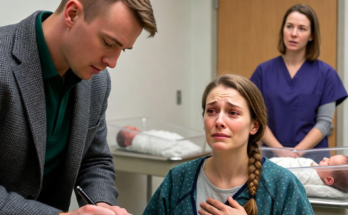
The doctor’s hand lingered on my shoulder for just a second too long.
“I’m so sorry,” she whispered, her eyes glistening behind her surgical mask. Then she turned and left my delivery room without another word.
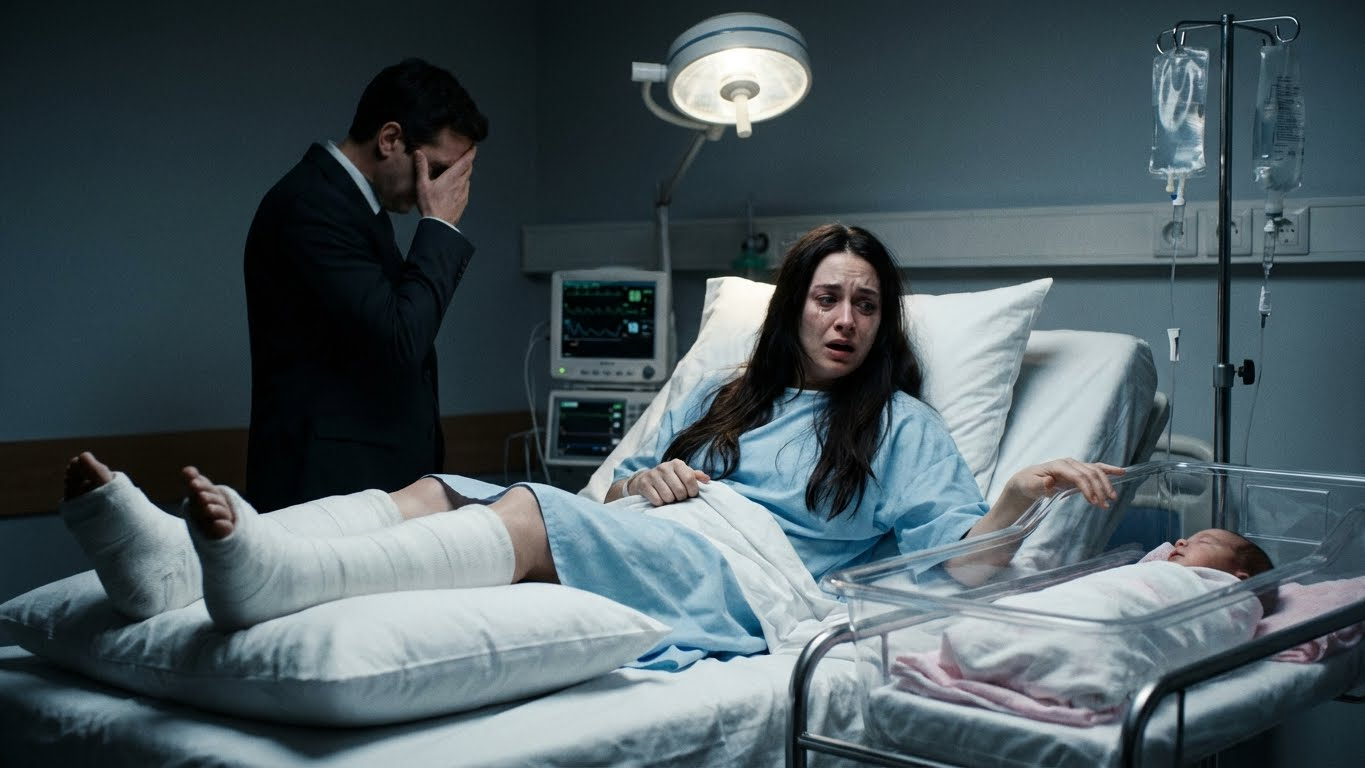
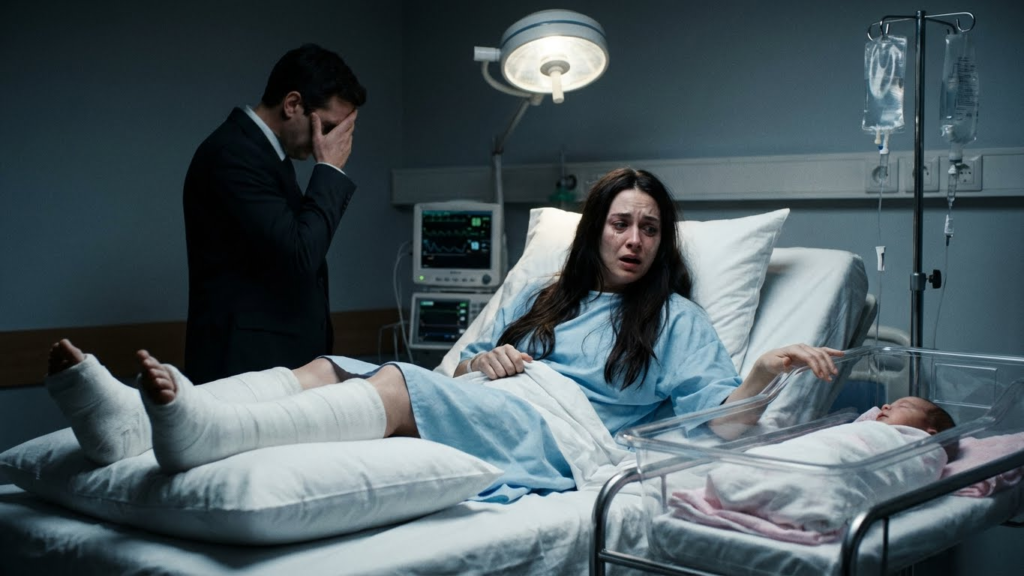
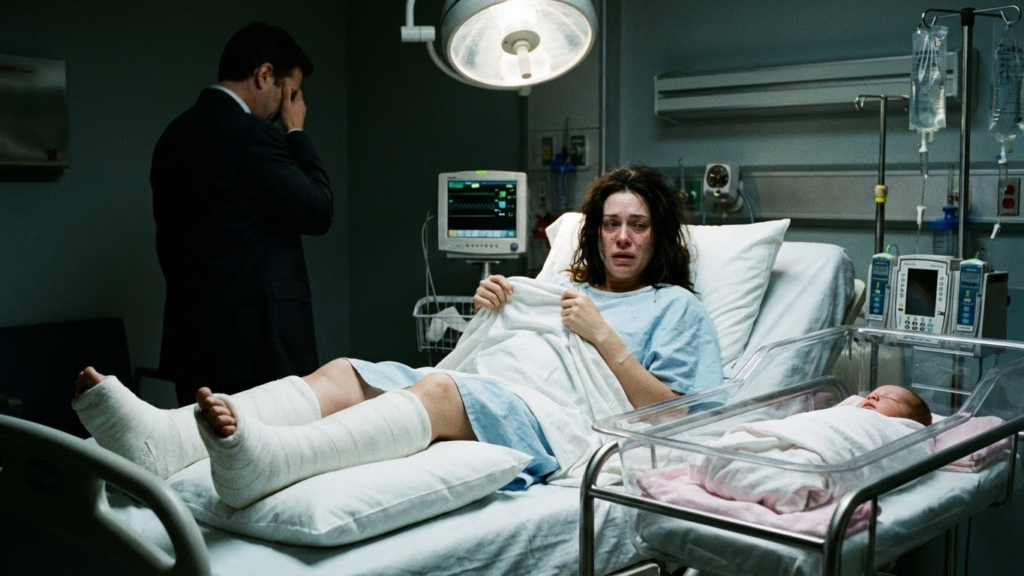
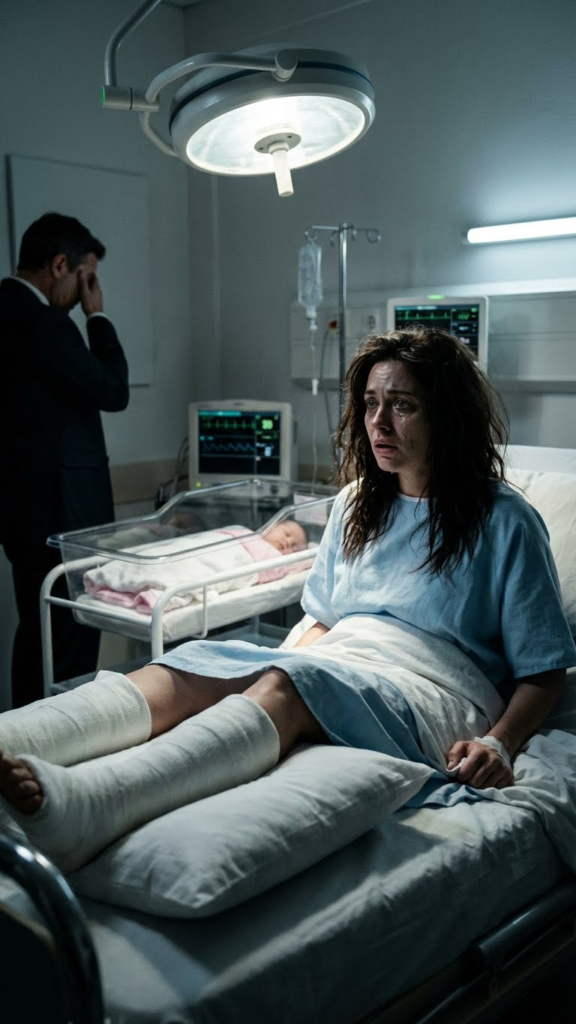
I lay there in the hospital bed, my newborn daughter sleeping in the bassinet beside me, trying to understand what just happened. My legs were still in casts from the car accident three weeks ago—the accident that had nearly killed us both. The epidural was wearing off. Everything hurt.
But nothing hurt like the look in Dr. Martinez’s eyes.
“What did she mean?” I asked my husband, James. He was standing by the window, staring out at the parking lot, his back to me and our baby. “James? Why did the doctor apologize?”
He didn’t turn around. His shoulders were rigid, his hands clenched at his sides.
“James, you’re scaring me. What’s going on?”
The silence stretched for what felt like hours. I could hear my own heartbeat pounding in my ears. The monitors beeping. A nurse laughing somewhere down the hall. Normal sounds in a moment that felt anything but normal.
Finally, he turned around. His face was pale, his eyes red-rimmed. He looked like he’d aged ten years in the twelve hours since my labor started.
“There’s something I need to tell you,” he said, his voice barely above a whisper. “Something I should have told you a long time ago.”
My hands instinctively moved to cover my sleeping daughter. Some primal part of me knew—whatever he was about to say would destroy everything.
“The accident,” he continued, each word seeming to physically pain him. “It wasn’t an accident, Rachel. The car that hit you—”
The door opened. A nurse walked in with my discharge papers and medication schedule, cheerfully oblivious to the bomb my husband was about to drop. James went silent, his jaw clenched so tight I could see the muscle twitching.
The nurse took fifteen minutes going over post-partum instructions and pain management for my broken legs. Fifteen minutes of torture while I waited for my world to end. She kept smiling, congratulating us, saying how lucky we were that both baby and I had survived.
Lucky.
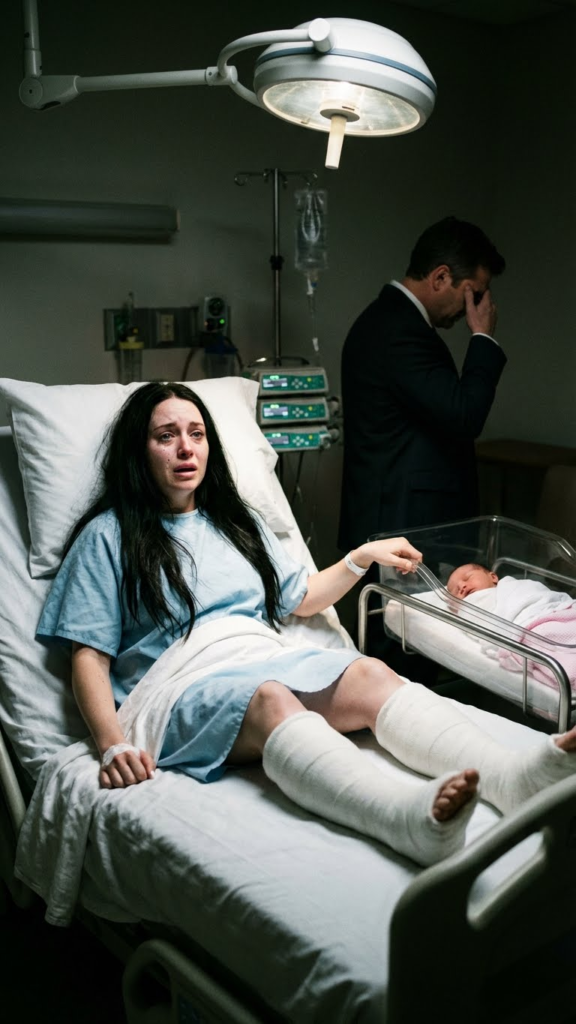
The moment she left, I locked eyes with James. “Finish what you were saying. Now.”
He walked to the door and locked it. That simple action—that click of the lock—told me everything I needed to know. Whatever secret he’d been carrying, it was worse than I’d imagined.
“The woman who hit you,” he said, his voice breaking. “Her name is Victoria Chen. She’s a nurse here. She works on the maternity floor.”
My blood went cold. “What?”
“She’s been my… we’ve been…” He couldn’t say it. Couldn’t form the words.
But he didn’t have to. The pieces were already falling into place. Dr. Martinez’s apology. The strange looks from nurses during my labor. The way James had been so insistent I deliver at this specific hospital instead of the one closer to our house.
“She tried to kill me,” I whispered. “Your mistress tried to kill me and our baby.”
James’s face crumbled. “Rachel, please, it’s not—”
“And Dr. Martinez knows. Everyone here knows.” I started laughing—a horrible, broken sound. “I gave birth surrounded by people who knew my husband’s mistress tried to murder me.”
To understand how I ended up in a hospital bed with two broken legs and a newborn, being confessed to by my cheating husband, you need to know how perfect our life looked from the outside.
James and I had been married for eight years. High school sweethearts who made it work through college, careers, and finally homeownership in a beautiful suburban neighborhood. We were the couple everyone envied—still holding hands at dinner parties, finishing each other’s sentences, planning our future.
When I got pregnant after years of trying, it felt like the final piece of our perfect life falling into place.
But perfection is often just a carefully maintained illusion.
The cracks started showing around my second trimester. James, who’d always been attentive, started working late constantly. He’d come home after I was asleep and leave before I woke up. When I asked about it, he said his company was going through a merger and he needed to prove his value.
I believed him. Why wouldn’t I? We’d been together for over a decade. He’d never given me a reason not to trust him.
I was so naive.
The pregnancy was difficult. I had severe morning sickness that lasted all day, gestational diabetes, and terrible back pain. I spent most days working from home in my pajamas, feeling increasingly isolated and unattractive.
James seemed distant. Distracted. When I’d try to talk about baby names or nursery colors, he’d nod absently and go back to his phone.
“Are you having second thoughts about becoming a father?” I asked him one night in my seventh month.
He looked startled. “What? No, of course not. I’m just stressed about work.”
“You barely talk to me anymore.”
“Rachel, I’m exhausted. Can we not do this right now?”
That became his standard response. I’m exhausted. Not now. You’re being hormonal.
I started to feel crazy. Was I being unreasonable? Was pregnancy making me paranoid?
Then came the parking lot.
It was a Tuesday afternoon, three weeks before my due date. I had a regular checkup at my OB’s office—ironically, at the same hospital where I’d later give birth. James was supposed to come with me but canceled last minute, citing an “emergency meeting.”
The appointment was routine. Baby was healthy, measuring right on track. Dr. Martinez said everything looked perfect for a normal delivery in a few weeks.
I was walking to my car in the hospital parking garage, one hand on my enormous belly, the other digging in my purse for my keys. I remember thinking about what to make for dinner. I remember the fluorescent lights flickering overhead. I remember hearing footsteps echoing behind me.
Then I heard an engine rev.
I turned around just in time to see a silver Honda accelerating directly toward me.
I tried to run, but at thirty-seven weeks pregnant, running wasn’t exactly an option. I managed to dive between two parked cars, but not fast enough. The Honda clipped my legs, spinning me around and slamming me against a concrete pillar.
The pain was instantaneous and overwhelming. I heard my own screaming like it was coming from someone else. I felt my body hit the ground. And then I felt nothing but terror—not for myself, but for my baby.
People came running. Someone called 911. A security guard kept asking me questions I couldn’t process. All I could think was: Please let my baby be okay. Please, please, please.
Through the chaos, I caught a glimpse of the Honda’s driver. A woman, Asian, late twenties or early thirties, staring at me through her windshield with an expression I couldn’t quite read. Horror? Guilt? Something else?
Then she drove away.
Security got her license plate, but in that moment, I didn’t care about catching her. I only cared about my baby.
I was rushed into emergency surgery. Both legs were broken—compound fractures that required pins and plates. But the doctors’ primary concern was the baby. The impact had caused placental abruption. My daughter was in distress.
They performed an emergency C-section while repairing my legs.
I woke up in recovery to find James sitting beside my bed, crying. Real, gut-wrenching sobs.
“The baby?” I croaked, my throat raw from intubation.
“She’s okay,” he choked out. “Four pounds, six ounces. She’s in the NICU but she’s okay. Rachel, I’m so sorry. I should have been there. I should have driven you—”
“It’s not your fault,” I whispered, reaching for his hand. “It was an accident.”
The look that crossed his face should have told me everything. But I was too drugged, too traumatized, too relieved that my baby was alive to read it properly.
Over the next three weeks, I remained in the hospital. My legs needed time to heal before I could be discharged. Our daughter—we named her Sophia—stayed in the NICU, growing stronger every day.
James visited daily, but something was off. He seemed anxious, constantly looking over his shoulder. He’d flinch every time a nurse walked by. He insisted I didn’t need to know the details about the driver who hit me, that he’d “handle everything” with the police and insurance.
I was too focused on recovery and bonding with Sophia to push the issue.
The hospital staff was wonderful—with one exception. There was a nurse named Victoria who always seemed to be assigned to my floor. She was competent, professional, but she’d barely make eye contact with me. When she did, her expression was strange. Guilty? Fearful? I couldn’t quite place it.
“Is Victoria new?” I asked another nurse one day.
“Oh no, she’s been here for five years. She’s usually on the maternity ward, but she’s been covering post-surgical lately. Why?”
“No reason. She just seems… uncomfortable around me.”
The nurse gave me an odd look but didn’t comment.
Three weeks after the accident, Dr. Martinez cleared me to go home with Sophia. She’d scheduled my discharge for a Tuesday—the same day I’d be officially released to leave the hospital with my daughter for the first time.
That was the day everything came crashing down.
After James’s initial admission about Victoria being his mistress, I couldn’t speak. Couldn’t process. My brain refused to accept what he was telling me.
“How long?” I finally whispered.
“Eight months.”
Eight months. I’d been pregnant for eight of them. He’d started his affair right around the time I’d told him we were expecting.
“Where did you meet her?”
“Here. At the hospital. When you had that false alarm labor scare in your second trimester, remember? She was your nurse that night. We started… talking.”
Talking. What a sanitized word for betrayal.
“And the accident?” My voice was mechanical now, shock creating a strange distance from my emotions. “Tell me about the accident, James.”
He sank into the chair beside my bed, his head in his hands. “Victoria became obsessed. I tried to end it when you were in your third trimester. I told her I was recommitting to you and the baby. She didn’t take it well.”
“Define ‘didn’t take it well.'”
“She threatened to tell you everything. To ruin my career. To—” He stopped.
“To what, James? Finish the sentence.”
“To make sure you never had the baby.”
The room spun. I gripped the bed rails to steady myself. “She threatened my pregnancy, and you didn’t warn me?”
“I thought she was just upset! I didn’t think she’d actually—”
“She tried to kill me!” My voice rose, causing Sophia to stir in her bassinet. I forced myself to lower my volume. “She hit me with her car in a hospital parking garage where there are cameras everywhere. What kind of psychopath does that?”
“The police have been building a case. They know it was deliberate. They arrested her two days ago.”
“Two days ago,” I repeated numbly. “You’ve known for two days that your mistress deliberately tried to murder me and our baby, and you’re just telling me now?”
“I didn’t know how to—”
“GET OUT!” I screamed, no longer caring if I woke the baby. “Get out of this room right now!”
“Rachel, please—”
“I said GET OUT!”
A security guard opened the door, responding to my screaming. “Ma’am, is everything alright?”
“No,” I said clearly. “Everything is not alright. I want this man removed from my room immediately. And I want to speak to hospital administration. Now.”
What happened over the next two days felt like an out-of-body experience.
Hospital administration sent their risk management team, their legal counsel, and eventually their CEO. They were terrified—and rightfully so. One of their nurses had committed attempted murder in their parking garage, targeting a pregnant patient. Their liability was astronomical.
But I wasn’t interested in suing the hospital. I was interested in the truth.
Dr. Martinez came to my room that evening, officially off-duty but clearly carrying the weight of guilt.
“I should have said something sooner,” she admitted, sitting in the chair James had vacated. “I suspected Victoria was involved with your husband. Hospital gossip spreads quickly. When you were brought in after the accident, the way she reacted… I knew. But I had no proof, and accusing a colleague of attempted murder without evidence—”
“You could have warned me that she worked here. That my husband’s mistress was walking these halls while I recovered.”
“You’re right. I failed you. I’m so, so sorry.”
Her apology felt genuine, but it didn’t change anything. I’d been surrounded by people who knew the truth while I’d remained oblivious, vulnerable, and in danger.
The police came next. Detective Morrison explained that Victoria had confessed everything. The affair. The obsession. The deliberate decision to run me down in the parking garage. She’d been charged with attempted murder, aggravated assault, and attempted feticide—intentionally trying to harm a fetus.
“Her attorney is trying to argue diminished capacity due to emotional distress,” Detective Morrison said. “But between the surveillance footage, her confession, and the digital evidence of her stalking behavior, she’s not getting off easy. We’re looking at fifteen to twenty-five years.”
Fifteen to twenty-five years. It seemed both too much and not enough for trying to kill a pregnant woman and her unborn child.
James tried to visit multiple times. I had security turn him away. His mother called, crying, begging me to let him explain. I blocked her number. His father sent an email saying I was being unreasonable and that “marriages require forgiveness.”
I deleted it without responding.
My own mother flew in from Oregon within hours of hearing what happened. She held me while I cried, helped me with Sophia, and quietly made plans.
“You’re coming home with me,” she said. “For as long as you need. You can’t stay here, and you certainly can’t go back to that house with him.”
“Mom, I have two broken legs. I have a newborn. I can’t just—”
“You absolutely can. I’ve already talked to a lawyer. A good one. She’s going to make sure James pays for everything—your medical bills, Sophia’s care, child support, and a very generous divorce settlement.”
Divorce. The word should have devastated me. Instead, it felt like relief.
Victoria Chen’s trial took place six months later. By then, I was walking again without casts, Sophia was healthy and thriving, and I’d filed for divorce.
I testified about the accident, the recovery, and the betrayal. James testified too, clearly hoping that cooperation would somehow redeem him. It didn’t.
The prosecution painted a clear picture: a woman so obsessed with her married lover that she attempted to eliminate his pregnant wife. The defense tried to argue temporary insanity, that Victoria had been manipulated and abandoned by James.
The jury didn’t buy it.
Victoria Chen was sentenced to eighteen years in prison. She’ll be eligible for parole in twelve.
As she was led out of the courtroom, she looked directly at me. “I’m sorry,” she mouthed.
I didn’t respond. Her apology meant nothing. Sorry doesn’t undo trauma. Sorry doesn’t give back the sense of safety that was stolen. Sorry doesn’t heal broken legs or erase the nightmares of a car accelerating toward your pregnant body.
James tried to approach me outside the courthouse. My lawyer stepped between us.
“Mr. Morrison, you’ve been served with divorce papers. Any further communication should go through legal counsel.”
He looked destroyed. Good.
It’s been a year since that terrible day in the hospital when Dr. Martinez whispered “I’m sorry” and my husband confessed everything.
Sophia is fourteen months old now—walking, babbling, and completely unaware of the violence that preceded her birth. She’s the light of my life, the reason I fought so hard to survive and recover.
The divorce was finalized eight months ago. James was ordered to pay substantial child support and alimony. He has supervised visitation rights, which he exercises inconsistently. Sophia barely knows him.
My legs healed, though I still have pins and plates that set off metal detectors. I walk with a slight limp when I’m tired. Small prices to pay for surviving.
I’ve started a support group for women who’ve experienced violence during pregnancy. We meet twice monthly at a community center. The stories I hear are heartbreaking—intimate partner violence, medical abuse, workplace discrimination against pregnant women. I never imagined there were so many of us.
Dr. Martinez and I have become unlikely friends. She’s testified at legislative hearings about the need for better protections for pregnant patients and more rigorous background checks for healthcare workers with access to vulnerable populations.
The hospital settled with me for an undisclosed amount. I used it to buy a house near my mother, fund Sophia’s college account, and start a nonprofit focused on pregnancy safety and domestic violence prevention.
Last week, I received a letter from Victoria Chen. It was forwarded through my lawyer. She’d written from prison, a long rambling apology asking for forgiveness and understanding.
I burned it without reading past the first paragraph.
Some people think I should forgive her. That holding onto anger is toxic. That she was “mentally unwell” and deserves compassion.
But here’s what I’ve learned: forgiveness is not required. Not for attempted murder. Not for trying to kill my child. Not for the months of physical therapy, the nightmares, the fear that never quite goes away.
I don’t forgive her. I don’t forgive James. And I’m okay with that.
Because sometimes the strongest thing you can do is refuse to minimize what was done to you. Sometimes survival isn’t about forgiveness—it’s about justice, boundaries, and building a new life from the rubble of the old one.
If there’s anything I want other women to take from my story, it’s this:
Trust your instincts. If something feels wrong in your relationship, investigate. Don’t let anyone gaslight you into thinking you’re paranoid or hormonal.
Your safety matters more than someone else’s comfort. If you need to make a scene, burn bridges, or be “difficult” to protect yourself and your children—do it.
Not all apologies deserve acceptance. Some actions are unforgivable, and that’s okay. You don’t owe anyone emotional labor, especially people who tried to harm you.
Document everything. The recordings, photos, and written timeline I kept became crucial evidence in both the criminal case and my divorce. Paper trails save lives.
And finally: you are stronger than you think. I survived a murder attempt while pregnant, gave birth with two broken legs, discovered my husband’s affair in my most vulnerable moment, and rebuilt my entire life with a newborn.
If I can do it, you can too.
Every morning, I wake up to Sophia’s babbling from her crib. I make coffee, feed her breakfast, and watch her explore her world with fearless curiosity. And I think about the woman I was a year ago—broken, betrayed, and terrified.
She would be so proud of who I’ve become.