I’m sitting in my car outside a funeral home, staring at an envelope that’s about to ruin me.
Inside is a letter from a man I mocked three months ago. An old man who died last week. And according to the clinic that just called me, he left me $50,000.
I don’t deserve a single penny.
Let me tell you what I did.
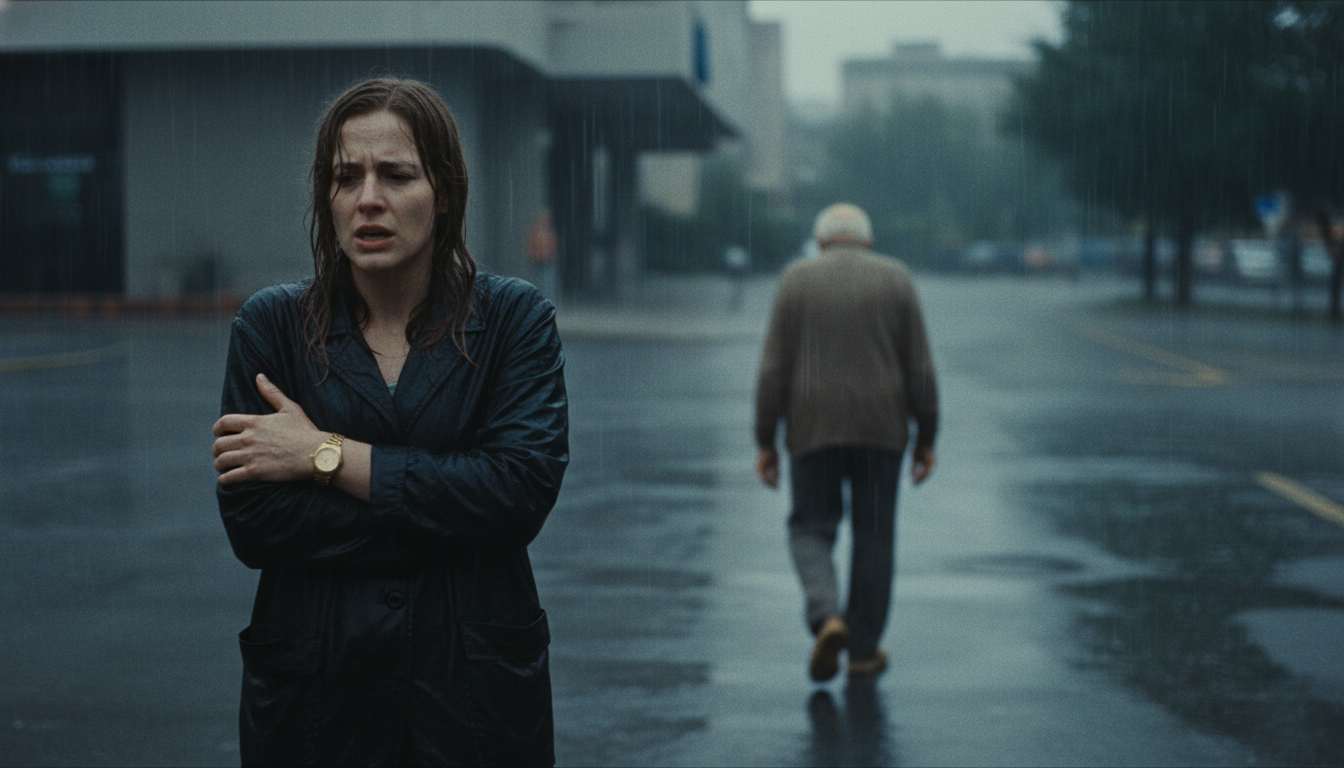
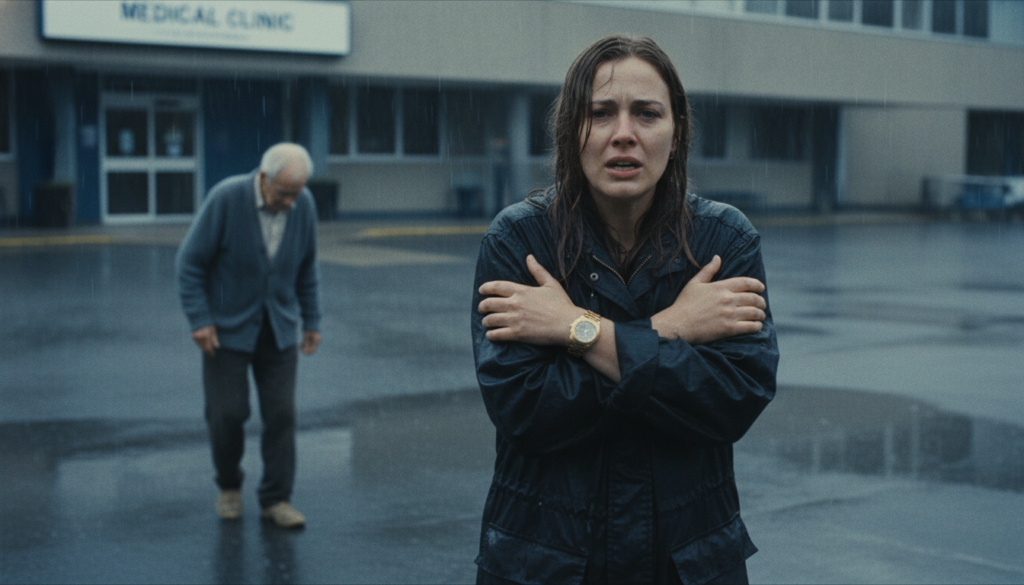
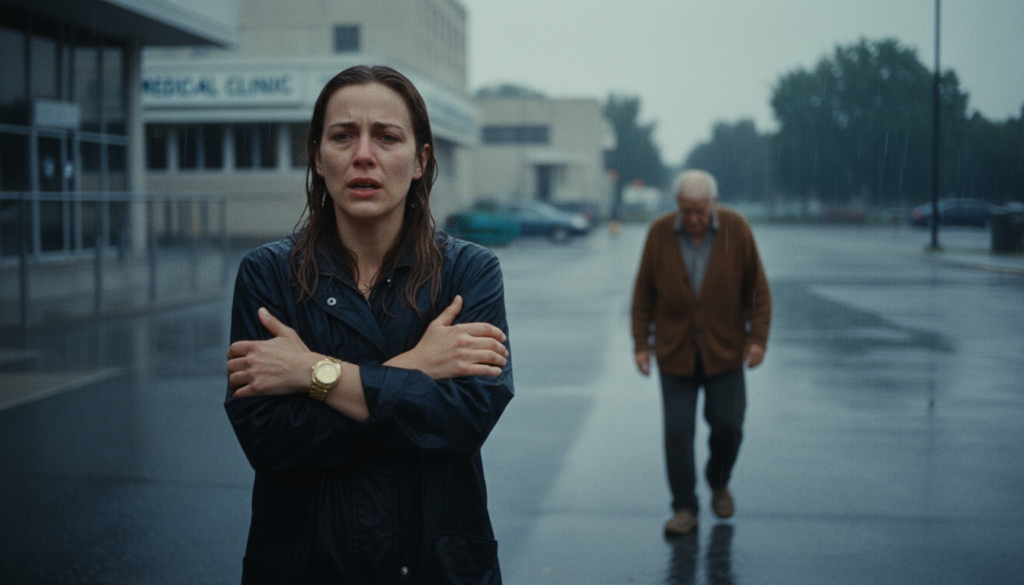
It was pouring rain. I’d just spent my last $847 on my daughter’s emergency doctor visit. My car was dead. My phone was dying. Rent was due in two days, and I had $3 left in my account. I was standing outside the clinic, soaking wet, trying not to cry where Emma could see me.
That’s when this old man shuffled up to me.
He looked like he’d gotten dressed from a charity bin—threadbare cardigan, pants too short, scuffed loafers. He was hunched over, maybe eighties, with thick glasses and trembling hands.
“Miss,” he said softly. “You’re going to catch pneumonia. Please, take my coat.”
He started taking off his cardigan.
And I laughed. Right in his face.
“I’m fine,” I snapped. “Keep your coat.”
Then I saw it—this gorgeous, gleaming watch peeking out from under his sleeve. Even through the rain, I could tell it was worth thousands. Maybe tens of thousands.
Something inside me snapped.
“You’ve got to be KIDDING me,” I said, loud enough that people turned to stare. “You’re wearing a watch worth more than my rent, and you’re offering me your raggedy cardigan? If you actually wanted to help, you’d HELP. Not pull this performative charity BS.”
His face didn’t change. Just those sad, gentle eyes looking at me.
“I understand,” he said quietly. “I hope your day gets better.”
Then he shuffled away, slow and careful on the wet pavement.
I felt justified. Angry. Righteous.
Two weeks passed. Two weeks of scrambling for work, dodging my landlord’s calls, and watching Emma’s medicine bottles get emptier while my bank account stayed at zero.
Then my phone rang.
“Ms. Rivera? This is Janet from Dr. Morrison’s office. We need to discuss your account.”
My heart sank. Here it was—the collections call. The one I’d been dreading.
“I know I owe money,” I started. “I’m working on—”
“No, no,” Janet interrupted, and her voice was strange. Shaky. “There’s been a situation. Do you remember a Mr. Henry Castellano? Elderly gentleman? He comes in regularly for treatments?”
The name meant nothing. “No, I don’t think—”
“He asked about you. Several times, actually. Ms. Rivera, he paid your bill. The entire balance. And he set up a medical fund in your daughter’s name for future care.”
The words didn’t make sense. I stood there in my apartment, Emma coloring at the kitchen table, and my brain just… stopped.
“I’m sorry, what?”
“There’s more,” Janet said, and now I could hear she was crying. “Mr. Castellano passed away last week. Stage four pancreatic cancer. He’d been in treatment with us for nine months.”
The floor tilted beneath me.
“He left specific instructions that we contact you,” Janet continued. “He wanted you to have a letter. Can you come to the clinic today?”
I don’t remember saying yes. I don’t remember the bus ride. I just remember sitting in that waiting room—the same room where I’d grabbed Emma in our soaking clothes, still furious at the world—while Janet handed me a manila envelope.
“Before you read it,” Janet said gently, sitting beside me, “I think you should know something about Mr. Castellano.”
What she told me next destroyed me.
Henry Castellano was 84 years old. He’d been a high school English teacher for forty years before retiring. His wife, Margaret, died three years ago after a long battle with Alzheimer’s. They’d been married for sixty-two years.
He had two children—both successful, both living across the country. They called occasionally. Visited once a year, maybe. They’d offered to move him closer, but he’d refused. This was where Margaret was buried. This was home.
He lived on social security and a modest teacher’s pension. His apartment was a one-bedroom in a building that should have been condemned years ago. When his cancer diagnosis came—aggressive, terminal—he’d cashed in his tiny life insurance policy to start treatment.
It wasn’t enough.
The watch. That beautiful, gleaming Rolex I’d seen on his wrist. That was Margaret’s. She’d worn it every single day of their marriage. Her father had given it to her when she graduated college in 1960. It was worth, according to the appraisal Henry had gotten, approximately $12,000.
He’d been trying to sell it for six months to pay for his chemotherapy.
But he couldn’t do it. Every time he got close, he’d look at that watch and see Margaret’s hand. Hear her laugh. Remember the way she’d tap it twice whenever she was thinking. It was all he had left.
So he sold everything else instead. Furniture. Books. His car. Margaret’s jewelry, except for the watch. He ate one meal a day. He took the bus to his treatments, each trip taking two hours because his hands shook too much to drive.
And on one of those trips—exhausted, nauseated, in pain—he saw me standing in the rain and offered me his cardigan.
His cardigan.
The only thing he could give in that moment.
“He came in the next day,” Janet told me, wiping her eyes. “Asked about you. Wanted to know if you and your daughter were okay. We couldn’t tell him much because of privacy laws, but he saw your account balance in the system. He saw the insurance denials. The outstanding bills.”
Henry Castellano went home that night and sold the watch.
He sold Margaret’s watch. The last piece of her he had.
And he gave me the money.
I couldn’t open the envelope in the clinic. I made it to my car, Emma at my sister’s house, and I just sat there shaking.
Finally, I tore it open.
The handwriting was shaky but careful. Teacher’s handwriting. Each letter precise despite the trembling hand that wrote it.
Dear Ms. Rivera,
If you’re reading this, I’ve passed on. I hope this finds you and your daughter healthy and well.
I want you to know that I don’t blame you for what you said in the rain. You were frightened, exhausted, and protecting your child. There is no shame in that. In fact, it reminded me so much of my Margaret when our kids were small. She was fierce like you. Strong like you.
You saw my watch and thought I was wealthy. I understand why. But I want to tell you something I learned in my eighty-four years on this earth: Wealth has nothing to do with money.
I was wealthy because I had Margaret. I was wealthy because I got to teach for forty years and watch young minds grow. I was wealthy because on that rainy day, I got to offer my coat to someone who needed it.
The fact that you didn’t take it doesn’t make me less wealthy. It just means you weren’t ready to receive that particular gift that day.
I sold Margaret’s watch to help you and your daughter. Please don’t feel guilty about this. Margaret would have wanted me to. She was a teacher too—second grade—and she loved children more than anything. She would have loved Emma. She would have wanted her to be healthy and safe.
This is not charity. This is not pity. This is one human being seeing another human being struggle and offering what they have. Right now, what I have is this money. Tomorrow, when I’m gone, what I’ll have is the peace of knowing I helped.
You offered me something that day too, though you didn’t realize it. You reminded me why Margaret’s watch mattered. Not because it was expensive, but because of what it represented—love, commitment, sacrifice. By selling it to help you, I honored her better than I ever could by keeping it locked in a drawer.
Please accept this gift. Use it for Emma. And maybe, someday when you’re able, offer someone else your coat in the rain. Even if they laugh. Especially if they laugh.
Kindness doesn’t require wealth. It only requires caring.
With respect and hope,
Henry Castellano
P.S. – The cardigan is in the envelope too. Janet is holding it for you. I had it cleaned. Please take it. It was Margaret’s favorite, and I think she’d be happy knowing someone else was keeping warm.
I sobbed in that car for an hour.
The funeral was small. Henry’s daughter, Katherine, was there with her family. His son called in via video. There were a handful of former students, now in their fifties and sixties, who’d driven hours to attend. The receptionist from the clinic. A neighbor.
And me.
I stood in the back, wearing the cardigan, holding Emma’s hand.
When Katherine saw me, she knew immediately who I was. She crossed the room and hugged me so tight I couldn’t breathe.
“You’re the woman from the clinic,” she whispered. “He talked about you constantly. He was so worried about you and your little girl.”
“I was horrible to him,” I choked out. “I laughed at him. I—”
“He loved that about you,” Katherine said, pulling back to look at me. “He said you reminded him of Mom. Fierce. Protective. Real. He said most people fake their kindness, but your anger was honest. He respected that.”
She reached into her purse and pulled out a photograph. Henry and Margaret, maybe in their thirties, standing in front of a Christmas tree. Margaret was wearing the watch, and Henry was wearing the cardigan.
“He wanted you to have this too,” Katherine said. “He told me: ‘If that young woman comes to my funeral, give her this picture. Tell her Margaret would have liked her.'”
I lost it completely.
The medical fund Henry set up paid for Emma’s care for two years. Every checkup, every emergency, every prescription—covered. When she got pneumonia last winter, I didn’t have to choose between her health and our rent. When she needed glasses, we could afford them.
But the real gift wasn’t the money.
The real gift was the lesson.
I started small. When I saw someone struggling at the grocery store, counting change for milk, I bought it for them. When the bus driver scolded an elderly woman for not having exact fare, I paid it. When my neighbor’s car broke down and she was panicking about getting to work, I called her an Uber.
None of these things fixed anyone’s life. None of them were enough.
But that was never the point.
Henry taught me that kindness isn’t about grand gestures. It’s not about having wealth to solve problems. It’s about seeing people and offering what you have—even when what you have is almost nothing.
Especially when what you have is almost nothing.
I keep the photograph on my fridge. Henry and Margaret, young and happy, wearing the cardigan and the watch. I look at it every morning and remember: That watch is gone now, sold to save Emma. That cardigan is mine now, worn to keep me warm.
But the love they represent? That’s eternal. That’s what Henry gave me.
Last month, something happened that made me understand the true power of what Henry started.
I was at the pharmacy, picking up Emma’s antibiotics, when I saw a young woman crying at the counter. The pharmacist was explaining that her insurance had denied coverage for her medication. It was $230. She had $40.
Without thinking, I stepped up. “I’ll cover the rest.”
The woman stared at me. “You don’t even know me.”
“Someone once helped me when I didn’t deserve it,” I said, pulling out Henry’s cardigan sleeve to show her. “This belonged to a man who taught me that kindness doesn’t need a reason.”
She cried. She thanked me. She asked my name.
I told her about Henry instead.
Two weeks later, I got an email. The woman—her name was Sarah—had started a “Cardigan Project” in her community. People donated money to a fund that paid for medications for those who couldn’t afford them. They called it the Henry Castellano Memorial Fund.
It’s raised over $75,000 in six weeks.
Seventy-five thousand dollars. Because Henry saw me in the rain. Because he offered his coat. Because he sold Margaret’s watch.
Katherine called me when she heard about it. We both cried.
“Dad would be so proud,” she said. “He always said one act of kindness creates ripples you can’t predict. You’re proving him right.”
But I’m not the one who created the ripples. Henry did. I’m just lucky enough to be riding the wave.
Last week, something impossible happened.
A man contacted Katherine. He was a collector who’d bought Margaret’s watch from the dealer Henry had sold it to. He’d heard about the Cardigan Project and tracked down Henry’s family.
“This watch should be in your family,” he said. “Your father was a remarkable man. Please accept it back as a gift.”
Katherine called me immediately. “Come to my house. Please. Today.”
When I arrived, she was sitting at her kitchen table with the watch in front of her.
“This belongs to you,” she said.
“Katherine, no. That’s your mother’s—”
“My mother would want you to have it,” she said firmly. “And my father sold it for you. It’s been paid for. In full. With the most precious currency that exists—sacrifice and love.”
She put it in my hands.
“Besides,” she added, smiling through tears, “you’re the only one wearing his cardigan. You should have her watch too.”
I wear it now. Not every day—it’s too precious, too heavy with meaning. But on important days. On days when I need to remember.
I look at this watch and I think: This is what love looks like. Not possession, but sacrifice. Not holding on, but letting go. Not keeping, but giving.
Henry could have kept this watch. Died with it on his wrist, the last piece of Margaret against his skin. Instead, he let it go to help a stranger who’d been cruel to him.
And somehow, impossibly, it came back.
Not because of karma or fate or justice. But because kindness creates more kindness. Because generosity inspires generosity. Because one old man’s sacrifice rippled out and touched hundreds of people who rippled it further until it reached someone who understood what this watch really meant.
I teach Emma about Henry. Every night before bed, I tell her a story about him. Sometimes it’s about how he was a teacher. Sometimes about how he loved Margaret. Sometimes about the day in the rain.
Last week, Emma asked me, “Mommy, why did the old man give you his sweater when you were mean?”
I thought about it carefully.
“Because he understood something I didn’t,” I told her. “He understood that kindness isn’t about whether people deserve it. It’s about who you are, not who they are.”
“But you deserved it,” Emma said seriously. “You were taking care of me.”
“Maybe,” I said. “But he didn’t know that. He just saw someone in the rain and offered what he had. That’s what real kindness is, baby. Seeing people and caring, even when you have every reason not to.”
Emma thought about this. Then she took off her favorite jacket—the pink one with butterflies that she refuses to let me wash—and held it out.
“I want to give this to someone who’s cold,” she said. “Like Mr. Henry.”
I cried. Of course I cried.
We washed the jacket together. We went to the homeless shelter downtown. Emma walked right up to a woman sitting on the steps and held it out.
“You look cold,” Emma said simply. “Do you want my coat?”
The woman stared. Then she started crying. She took the jacket with shaking hands and held it like it was made of gold.
“Thank you,” she whispered. “I haven’t been warm in so long.”
Emma hugged her. Just walked right up and hugged this stranger, this woman society tells us to fear and avoid, and held on tight.
“My friend Mr. Henry taught us that,” Emma explained. “Kindness doesn’t need a reason.”
I watched my daughter embody everything Henry had tried to teach me, and I understood: This is how legacies live. Not in money or monuments, but in actions rippling forward through time.
Henry Castellano died alone in a hospital room, having sold everything he loved to help a stranger who’d mocked him.
But he wasn’t alone. He’s with me every time I offer help. He’s with Sarah and the Cardigan Project. He’s with Emma, hugging a homeless woman on a shelter step. He’s with every person who’s been touched by his story and decided to offer their own coat in the rain.
I laughed when he offered me his cardigan. I laughed at his generosity, his sacrifice, his love.
But I’ll spend the rest of my life making sure that laugh becomes a cry of gratitude. Making sure his kindness echoes forward. Making sure Margaret’s watch and Henry’s cardigan never stop finding people who need them.
Because that’s what real wealth is. Not what you keep, but what you give away. Not what you hold, but what you release.
Henry was the richest man I’ve ever known.
And he wore a $10,000 watch and a threadbare cardigan.
Both worth more than all the money in the world.