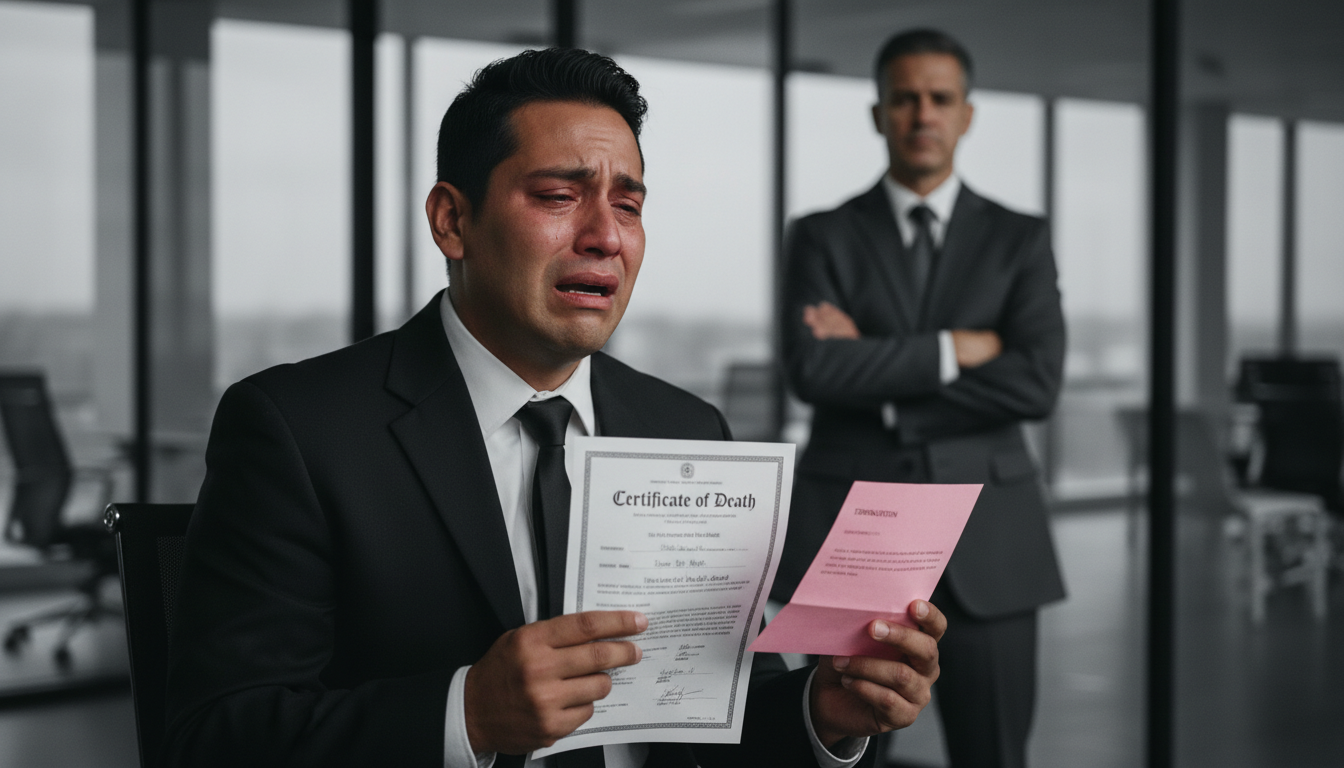
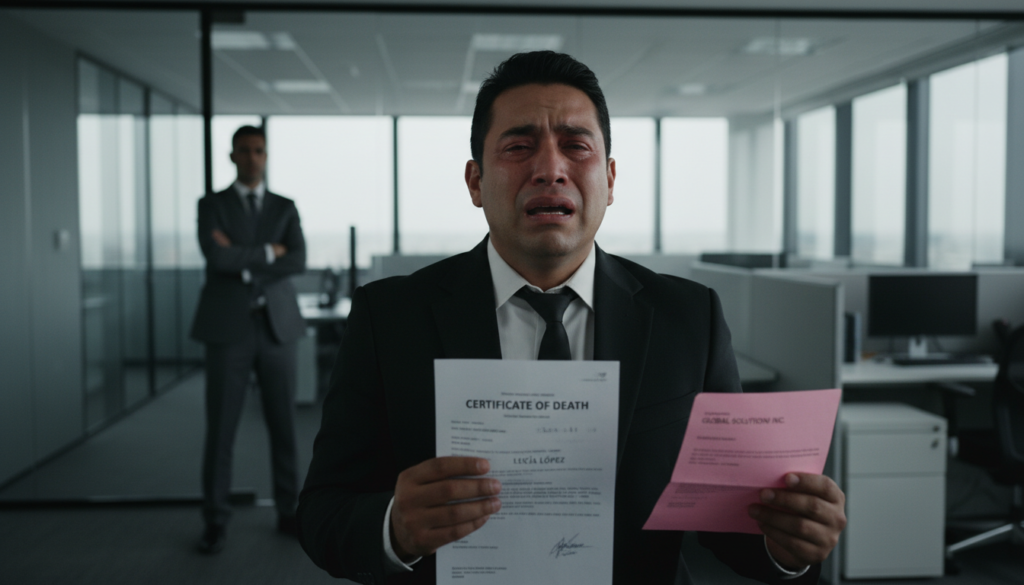
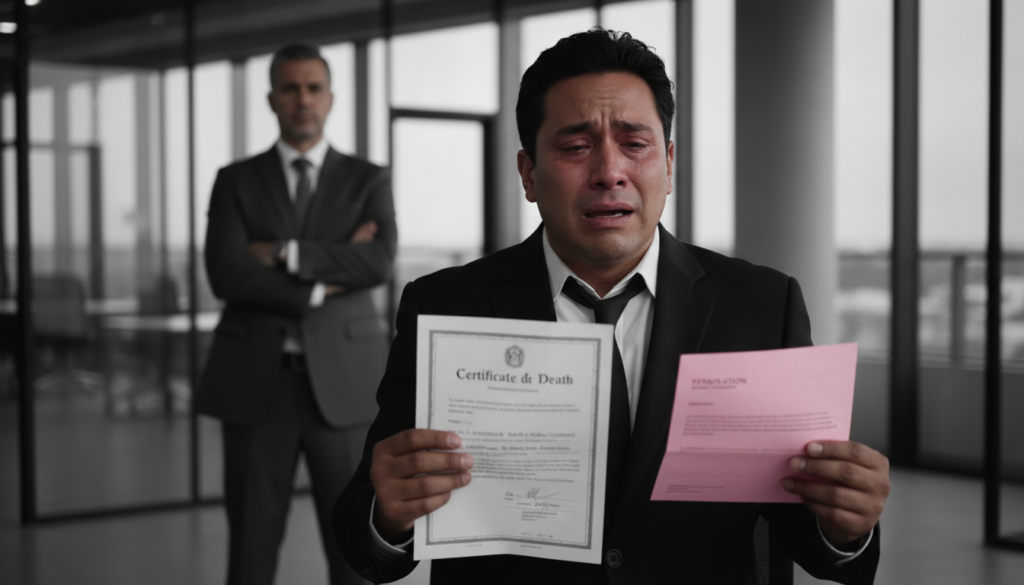
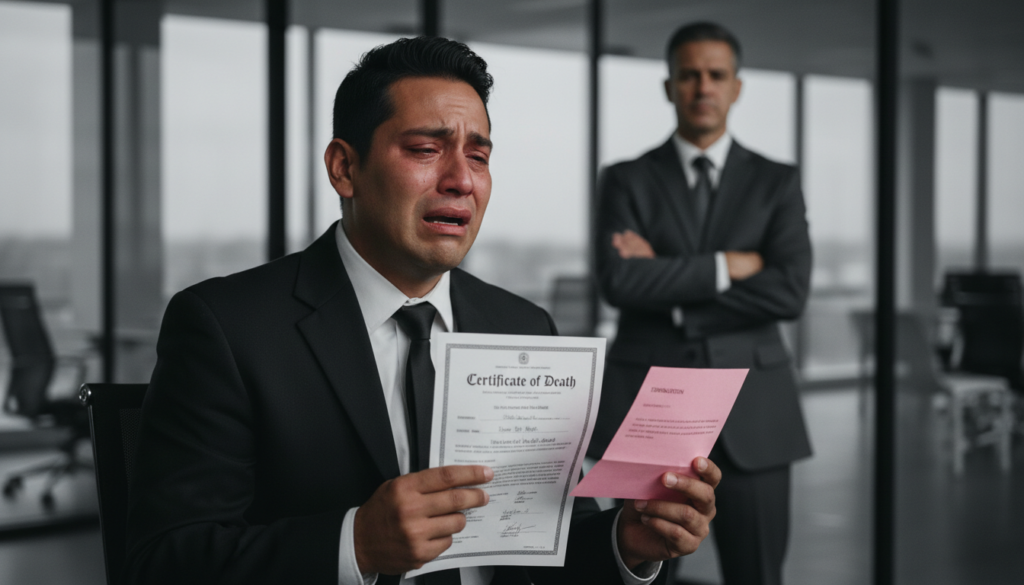
I’m standing in my boss’s office with my daughter’s death certificate in one hand and a termination letter in the other, and I can’t feel anything anymore.
Thirty minutes ago, I buried my eight-year-old daughter. Lily. My entire world. She died in my arms four days ago after a drunk driver ran a red light while we were walking to get ice cream. She loved mint chocolate chip. She never got to finish that last cone.
I wasn’t supposed to be here. I was supposed to be at the reception, surrounded by family, trying to figure out how to keep breathing. But my boss—Richard Vance, VP of Operations at Grandstone Financial—called me during the burial service.
“Where are you?” he’d barked when I finally answered, my phone vibrating in my pocket as the priest was speaking. “The Henderson presentation is in two hours. You’re needed.”
“Richard,” I’d whispered, stepping away from my daughter’s graveside. “I’m at my daughter’s funeral. I told you last week—”
“That was supposed to be yesterday,” he snapped. “You said yesterday. Today is Thursday. The meeting is today. Get here now or you’re done.”
“The funeral home had to reschedule because of the coroner’s report delays—”
“I don’t care about your excuses, Martinez. Be here in an hour or clean out your desk.”
He hung up.
I looked back at Lily’s tiny white casket, covered in pink roses because that was her favorite color. At my wife Sarah sobbing in her mother’s arms. At my son Diego, only five, asking his grandmother why his sissy was sleeping in a box.
I had a choice. Be there for my family in the worst moment of our lives, or keep the job that paid for our mortgage, Diego’s preschool, and Sarah’s medication for the depression that had swallowed her whole since the accident.
I made a choice that I knew would destroy me.
I kissed Sarah’s forehead. “I have to go to work,” I whispered. “I’m so sorry. I’ll lose my job if I don’t.”
She looked at me with empty eyes. “Then go,” she said flatly. “Lily’s already gone. What does it matter?”
I came to work.
I arrived seventeen minutes late. Traffic. Tears. A panic attack at a stoplight. I don’t even remember the drive.
Richard was waiting at my desk, arms crossed, face like stone.
“You’re late,” he said coldly. “Clean out your desk. You’re terminated. Effective immediately. For job abandonment and insubordination.”
“I was at my daughter’s funeral,” I said again, my voice hollow and distant, like it belonged to someone else.
“You were late. That’s all that matters here. This is a professional environment, Martinez. Your personal problems don’t override company obligations. Maybe if you’d managed your time better, you’d still have a career.”
That’s when something inside me shattered. I grabbed Lily’s death certificate from my briefcase—I’d had to bring it for bereavement leave paperwork—and slammed it on his desk.
“This is my personal problem,” I said, my voice shaking with rage I didn’t know I still had. “My eight-year-old daughter died. I just buried her. And you fired me for being seventeen minutes late to her funeral.”
Richard glanced at the certificate. His face didn’t change. Not even a flicker of humanity.
“Company policy is clear,” he said, pushing the certificate back toward me like it was contaminated. “You should have been here on time. Maybe this will teach you about priorities.”
I wanted to hit him. I wanted to scream. I wanted to make him feel a fraction of the pain tearing through my chest. Instead, I just stood there, broken and empty.
Then I heard a voice from the doorway.
“Richard Vance?”
We both turned. A man in an immaculate charcoal suit stood there—tall, silver-haired, maybe sixty, with sharp eyes behind wire-rimmed glasses. I didn’t recognize him, but Richard’s face went pale.
“Mr. Chen,” Richard stammered, his arrogant composure cracking. “I didn’t know you were—what are you doing here?”
“I came to meet with your CEO about a potential partnership,” the man said quietly, stepping into the office. His eyes moved to me, then to the death certificate on the desk, then back to Richard. “But I think I’ve seen enough.”
“This is a private personnel matter—” Richard started, his voice rising defensively.
“No,” Mr. Chen interrupted, his voice sharp as broken glass. “This is a father who just buried his child being punished for his grief. And you—” he looked at Richard with pure contempt— “just made the worst mistake of your career.”
“With all due respect, Mr. Chen, you don’t understand the situation—”
“I understand perfectly,” Mr. Chen said, picking up Lily’s death certificate and reading it carefully. His jaw tightened. “This child died four days ago. The funeral was today. This man came to work anyway, and you fired him for being seventeen minutes late.”
He set the certificate down gently, like it was made of glass.
“I lost my daughter twenty years ago,” Mr. Chen said quietly. “Car accident. She was seven. And the day of her funeral, my boss at the time told me the same thing you just told this man. That work came first. That my grief was inconvenient.”
Richard’s face was white now.
“I never forgot that,” Mr. Chen continued. “I built my entire company on a different principle: that employees are human beings first. That kindness matters more than quarterly reports. And that anyone who treats grief as an inconvenience doesn’t deserve to lead.”
He turned to me. “Mr. Martinez, is it?”
I nodded, unable to speak.
“I’m Michael Chen. I own Chen Industries. We’re Grandstone’s largest potential investor—or we were.” He looked back at Richard. “Consider that deal dead. And I’ll be recommending to every other firm in our network that they terminate relationships with any company that employs you.”
Richard’s face went from white to red. “You can’t do that—”
“I can. And I will.” Mr. Chen pulled out his phone. “I’m texting your CEO right now. I imagine you’ll be having a very different conversation shortly.”
Let me back up and tell you how I ended up working for a monster like Richard Vance.
I’d been at Grandstone Financial for six years. Started as a junior analyst, worked my way up to senior project manager. The pay was good—great, actually. $95,000 a year, full benefits, enough to buy a small house in the suburbs and give Sarah the chance to stay home with the kids.
Richard Vance joined the company three years ago as VP of Operations. He was everything I wasn’t: Ivy League educated, trust fund raised, ruthlessly ambitious. He saw employees as resources to be maximized, not people to be valued.
But he got results. Projects finished early. Clients signed. The board loved him.
For those of us actually doing the work, he was a nightmare. Fourteen-hour days were standard. Weekends were “optional” in the sense that saying no meant career suicide. He once made an analyst present via Zoom from her hospital bed after surgery because “the client doesn’t care about your gallbladder.”
I’d complained to HR twice. Both times, I was told Richard’s “management style” was “intense but effective.” Translation: he made the company money, so his behavior was protected.
When Lily died, I’d immediately contacted HR and Richard, requesting bereavement leave. Company policy gave three days for immediate family. I took four, thinking surely they’d understand.
Richard had called me on day three. “The Henderson presentation is Thursday,” he’d said. “You need to be back.”
“My daughter’s funeral is Thursday,” I’d replied, my voice breaking.
“Then have it Wednesday.”
“The funeral home can’t—the coroner hasn’t released her body yet—”
“Not my problem, Martinez. Thursday. Be there.”
I’d escalated to his boss, the CFO. She’d said, “I’m sure you and Richard can work something out.”
They’d closed ranks around him.
So when the funeral home finally confirmed Thursday morning, I’d emailed Richard immediately: “Funeral scheduled for Thursday, 10 AM. I’ll come to work after.”
He’d replied: “Meeting is at 2 PM. Make it work.”
I thought I had. I thought if I showed up, even late, even broken, it would be enough.
I was wrong.
Mr. Chen’s text sent shockwaves through Grandstone’s executive floor within minutes.
First, Richard’s phone rang. He looked at the caller ID and his face went gray. “I need to take this—”
“Answer it here,” Mr. Chen said flatly. “I want to hear.”
Richard answered on speaker. The CEO’s voice came through, tight with barely controlled fury.
“Richard, what the hell did you just do?”
“Sir, I can explain—”
“Michael Chen just pulled a $50 million investment and told me you fired a grieving father for being late to his child’s funeral. Please tell me that’s not true.”
Richard’s mouth opened and closed. “The employee was late to a critical client meeting—”
“His daughter died four days ago!” the CEO shouted. “Are you insane?”
“Company policy states—”
“Company policy doesn’t override basic human decency! You’re suspended pending investigation. Don’t say another word. I’m coming down there.”
The line went dead.
Richard looked at Mr. Chen, then at me. For the first time, I saw fear in his eyes.
“This is a misunderstanding,” he said desperately. “I was just enforcing policy. You can’t destroy my career over this—”
“Watch me,” Mr. Chen said quietly.
The CEO arrived ten minutes later—Jonathan Marsh, a man I’d only seen in company-wide emails. He looked at me, at the death certificate, at Richard’s pale face, and his expression hardened.
“Mr. Martinez,” he said gently. “I am profoundly sorry for your loss and for what just happened here. Please, sit down.”
I sat, feeling disconnected from my body.
“Walk me through everything,” Marsh said. “Starting from when your daughter passed.”
I told him. All of it. The accident. The hospital. Watching Lily die. Notifying HR. Richard’s calls. The impossible choice. The funeral. The phone call during the burial.
By the end, Marsh’s face was ashen.
“You called him during the funeral?” he asked Richard, his voice deadly calm.
“The client meeting—”
“There was no client meeting,” Marsh interrupted. “I checked our calendar while walking down here. Henderson rescheduled to next week. You knew that.”
The room went silent.
“You called him during his daughter’s burial,” Marsh continued, “demanded he come to work for a meeting that didn’t exist, and fired him when he arrived late?”
Richard said nothing.
“Why?” Marsh asked. “Why would you do that?”
“He’s been underperforming,” Richard said weakly. “This was just the final—”
“His performance reviews are excellent,” Marsh cut him off. “I pulled his file. He’s exceeded expectations for five straight years. Try again.”
Richard’s face flushed red. “He complained about me to HR. Twice. This was about setting an example—”
“There it is,” Mr. Chen said softly. “Retaliation.”
Marsh turned to me. “Mr. Martinez, you’re reinstated effective immediately with full back pay. You’ll report to me directly. Take as much time as you need. And when you’re ready to return, we’ll discuss compensation for this nightmare.”
He turned to Richard. “You’re done. Not just suspended. Terminated. For cause. I’ll have security escort you out.”
Richard’s face went purple. “You can’t—I’ll sue—”
“Please do,” Marsh said coldly. “I’d love to have this conversation in front of a jury. Now get out of my building.”
After Richard was escorted out by security, still sputtering threats, Mr. Chen turned to me.
“Mr. Martinez, could we speak privately?”
Marsh nodded and left. Mr. Chen closed the office door.
“I need to tell you something,” he said, sitting down across from me. “When I said I lost my daughter twenty years ago, I wasn’t exaggerating. Her name was Grace. She was seven. Killed by a drunk driver on her way home from school.”
My breath caught. “Just like Lily.”
“Just like Lily,” he confirmed. “And my boss at the time—I was working as an engineer at a tech startup—told me that grief was a luxury I couldn’t afford. That if I couldn’t put the company first, I should quit.”
“What did you do?”
“I quit,” he said simply. “That night. And I started my own company with the principle that no employee would ever choose between their humanity and their paycheck.”
He pulled out a business card. “Chen Industries has an opening for a senior project director. The salary is $145,000. Full benefits. Unlimited bereavement leave. And a company culture that treats grief like what it is—a part of being human.”
I stared at the card. “You’re offering me a job? Right now?”
“I’m offering you a choice,” he said gently. “You can stay here, work for Marsh, who seems decent. Or you can work for me, for a company built by someone who understands exactly what you’re going through.”
“Why?” I asked, my voice breaking. “You don’t know me.”
“I know enough,” he said. “I know you came to work on the worst day of your life because you were afraid of losing your income. I know you loved your daughter enough to bury her and still try to protect your family. That’s the kind of character I want in my company.”
He stood up. “Think about it. But Mr. Martinez? Whatever you decide, I want you to know something. Your daughter mattered. Her life mattered. Your grief matters. And any person who tells you otherwise is wrong.”
I broke down completely.
I didn’t go back to the funeral reception. I went home, walked into my house, and found Sarah sitting in Lily’s room, holding her favorite stuffed elephant.
“I lost my job,” I said.
She looked up, eyes red and empty. “I know. Your mom called.”
“No,” I said, sitting beside her. “I got it back. And then I got offered a better one.”
I told her everything. Richard. Mr. Chen. The job offer. The $50,000 salary increase.
“Take it,” she said immediately.
“But Grandstone just reinstated me—”
“Take it,” she repeated, more firmly. “Work for someone who understands. Who won’t make you choose between your family and survival. Lily would want that.”
At her name, we both started crying again.
That night, I called Mr. Chen and accepted the position.
Three days later, Richard Vance’s termination went public. Not because Grandstone announced it, but because someone leaked it to the press—probably Mr. Chen’s team.
The headline: “VP Fired Grieving Father for Attending Child’s Funeral—Loses Job After Billionaire Intervenes.”
It went viral.
Within forty-eight hours, Grandstone was facing a PR nightmare. Their stock dropped six percent. Three major clients suspended contracts pending ethics reviews. The board launched a full investigation into Richard’s entire tenure.
They found a pattern. Eight other employees had been fired or demoted for personal emergencies. One woman was terminated for taking her mother to chemotherapy. A man was written up for attending his son’s graduation. Another was passed over for promotion because he requested paternity leave.
All Richard. All buried by HR.
Grandstone ended up settling with all eight employees. Total cost: over $3 million. Richard’s employment contract was voided for cause, stripping him of his severance and stock options. Last I heard, he was blacklisted from every major financial firm in the country.
Mr. Chen’s intervention didn’t just save my career. It exposed a systemic rot that had been hidden for years.
Six months after I started at Chen Industries, Mr. Chen invited me to lunch. We’d worked together closely—he was everything Richard wasn’t. Patient. Kind. Understanding.
“There’s something I want to show you,” he said after we ate.
He drove me to a small park in the city. In the center was a children’s playground, beautiful and well-maintained, with a bronze plaque:
Grace Chen Memorial Playground. In memory of a daughter loved beyond measure. May children always play here safely.
“I built this twenty years ago,” Mr. Chen said quietly. “After Grace died. I needed her life to mean something beyond my grief.”
He turned to me. “I want to build another one. In Lily’s name. If you’ll allow it.”
I couldn’t speak.
“You don’t have to decide now,” he continued. “But I’ve been thinking about it since the day we met. Grace and Lily. Two little girls who deserved better. Maybe we can make sure other children have a safe place to play. In their memory.”
Three months later, we broke ground on Lily Martinez Memorial Park. Sarah and Diego were there. So was Mr. Chen’s wife, Margaret, who’d lost Grace too and understood our pain in a way few people could.
At the dedication ceremony, Mr. Chen gave a speech.
“Twenty years ago, I lost my daughter to a drunk driver,” he said to the gathered crowd. “And I met a man who told me my grief was inconvenient. That made me angry. But six months ago, I met another father who’d lost his daughter the same way. And I met another man—Richard Vance—who told him the same thing.”
He paused. “But this time, I was in a position to do something about it. To make sure that father—Daniel Martinez—didn’t lose everything while grieving. And together, we’ve built this park. A place where children can be safe. Where families can heal. Where Grace and Lily’s names will live on in joy and laughter.”
He looked at me. “Richard Vance tried to teach you that work matters more than family. He was wrong. This park is proof. Your daughter’s life matters. Your grief matters. And kindness, even from strangers, can change everything.”
I still work for Mr. Chen. I’m now VP of Operations—the same title Richard once held, but I try to use it differently.
When employees need time off, I give it. When personal emergencies happen, we adjust. When someone’s struggling, we help.
Last month, one of my team members lost his father. I called him personally.
“Take all the time you need,” I said. “Family comes first. Always.”
“But the Morrison project—” he started.
“Will wait,” I interrupted. “Your father matters more than any project. We’ll cover for you. Just take care of yourself.”
He cried. Then he thanked me.
Later, Mr. Chen pulled me aside. “You handled that well,” he said.
“I learned from the best,” I replied. “Both the best and the worst.”
He smiled sadly. “Grace would have been twenty-seven this year. Sometimes I wonder what she’d be doing. Who she’d have become.”
“Lily would be ten,” I said. “She wanted to be a veterinarian. She loved animals.”
We stood there, two fathers who’d lost daughters, who’d found each other in tragedy, and built something better from the wreckage.
Sarah and I are healing. Slowly. Diego is seven now, and every year on Lily’s birthday, we take him to her park. He plays on the swings she never got to use. He laughs on the slide she never got to climb.
And we remember. Not just the pain, but the love. Not just the loss, but the life.
Richard Vance taught me that some people see grief as weakness. As inconvenience. As something to punish.
Michael Chen taught me that grief is human. That kindness costs nothing. That sometimes, the right person appearing at the right moment can change everything.
I think about that day often. Standing in Richard’s office, broken and empty, holding my daughter’s death certificate. Thinking my life was over.
And then a stranger walked in.
A stranger who’d lost his daughter the same way. Who understood. Who cared. Who used his power not to punish, but to protect.
Mr. Chen saved my career. But more than that, he saved my faith in humanity. He showed me that kindness exists. That some people fight for what’s right. That grief doesn’t have to destroy you if someone helps carry the weight.
I keep Lily’s picture on my desk. Right next to a photo from the park dedication—me, Sarah, Diego, Mr. Chen, and his wife Margaret, standing under the sign with Lily’s name.
Sometimes clients ask about it. I tell them the story. Not all of it—some pain is private—but enough.
And I always end the same way:
“That’s my daughter. She died too young. But her name lives on because a kind man saw a father in pain and chose to help instead of hurt. That’s the kind of company we run here. That’s the kind of people we are.”
Richard Vance tried to teach me that compassion is a weakness.
Michael Chen proved that compassion is the only strength that matters.
My boss fired me for being late to my daughter’s funeral.
A rival billionaire made him pay.
But more than that—he made sure Lily’s life, and Grace’s life, meant something beyond tragedy.
He made sure kindness won.