
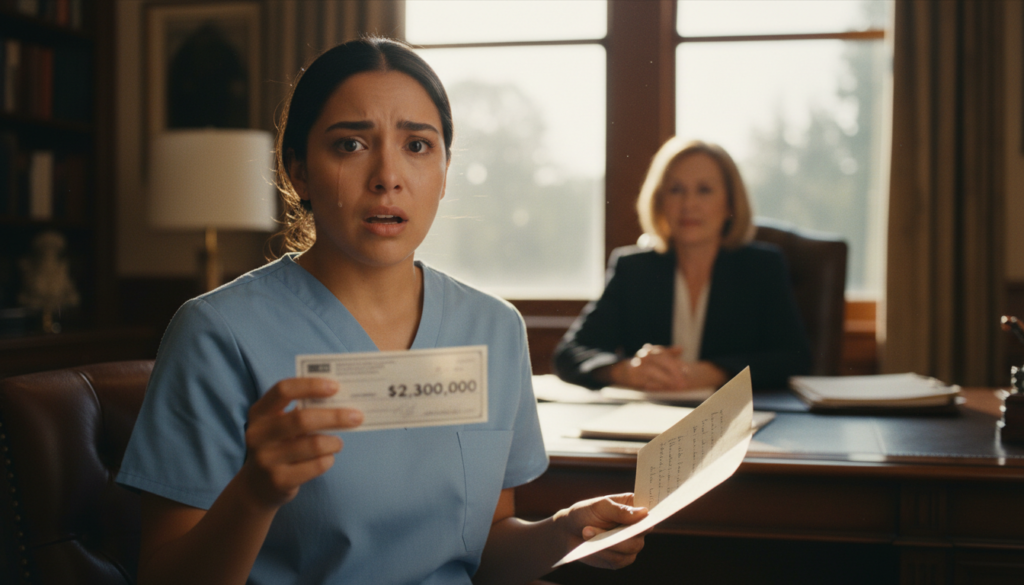
I’m standing in a lawyer’s office, staring at a check for $2.3 million, and all I can think about is the chess game I never got to finish.
The attorney—a woman in her fifties with kind eyes and a gentle voice—is explaining something about estates and beneficiaries and probate, but I can’t hear her properly. My hands are shaking too hard. The check feels surreal, like a prop from a movie or a prank that someone’s about to reveal.
“Ms. Torres,” she says gently, leaning forward, “did you hear what I said? Mr. Sullivan left you everything. His entire estate.”
Mr. Sullivan. Room 14B at Riverside Nursing Home. The man everyone on staff called “the Ghost” because he never talked, never smiled, never had visitors. The man my coworkers would literally step over while rushing to check on residents they deemed more “worthy” of their time and attention.
The man I played chess with every Thursday for three years.
“I don’t understand,” I whisper, my voice cracking. “He never said anything about money. We just… we played chess. We talked about books and his garden and his wife. That’s all.”
“He had no living relatives,” the attorney explains, her tone soft and patient. “No children. His wife passed away eight years ago. Distant cousins, maybe, but no one close. His entire estate—the house in Connecticut, the investment portfolio, the savings—it all goes to you. Because, and I’m quoting directly from his will here, ‘She was the only person in three years who saw me as human.'”
My throat closes up completely. I can’t breathe.
Three years ago, I started working at Riverside Nursing Home as a nursing assistant. It was minimum wage work with brutal twelve-hour shifts, but I desperately needed the job. My divorce had just finalized, leaving me with nothing but $47,000 in debt, a restraining order against my ex-husband, and a determination to rebuild my life from nothing.
I was assigned to the east wing—the wing the other staff called “the forgotten floor.” That’s where they put residents with advanced dementia, severe behavioral issues, or in Mr. Sullivan’s case, those who’d simply “given up on life” and were seen as lost causes.
Mr. Sullivan never caused trouble. He never screamed or threw things or tried to escape like some of the others. He just sat in his wheelchair by the window every single day, staring out at the garden, silent and completely still. Like a statue.
The other nurses ignored him completely. “Waste of time,” they’d say during shift changes. “He doesn’t even talk. Just sits there like he’s already dead.”
But one Thursday afternoon, during my lunch break, I happened to walk past his room and noticed he was staring intensely at something on his nightstand. A chess set. An absolutely gorgeous one too—wooden, with pieces that looked hand-carved, probably antique.
Without thinking, I knocked gently on his door frame and stepped inside.
“Do you play?” I asked, gesturing to the chess set.
He turned his head slowly and looked at me—really looked at me, with sharp blue eyes that suddenly didn’t seem empty at all—for the first time since I’d started working there.
And he nodded. Just once. But it was enough.
That was the beginning of everything.

For the next three years, every single Thursday during my lunch break, I played chess with Walter Sullivan.
That first game, he didn’t say a word. Just moved his pieces with steady, deliberate hands. He destroyed me in about fifteen moves. I’m not a great chess player, but I’m not terrible either. He was brilliant.
The second week, after he beat me again, he spoke his first words in what I later learned had been eighteen months of silence: “You moved your knight wrong.”
I nearly dropped my water bottle. “You can talk?”
“Never had a reason to before,” he said quietly. His voice was rough from disuse but educated, refined. “Most people here don’t listen anyway.”
“I’m listening,” I said.
He studied me for a long moment, then nodded. “I believe you are.”
After that, he started opening up. Slowly at first, like a flower that had been closed for too long. He told me about his late wife, Caroline, who he’d been married to for fifty-four years. About how they’d met at an architecture firm in Manhattan where they both worked in the 1960s. How she’d been the only woman in the office and had to fight twice as hard to be taken seriously.
He told me about the houses he’d designed—beautiful, award-winning residential homes across New England. About the garden he and Caroline had built together at their Connecticut property, where they’d spent forty years growing heirloom roses and hosting garden parties.
About how, after Caroline died of cancer eight years ago, he’d simply… stopped. Stopped designing. Stopped gardening. Stopped living, really. His children—the ones he’d always wanted but never had—didn’t exist to carry on his legacy. So he’d sold most of his possessions, moved into Riverside, and waited to die.
“Why Riverside?” I asked one Thursday. “If you have money, you could afford somewhere much nicer.”
He shrugged. “What difference does it make? Nice walls. Cheap walls. When you’re just waiting for the end, the view doesn’t matter.”
“But you’re not just waiting anymore,” I pointed out. “You’re playing chess with me.”
He smiled then—the first time I’d ever seen it—and said, “No. I suppose I’m not.”
What I didn’t realize until much later was how different Walter’s experience at Riverside was from mine.
To me, he was brilliant, funny, and fascinating. He recommended books I’d never heard of. He taught me about architecture and design principles. He told me stories about 1960s New York that felt like scenes from movies.
To everyone else on staff, he was furniture.
I remember one particularly awful incident about eighteen months into our Thursday routine. I was running late for our chess game because I’d been helping another resident. When I finally got to Walter’s room, I found him on the floor by his wheelchair.
He’d tried to reach a book on his shelf and fallen. His call button was across the room, knocked away in the fall.
“How long have you been down there?” I asked, horrified, helping him up.
“Two hours,” he said calmly. “Three nurses walked past. One stepped over me to check the resident next door.”
My blood went cold. “They stepped over you?”
“I’m the Ghost, remember?” He said it without bitterness, just stating a fact. “I don’t complain. I don’t cause problems. So I’m invisible.”
I reported it to the charge nurse. She shrugged. “Mr. Sullivan should use his call button if he needs help.”
“It was knocked away in the fall!”
“Then he should be more careful.”
That’s when I realized: The system didn’t just ignore Walter because he was quiet. It ignored him because he didn’t have advocates. No family visiting. No one calling to check on him. No one to complain on his behalf.
He was completely alone.
Except for me and our Thursday chess games.
Two weeks before Walter died, he seemed different. More tired. More contemplative. We were in the middle of a game—he was winning, as always—when he suddenly spoke.
“I’ve updated my will,” he said casually, moving his bishop.
“That’s good,” I replied, not thinking much of it. “It’s important to have your affairs in order.”
“I want you to know something, Maria,” he continued, using my first name for maybe the tenth time in three years. “You saved my life.”
I looked up from the board, startled. “Walter, I’m just a nursing assistant who plays chess with you.”
“No,” he said firmly. “You’re a woman who saw a human being when everyone else saw an inconvenience. Do you know how rare that is? How precious?”
“I just treated you like a person—”
“Exactly,” he interrupted. “After Caroline died, I thought I was done. Finished. I moved here fully intending to let myself fade away. I stopped eating properly. Stopped caring about anything. I was just… waiting.”
He paused, his blue eyes watery but intense.
“Then you knocked on my door and asked if I played chess. And for the first time in two years, someone wanted to know something about me. Not my medical history. Not my insurance information. Not whether I’d taken my medications. You wanted to know if I played chess.”
“Of course I did,” I said, my throat tight. “That beautiful set was just sitting there—”
“That set was Caroline’s,” he said softly. “Her father gave it to her when she was twelve. She was a chess champion in high school. After she died, I brought it here thinking I’d never use it again. But you asked. And I remembered what it felt like to be alive.”
I had tears streaming down my face. “Walter—”
“I want you to promise me something,” he continued. “When I’m gone, and you find out what I’ve done, I want you to promise me you’ll use it well. Not just for yourself. For others too. The way you helped me.”
“What are you talking about?”
He smiled mysteriously. “You’ll see. Checkmate, by the way.”
I looked down at the board. He’d won again, and I hadn’t even noticed.
Now, sitting in this attorney’s office, I open the envelope with shaking hands. Inside is a letter written in Walter’s careful, architectural handwriting.
My Dear Maria,
If you’re reading this, I’ve finally joined Caroline, and I hope she’s not too angry with me for taking so long to get there.
By now, you know about the money. I imagine you’re in shock. Perhaps angry that I never told you. I need you to understand why I kept it secret.
For three years, you visited me every Thursday. You played chess with me. You talked to me. You brought me books and told me about your life and asked about mine. You did all of this when you thought I was just a poor old man with nothing to offer but conversation.
That’s how I knew your kindness was real.
If you’d known about my wealth, I would never have been certain. Would you still have come? Of course, you’re a good person, so probably. But there would always be that small doubt in my mind. That tiny voice asking: “Is she here for me, or for what I can give her?”
This way, I know. You were there because you saw a lonely old man and decided he deserved dignity. You were there because you believe people matter, regardless of their bank accounts or their usefulness. You were there because you have the rarest gift I’ve ever encountered: genuine compassion without expectation of reward.
The money is not a reward for your kindness. Kindness should never be transactional. The money is simply what I have to give, and I’m giving it to someone who will use it well.
I have three requests:
First: Get out of debt. Maria, I know you’re drowning in bills from your divorce. I know you work sixty hours a week just to stay afloat. I know you eat ramen for dinner most nights because you’re saving every penny. Stop suffering. You’ve earned peace.
Second: Pursue your dream. You told me once, in passing, that you’d always wanted to be a social worker. That you’d started a degree before your marriage but never finished. Finish it. Help others the way you helped me.
Third: Remember that wealth isn’t money. It’s time. It’s freedom. It’s the ability to see people clearly and help them without destroying yourself in the process. You gave me three years of your lunch breaks. That was wealth beyond measure. Now you have the financial wealth to match. Use both wisely.
Thank you for playing chess with an invisible old man. Thank you for seeing me when I’d forgotten what it felt like to be seen. Thank you for giving me three more years of purpose when I thought I had none left.
Caroline would have loved you. I wish you could have met her.
With profound gratitude and affection,
Walter
P.S. – The chess set is in storage with my other personal effects. It’s yours too. I’ve already won our last game, so you owe me a rematch in the next life. I expect you to practice.
By the time I finish reading, I’m sobbing so hard I can’t breathe. The attorney quietly hands me tissues and waits.

“There’s more,” the attorney says gently after I’ve composed myself slightly. “The house in Connecticut. Mr. Sullivan left instructions that you should visit it before making any decisions about selling.”
A week later, I make the drive to Connecticut. The house is in a small town two hours north of the city—a beautiful mid-century modern design that’s clearly Walter’s work. Clean lines. Floor-to-ceiling windows. Stunning integration with the natural landscape.
And the garden. Oh, the garden.
Even in early autumn, it’s breathtaking. Roses everywhere, carefully maintained by a gardener Walter had kept on payroll. Stone paths. A small pond. Benches positioned perfectly to catch the morning light.
In the center of the garden is a stone bench with a plaque: Caroline and Walter’s Garden. Where love grew.
I sit on that bench and cry for an hour.
The house is full of Walter’s life. Architectural drawings framed on walls. Photographs of him and Caroline—young and in love, middle-aged and building this place together, elderly and still holding hands. Books everywhere. The chess set on a shelf, waiting.
In the master bedroom, I find another envelope with my name on it. Inside is a deed. Walter has left the house itself to a local charity that helps domestic violence survivors—women like me, fleeing bad situations with nothing.
But the garden? That’s mine. “To maintain and share,” his note says. “Gardens are meant to be enjoyed by many, not locked away.”
I paid off every penny of my debt. All $47,000 gone in a single bank transfer. I cried when I checked my balance and saw actual positive numbers for the first time in five years.
I quit my job at Riverside Nursing Home, but not before reporting the negligent treatment I’d witnessed. The state investigation that followed led to the firing of three staff members and a complete overhaul of their patient care protocols. Residents in the “forgotten wing” now receive the same standard of care as everyone else.
I enrolled in social work school full-time. I’m graduating this spring with my master’s degree.
And I turned Walter’s garden into something beautiful.
Every Thursday—because Thursday will always be our day—I open the garden to visitors. Free of charge. Domestic violence survivors get first priority. Women rebuilding their lives come and sit in Caroline and Walter’s garden and remember what peace feels like.
I’ve hired two part-time gardeners—both women escaping bad situations, both being paid a living wage to learn a new skill while they heal.
The chess set lives in the garden shed. Every Thursday, I play a game against myself, moving pieces for both sides. I’m getting better. Walter would be proud.
But here’s what I want everyone to understand: The money changed my life. Of course it did. Financial security is transformative when you’ve lived without it.
But that’s not why Walter Sullivan changed my life.
He changed my life by teaching me something I’d forgotten during my terrible marriage, during my divorce, during those brutal years of barely surviving: I had value. Not because of what I could do for others, but because of who I was.
Every Thursday when I sat in his room, I thought I was giving him something—companionship, dignity, human connection. And I was. But he was giving me something far more valuable: proof that kindness mattered. That seeing people mattered. That my choice to treat an “invisible” old man with dignity wasn’t foolish or naive or a waste of time.
It was revolutionary.

Last Thursday, a new visitor came to the garden. A young woman, maybe twenty-five, with a black eye still healing and a duffle bag containing everything she owned.
“Is this the free garden?” she asked nervously. “The one for women like… women who…”
“For women rebuilding,” I finished gently. “Yes. Come in.”
She walked through slowly, touching roses, sitting on benches, breathing deeply. After an hour, she found me pruning near Caroline and Walter’s bench.
“This is the most beautiful place I’ve ever seen,” she whispered. “I haven’t felt safe in two years. But I feel safe here.”
“Good,” I said. “That’s what gardens are for. Healing. Growing. Starting again.”
“Are you the owner?”
“I’m the guardian,” I corrected. “This garden belongs to two people who understood that wealth isn’t money. It’s time. It’s kindness. It’s seeing people when the world tells you they’re invisible.”
She thought about that. “Thank you for seeing me today.”
“Thank you for coming,” I replied. “Would you like to learn about roses? I’m always looking for help maintaining this place.”
Her eyes filled with tears. “I don’t know anything about gardens.”
“Neither did I,” I said honestly. “But someone once believed I was worth investing in. I’m just passing that forward.”
She stayed for three hours. She came back the next day. And the next.
Last week, she got her own apartment. She’s working at a local bakery and taking night classes. She comes to the garden every Thursday to help with maintenance.
“I’m going to do this someday,” she told me last week. “When I have money, I’m going to help someone else. Pass it forward, like you said.”
“You already are,” I told her. “Every Thursday you show up. Every rose you plant. Every woman who sees you healing and thinks ‘maybe I can too.’ You’re already passing it forward.”
That’s what Walter taught me. Wealth isn’t the money in your account. It’s not the house you own or the car you drive.
Wealth is the ability to see people clearly. To offer kindness without expecting return. To believe that every human being—even the quiet old man in Room 14B that everyone calls “the Ghost”—deserves dignity.
The nursing home residents everyone ignored turned out to be a millionaire.
But that’s not why he changed my life.
He changed my life because he proved that true wealth is measured in Thursday chess games, in seeing the invisible, in believing that kindness is never wasted.
And now I have both kinds of wealth—financial and spiritual.
I’m spending the rest of my life making sure both are used well.
Every Thursday, I play chess with Walter’s memory in the garden he loved.
I never win.
But I’m learning. And he’d say that’s all that matters.