I was standing in a lawyer’s office, staring at a property deed with my name on it, trying to understand how the 80-year-old woman I’d helped at the bank three months ago had just left me a house worth $1.2 million.
“This can’t be right,” I whispered, my hands trembling. “I barely knew her.”
The lawyer, a kind-faced man in his fifties, smiled gently. “Mrs. Eleanor Hartwell was very specific in her instructions. She said, and I quote: ‘That young woman showed me more kindness in ten minutes than my own family showed me in ten years. She deserves this more than any of them.'”
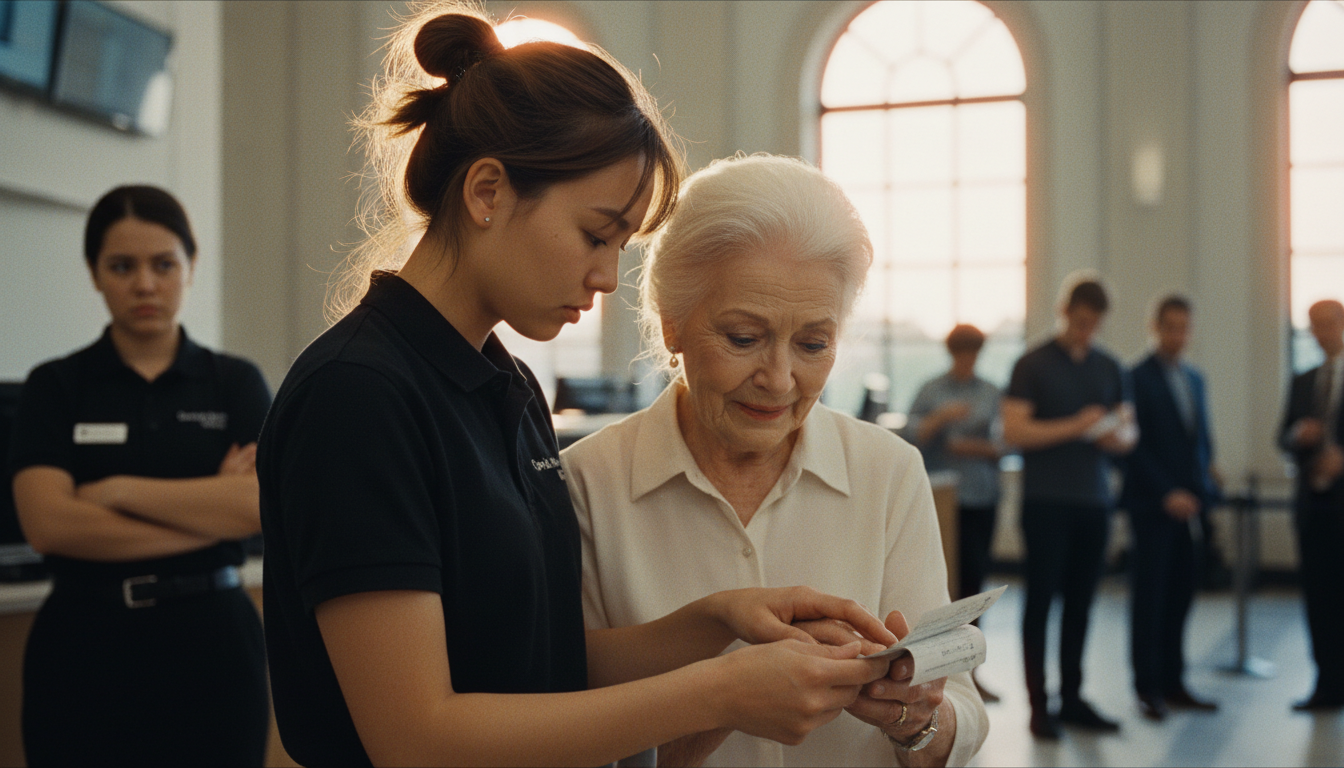
My mind flashed back to that Tuesday afternoon at First National Bank. I’d been depositing my pathetic $247 paycheck from my job at the coffee shop, mentally calculating which bill I could skip this month, when I noticed her.
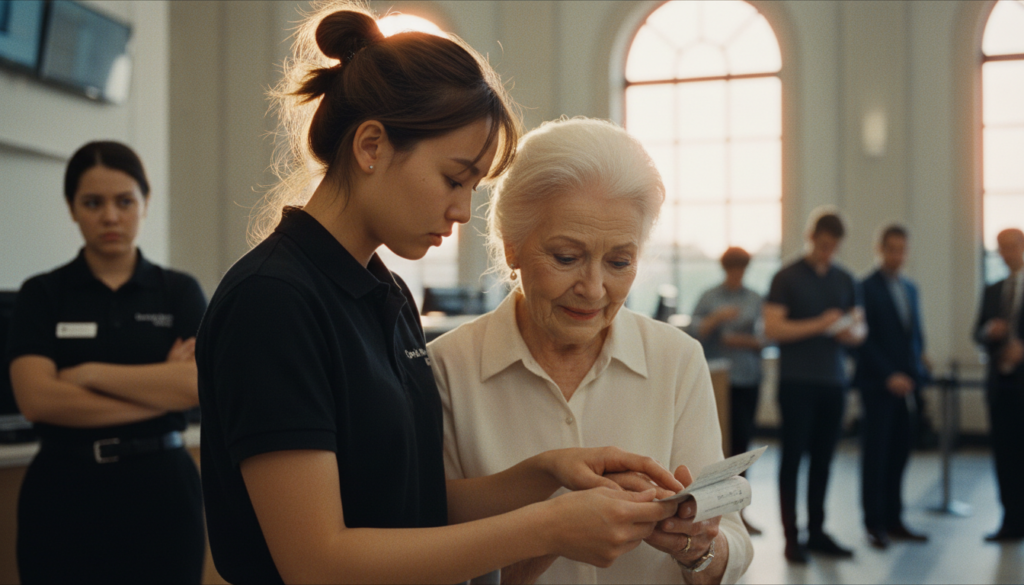
She was standing at the counter, confused and flustered, while the bank teller spoke to her with barely concealed impatience. Her hands were shaking as she tried to fill out a deposit slip, and I could see tears forming in her eyes.
I should have minded my own business. I was running late for my second job. I had my own problems.
But something about the way the teller rolled her eyes when the elderly woman asked another question made my blood boil.
I walked over. “Excuse me, ma’am, do you need some help?”
She looked up at me with these bright blue eyes, grateful and embarrassed. “Oh, I’m sorry dear. I’m holding up the line. My hands don’t work like they used to, and these new forms are so confusing…”
“It’s okay,” I said, taking the pen gently. “I’ve got time. What do you need to do?”
That simple act—helping her fill out a deposit slip, walking her through the ATM, and then helping her to her car because she was unsteady on her feet—took twenty minutes. Twenty minutes that made me late to my shift and cost me an hour’s pay.
But now, three months later, I was standing in a lawyer’s office, learning that Eleanor Hartwell had passed away two weeks ago and left me everything.
“There’s more,” the lawyer said, sliding another envelope across the desk.
To understand why this inheritance felt so surreal, you need to know who I was at that bank that day.
My name is Maya Chen. I’m 26 years old. Six months ago, I was a college graduate with a degree in social work and $87,000 in student loan debt, working two minimum-wage jobs just to make rent on a studio apartment with a broken heater and cockroaches.
I’d graduated with honors, full of idealism and hope. I wanted to help people. Make a difference. Change lives.
Reality hit hard. Every social work position required three years of experience I didn’t have, or paid so little I’d be homeless within months. I applied to 47 jobs. Got three interviews. Zero offers.
So I worked at a coffee shop from 6 AM to 2 PM, making lattes for people who didn’t say thank you. Then I worked at a retail store from 3 PM to 9 PM, folding clothes that customers immediately unfolded.
I was exhausted constantly. My apartment was 400 square feet of depression. I ate ramen four nights a week. My student loans went into forbearance because I couldn’t afford the payments. My car had been repossessed. I took two buses to get anywhere.
And I was lonely. Soul-crushingly lonely. My college friends had moved away for jobs or grad school. My family was across the country, and I was too proud to tell them how badly I was struggling. Every day felt like drowning in slow motion.
That Tuesday at the bank, I’d just gotten my paycheck—$247 after taxes for 32 hours of work. My rent was $950. I was $200 short, again. I was calculating whether I could ask my landlord for another extension or if I should just start looking for someone’s couch to crash on.
I was not in a helpful mood. I was not feeling kind or generous. I was feeling sorry for myself and angry at the world.
But then I saw Eleanor.
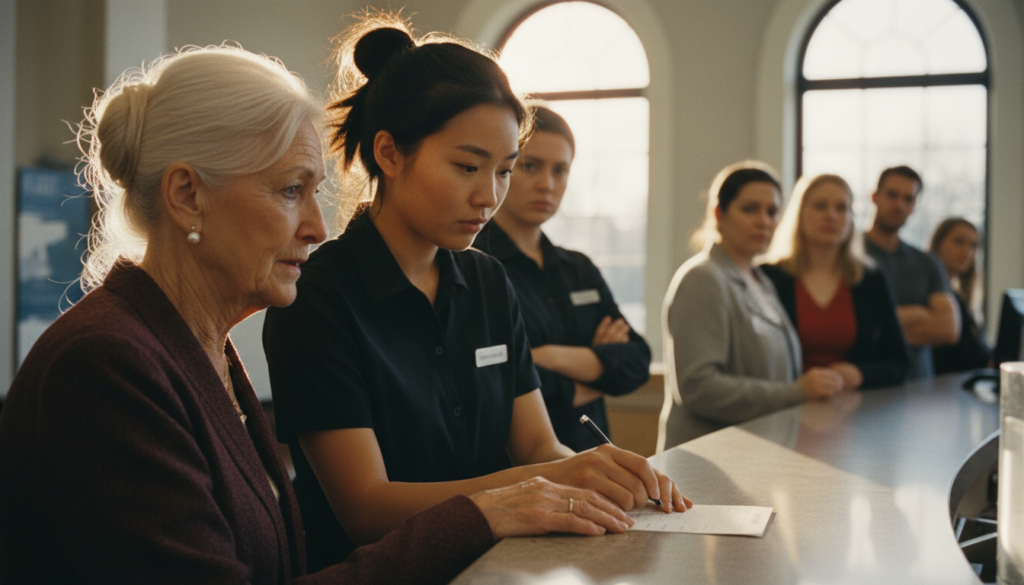
The bank was busy. About fifteen people in line, all looking impatient. Eleanor was at the counter, and even from across the room, I could hear the frustration in the teller’s voice.
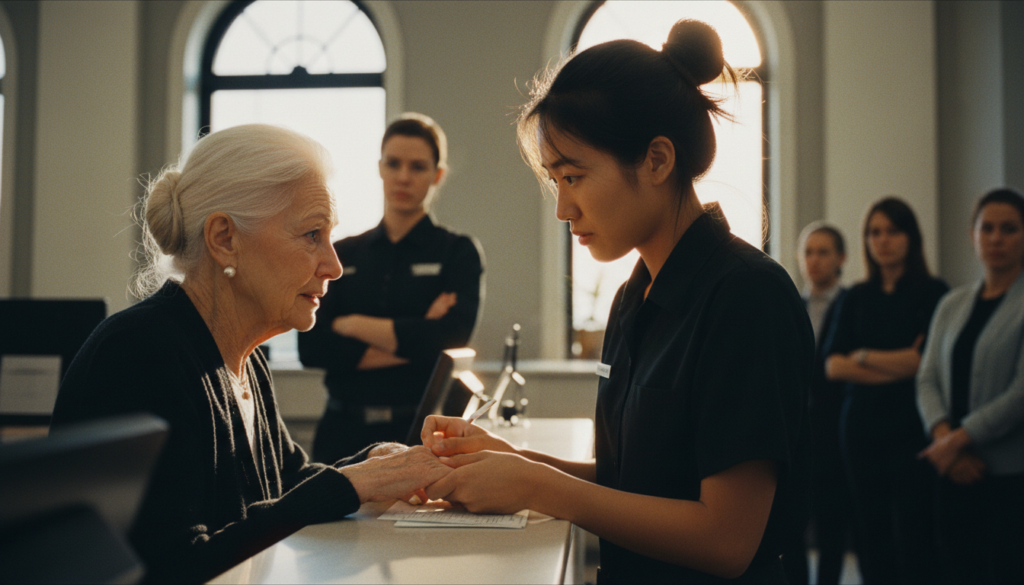
“Ma’am, I’ve explained this three times. You need to fill out the deposit slip completely. Name, account number, amount, date. It’s not complicated.”
Eleanor’s hands were shaking so badly she could barely hold the pen. “I’m sorry, dear. My arthritis is acting up today, and I left my reading glasses at home. Could you just—”
“I can’t fill it out for you. Bank policy. Please step aside so I can help the next person.”
Eleanor’s face crumbled. She stepped aside, clutching her deposit slip and envelope of cash, looking lost and humiliated.
That’s when I made a choice. Not because I’m some amazing person. Not because I was having a great day. But because I knew what it felt like to be invisible. To be treated like you don’t matter. To feel stupid and small.
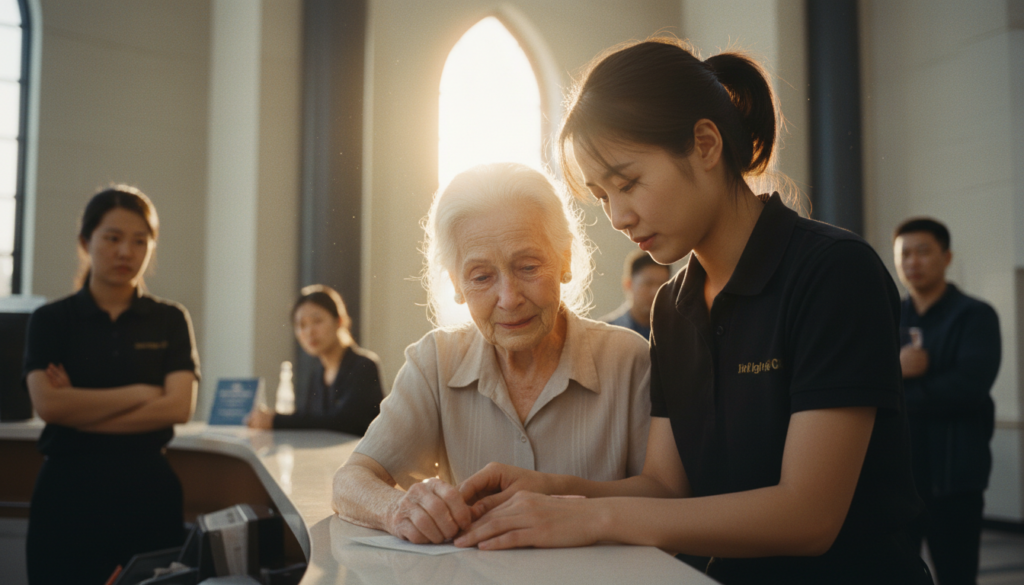
I walked over. “Hi, I couldn’t help but overhear. Can I help you?”
Her face lit up with such genuine gratitude it almost broke me. “Oh, would you? I’m so sorry to trouble you. I’m just having such a hard time seeing these tiny boxes, and my hands…”
“It’s no trouble at all,” I lied. I glanced at my watch. I had 25 minutes to deposit my check, catch the bus, and get to my retail job. I was already cutting it close.
I helped her fill out the deposit slip. Her name: Eleanor Hartwell. She was depositing $3,200 in cash. “My late husband’s pension check finally came through,” she explained. “Took them eight months after he passed. I need to deposit it before I lose it.”
I helped her back to the counter. The same teller looked annoyed but processed the transaction. Eleanor thanked her, but the teller didn’t even make eye contact.
“Would you like a receipt?” I asked Eleanor, since the teller hadn’t offered.
“Oh, yes please.”
After the transaction, Eleanor seemed unsteady. “Are you parked close by?” I asked. “I can walk you to your car.”
“That would be wonderful. It’s just… I’m parked in the far lot. I couldn’t find anything closer.”
Of course she was. I watched the minutes tick by as we slowly made our way across the parking lot. She walked with a cane, each step careful and deliberate.
“You’re very kind,” she said as we walked. “Most young people these days are in such a hurry. They don’t have time for old ladies like me.”
“You’re not an old lady,” I said, smiling. “You’re a person who needed help. That’s all.”
We reached her car—a beautiful vintage Cadillac, immaculately maintained. “My husband bought this car in 1987,” she said, patting it fondly. “Hasn’t run in three years, but I keep paying for parking because I can’t bear to sell it. Silly, isn’t it?”
“Not silly at all,” I said. “It’s a beautiful car. And some things are worth more than their practical value.”
She looked at me with those bright blue eyes. “What’s your name, dear?”
“Maya. Maya Chen.”
“Maya. That’s a beautiful name. Thank you for your kindness today. You have no idea what it meant to me.”
I helped her into the driver’s seat, made sure she was settled, and rushed back to catch my bus. I missed it by thirty seconds. Had to wait twenty minutes for the next one. Showed up to my retail job forty minutes late.
My manager was furious. “This is the third time this month, Maya. I’m docking you an hour’s pay.”
“I’m sorry. I missed my bus—”
“Not my problem. Do it again and you’re fired.”
I spent that shift folding clothes and wondering if helping that old woman had been worth losing $12 I desperately needed.
I didn’t think about Eleanor again. Life was too busy, too stressful, too consuming.
Two weeks later, I got evicted. My landlord had finally had enough of the late payments. I had a week to find somewhere else to live.
I ended up on my coworker’s couch—a woman named Janet who barely knew me but took pity when I broke down crying during our shift. She had two kids in a small apartment, but she made room.
“You can stay until you get back on your feet,” she said kindly. “We’ve all been there.”
I felt like such a failure. Twenty-six years old, college degree, sleeping on a stranger’s couch, working 70 hours a week and still drowning.
I started skipping meals to save money. Lost fifteen pounds in a month. My hair started falling out from stress. I developed an eye twitch. My mom called and I lied about how great everything was.
Three months after meeting Eleanor, I was at my absolute lowest. I’d been living on Janet’s couch for seven weeks. One of my jobs had cut my hours. I had $23 in my bank account. I was seriously considering moving back home, across the country, and admitting complete defeat.
That’s when I got the call.
“Is this Maya Chen?” A professional male voice.
“Yes?”
“This is Robert Morrison from Morrison & Associates Law Firm. I’m calling regarding the estate of Eleanor Hartwell. Do you have a moment?”
My heart stopped. “Estate? Is she… did something happen to her?”
“I’m sorry to inform you that Mrs. Hartwell passed away two weeks ago. You’re named in her will. Could you come to our office tomorrow at 2 PM?”
I couldn’t afford to miss work. But something in his voice made me say yes.
I took an unpaid half-day from the coffee shop and showed up at this fancy law office in downtown, wearing my one professional outfit that no longer fit properly because I’d lost so much weight.
That’s when Robert Morrison handed me the property deed.
“There’s more,” the lawyer said now, sliding that second envelope across his desk.
Inside was a handwritten letter. Eleanor’s handwriting was shaky but elegant.
Dear Maya,
If you’re reading this, I’m gone. I hope you’ll forgive an old woman for her secrets and her schemes.
That day at the bank wasn’t our first meeting. I’d been watching you for three weeks.
My heart started pounding.
You see, I own—owned—the coffee shop where you work. Well, I own the building and collect the rent. I come in every Tuesday morning and sit in the corner. I’ve been watching you.
I watched you give a homeless man your employee meal when you thought no one was looking. I watched you stay twenty minutes after your shift to help train a new employee who was struggling. I watched you pay for a customer’s coffee when her card was declined, even though I know you can barely afford your own meals.
And I watched the way the world treated you. Customers who were rude. Your manager who never said thank you. The way you held yourself together even though I could see you were breaking.
When I saw you at the bank that day, I decided to test something. I wanted to see if you’d help me even when it cost you something. I knew you were late. I knew helping me would make you late to work. I even parked far away on purpose.
You helped me anyway. You were patient, kind, and dignified even though I could see you were exhausted and stressed.
That’s when I knew.
Maya, I have two children and five grandchildren. None of them have visited me in three years. They call when they need money and ignore me the rest of the time. They were already counting my money before I was dead.
I don’t want people like that inheriting what my husband and I built. I want it to go to someone who understands kindness. Someone who gives even when they have nothing. Someone like you.
The house is yours, completely paid off. Do what you want with it. Live in it, sell it, rent it. There’s also a trust fund—$200,000 for living expenses and paying off your debts.
But more than that, I’m leaving you my husband’s business. He owned three rental properties in the downtown area. They generate about $15,000 a month in income. Enough to live on comfortably. Enough to pursue the social work career you abandoned because it didn’t pay enough.
Use this gift to do what you were meant to do—help people. Be the kind, generous person you already are, but without the burden of poverty holding you back.
One last thing: I wasn’t alone that day I died. I was holding the receipt from the bank—the one you asked for on my behalf. I was thinking about you, grateful that in my last months, I met someone who restored my faith in humanity.
Thank you, Maya, for showing an old woman that kindness still exists.
With love and gratitude,
Eleanor Hartwell
I couldn’t see the last paragraph through my tears.
The lawyer handed me tissues. “Her children are contesting the will, of course. But it’s ironclad. She updated it the week after meeting you and had multiple witnesses. It’ll hold up.”
“I can’t accept this,” I whispered. “It’s too much.”
“Mrs. Hartwell was very clear. She said you’d say that. She said to tell you: ‘Kindness isn’t weakness, Maya. It’s strength. And the world needs strong people like you.'”
I moved into Eleanor’s house three weeks later. It’s a beautiful Victorian in a quiet neighborhood—three bedrooms, a garden, a front porch where I sit every morning with coffee.
I quit both my jobs. Used some of the trust money to pay off my student loans completely. Started volunteering at a community center, helping low-income families navigate social services.
Last month, I finally accepted a social work position I’d been offered but couldn’t afford to take—working with elderly adults in assisted living. The pay is modest, but I can afford it now because of the rental income.
I help people like Eleanor. People who are forgotten, dismissed, treated like inconveniences. And I do it because one old woman saw me when I felt invisible.
Eleanor’s children eventually dropped the contest after their lawyer told them they’d lose. They never came to claim any of her personal belongings. I packed up her house myself, donated most of it, kept some photos and her husband’s watch.
I found her journals. She’d written about me: “Met a girl today who helped me at the bank. She was so kind. So tired and kind. It reminded me of who I used to be before life made me careful. I think I’ll leave her everything. My children don’t need my money—they need to learn to give instead of take. But this girl already knows how. She just needs the chance to do it properly.”
That entry was dated three weeks before she passed. She’d planned this carefully, thoughtfully. She’d given me not just money, but purpose.
People ask me all the time: “Do you feel guilty? Like you didn’t earn it?”
Here’s my answer: I feel grateful. And responsible.
Eleanor didn’t give me this money to sit on it. She gave it to me so I could live the life I was meant to live—helping others. So that’s what I’m doing.
I’ve started a nonprofit using the rental income. We provide small emergency grants to people in crisis—rent assistance, utility bills, car repairs. The things that seem small but mean everything when you’re drowning.
Last week, I helped a single mom who was about to be evicted. I paid her back rent—$1,200. It was nothing to me now. It was everything to her.
“Why?” she asked, crying. “You don’t even know me.”
“Because someone did it for me,” I said. “And now I’m passing it forward.”
That’s Eleanor’s real legacy. Not the house or the money. The understanding that wealth means nothing if you don’t use it to lift others up.
I think about that Tuesday at the bank constantly. What if I’d walked past Eleanor? What if I’d been too busy, too stressed, too wrapped up in my own problems?
My entire life would be different. I’d probably still be working two jobs, sleeping on Janet’s couch, drowning in debt and depression.
One small act of kindness—twenty minutes of my time—changed everything.
But here’s the thing: I didn’t help Eleanor to get something back. I helped her because it was right. Because she needed help and I could provide it. Because treating people with dignity matters.
The reward was a complete surprise. And I think that’s how real kindness works. You don’t give to receive. But sometimes, the universe finds a way to balance the scales.
I’m writing this from Eleanor’s front porch. My front porch now. The garden is blooming—roses Eleanor planted years ago. I maintain them in her memory.
I have a photo of her on the mantel. It’s from 1960, her wedding day. She’s young and beautiful and laughing. Her husband is looking at her like she’s the only person in the world.
I never knew her well, but I feel like she knew me. Saw me. Understood me in a way most people don’t.
She gave me more than money. She gave me proof that kindness matters. That helping people—even in small ways, even when it costs you something—creates ripples you can’t predict.
Last week, a woman at the grocery store was short $12 at checkout. She started putting items back, embarrassed. I handed the cashier $20.
“You don’t have to—” she started.
“I know,” I said, smiling. “But someone helped me once when I needed it. I’m just paying it forward.”
She teared up. Thanked me three times. I’ll probably never see her again. And that’s okay. That’s how kindness works. You cast it out into the world and trust it to land where it’s needed.
If you’re reading this and you’re struggling—working too hard for too little, feeling invisible and forgotten, wondering if any of it matters—it does. Your kindness matters. Your compassion matters. The small ways you help people matters.
You never know who’s watching. Who’s noticing. Whose life you might be changing without even realizing it.
Eleanor changed my life. And all I did was help her fill out a deposit slip.
That’s the power of kindness. That’s the ripple effect of treating people with dignity and respect.
Be the person who stops to help. Who takes an extra twenty minutes. Who sees people who others overlook.
Not because you might get a million-dollar inheritance. But because it’s right. Because we’re all human. Because the world needs more people who give without expecting anything back.
And who knows? Maybe your kindness will come back to you in ways you can’t imagine.
Mine certainly did.
Thank you, Eleanor. I promise to make you proud.