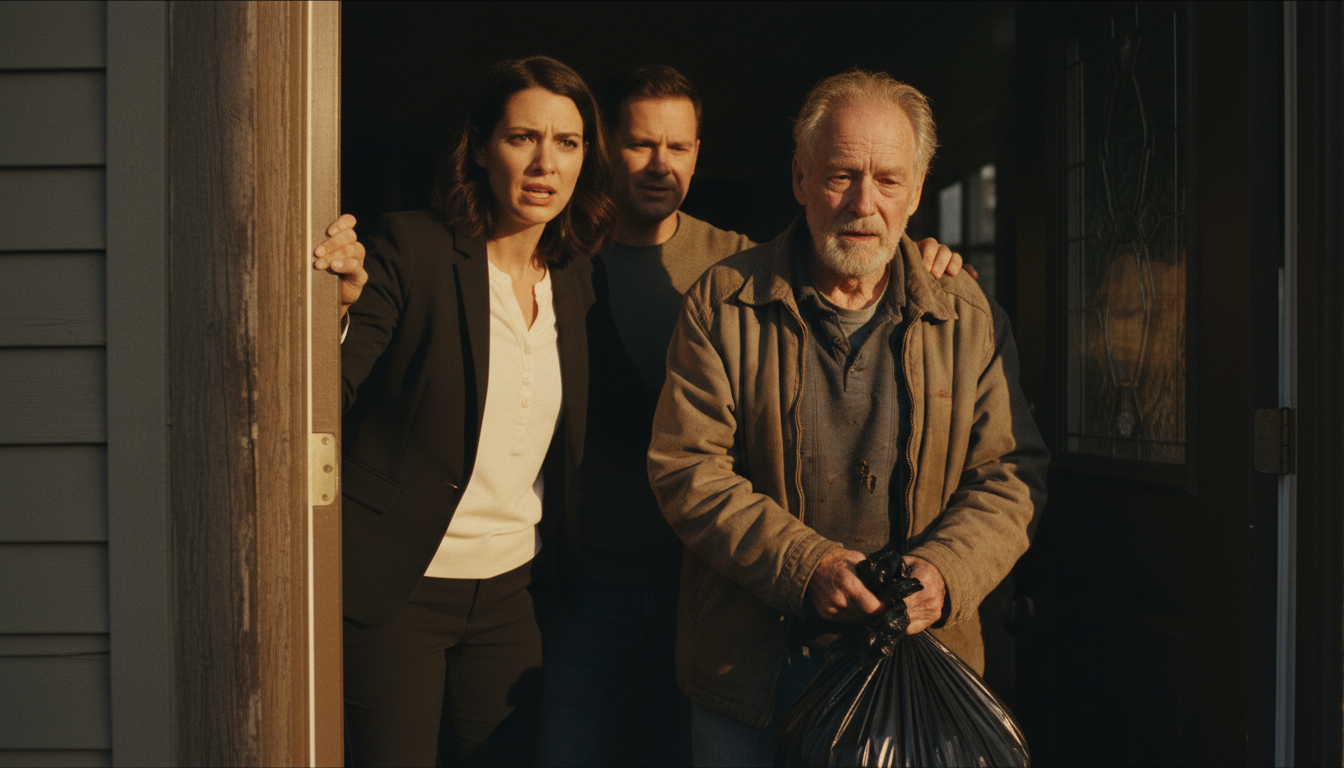
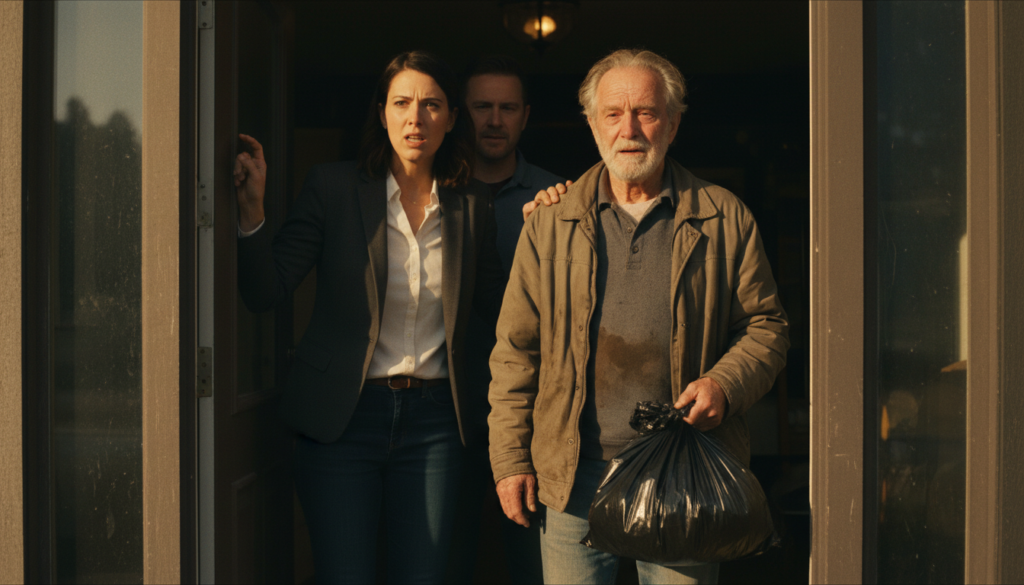
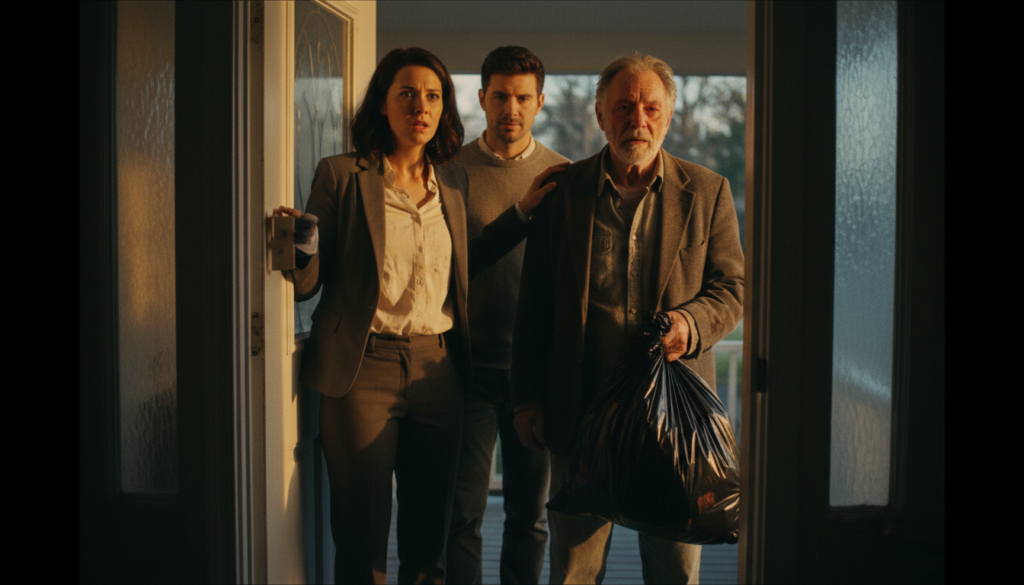
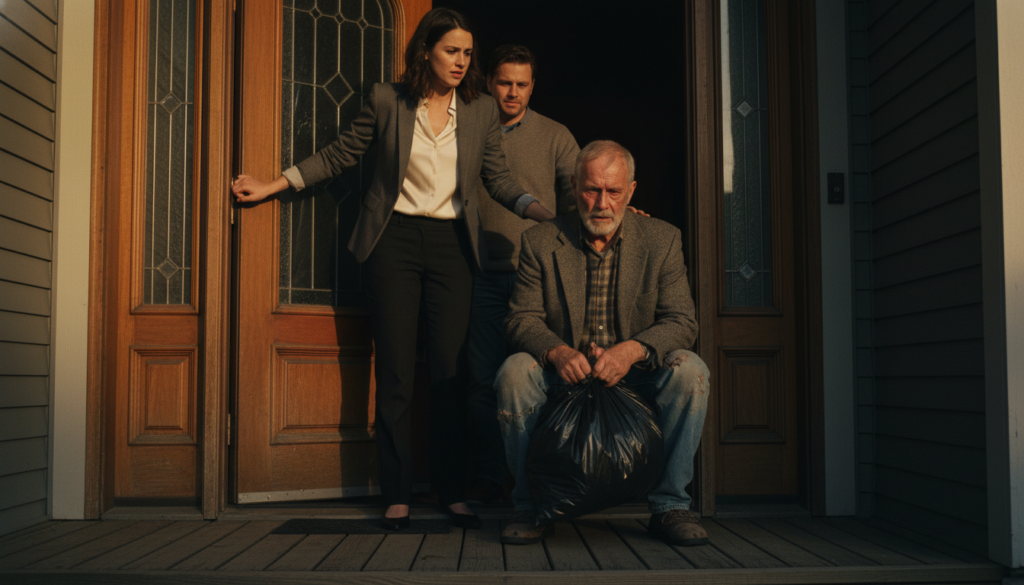
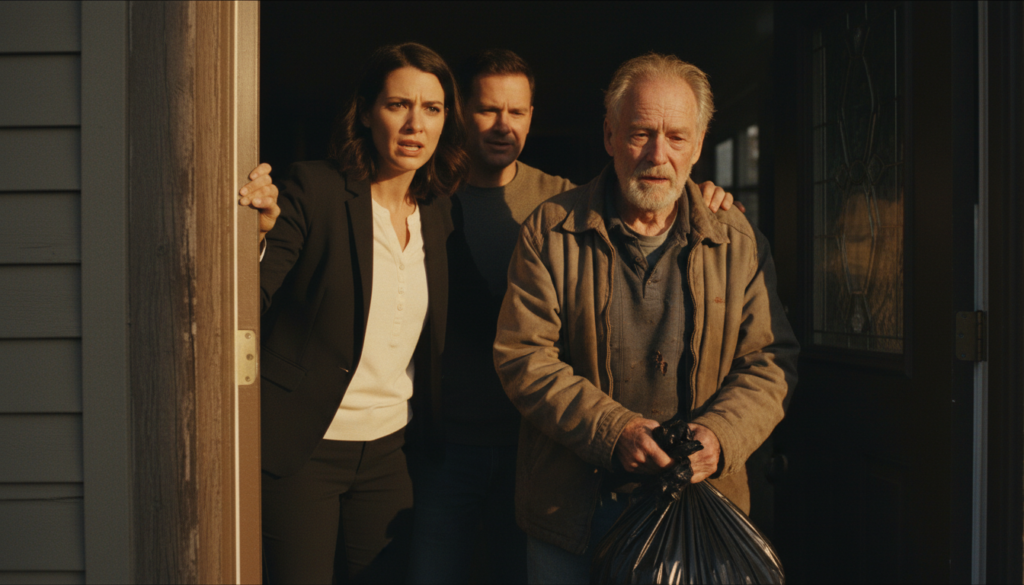
I opened my front door and found my father standing there in clothes I’d never seen him wear—stained, ill-fitting, wrong. The man who’d built a billion-dollar empire was holding a garbage bag of belongings and looking at me with eyes I didn’t recognize. Desperate eyes.
“Emily,” he said, his voice cracking. “I… I didn’t know where else to go.”
My hands tightened on the doorframe. Ten years. It had been ten years since he’d looked me in the eye and said, “If you marry that janitor, you’re no daughter of mine.” Ten years since he’d refused to walk me down the aisle. Ten years since he’d told me I was throwing my life away on someone beneath our family.
And now he was here. Homeless. Broken.
“What happened?” I whispered, even though part of me didn’t want to know. Part of me wanted to slam the door in his face the way he’d slammed the door on my life.
“Everything,” he said simply. “I lost everything, Emily. The company, the houses, the cars. Your mother left me six months ago. Your brother won’t return my calls. I’ve been living in my car for three weeks, but they towed it yesterday. I have nowhere to go.”
Behind me, I heard Marcus—my husband, the janitor my father had despised—walk into the hallway. I felt his hand on my shoulder, steady and warm. The hand of a man who’d worked every day for ten years to build the beautiful life we now had.
“Em?” Marcus said quietly. “Who is it.”
I looked at my father. At his shame. At his brokenness. At the man who’d chosen his pride over his daughter.
And I had a choice to make. The same choice he’d made ten years ago when I needed him most.
Ten Years Earlier: The Day My Father Disowned Me
I need to take you back to understand how we got here. Back to the day my life split into before and after.
I was 24 years old, fresh out of business school, working at my father’s company—Richardson Industries, a tech manufacturing conglomerate worth $1.8 billion. My father, Richard Richardson, was CEO. My mother, Catherine, was the perfect corporate wife. My older brother, Jason, was being groomed to take over the company.
And me? I was supposed to marry Bradley Cunningham, heir to another tech fortune. Our families had practically arranged it. Bradley and I had dated for two years—a relationship that felt more like a business merger than a romance.
But then I met Marcus.
He worked as a janitor at our corporate building, cleaning offices after hours. I’d started staying late to work on a project, and we’d talk while he cleaned. At first, just small talk. Weather. Sports. Nothing deep.
But Marcus was different from anyone I’d ever known. He was genuine. Kind. He asked me real questions—not about my father’s company or my family’s money, but about what I wanted. What made me happy. What my dreams were.
“You seem sad,” he said one night, three months after we’d started talking. “Like you’re living someone else’s life.”
No one had ever seen me that clearly.
We started meeting for coffee before work. Then dinner. Then I was falling for him in a way I’d never fallen for Bradley. Marcus made me laugh. Made me feel seen. Made me feel like Emily, not Richard Richardson’s daughter.
When I told my parents I was breaking up with Bradley to date Marcus, my father laughed. Actually laughed.
“Date? You’re going to date the janitor? Emily, this is a phase. You’re rebelling. Fine. Get it out of your system. But don’t do anything stupid.”
But it wasn’t a phase. Six months later, Marcus proposed with a simple silver band he’d saved six months to buy. It was the most beautiful thing I’d ever seen.
“I know I can’t give you the life you’re used to,” Marcus said, kneeling in his tiny studio apartment. “But I can give you honesty, loyalty, and every bit of love I have. Will you marry me?”
I said yes immediately.
My father’s reaction was nuclear.
“Absolutely not,” he said when I told him. “I forbid it.”
“You can’t forbid me from marrying someone I love.”
“Love?” He spat the word like it was poison. “Emily, you’re 24 years old. You don’t know what love is. You know what this is? It’s embarrassment. How do you think this looks? My daughter marrying someone who mops floors for a living?”
“Marcus is getting his degree,” I said, fighting back tears. “He’s working on his MBA at night. He’s smart and hardworking and—”
“And poor. And beneath you. This marriage will not happen.”
“It will. With or without your blessing.”
That’s when my father’s face went cold. “Then it will be without. If you marry him, you’re cut off. No trust fund. No job at the company. No family. I will not watch my daughter throw her life away on some gold-digger janitor.”
“He’s not a gold-digger! He doesn’t want your money!”
“Everyone wants money, Emily. He’s playing a long game, and you’re too naive to see it. Choose. Him or your family.”
I chose Marcus.
My father didn’t come to the wedding. Neither did my mother or brother. Out of my entire family, only my aunt Margaret attended, and my father stopped speaking to her too.
I lost my job at Richardson Industries the next day. My trust fund—$2 million I was supposed to inherit at 25—was redirected to a charity. My father’s lawyer called to inform me I was no longer listed in the family will.
Marcus and I got married in a small courthouse ceremony with twelve guests and a cake from Costco. It was the happiest day of my life and the most painful.
The First Five Years: Building From Nothing
Those first years were hard. Brutally hard.
We lived in Marcus’s studio apartment. I got a job as a marketing coordinator at a small firm making $38,000 a year. Marcus continued working as a janitor while finishing his MBA. We had $400 in savings and $80,000 in student loan debt between us.
My mother called once, six months after the wedding. “Have you come to your senses yet?” she asked. “Your father is willing to forgive this mistake if you get an annulment.”
“It wasn’t a mistake, Mom. I love him.”
“Love doesn’t pay bills, Emily.”
She hung up. I didn’t hear from her again for nine years.
But Marcus and I built something beautiful from nothing. He graduated with his MBA and got a job as a junior analyst at a mid-size firm. I got promoted. We moved to a one-bedroom apartment. Then a two-bedroom.
We learned to cook instead of eating out. We bought furniture from thrift stores. We celebrated anniversaries with picnics in the park because we couldn’t afford fancy restaurants.
And we were happy. Genuinely, deeply happy.
Three years after we married, Marcus started his own consulting firm. It was a risk—we borrowed $15,000 from the bank and I took a second job to cover expenses while he got it off the ground.
Five years after we married, his firm had twelve employees and was turning a profit. We bought our first house—a modest three-bedroom in a good neighborhood. Nothing like the mansions I’d grown up in, but it was ours.
Seven years after we married, I got pregnant with our daughter, Sophie. Marcus held my hand through 18 hours of labor and cried when she was born.
“She’s perfect,” he whispered. “You’re perfect. I’m the luckiest man alive.”
I thought about my father in that moment. How he was missing this. Missing his granddaughter. Missing my life. All because of pride.
I tried to reach out once, when Sophie was born. Sent a photo and a note: You have a granddaughter. Her name is Sophie Catherine Richardson-Ward. I thought you’d want to know.
The letter came back unopened. “Return to sender” stamped across it.
That’s when I finally accepted it. My father had made his choice. He’d chosen his pride over me. I had to let him go.
Year Ten: The Life We Built
Ten years after he disowned me, Marcus and I had built something incredible.
His consulting firm had grown to 50 employees and had major corporate clients. I’d become Marketing Director at my company. We’d paid off all our debt. Our house was paid off. We had college funds for Sophie and her baby brother, Lucas.
We weren’t billionaires. But we were comfortable. Secure. Happy.
Sophie was seven, smart and funny and kind. Lucas was three, all energy and curiosity. We coached their soccer teams. We went to Disney World. We had family dinners every night.
I rarely thought about my old life anymore. The world of galas and designer clothes and business mergers felt like someone else’s memory.
Then my father showed up at my door.
The Moment of Truth
“Marcus, it’s my father,” I said, still standing in the doorway, blocking him from entering.
Marcus came to stand beside me. He looked at my father—really looked at him. At his worn clothes, his defeated posture, his shame.
“Mr. Richardson,” Marcus said quietly.
My father flinched. “I don’t expect forgiveness,” he said, looking at Marcus. “I was wrong about you. About everything. I just… I have nowhere else to go. Emily is the only person I have left.”
“What happened?” I asked again.
The story came out in broken pieces. Bad investments. A CFO who’d been embezzling for years. A hostile takeover he couldn’t stop. Bankruptcy. Scandal. My mother leaving him for one of his former business partners. Jason refusing to help because Dad had been too controlling, too demanding, too impossible to please for too many years.
Everything my father had valued—power, money, status—was gone. And everyone he’d thought he could count on had abandoned him.
“I’ve been sleeping in my car for three weeks,” he said, voice breaking. “Living off gas station food. I tried homeless shelters but they’re full. I tried calling your brother, your mother, old colleagues. No one will take my calls. You’re my last hope, Emily. I know I don’t deserve it, but—”
“You’re right,” I said, my voice hard. “You don’t deserve it.”
His face crumpled.
“You threw me away like garbage when I didn’t live up to your expectations. You missed my wedding. You’ve never met your grandchildren. You returned the letter I sent when Sophie was born without even opening it. You chose money and pride over your own daughter.”
“I know,” he whispered. “I know, and I’m so sorry. I was wrong. About everything. About Marcus, about what matters, about what kind of man I wanted to be. I was a terrible father. I don’t expect you to forgive me. But Emily, I’m begging you. Please. I have nowhere to go.”
I felt Marcus’s hand squeeze my shoulder. A silent reminder that whatever I decided, he’d support me.
I looked at my father. Really looked at him. And I realized something: I had a choice to be like him or to be different.
I could slam the door. Give him the same mercy he’d shown me. Let him feel what it’s like to be rejected by family when you need them most.
Or I could be better than he was.
“Come inside,” I said finally.
The First Few Weeks
My father slept on our couch that first night. I gave him clean clothes—some of Marcus’s old things that fit reasonably well. Made him dinner. Let him shower and sleep in safety for the first time in weeks.
The next morning, Sophie came downstairs and found a strange old man at our breakfast table.
“Who’s that?” she asked, climbing into my lap.
“That’s your grandfather,” I said quietly. “He’s going to be staying with us for a little while.”
“The grandfather you told me about? The one who was mean to you?”
Kids. They cut right through the bullshit.
“Yes,” I said. “But people can change. We’re going to give him a chance to change.”
My father’s eyes filled with tears.
Over the next few weeks, I watched my father struggle with his new reality. He tried to help around the house—doing dishes, folding laundry, basic tasks he’d probably never done in his life. He was terrible at it, but he tried.
Marcus was kind to him, but distant. Professional. He’d greet him in the morning, ask if he needed anything, but didn’t engage beyond that.
One night, I found them in the kitchen. Marcus was making his lunch for the next day, and my father was sitting at the table.
“I owe you an apology,” my father said. “What I said about you ten years ago… I was wrong. You’re a good man. You’ve built something remarkable. You’ve been a better husband to my daughter than I was a father to her.”
Marcus was quiet for a long moment. “I appreciate that, Mr. Richardson. But the person you really need to apologize to is Emily. Every day. For the rest of your life.”
The Slow Healing
It took months. Slow, painful months.
My father had to apply for social security. Had to accept government assistance. Had to work with a bankruptcy attorney to sort through the wreckage of his financial collapse.
And he had to learn who he was without money.
I watched him struggle with it. Watched him have panic attacks about his worthlessness. Watched him spiral into depression. We got him into therapy—using our health insurance since he had none.
“I don’t know who I am,” he told me one night. “For 40 years, I was Richard Richardson, CEO. Now I’m just… nothing.”
“You’re not nothing,” I said. “You’re a person. Just a person. That’s what you never understood, Dad. Your worth isn’t your net worth. It’s how you treat people. How you love. How you show up.”
“I didn’t show up for you.”
“No. You didn’t.”
“Can you ever forgive me?”
I thought about that. Really thought about it.
“I’m working on it,” I said honestly. “But forgiveness takes time. You broke my heart, Dad. You missed ten years of my life. You have two grandchildren you don’t even know. That’s not something I can just forgive overnight.”
“I understand.”
But he kept trying. He started playing with Sophie and Lucas, learning their likes and dislikes. He’d read to them before bed. Help with homework. Show up for their soccer games.
One day, six months after he’d appeared on our doorstep, Sophie climbed into his lap and said, “Grandpa, tell me a story.”
I watched my father’s face. The pure joy and pain and gratitude all mixed together.
“Okay,” he said, voice thick with emotion. “Let me tell you about a foolish old man who almost missed out on the most important things in life.”
One Year Later: The Transformation
It’s been a year since my father showed up at my door. He doesn’t live with us anymore—we helped him find a small studio apartment and get on his feet with a part-time job at a local community center, helping low-income families with financial literacy.
The irony isn’t lost on any of us. The man who’d been a billionaire CEO now teaches people living in poverty how to manage their money. But he’s good at it. And he’s humble now. Finally humble.
Last week, we had Sunday dinner at our house. My father, Marcus, me, the kids. We do this every week now.
After dinner, my father asked to speak with me and Marcus privately.
“I’ve been in therapy for a year now,” he said. “Working through a lot of things. And my therapist helped me realize something. I never really apologized. Not properly.”
He took a deep breath.
“Emily, I’m sorry. I’m sorry for valuing money over you. For caring more about appearances than your happiness. For missing your wedding, your pregnancies, the first years of your marriage. I’m sorry for being a terrible father who taught you that love is conditional. It’s not. It never should have been.”
He turned to Marcus.
“Marcus, I’m sorry for judging you based on your job instead of your character. You’re one of the best men I’ve ever known. You’ve built a successful business through hard work and integrity. You’ve loved my daughter the way she deserves to be loved. You’ve raised your children to be kind and thoughtful. You’re everything I should have been and wasn’t. Thank you for being a better man than me.”
Marcus’s eyes were wet. “Thank you, sir. That means a lot.”
“And thank you,” my father continued, “for convincing Emily to let me in that day. I saw you squeeze her shoulder. I know you were supporting whatever decision she made. If you’d told her to close the door, she probably would have. Thank you for being the kind of man who chooses compassion over revenge.”
“We all need second chances,” Marcus said simply. “I’m just glad you’re using yours well.”
The Lesson I Learned
Here’s what I’ve learned from this whole experience: Forgiveness isn’t about excusing what someone did. It’s about freeing yourself from the weight of their mistakes.
My father was wrong. Completely, totally wrong. He hurt me deeply, and some part of me will always carry that pain.
But holding onto that pain, letting it turn into bitterness and revenge, would only hurt me. When he showed up at my door, I had a choice: be like he was—judgmental, unforgiving, conditional with my love—or be better.
I chose to be better.
Not because he deserved it. But because I deserved not to carry that anger anymore.
Marcus taught me that. Marcus, who my father thought was beneath us, who supposedly wasn’t good enough for our family. Marcus showed me that real strength is choosing kindness when you have every right to choose cruelty.
Where We Are Now
My father is in Sophie’s life now. In Lucas’s life. He comes to their school plays and birthday parties. He’s patient and present in ways he never was with me when I was growing up.
One night, Sophie asked me, “Mom, why was Grandpa mean to you before?”
“Because he thought the wrong things mattered,” I said. “He thought money and status were more important than love. But he learned he was wrong.”
“How did he learn?”
“He lost everything. And then he found out what really matters—family, love, people who show up for you. Those are the things that matter.”
“Did you show up for him?”
“Yes. Even though it was hard.”
“Because you’re nice?”
“Because everyone deserves a second chance to do better.”
She thought about that, then nodded. “Grandpa is doing better now. He’s nice to us.”
“Yes, he is.”
My relationship with my father will never be what it could have been. Too much time was lost. Too much hurt happened. But it’s something. And something is better than the nothing we had.
Marcus’s firm is thriving. I got promoted to VP of Marketing. Our kids are happy and healthy. My father is rebuilding his life slowly, with humility and grace.
And me? I’m at peace. Finally at peace.
Final Thoughts
If you’re reading this and you’ve been cut off by family, rejected for your choices, told you’re not good enough—I see you. I’ve been there.
And if you’re reading this and you’re the one who cut someone off, who let pride or judgment or expectations ruin a relationship—it’s not too late. Real apologies matter. Real change is possible.
My father showed up at my door homeless and broken. I could have turned him away. Part of me wanted to. Part of me wanted him to suffer the way he’d made me suffer.
But that wouldn’t have healed anything. It would just have created more pain.
Kindness, real kindness, is choosing compassion even when it’s hard. Even when the person doesn’t deserve it. Even when you have every right to say no.
I’m glad I said yes. Not for my father. For me. For my kids. For the example I want to set about what forgiveness looks like.
Ten years ago, my father chose money over me. Last year, I chose grace over revenge. And that made all the difference.