The Day Everything Changed
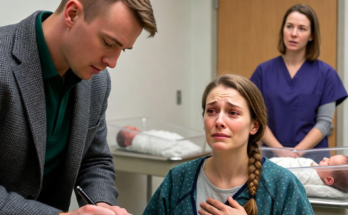
I was sitting in the sterile billing office of Richmond Memorial Hospital, three years after burying my husband, when the financial counselor looked up from her computer screen with an expression of genuine confusion and said, “Mrs. Anderson, I’m not sure how to explain this, but your bill has already been paid. In full. By a Thomas Anderson.”
My blood turned to ice. The fluorescent lights suddenly seemed too bright. The air too thin.
Thomas Anderson was my husband. Thomas Anderson died in a boating accident on August 14, 2023. I’d identified his body at the morgue—bloated from three days in the Atlantic, but unmistakably him. I’d planned his funeral while in shock, chosen the urn for his ashes, written his obituary with hands that wouldn’t stop shaking. I’d scattered those ashes off the coast of Maine where he’d proposed to me fifteen years earlier, watching the gray powder disappear into the waves while our daughter Mia, only seven years old, sobbed into my shoulder.
I’d spent three years rebuilding my life as a widow. Three years raising Mia alone, working two jobs to keep our house, learning to exist in a world where the man I’d loved since I was twenty-two no longer did.
“That’s impossible,” I whispered, my hands starting to shake uncontrollably. “My husband is dead.”
The counselor—Margaret, her name tag said—frowned at her computer screen, clearly uncomfortable. “The payment came through this morning at 6:47 AM. Credit card ending in 4487. Name on the account: Thomas J. Anderson. Billing address matches yours. It covered your entire cancer treatment to date—$127,000.”
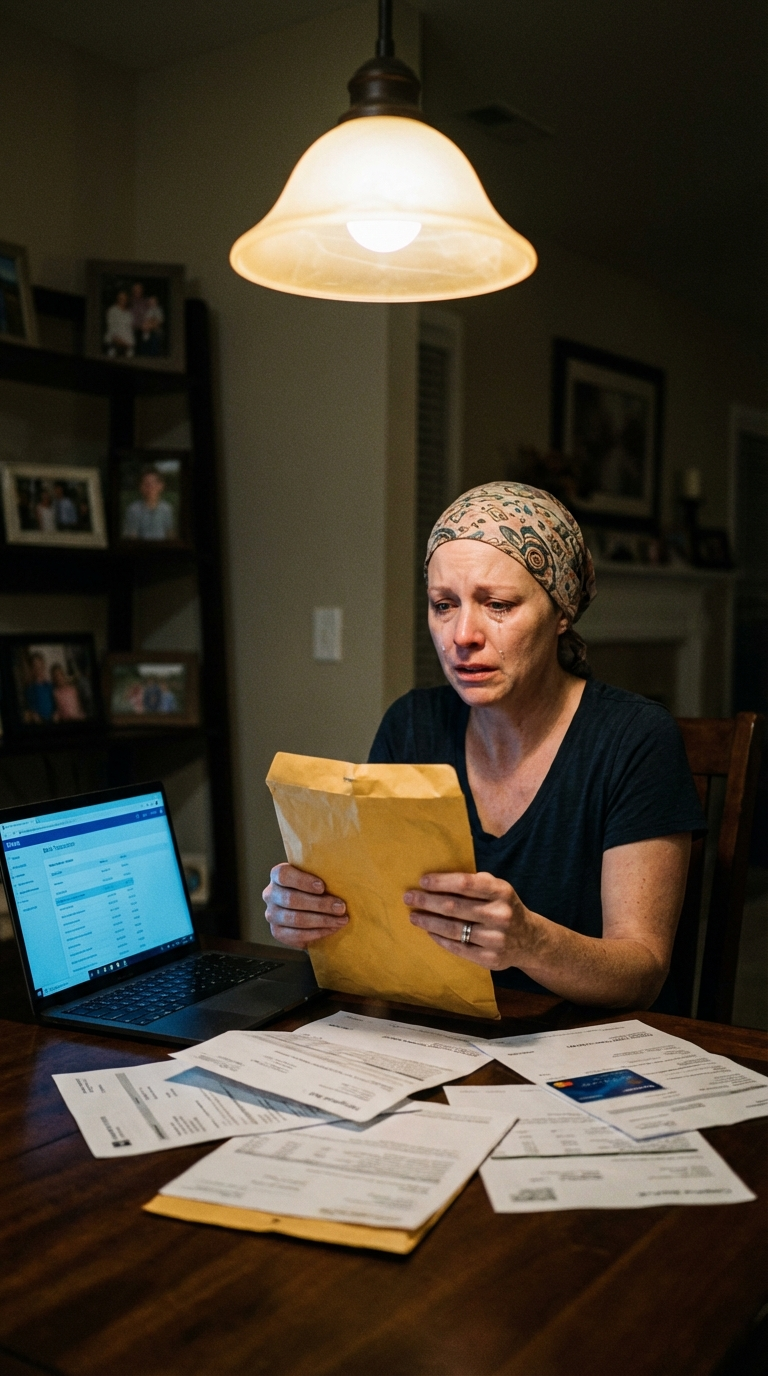
I couldn’t breathe. That was Tom’s credit card. The Visa he’d used for everything. The one I’d canceled three years ago after his death, after spending hours on hold with customer service, explaining over and over that the account holder was deceased, please close the account, please stop sending statements to a dead man.
“There must be a mistake,” I said, but my voice sounded distant, like it belonged to someone else. “Someone stole his identity. Someone hacked—”
“Mrs. Anderson, are you alright? You’re very pale. Should I call someone?”
I wasn’t alright. I was thirty-nine years old, dying of stage three breast cancer discovered six months ago during a routine mammogram. I’d already gone through eight rounds of chemotherapy that had stolen my hair, my energy, and nearly my will to live. I was staring down a double mastectomy scheduled for next week, drowning in medical debt my insurance refused to cover, selling our house to pay for treatment that might not even work.
And apparently, my dead husband had just paid for everything.
I drove home in a daze, my fingers numb on the steering wheel. Mia was asleep in the backseat, exhausted from spending another day at my sister’s house while I dealt with medical appointments and billing nightmares. She was ten now, old enough to understand that Mommy was sick, young enough to still believe everything would be okay because adults said so.
She had no idea her father might not be dead.
When I got home, I carried Mia upstairs, tucked her into bed, and did what I should have done immediately: I called the credit card company.
“CitiBank, this is Derek, how can I help you?”
“I need information about an account,” I said, my voice shaking. “It belongs to my deceased husband, but there was a payment made today that shouldn’t be possible.”
“I’m sorry for your loss, ma’am. Let me pull up that account.”
I gave him the number. Heard typing.
“Okay, yes, I see the account. Mrs. Anderson, this account shows as active. It was reactivated six months ago on September 3rd.”
My stomach dropped. “That’s not possible. I closed it three years ago when my husband died.”
“I’m showing that a reactivation request was submitted online with all the correct security information. Once it was verified, the account was reopened with the same terms and credit limit.”
“What do you mean ‘all the correct security information’?”
“Password, security questions—mother’s maiden name, city of birth, last four digits of social security number. Whoever reactivated this card knew everything.”
Because it was Tom. It had to be Tom.
But Tom was dead. I’d seen his body with my own eyes.
“Can you tell me where this card has been used?” I asked, my voice barely a whisper.
“Yes, ma’am. Let me pull up the transaction history. There are quite a few over the past six months. Gas stations in Montana—Billings, Missoula. Grocery stores in Wyoming—Jackson, Laramie. A hotel in Colorado last month—Denver. And then several transactions in Oregon over the past two weeks. Portland area.”
Each location was a knife in my chest. Tom was alive. He’d been alive for six months, maybe longer. He’d been driving across the western United States, buying gas and groceries and staying in hotels, while I was here dying of cancer, selling everything we’d built together to pay for treatment.
“Where was the most recent transaction?” I asked.
“Portland, Oregon. Two days ago. Fred Meyer grocery store. $87.43.”
“And the hospital payment?”
“That came through this morning from the same card. $127,000 to Richmond Memorial Hospital.”
He knew. He knew I was sick. He’d been watching.
I hung up and sat in the darkness of my living room, my mind fracturing into a thousand pieces. Tom was alive. My husband, the father of my child, the man I’d mourned for three years—he’d faked his death. He’d left us. Abandoned us. Started a new life somewhere in the Pacific Northwest.
But then why pay for my cancer treatment? Why reveal himself now after three years of silence?
I opened my laptop with shaking hands and started searching. Thomas Anderson, Montana. Thomas Anderson, Wyoming. Thomas Anderson, Portland, Oregon.
Nothing. He was a ghost in every database I could access.
But ghosts don’t reactivate credit cards. Ghosts don’t pay hospital bills.
I pulled up our old bank statements, the ones from 2023, the months before his supposed death. Started looking for irregularities I’d missed in my grief. And I found them immediately, obvious now that I was looking: dozens of small withdrawals and transfers I didn’t recognize. $200 here, $500 there, sometimes $1,000. All moved to accounts I’d never seen before, accounts that weren’t in our joint names.
Starting in January 2023, seven months before his death. By August, he’d moved nearly $50,000 out of our accounts in increments small enough that I hadn’t noticed in the chaos of daily life.
He’d been planning this. Planning for months to disappear. To fake his death and leave me—leave us—and start over somewhere else under a new name.
But then why stay connected? Why keep the credit card active? Why pay my medical bills?
My phone buzzed on the coffee table. Unknown number. Portland area code.
I stared at it for three rings, my heart hammering against my ribs. On the fourth ring, I answered.
“Claire?” The voice was unmistakable. Deeper, rougher, like he’d been smoking or shouting or living hard. But unmistakably Thomas. Unmistakably my husband.
“You son of a bitch,” I whispered.
A long pause. “I know. I know. But you need to let me explain. Please, Claire. I did this to protect you. To protect Mia. There are people—dangerous people—and I had to disappear. But I’ve been watching. I’ve been keeping tabs on you both. And when I saw you were sick, when I saw the medical bills piling up, I couldn’t just sit here and do nothing. I had to help.”
“You let me think you were DEAD,” I said, my voice rising despite Mia sleeping upstairs. “You let your daughter believe she lost her father. For THREE YEARS. And now you want me to let you explain?”
“Yes. God, yes. Claire, I need you to understand—”
“Where are you?”
“I can’t tell you that yet. It’s not safe.”
“Not safe for who? You? Because you seem to be doing just fine out there in Portland buying fucking groceries while your daughter cries herself to sleep asking why Daddy had to die.”
His breath hitched. “She still asks?”
“Every week. Sometimes every day. ‘Why did Daddy leave us?’ ‘Where is Daddy now?’ ‘Does Daddy miss me?’ And I have to lie to her, Tom. I have to tell her you’re in heaven watching over us when apparently you’re in fucking Oregon watching over us from a Fred Meyer parking lot.”
“Claire—”
“How could you do this to her? To ME? What could possibly justify—”
“I’ll tell you everything,” he interrupted, his voice urgent. “But not over the phone. There’s an envelope. Under the loose floorboard in our bedroom closet. The one I showed you when we first bought the house, remember? I said it was for emergencies.”
I did remember. It had seemed paranoid at the time, excessive. “Just in case,” he’d said. “You never know when you might need to hide something important.” I’d laughed and called him dramatic.
“Read what’s in there,” Tom continued. “All of it. And then decide if you want to hear my side. But Claire—and this is important—you’re in danger now. They know I paid your hospital bill. They monitor these things. They’ll be watching you, trying to use you to find me. You need to be careful. You need to—”
The line went dead.
I pulled the phone away from my ear, staring at the screen. Call ended. Not disconnected—ended. He’d hung up.
I sat there for five minutes, maybe ten, trying to process what had just happened. Then I stood, climbed the stairs like a woman walking to her execution, and opened our bedroom closet.
The loose floorboard was in the back corner, hidden under a stack of shoeboxes I never touched. I moved them aside, pried up the board with shaking fingers, and found the envelope.
Manila. Thick. Heavy with papers. On the front, in Tom’s familiar handwriting: “For Claire. I’m sorry for everything that’s about to happen. Read this and you’ll understand why I had no choice. I love you. I never stopped loving you. -T”
I opened it.
The Contents of the Envelope
Inside were documents I didn’t understand at first. Legal papers. Photographs. A USB drive. And a letter, handwritten, dated August 12, 2023—two days before Tom’s supposed death.
I read the letter first:
Claire,
If you’re reading this, I’m gone. Either I’m dead for real, or I had to disappear. Either way, I’m sorry. I’m so fucking sorry.
I need you to understand: I didn’t want this. I didn’t choose this. I got involved in something I shouldn’t have, and now people are going to come looking for me. Dangerous people. People who won’t hesitate to hurt you or Mia to get to me.
Three years ago, I witnessed something I wasn’t supposed to see. A murder. I was working late at the firm, staying past midnight to finish the Richmond Development audit—you remember, the one that was making me miserable all summer. I left around 2 AM, walked to my car in the parking garage, and I saw it happen.
Senator James Richter and a man I later identified as Marcus Volkov, head of the Volkov crime family, were meeting in the garage. I didn’t think anything of it at first—rich people meeting in weird places, whatever. But then I heard shouting. Saw Richter pull out a gun. Saw him shoot someone—a young man, maybe twenty-five, I never learned his name. Shot him twice in the chest and left him bleeding on the concrete.
I hid behind a pillar. Didn’t move. Didn’t breathe. Watched Richter and Volkov drag the body into a van and drive away like nothing had happened.
I should have gone to the police immediately. But Richter is a U.S. Senator, Claire. Volkov runs half the organized crime on the East Coast. Who was going to believe me? What proof did I have? My word against theirs?
So I didn’t say anything. I went home. I convinced myself I’d imagined it or misunderstood what I’d seen. I tried to forget.
But they knew. Someone saw me. Someone told them. And two weeks later, a man showed up at our house while you were at work. Told me he represented “certain parties” who were aware I’d witnessed an unfortunate incident. Told me I had two choices: keep my mouth shut and live, or talk and watch my family suffer.
I kept quiet. For three years, I kept quiet. But it ate at me, Claire. That young man had a family. Had a mother who reported him missing. And I knew what happened to him but I couldn’t say anything because I was too scared, too selfish, too desperate to protect you and Mia.
Then six months ago, the FBI contacted me. They’d been building a case against Volkov for years, and they had evidence that connected him to multiple murders, including the one I’d witnessed. They needed me to testify. They needed an eyewitness to tie Richter to Volkov, to prove the senator was on the crime family’s payroll.
I said yes. I agreed to testify. And the day I did, I signed all our death warrants.
They found out. I don’t know how—someone in the FBI leaking information, someone monitoring my calls, I don’t know. But two weeks after I agreed to cooperate, someone tried to kill me. Ran me off the road driving home from work. I survived, but it was a warning. Next time, they’d come for you. For Mia.
So I made a choice. I’m going to disappear. I’m going to fake my death—I’ve been planning it for months, setting aside money, creating a new identity. I’ll stage a boating accident. They’ll find my boat. They’ll find a body (not mine—I won’t explain how I’m getting it, you don’t need that on your conscience). You’ll identify it as me because you’ll believe it is. And then I’ll be gone.
The FBI is helping—off the books, unofficially. They’re putting me in a version of witness protection that doesn’t officially exist. I’ll testify at trial under a pseudonym, from a secure location. And then I’ll disappear forever.
You’ll be safe. Mia will be safe. Volkov and Richter will think I’m dead, and they’ll leave you alone.
I know this is going to destroy you. I know you’re going to hate me. I know Mia will grow up thinking her father abandoned her. But it’s the only way to keep you both alive.
I’ve set up accounts for you—the USB drive has all the information. Offshore accounts in your name with enough money to pay off the house and cover Mia’s college. They can’t be traced back to me. Take the money. Use it. Give Mia the life she deserves.
I love you, Claire. I loved you from the moment we met. I’ll love you until the day I actually die. I’m sorry I couldn’t be braver. I’m sorry I had to choose between justice and protecting my family. I chose you. I’ll always choose you.
Forever yours,
Tom
I read it three times, each time with less comprehension than the last. Tom had witnessed a murder. A U.S. Senator had killed someone. The mob had threatened our family. The FBI had recruited him. He’d faked his death to protect us.
It sounded insane. Like a movie plot. Like something that didn’t happen to ordinary people living ordinary lives in suburban Virginia.
But the documents backed it up. Photos of Tom meeting with federal agents. Copies of witness statements. News articles about young men who’d gone missing three years ago. Legal papers about the trial: United States v. Marcus Volkov and James Richter.
And the USB drive. I plugged it into my laptop with shaking hands.
Bank account information. Offshore accounts in the Cayman Islands in my name. $2.3 million, divided into three accounts.
I burst into tears. Not relief. Not gratitude. Just overwhelming, crushing grief for the life we’d lost, for the man who’d felt he had no choice but to die to save us.
The Decision
I spent the rest of the night reading everything in the envelope. By morning, I understood: Tom had died to protect us. And by paying my hospital bill, he’d revealed himself to the very people he’d been hiding from.
Which meant we were all in danger now.
At 7 AM, my phone rang again. Portland number.
“Claire, did you read it?”
“Yes,” I said, my voice hollow. “All of it.”
“Do you understand?”
“I understand that you witnessed a murder and instead of going to the police immediately like a normal person, you hid for three years and then faked your death.”
“I was trying to protect you—”
“You ABANDONED us, Tom. You let us grieve. You let your daughter believe her father was dead. There had to be another way.”
“There wasn’t,” he said firmly. “They would have killed you. Both of you. These people don’t make threats they don’t follow through on.”
“So what happens now? You called me. You paid my hospital bill. Doesn’t that expose us?”
“Yes,” he admitted. “That’s why I’m calling. You need to leave. Now. Today. Pack whatever you need and go somewhere safe. Somewhere they can’t find you.”
“Are you insane? I have cancer, Tom. I have surgery scheduled for next week. I can’t just disappear.”
“You don’t have a choice anymore. They know I’m alive. They’ll be watching you.”
“Let them watch. I’m not running.”
“Claire—”
“No. You ran. You made that choice for yourself. But you don’t get to make it for me and Mia. We have a life here. She has school, friends, stability. I’m not uprooting her because you decided to pay my medical bills and expose us.”
“Then you’re going to get her killed.”
The words hit like a slap. “Don’t you dare put that on me. You did this. You’re the one who got involved, who testified, who faked his death. This is YOUR fault, not mine.”
Silence on the other end.
“I need to go,” I said. “I have to take Mia to school.”
“Claire, wait—”
I hung up.
The Warning
For two days, nothing happened. I took Mia to school. Went to work at the insurance office where I’d been barely hanging on for the past year. Attended my pre-surgery appointment. Lived my life like I wasn’t waiting for men with guns to show up at my door.
On the third day, someone did show up. But not who I expected.
FBI Agent Sarah Chen arrived at my house at 8 PM, after Mia was asleep. She showed me her credentials, apologized for the late hour, and asked if we could speak privately.
“Mrs. Anderson, I’m here about your husband.”
“My dead husband?”
She had the grace to look uncomfortable. “Thomas Anderson is alive, as you’ve recently discovered. He’s been in unofficial protective custody for three years while we built our case against Marcus Volkov and James Richter. That case is going to trial in four months. Tom’s testimony is crucial.”
“And?”
“And someone leaked that he’s alive. We don’t know who, but the Volkov organization knows. They’ve been trying to find him for weeks. When he paid your hospital bill, he essentially sent up a flare. Now they know the best way to draw him out.”
“Is through me and my daughter,” I finished.
“Yes.”
“So what do I do?”
Agent Chen leaned forward. “We can offer you protective custody. You and your daughter. New identities, relocation, full support until the trial concludes and Volkov is in prison.”
“For how long?”
“Six months minimum. Possibly longer.”
“I have surgery in a week. I’m in the middle of cancer treatment.”
“We’ll arrange for medical care wherever you’re relocated.”
I thought about Mia. About uprooting her life again, taking her away from everything familiar, telling her we had to disappear because Daddy wasn’t really dead but also couldn’t come home.
“No,” I said. “We’re staying.”
“Mrs. Anderson, I don’t think you understand how dangerous—”
“I understand perfectly. But I’m not running. If Volkov wants to come after me, let him come. I’m not afraid of criminals when I’m already fighting cancer.”
Agent Chen looked at me like I was insane. Maybe I was.
“At least let us put protection on you. Surveillance. Someone watching your house.”
“Fine,” I agreed. “But we’re staying.”
She left her card. Promised someone would be watching 24/7. Told me to call immediately if anything seemed wrong.
After she left, I went upstairs and checked on Mia. She was sleeping peacefully, clutching the stuffed elephant Tom had won for her at a carnival the summer before he died.
I made a decision then: if Tom wanted to protect us, he could do it in person.
The Call
I called the Portland number at midnight.
“Claire?”
“I met with the FBI today.”
Silence.
“They offered us protective custody. I said no.”
“Claire, that’s insane—”
“I’m not running, Tom. And if you actually want to protect us, you need to come home.”
“I can’t. They’ll kill all of us if I—”
“Then we die. But at least we die together instead of you hiding in Oregon while Mia and I become bait.”
“You don’t mean that.”
“I absolutely mean that. You want to save us? Fine. Come save us. In person. Face the people you’re hiding from. Testify at trial. End this.”
“Claire—”
“You have forty-eight hours. Either come home or stay gone forever. But if you stay gone, don’t ever contact us again. Don’t pay our bills. Don’t watch from a distance. Let us actually grieve instead of living in this nightmare where you’re dead but not really dead.”
“Claire, please—”
“Forty-eight hours, Tom. Come home or stay dead.”
I hung up.
Tom Comes Home
Thirty-six hours later, there was a knock on my door at 2 AM. I looked through the peephole and saw him.
Tom. My husband. Older, thinner, with a beard and longer hair. But unmistakably him.
I opened the door.
We stared at each other for a long moment. Then I slapped him across the face with all the strength I had.
“That’s for dying,” I said.
Then I kissed him.
“And that’s for coming back.”
He started crying. “I’m so sorry. God, Claire, I’m so sorry.”
“I know. Come inside.”
He did. We sat in the living room in the dark, and he told me everything. The murder. The threats. The FBI. The three years of hiding. The guilt. The surveillance he’d been doing on us from afar, watching Mia grow up through binoculars and social media posts, watching me get sick and not being able to help until he couldn’t stand it anymore.
“When I saw your medical bills, when I realized you were selling the house to pay for treatment, I couldn’t just sit there anymore. I had to do something.”
“You exposed us,” I said.
“I know. I’m sorry. But I couldn’t watch you die from a distance and do nothing.”
“So what happens now?”
“Now I testify. I go public. I finish what I started three years ago and put Volkov and Richter in prison. And then we figure out if you can ever forgive me.”
“What about Mia?”
“She’s upstairs?”
“Asleep.”
“Can I see her?”
I nodded.
We went upstairs together. Opened Mia’s door quietly. She was still sleeping, still clutching the elephant.
Tom stood in the doorway, tears streaming down his face, looking at his daughter for the first time in three years.
“She’s so big,” he whispered.
“She’s ten. She’s forgotten what you look like.”
“I know.”
“When she wakes up, she’s going to think she’s dreaming.”
“What do I tell her?”
“The truth,” I said. “That you had to go away to keep us safe. That you loved us the whole time. That you’re home now.”
“Will she believe me?”
“I don’t know. But you’re going to spend every day for the rest of your life proving it to her.”
The Trial
The trial of United States v. Marcus Volkov and James Richter began four months later. Tom testified in person, in open court, despite the FBI’s objections. He wanted Volkov to see his face. Wanted Richter to know he wasn’t afraid anymore.
His testimony was devastating. He described the murder in detail. Identified both men. Provided documentation of threats made against him. Corroborated evidence the FBI had spent years collecting.
The defense tried to destroy him. Called him a liar. Suggested he’d faked his death to avoid debts or infidelity or any number of other scandalous reasons. But Tom held firm.
“I faked my death to protect my family from murderers,” he said calmly. “And I’d do it again.”
Volkov and Richter were convicted on all counts. Multiple life sentences. No parole.
We were free.
Five Years Later
Today, Tom and I are still married. It hasn’t been easy. Three years of grief and betrayal don’t disappear overnight. We did therapy—lots of therapy. Had fights that shook the walls. Cried more tears than I thought possible.
But we’re still here.
Mia is fifteen now. She and Tom have rebuilt their relationship slowly, carefully. She’s forgiven him, mostly. Some days she’s angry. Most days she’s just glad he’s home.
My cancer is in remission. The surgery and follow-up treatment worked. I’ve been cancer-free for four years.
Tom works as a consultant now, using a variation of his real name. We moved to Colorado—fresh start, new city, away from the memories. Mia loves it. We all love it.
And sometimes, late at night, Tom and I talk about those three years. About the choices he made. About whether he did the right thing.
“I don’t know if I’d make the same choice again,” he admits. “Knowing what it did to you and Mia. But I also know that if I’d stayed, we might all be dead.”
“I know,” I say. “I understand why you did it. I just wish there’d been another way.”
“Me too.”
We sit in comfortable silence, this man who died and came back, this woman who survived cancer and betrayal and learned to forgive.
“Thank you,” I say finally.
“For what?”
“For paying my hospital bill. For revealing yourself even though it put you in danger. For choosing to save me even when it cost you everything.”
“I’d do it again,” he says. “A thousand times over. You’re worth any risk.”
And I believe him.