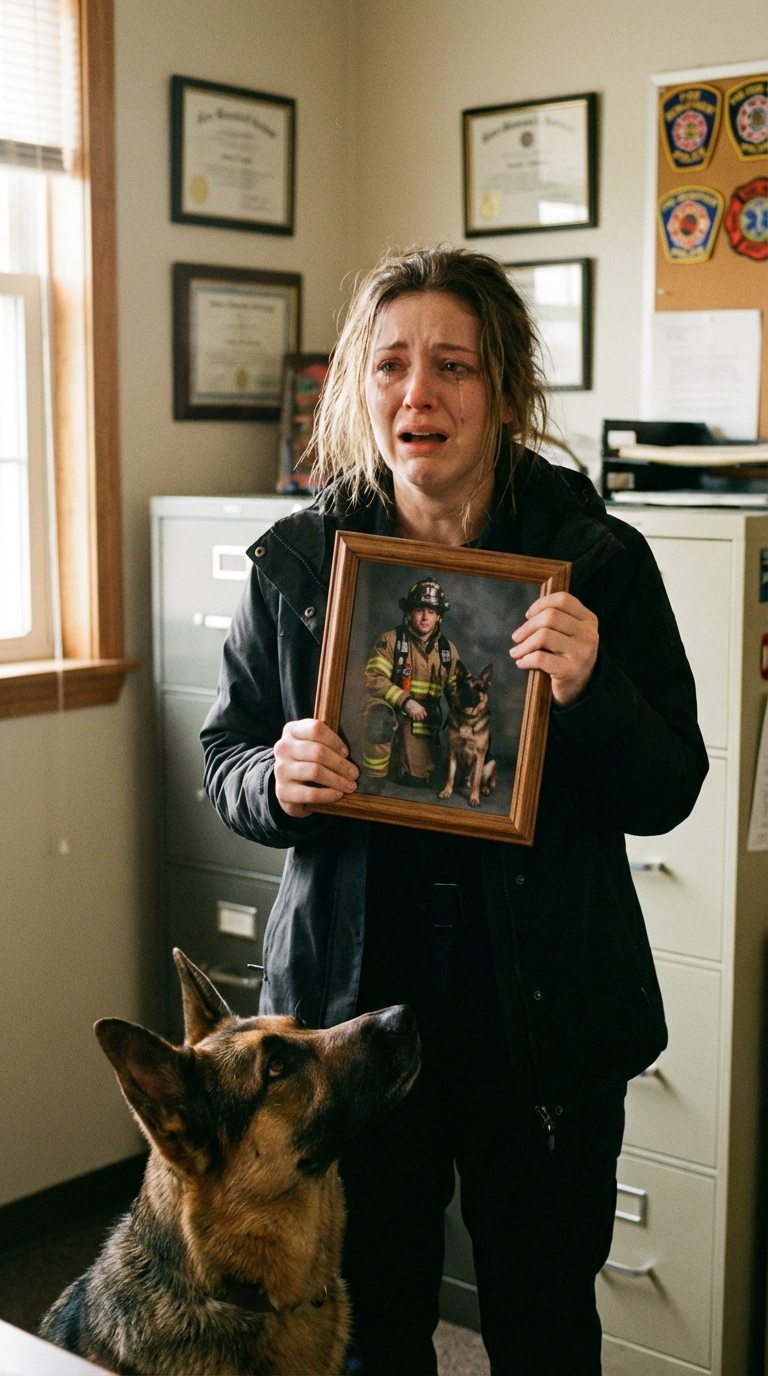
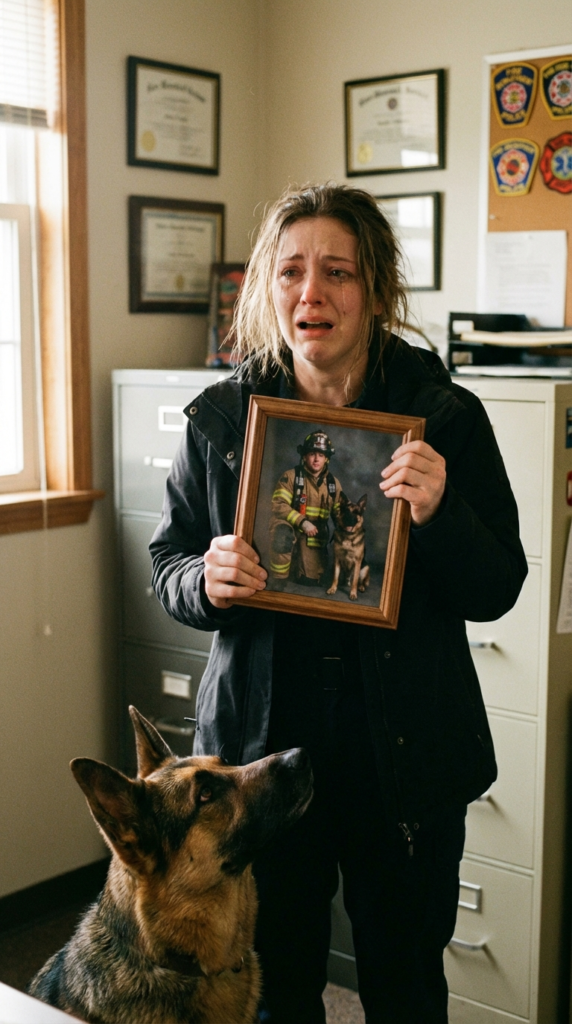
I was standing in Fire Marshal Tom Davidson’s cramped office at Portland Fire Station 23, staring at a photograph of a firefighter in full gear with a German Shepherd by his side, when he said the words that would change everything: “Captain Michael Hayes died saving six people from that apartment fire eight months ago. His search and rescue dog Blaze went missing during the chaos. We assumed he’d died in the building collapse too.”
Blaze. My dog’s name was Blaze.
The German Shepherd sitting at my feet—the dog I’d adopted from Portland Animal Shelter just three months ago, the dog who’d become my constant companion, the dog who’d woken me up by barking frantically at 3 AM last Tuesday when my apartment caught fire, the dog who’d literally saved my life by refusing to let me go back to sleep—wasn’t just any rescue dog.
He was a trained fire search and rescue K9 with hundreds of hours of specialized training. And his handler had died a hero in the line of duty.
“Ms. Porter,” Marshal Davidson continued, pulling out a thick file folder, “we’ve been trying to track down Blaze since the night Captain Hayes died. He disappeared during the building collapse. We searched for three weeks. Interviewed witnesses. Posted bulletins. How exactly did you end up with him?”
My hands were shaking. I reached down to touch Blaze’s head, needing the physical connection to this dog who’d become my entire world in just three months. “I adopted him from Portland Animal Shelter in October. They said he’d been found wandering as a stray in Southeast Portland. That he’d been there for two weeks and nobody had claimed him. They didn’t say anything about him being a trained rescue dog. They didn’t say anything about him belonging to a firefighter who died.”
Marshal Davidson’s frown deepened. “That doesn’t make any sense. Blaze has a microchip registered directly to the Portland Fire Department. It’s in our system. Anyone scanning him should have immediately flagged him as department property and contacted us. Why didn’t the shelter call?”
“They did scan him,” I said, my voice rising with confusion and growing dread. “The shelter tech told me the chip was there but the information was corrupted or something. That they couldn’t retrieve any owner data. So after the legal hold period with no claims, they cleared him for adoption. I thought I was just getting a really well-behaved stray.”
“That’s impossible.” Davidson pulled out his phone and made a call. “Denise? Tom Davidson. I need you to pull the file on Blaze—K9 unit 47. Specifically, I need the chip registration and monitoring logs since February… Yeah, I’ll hold.”
He put the phone on speaker. We waited in tense silence.
“Tom?” A woman’s voice came through. “I’ve got the file. Chip registration is active and current. Never been flagged as corrupted or compromised. But there’s something weird here. Someone accessed the file in September—three weeks after Hayes died—and added a notation marking the chip as ‘signal suppressed due to technical malfunction.’ But there’s no authorization signature. No incident report. Nothing that explains why that notation would be added.”
Davidson and I stared at each other.
“Someone deliberately suppressed his chip information,” I whispered.
“Denise, I need you to trace who made that notation. And pull security logs for anyone who accessed Hayes’s K9 files between February and October. I want names.” He hung up.
“Why would someone do that?” I asked. “Why would someone want Blaze to disappear?”
Marshal Davidson was quiet for a long moment. When he spoke, his voice was careful. “Ms. Porter—Rachel—how much do you know about the fire that killed Captain Hayes?”
“Just what was in the news. Five-alarm fire in an apartment building on Cedar Street. Multiple casualties. Several firefighters injured. Hayes died when part of the building collapsed.”
“That’s the official story. But there’s more to it.” Davidson pulled out another file. “For six months before his death, Captain Hayes was conducting an unofficial investigation into a series of suspicious fires in Southeast Portland. Seven fires in eight months, all in low-income apartment buildings, all ruled accidental but with strange similarities. Hayes thought they were arson. He was documenting patterns, collecting evidence, building a case.”
“Why unofficial?”
“Because the official investigations had ruled them accidents. Hayes was told to drop it. But he couldn’t let it go. He had a notebook—called it his ‘fire diary’—where he documented everything. Accelerant patterns, timing, connections between buildings. He was convinced someone was systematically burning buildings for profit. Insurance fraud, maybe, or clearing properties for redevelopment.”
“And then he died in a fire,” I said slowly.
“In a fire that had the same signature as the ones he was investigating. A fire that started suspiciously quickly. A fire where the structural collapse that killed him happened in a section of the building that shouldn’t have been compromised that severely.” Davidson’s jaw was tight. “Some of us think Michael Hayes was killed to stop his investigation.”
My stomach dropped. “You think he was murdered.”
“I think it’s awfully convenient that a firefighter investigating arson dies in a suspicious fire, and then his K9—the dog who was with him that night, who might have witnessed something—mysteriously disappears with his chip information suppressed.”
I looked down at Blaze, who was watching me with those intelligent brown eyes that had seen his handler die. “Blaze was there when it happened.”
“Blaze was with Hayes when they went into that building. When Hayes didn’t come out, Blaze stayed inside looking for him. We had to pull him out physically. He was going crazy, trying to get back in. And then during the chaos of the collapse response, he just… vanished. We figured he’d bolted from trauma, maybe got killed in a secondary collapse. But now—” Davidson gestured at the dog. “Now I think someone took him deliberately.”
“But why? He’s a dog. He can’t testify.”
“No. But he’s a trained search dog. If someone wanted to destroy evidence in that building—remove something Hayes had found, plant something to support the accident narrative—Blaze could have detected it. Could have indicated to other handlers that something was wrong. Easier to make the dog disappear.”
I felt sick. “So someone stole a fire department K9, suppressed his chip, and dumped him far enough away that he’d end up in a shelter instead of being recognized?”
“That’s my theory. And it worked. Until three months ago when you adopted him.” Davidson leaned forward. “Now I need to know about your fire. The one where Blaze saved you. Tell me everything.”
The Fire That Changed Everything
I took a deep breath, remembering the terror of last Tuesday night.
“I’d been asleep for maybe two hours. It was around 3 AM. I woke up to Blaze barking. Not normal barking—frantic, desperate barking right next to my bed. I tried to calm him down but he wouldn’t stop. He grabbed my sleeve with his teeth and started pulling. Actually pulling me out of bed.”
“That’s trained alert behavior,” Davidson interjected. “He was indicating danger.”
“I didn’t know that then. I just thought he was freaking out. But he was so insistent that I got up. And the second I opened my bedroom door, I smelled it. Smoke. Heavy smoke filling my hallway.”
The memory made my hands shake. Blaze leaned against my leg, sensing my distress.
“The apartment filled with smoke in seconds. I couldn’t see. Could barely breathe. Blaze led me to the door—I literally had my hand on his collar following him because I was blind. He got me to the stairwell. Probably saved my life.”
“You would have died from smoke inhalation,” Davidson said flatly. “The fire report says you had maybe ninety seconds of breathable air left when firefighters found you in the stairwell. Blaze gave you those ninety seconds.”
Tears stung my eyes. “He did what he was trained to do. He saved me just like he was trained to save people. Even after losing his handler. Even after being abandoned and ending up in a shelter. He still did his job.”
“That’s what good K9s do. They live for the work.” Davidson’s expression softened. “Michael Hayes loved that dog. They were partners for five years. He used to say Blaze had saved more lives than he ever would. That he was the real hero.”
“Tell me about him,” I said. “Tell me about Captain Hayes.”
Davidson pulled out more photos from the file. Michael Hayes at various stages of his career. Always with Blaze. Always smiling.
“Michael Hayes was one of the best firefighters I’ve ever known. Dedicated, brave, intuitive. He had instincts for fire behavior that you can’t teach. And he and Blaze were a perfect team. They’d done hundreds of search and rescue operations together. Found dozens of survivors in situations where nobody else could.”
He showed me a photo of Hayes receiving a medal. “That’s from 2023. They found a trapped family in a collapsed warehouse. Against orders, Hayes and Blaze went into an unstable section and pulled out four people. He got a valor citation. Blaze got a steak dinner.”
Despite everything, I smiled. “Sounds like a good handler.”
“The best. He was also a good man. Coached youth soccer. Volunteered at the burn center. Was raising his teenage daughter alone after his wife died from cancer three years ago.” Davidson’s voice broke slightly. “Ella. She’s sixteen now. She lost her mom, then her dad, then even her dad’s dog disappeared. That girl has been through hell.”
My heart shattered. “She doesn’t know Blaze is alive?”
“Nobody did. Until you walked into my office this morning asking about the fire investigation and I saw that dog.”
I’d come to the fire marshal’s office to ask about the investigation into my apartment fire. To understand what had happened. I’d brought Blaze because I brought him everywhere—three months of bonding had made us inseparable. I never imagined I’d discover his true identity.
“There’s something else I need to tell you,” I said quietly. “About my apartment building. About the person who lived below me.”
Davidson pulled out a notepad. “Go on.”
“The fire started in apartment 2B. Directly below mine. The tenant was a guy named Derek Walsh. I didn’t know him well—saw him maybe twice in the four months I lived there. Quiet guy, kept to himself.”
“And?”
“And about two weeks before the fire, something weird happened. I was coming home with Blaze and we passed Walsh’s door. Blaze went absolutely crazy. Like, aggressive crazy. Barking, lunging, trying to get at the door. I’d never seen him react like that to anything. He was always so calm and friendly. But at that door, he was like a different dog. Vicious.”
Davidson sat up straighter. “What did you think caused it?”
“I thought maybe Walsh had a cat or another dog that Blaze could smell. Or maybe Walsh had been mean to dogs before and Blaze sensed it. I don’t know. I just pulled him away and avoided that hallway after that.”
“Rachel.” Davidson’s voice was intense. “Trained search and rescue dogs are also trained to alert on accelerants. Gasoline, lighter fluid, anything that’s used to start fires. Blaze was alerting on something in that apartment.”
The implications hit me like a truck. “You think Walsh was the arsonist?”
“I think it’s too much of a coincidence that you adopt a missing K9 who was investigating arson, move into a building where Blaze indicates on someone’s apartment, and then that person sets a fire. Where is Walsh now?”
“I don’t know. Nobody’s seen him since the fire. The police said they’re looking for him as a person of interest.”
Davidson was already on his phone. “I need you to pull everything on a Derek Walsh. Southeast Portland, apartment 2B at the River Terrace complex… Yeah, the arson last week… No, this is connected to the Hayes case. I think Walsh might have been involved in the Cedar Street fire.”
He hung up and looked at me with grim certainty. “Rachel, I think someone has been looking for Blaze for eight months. And when they finally found him—living in your building, walking past Walsh’s door every day—they panicked. They tried to eliminate both of you.”
“But I survived. Because of Blaze.”
“Because of Blaze,” Davidson agreed. “That dog saved your life twice. Once when he led you out of that apartment, and once before when someone tried to suppress his chip and make him disappear. Because if you hadn’t adopted him, if he’d stayed in that shelter or been euthanized like unclaimed dogs eventually are, nobody would have ever questioned the official story about Hayes’s death.”
I was shaking, overwhelmed by the magnitude of what I’d stumbled into. “What happens now?”
“Now we reopen the investigation into Captain Hayes’s death. Now we find Derek Walsh and everyone connected to him. Now we get justice for one of the best firefighters Portland ever had.” Davidson reached down and scratched Blaze behind the ears. “And now this good boy gets to go home to his family. Ella Hayes deserves to know her dad’s dog survived. That he’s still being a hero.”
My heart broke. “You’re taking him away?”
“He’s department property, Rachel. And more importantly, he’s Ella’s dog. Her last connection to her father.”
“I know,” I whispered, even as tears streamed down my face. “I know he has to go home. But—” I buried my face in Blaze’s fur. “He saved my life. And I love him.”
“I know you do,” Davidson said gently. “But he loves someone else. He’s been away from his real home for eight months. He needs to go back.”
I nodded, unable to speak.
“But Rachel? You’re part of this story now. Part of getting justice for Hayes. And I think Ella would want to meet you. Would want to know the person Blaze saved after her father died. Would you be willing to meet her?”
“Yes,” I managed. “Yes, I’d like that.”
Davidson made some calls. Arrangements. Within an hour, I was following his truck to a house in Northeast Portland, Blaze sitting in my passenger seat like always, neither of us knowing this was our last car ride together.
Meeting Ella Hayes
The house was a modest ranch-style home with a well-maintained yard. Wind chimes hung on the porch. A soccer ball sat by the door. Normal suburban life.
Except the girl who answered the door had haunted eyes that had seen too much loss for sixteen years.
Ella Hayes was tall and athletic with her father’s kind eyes and a wariness that came from grief. She looked at Marshal Davidson first, then at me, then her gaze dropped to Blaze.
She froze.
“Blaze?” she whispered.
The dog went crazy. Ears forward, tail wagging like helicopter blades, a high whine of recognition and joy. He pulled toward her with strength I’d never felt from him before.
“Oh my God,” Ella said, her voice breaking. “Oh my God, Blaze?”
I let go of the leash.
Blaze launched himself at Ella, nearly knocking her over. She dropped to her knees and he was all over her, licking her face, pressing against her, making sounds of pure joy.
“I thought you were dead,” Ella sobbed, wrapping her arms around the dog. “I thought I lost you too. I thought—”
She couldn’t finish. She just held onto Blaze while he covered her face in kisses and made those happy whining sounds dogs make when they’re reunited with their person.
I stood there watching, crying, my heart breaking and healing at the same time.
Davidson explained everything while Ella held her father’s dog. The suppressed chip. The shelter. My adoption. The fire. Walsh. The investigation.
“He saved her life,” Ella said, looking at me with tears streaming down her face. “He saved your life just like Dad trained him to. Even after everything, he still did his job.”
“He’s an amazing dog,” I said, my voice thick with emotion. “I only had him for three months but he changed my life. I was so alone, and he—he became everything to me.”
Ella stood up, still holding Blaze’s collar. “Can we go inside? I want to show you something.”
We followed her into the house. The living room was clearly a memorial to Michael Hayes. Photos everywhere. Commendations on the walls. A flag in a display case.
Ella led us to a bookshelf and pulled down a notebook. Worn leather, stuffed with papers and photos.
“Dad’s fire diary,” she said. “The one he was keeping about the arson investigation. The police gave it back to me after he died. I’ve read it a hundred times trying to understand what happened to him.”
She opened it to a page marked with a photo. The photo showed Hayes and Blaze at a fire scene, both looking exhausted but professional.
“This was from the fifth suspicious fire Dad investigated. February 14th, six days before he died. He wrote about finding evidence of accelerants in a pattern that matched the previous fires. He documented everything. And look—” She pointed to a name written in the margin. “Derek Walsh. Dad had identified him as a person of interest. Someone who’d been seen near multiple fire scenes.”
Davidson took the notebook, scanning the pages with growing intensity. “Jesus. Michael had everything. Names, dates, locations, patterns. This is enough to build a case.”
“But he died before he could take it to anyone,” Ella said bitterly. “And Walsh got away with it. Got away with killing my dad.”
“Not anymore,” Davidson said firmly. “With this evidence and what happened at Rachel’s building, we can connect Walsh to all of it. We can prove your father was right. We can get him justice.”
Ella looked at Blaze, then at me. “Thank you for taking care of him. For giving him a home when he had nowhere to go.”
“He took care of me,” I said. “He saved my life. I owe him everything.”
“Can I ask you something?” Ella said hesitantly. “Did he seem… happy? With you? I know you only had him for three months, but was he okay?”
I thought about morning walks and evening cuddles, about Blaze sleeping at the foot of my bed every night, about the way he’d lean against me when I was sad like he knew I needed comfort.
“He was wonderful,” I said honestly. “Loving and gentle and so, so smart. But Ella—” I knelt down to Blaze’s level. “He missed you. I think part of him was always searching for his family. And now he found you.”
Blaze looked between us, sensing the emotional weight of the moment.
“Do you want to say goodbye?” Ella asked gently.
I nodded, unable to speak. I wrapped my arms around Blaze one last time, buried my face in his fur, and whispered, “Thank you for saving me. Thank you for being mine, even for just a little while. Be good. You’re home now.”
Blaze licked my face, his tail wagging gently, and I knew he understood.
I stood up, wiped my tears, and looked at Ella. “Take care of him. He’s special.”
“I will,” she promised. “And Rachel? I’d like to stay in touch. If that’s okay. You’re part of his story now. Part of our story.”
“I’d like that,” I said.
Davidson drove me home. The apartment building was still uninhabitable from fire damage, so I was staying with my sister temporarily. Without Blaze, everything felt empty.
The Investigation Accelerates
Over the next three weeks, everything moved fast.
Marshal Davidson reopened the investigation into the Cedar Street fire using Michael Hayes’s diary as the foundation. With the new evidence and Walsh connection, they got a warrant to examine Hayes’s death more closely.
They found what Hayes had suspected: accelerants in places they shouldn’t be. Structural damage consistent with explosives, not natural fire behavior. Evidence that had been overlooked or suppressed in the original investigation.
Someone had deliberately caused that building to collapse with Hayes inside.
Meanwhile, Portland PD was hunting Derek Walsh. They tracked him to Seattle, then Vancouver. An arrest warrant was issued for arson and attempted murder for my apartment fire.
And they discovered Walsh wasn’t working alone.
The investigation uncovered a network of property developers, corrupt building inspectors, and hired arsonists who’d been systematically burning low-income buildings across Southeast Portland. Once the buildings were condemned, developers could buy the land cheap and build expensive condos.
Michael Hayes had been close to exposing all of it. So they’d killed him and made it look like an accident.
“There are six people in custody,” Davidson told me during one of our regular update calls. “Including Walsh. They’re all turning on each other, trying to cut deals. Walsh is claiming he was just hired muscle, that he didn’t know Hayes would be in that building. But we’ve got him on multiple counts of arson and murder conspiracy.”
“Will he face justice for Captain Hayes?”
“Yes. The DA is confident we can get murder charges to stick. And Rachel—you’re going to have to testify. About the fire at your building. About Blaze’s reaction to Walsh’s apartment. Are you okay with that?”
“Absolutely,” I said without hesitation. “Whatever it takes.”
Six Months Later: The Trial
The trial of Derek Walsh and his co-conspirators made national news. The story had everything: hero firefighter killed investigating corruption, loyal dog who survived and helped crack the case, average citizen who stumbled into justice.
I testified about adopting Blaze, about his reaction to Walsh’s apartment, about the fire and how Blaze saved my life. The defense tried to discredit me, suggesting I’d misinterpreted normal dog behavior.
Then Ella Hayes took the stand with her father’s diary and showed the jury Michael Hayes’s detailed investigation, his conclusions, his identification of Walsh.
Then expert witnesses explained accelerant patterns and how the Cedar Street fire matched Walsh’s methodology.
Then other victims testified about losing their homes to these suspicious fires.
The jury deliberated for four hours.
Guilty on all counts.
Derek Walsh got life in prison without parole for the murder of Captain Michael Hayes. His co-conspirators got various sentences totaling over a hundred years combined.
After the verdict, Ella and I stood on the courthouse steps while cameras flashed and reporters shouted questions.
“Justice for my father,” Ella said into the microphones. “Finally. After eight months, we have answers. We have accountability. And we have his diary showing he died doing what he always did—protecting people and fighting for what was right.”
A reporter shouted: “What about Blaze? The dog who helped crack the case?”
Ella smiled—the first real smile I’d seen from her. “Blaze is a hero, just like my dad. He survived the same fire that killed his handler, saved another life after being rescued himself, and his story led us to the truth. Dad would be so proud of him.”
“Do you have Blaze here today?” another reporter asked.
“We do.” Ella gestured, and Marshal Davidson approached with Blaze on a leash, wearing a special vest that read “SEARCH AND RESCUE K9 – PORTLAND FIRE.”
The crowd went wild. Cameras went crazy. Blaze sat calmly, professionally, his training evident in his composure.
But when he saw me at the edge of the crowd, his ears perked forward and his tail started wagging.
“Go on,” Ella said, unclipping his leash. “Go see her.”
Blaze trotted over to me and I knelt down to hug him, overwhelmed with emotion.
“Good boy,” I whispered. “Such a good boy. I’m so proud of you.”
He licked my face and leaned into me, and I knew despite everything—despite being reunited with his family, despite being back where he belonged—he remembered me. Remembered the months we’d spent together. Remembered that I’d loved him.
“Rachel?” Ella was beside me. “Can we talk for a minute?”
We stepped away from the cameras, finding a quiet corner of the courthouse plaza. Blaze stayed between us, connected to both of us.
“I have a proposition,” Ella said. “Blaze is officially retired from active duty. He’s six years old, and after everything he’s been through, Davidson thinks he deserves to relax. So he’s mine now. Fully mine.”
“That’s wonderful,” I said, meaning it despite the ache in my chest.
“But here’s the thing,” Ella continued. “I’m sixteen. I’m in school all day. My aunt works full time. Blaze is alone a lot. And I can see—” She gestured at the dog. “I can see he loves you. He lights up when he sees you. And I think… I think maybe he could have two homes. You and me. Joint custody or whatever.”
My heart stopped. “What?”
“You saved his life by adopting him when nobody else wanted him. He saved your life in return. You’re bonded. And I’m not going to take that away from him—or from you. So what do you say? Co-parenting a hero dog?”
Tears streamed down my face. “Are you serious?”
“Completely. Blaze deserves all the love he can get. And so do you. So do I. We’re all connected now—by Dad, by Blaze, by this whole impossible story. We might as well be connected by choice too.”
I looked at Blaze, who was watching us both with those intelligent eyes, tail wagging like he approved of this plan.
“Yes,” I said. “God, yes. I would love that.”
Ella hugged me. “Then it’s settled. Welcome to the family, Rachel.”
One Year Later: Full Circle
Today is the one-year anniversary of the Cedar Street fire. The anniversary of Michael Hayes’s death.
Ella, her aunt Patricia, Marshal Davidson, a dozen firefighters from Station 23, and I are gathered at a memorial that was unveiled this morning in the park near the fire station.
It’s a bronze statue of Captain Michael Hayes in full gear with Blaze by his side. The plaque reads:
“CAPTAIN MICHAEL HAYES – PORTLAND FIRE DEPARTMENT
1987-2025
HE DIED A HERO, INVESTIGATING CORRUPTION AND SAVING LIVES
HIS LEGACY LIVES ON IN THE LIVES HE TOUCHED
AND THE DOG WHO CARRIED HIS MISSION FORWARD”
Blaze sits between Ella and me, wearing his ceremonial vest, watching the memorial with the calm dignity of a dog who understands he’s being honored.
After the official ceremony, after the speeches and the photos, Ella and I take Blaze for a walk through the park. It’s become our Sunday ritual—the three of us spending time together, honoring the connection that brought us into each other’s lives.
“Do you ever think about how weird this all is?” Ella asks. “Like, what are the odds? You adopting Dad’s dog without knowing. Moving into a building where the guy who killed Dad happened to live. Blaze alerting on him. All of it leading back to justice.”
“I think about it every day,” I admit. “It feels like fate. Like Michael somehow knew Blaze would find the right person. Would end up in a place where he could finish what your dad started.”
“Mom used to say Dad had a sixth sense about fires,” Ella says quietly. “That he knew things before they happened. Maybe he knew about Blaze too. Maybe he knew that dog would save lives even after he was gone.”
We walk in comfortable silence for a while. Blaze trots between us, occasionally sniffing interesting things, completely content with his two-home, two-family life.
“I got into college,” Ella says suddenly. “Early decision. University of Washington. I’m going to study fire science and investigation. Because of Dad. Because of everything that happened.”
“Ella, that’s amazing!” I hug her. “Your dad would be so proud.”
“I hope so. I want to do what he did. Fight corruption, protect people, make sure no more firefighters die trying to expose the truth.” She smiles. “And I’m going to specialize in arson investigation. Going to be the person who catches the Derek Walshes of the world before they kill anyone.”
“You’re going to be incredible,” I say honestly.
“What about you? What’s next for you?”
“I’m writing a book,” I admit. “About everything that happened. About your dad, about Blaze, about the investigation. The publisher says it could help reform how fire investigations are conducted. Could lead to better protections for firefighters who report corruption.”
“Dad would love that. He always said the system needed fixing.”
We loop back to the memorial. The crowds have dispersed but Davidson is still there, standing before the statue with his hand on the bronze Blaze’s head.
“He was my best friend,” Davidson says when we join him. “Twenty years we worked together. And losing him—knowing he died because he was trying to do the right thing—it nearly broke me. But then you found his dog. And Blaze led us to the truth. And now Michael’s legacy isn’t just about how he died. It’s about the justice we got. The corruption we exposed. The lives we saved by stopping those arsons.”
“He’s a hero,” I say simply.
“They both are,” Davidson corrects, looking at Blaze. “The man and his dog. Both heroes. Both still saving lives even now.”
As if understanding, Blaze walks up to the statue and sits beside it, his living form next to his bronze counterpart. The image is so perfect that several people start taking photos.
“That’s going to be on every news outlet tomorrow,” Ella laughs.
“Good,” Davidson says. “Let people see. Let them remember Captain Michael Hayes and K9 Blaze. Let them remember heroes come in all forms.”
Today
It’s been eighteen months since I adopted a dog from a shelter. Eighteen months since that dog saved my life. Eighteen months since I discovered he was a trained hero who’d lost his handler and been deliberately hidden away.
Blaze is seven years old now, officially retired, splitting his time between my apartment and Ella’s house. He’s gained weight and his muzzle is starting to gray, but his eyes are still sharp and his spirit is still strong.
He’s still a hero. Just in smaller ways now.
Last month, Blaze alerted on a gas leak in my apartment building before anyone else smelled it. Building was evacuated, leak was fixed, disaster averted.
Two weeks ago, he found a lost child in the park during one of our walks. The boy had wandered away from his parents and was crying behind some bushes. Blaze led us right to him.
Once a search and rescue dog, always a search and rescue dog.
Derek Walsh and his co-conspirators are in prison. The corrupt building inspectors lost their licenses. New regulations were passed requiring independent oversight of fire investigations.
Michael Hayes was posthumously awarded the Medal of Valor, Portland’s highest honor for firefighters. His name is on the memorial wall at Fire Station 23. His story is taught in fire academies as an example of integrity and courage.
Ella is thriving. She’s found purpose in her father’s death—using it to fuel her own journey toward justice. We talk almost every day. She’s become like a little sister to me.
And Blaze—beautiful, heroic, impossible Blaze—gets to be loved by two families who understand how special he is.
Sometimes I look at him and think about all the coincidences that had to align for our story to happen. The suppressed chip that kept him hidden. The shelter that put him up for adoption. My decision to adopt that specific dog that specific day. Moving into that specific apartment building. Walsh living below me. The fire. All of it.
Too many coincidences. Which means it probably wasn’t coincidence at all.
I don’t know if I believe in fate or divine intervention or the idea that Michael Hayes somehow guided Blaze to me from beyond. But I believe in the connection between a handler and his dog. I believe in the power of training and instinct and love. I believe good dogs know where they’re needed.
And I believe Blaze found me because we both needed saving.
He saved my life that night in the fire. But I’d saved his first—by adopting him, by loving him, by being in the right place at the right time to give him a second chance at purpose.
We saved each other. And in doing so, we helped get justice for the man who’d trained him, loved him, and died a hero.
“Good boy,” I whisper to Blaze, scratching behind his ears the way he likes. “Best boy. My hero.”
He leans into me, content and peaceful, a retired search and rescue dog who’s earned his rest.
But his work isn’t done. It’ll never be done. Because once a hero, always a hero.
And some heroes wear fur and save lives just by being exactly who they were always meant to be.