The Hospital Cafeteria
I was sitting in the depressing fluorescent-lit cafeteria of Portland General Hospital, nursing a terrible cup of coffee and watching my five-year-old daughter Emma color at the next table, when she suddenly jumped up and walked directly toward a stranger sitting alone in the corner.
The man was in his early forties, wearing an expensive charcoal suit that probably cost more than my monthly rent. His head was in his hands, shoulders shaking with sobs he was trying desperately to contain. His grief was so raw, so visible, that everyone in the cafeteria was pretending not to notice him—giving him the privacy his obvious pain demanded.
Everyone except my daughter.
“Emma, no—” I started, but she was already there, standing fearlessly beside his table.
“Mister,” she said in her clear, serious five-year-old voice. “Do you miss your daddy too?”
The man looked up, his face red and tear-streaked, eyes swollen from crying. He stared at Emma like she’d appeared out of nowhere, this tiny child asking the most profound question at exactly the moment he needed to hear it.
“What?” he managed, his voice hoarse and breaking.
“Your daddy,” Emma said with the fearless compassion that only children who’ve experienced loss seem to possess. “You’re crying like I cry when I miss my daddy. Did your daddy go to heaven too?”
I rushed over to pull her away, my face burning with embarrassment. “Emma, sweetheart, you can’t just—I’m so sorry, sir. She doesn’t understand boundaries yet. She doesn’t mean to intrude—”
But the man held up his hand, stopping my apology. Fresh tears spilled down his face. “Yes,” he whispered to Emma, his voice barely audible. “My father died yesterday. I just… I just came from saying goodbye to him upstairs. They’re disconnecting life support in an hour.”
Emma’s face crumpled with immediate understanding. “That’s so sad. I’m really sorry. My daddy died in a car accident when I was three. I don’t remember him very much anymore but Mommy shows me pictures and she says he loved me more than anything in the whole world.”
The man’s composure shattered completely. He put his face back in his hands and sobbed—deep, wrenching sobs that seemed to come from the very core of his being. The kind of grief that’s too big to contain, too overwhelming to hide.
Emma did something I’ll never forget for the rest of my life. Without hesitation, without fear, she climbed onto the chair next to him and wrapped her tiny arms around his shoulders in a hug.
“It’s okay to be sad,” she said softly, patting his back the way I patted hers during nightmares. “Mommy says crying helps the hurt come out so it doesn’t stay stuck inside you.”
The man—this complete stranger in his expensive suit—held onto my daughter like she was a life raft in a storm. He clung to her small frame and cried into her shoulder while she patted his back and made soothing sounds.
I stood there frozen, tears streaming down my own face, watching this impossible moment of pure human connection between a grieving child and a grieving man.
The cafeteria had gone silent. Everyone was watching now, no longer pretending not to see. Several people were crying too, moved by the raw emotion of the scene.
After several minutes, the man pulled himself together enough to speak. He gently released Emma and wiped his eyes with shaking hands. “I’m sorry,” he said, looking between Emma and me. “I’m not usually— I don’t normally fall apart in public. I’ve been trying to hold it together all day but I just—I couldn’t—”
“You don’t need to apologize,” I said gently, sitting down across from him. “Grief doesn’t follow rules. It comes when it comes.”
“Thank you,” he said to Emma, his voice thick with emotion. “Thank you for seeing me. For caring. You have no idea what you just gave me.”
“You’re welcome,” Emma said with simple sincerity. “What’s your name? I’m Emma Rose Carter. I’m five and a half.”
The man smiled through his tears. “I’m David. David Morrison. I’m forty-three and I just lost my best friend.”
“Your daddy was your best friend?” Emma asked.
“He was. He was my father, my business partner, my mentor, everything. We built a company together. Morrison Technologies. We spent every day together for twenty years. And yesterday he had a massive stroke and today I have to—” His voice broke again. “Today I have to let him go.”
“I’m Jennifer,” I said, extending my hand. “Emma’s mother. We’re here for my mom’s physical therapy appointment after her hip surgery. I’m so sorry for your loss.”
David shook my hand, his grip firm despite the tremor. “Thank you. Both of you. I should be at work. I’m the CEO—I have 200 employees counting on me, meetings that can’t be rescheduled, decisions that need to be made. But I can’t stop crying. I can’t function. I left the office and just drove here because this is where my father is and I don’t know what else to do.”
“You don’t need to do anything else,” I said. “You need to grieve. Everything else can wait.”
Emma was studying David with intense focus. “You look really lonely,” she observed with the blunt honesty of children.
David let out a sound between a laugh and a sob. “I am really lonely. You’re very perceptive for five.”
“Do you have a family? Like a wife or kids?”
“Emma—” I started, but David waved off my concern.
“It’s okay. No, Emma, I don’t. I was married but we divorced three years ago. We never had children. I always thought I’d have time for that later, after I built the company. But I chose work instead of family. And now my father’s gone and I realize I have nobody. No real family. Just employees and business partners and people who need things from me. But nobody who just… cares.”
The loneliness in his voice was devastating.
“That’s really sad,” Emma said matter-of-factly. “You should have a family. Everyone needs a family.”
“You’re right,” David said. “I should have. But I didn’t make the right choices.”
“You can share my mommy,” Emma announced with the absolute certainty that only a five-year-old possesses. “She’s really nice and she gives good hugs and she makes pancakes shaped like Mickey Mouse.”
David laughed—a real laugh this time. “That’s very generous of you, Emma.”
“I’m serious,” Emma insisted. “You need somebody and we’re really good at being a family. Right, Mommy?”
I was crying again. “Right, sweetheart. We’re very good at being a family.”
David looked at me with an expression I couldn’t quite read. “How did she become so wise?”
“She understands loss,” I said quietly. “Her father—my husband Mark—was killed by a drunk driver two years ago. Emma was three. She doesn’t remember much about him, but she remembers what it felt like to lose him. And somehow that made her more sensitive to other people’s pain.”
“I’m so sorry,” David said. “That’s devastating.”
“It was. It still is some days. But we’re surviving. We have each other.”
We sat together for another hour. Emma colored in her Frozen coloring book while David and I talked. He told me about his father—about starting Morrison Technologies in their garage twenty-five years ago, about building it into a tech company worth hundreds of millions, about the pancreatic cancer that had taken his father from diagnosis to death in four months.
“We never stopped working together,” David said. “Even when he got sick, he’d come to the office. We’d have board meetings in his hospital room. I thought we’d have more time. I thought cancer was something we could beat with money and determination. But it didn’t care about any of that.”
I told him about Mark—about meeting in college, about building a life together, about the call at 2 AM telling me he’d been hit by someone driving drunk. About raising Emma alone on a teacher’s salary while Mark’s modest life insurance policy slowly ran out.
“I’m working two jobs now,” I admitted. “Teaching fourth grade during the day, waitressing three nights a week. My mother watches Emma when I’m at the restaurant. We’re making it, but just barely. Mark’s parents want to take Emma sometimes—they say I’m not providing enough for her, that she deserves better. But I can’t lose her too. She’s all I have left of him.”
David’s expression darkened. “They’re threatening custody?”
“They’ve mentioned lawyers. They say Emma should have advantages I can’t provide. Private school, tutors, enrichment activities. All the things money can buy.” I wiped my eyes. “They’re not wrong. I want those things for her too. But I’m doing the best I can.”
“You’re doing an incredible job,” David said firmly. “Emma is kind, empathetic, brave, and loving. Those qualities don’t come from money or private schools. They come from good parenting. From love.”
“Thank you,” I whispered.
Emma looked up from her coloring. “Mommy, we have to go soon. Grandma’s appointment is in ten minutes.”
I checked my watch. She was right. “We should go. David, it was really nice meeting you. I hope—I hope you find some peace today.”
David stood, looking reluctant to end this unexpected connection. “Thank you. Both of you. You gave me something I didn’t know I needed.”
Emma hugged him goodbye. “Don’t be too sad, okay, Mr. David? Your daddy is with my daddy in heaven now. They can be friends and watch over us together.”
David broke down one more time, kneeling to hug her properly. “Thank you, Emma. I’ll try to remember that.”
Three Days Later
I’d thought about David Morrison dozens of times in the three days since our meeting. Wondered how his father’s funeral had gone. Hoped he was managing his grief. But I’d assumed we’d never see him again—just another random connection in a city of millions.
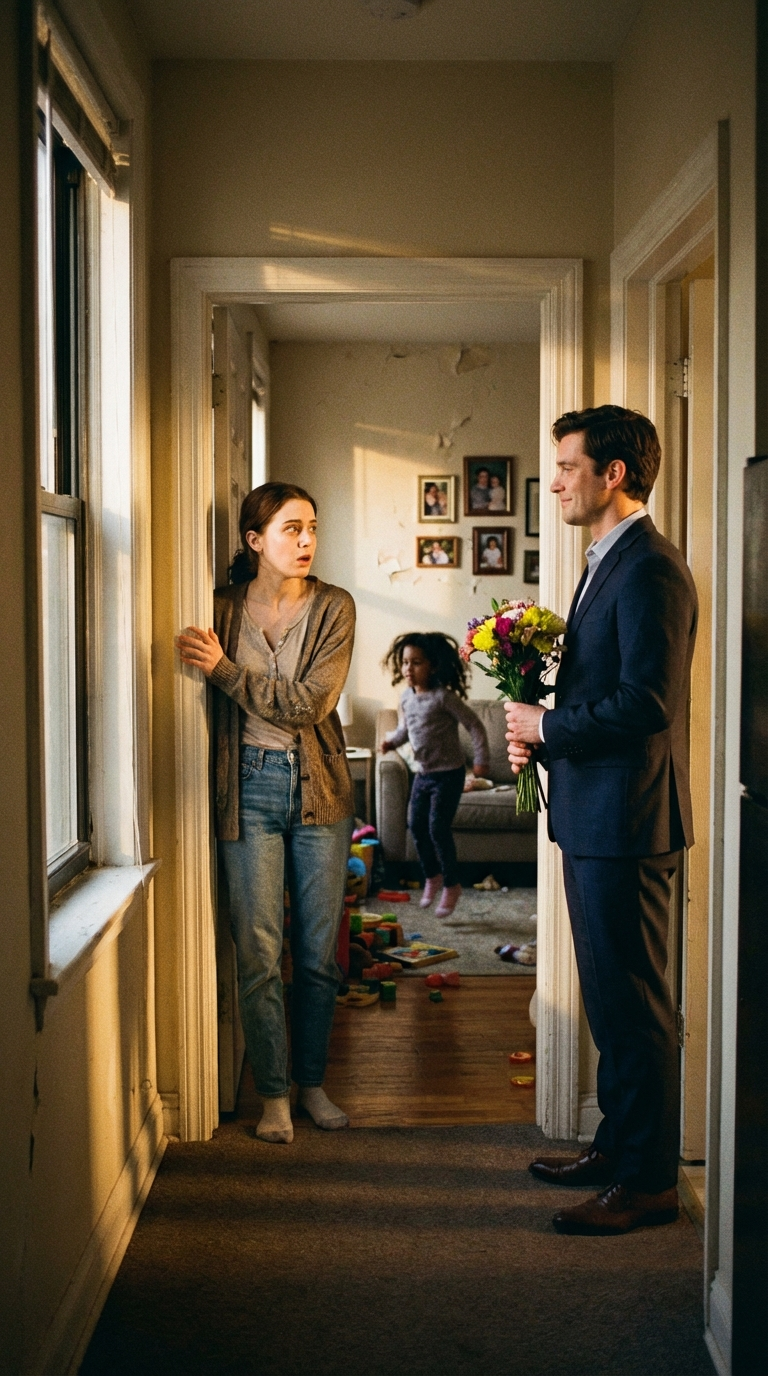
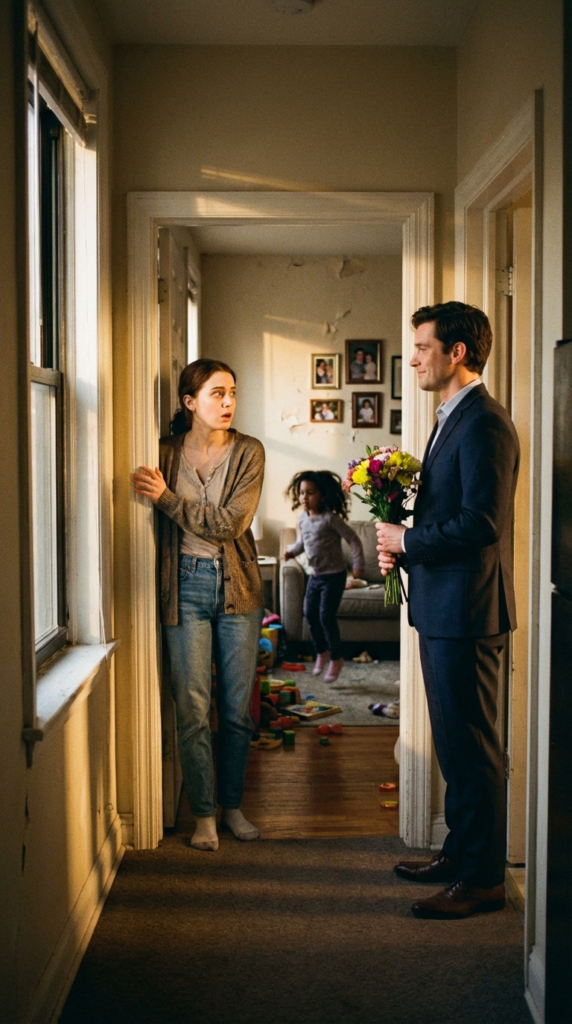
Then, on Friday evening while Emma and I were eating mac and cheese for dinner, there was a knock at my apartment door.
I opened it to find David Morrison standing in my hallway, wearing jeans and a sweater instead of his CEO suit, holding a bouquet of flowers and looking nervous.
“Hi,” he said. “I’m sorry to show up unannounced. I hope this isn’t weird or intrusive. I got your address from the hospital visitor log—I told them I was a friend who needed to return something you’d left. Which was technically a lie, but I needed to see you both again.”
“David,” I said, shocked. “Come in. Is everything okay?”
He stepped into my small apartment, looking around at the modest furnishings, the toys scattered on the floor, the life we’d built in this cramped space.
“Everything is— Well, no. Nothing is okay. My father’s funeral was yesterday. It was beautiful and terrible. And I kept thinking about what Emma said. About family. About sharing. And I realized she was right.”
“Mr. David!” Emma appeared from her bedroom, dragging her stuffed elephant. “You came back!”
David knelt down to her level, his face softening. “Hi, Emma. I came to talk to your mom about something. Is that okay?”
“Sure! Do you want to see my room? I have lots of stuffed animals.”
“Maybe in a little bit. I need to talk to your mom first.”
Emma shrugged and went back to her room.
David and I sat on my worn couch. He was clearly nervous, fidgeting with his hands.
“Jennifer, I know this is going to sound insane. I know we’ve only met once, and you have no reason to trust me. But I can’t stop thinking about what happened in that cafeteria. About Emma’s compassion. About the connection we all felt. And about what you said about struggling financially while raising her alone.”
“David—”
“Please, let me finish. I’ve spent three days thinking about nothing but this. My father’s death taught me something crucial: success isn’t measured in money or business achievements. It’s measured in relationships. In love. In the lives we touch. And I’ve been living the wrong life.”
He took a deep breath. “I have an eight-bedroom house that’s completely empty. I have more money than I’ll ever spend. I have a company that runs itself at this point. But I have no purpose beyond work. No reason to come home. No one who cares if I’m having a bad day or needs a hug or just wants to watch a movie together.”
“What are you saying?”
“I’m saying that Emma was right. About sharing. About family. And I want to make you both an offer.”
My heart was racing. “What kind of offer?”
“Let me help you. Let me be part of your lives—not romantically, I’m not asking for that. But let me take away your financial stress. Let me pay off your debts, set up a college fund for Emma, make sure you never have to work two jobs again. Let me give Emma the advantages she deserves—not because you’re not enough, but because I have the resources to help and I want to.”
I stared at him, unable to process what I was hearing. “You want to… give us money? Like charity?”
“Not charity. Investment. I want to invest in family. In the family I’ve always wanted but never made time for. In exchange for helping with finances, I want to be part of your lives. I want to have dinner with you sometimes. Take Emma to the park. Help with homework. Be the friend—the family—we all need.”
“David, that’s insane.”
“I know. But I’ve never been more sure of anything. My father spent his last month telling me I was wasting my life building a company instead of a family. That I’d regret it. And he was right. But then I met you and Emma, and I saw a chance to have what I’d missed. Not through dating or marriage—I’m not ready for that. But through friendship. Through chosen family.”
“You want us to be your chosen family?”
“Yes. Exactly that. I want Emma to feel comfortable calling me when she needs something. I want you to know you have someone to rely on. And I want to have people who see me as David, not as a CEO or a business asset.”
“This is crazy,” I said, my mind spinning.
“Is it? Or is it two people who lost someone they loved finding a way to help each other heal?”
Emma appeared in the doorway. “Mommy, is Mr. David going to be my new friend?”
David and I both turned to her.
“What do you think, Emma?” David asked gently. “How would you feel if I spent more time with you guys? Maybe took you to the zoo, or helped your mom fix things around the apartment, or came over for dinner sometimes?”
“Like a daddy?” Emma asked, her voice small and hopeful in a way that broke my heart.
David’s eyes filled with tears. “Not exactly like your daddy. Nobody can replace him. But maybe like an uncle? Or a really good friend who cares about you a lot?”
“Can you come to my school things? Mommy says daddies come to those but I don’t have a daddy anymore.”
“I would be honored to come to your school things,” David said, his voice thick with emotion.
Emma looked at me. “Can we keep him, Mommy? Please? He needs us and we need him and it would be perfect.”
I looked between my daughter and this man I’d known for less than a week. This billionaire CEO who’d found us in a hospital cafeteria and decided we were the family he’d been missing.
It was insane. It was the most irrational decision I’d ever have to make.
But as I looked at David’s hopeful face and heard Emma’s excited voice and thought about all the nights I’d cried wondering how I’d pay rent and keep her safe…
I was shaking. I didn’t know whether to scream or laugh.
But what I did next shocked everyone—including myself.
“Okay,” I said. “Yes. Let’s try this. But with rules. And boundaries. And therapy to make sure we’re all doing this for healthy reasons.”
David’s face lit up like a child on Christmas morning. “Yes. Absolutely. Whatever you need. Whatever makes you comfortable.”
“And we take this slow,” I continued. “You don’t just move in or anything crazy. We start with dinner once a week. Build trust. See if this actually works or if it’s just grief talking.”
“Fair,” David agreed.
Emma jumped up and down. “We’re going to be a family! A new kind of family!”
And that’s how David Morrison—billionaire CEO—became part of our lives.
Six Months Later: Building Trust
The first three months were awkward. David would come over for dinner every Wednesday, often bringing expensive wine I’d never taste otherwise or toys for Emma that made her squeal with joy. We’d eat, talk, and slowly learn to be comfortable with each other.
He was surprisingly good with Emma. Patient, playful, genuinely interested in her endless stories about preschool and her stuffed animals. He’d get on the floor and play Barbies without embarrassment. He’d read bedtime stories in funny voices that made her giggle.
“You’re a natural,” I told him one night after Emma had fallen asleep.
“I’m winging it,” he admitted. “But she makes it easy. She’s such a bright, loving kid, Jennifer. You’ve done an amazing job.”
The financial help came gradually, carefully. First, he paid off my credit card debt—$8,000 that had been crushing me. Then he set up an investment account for Emma’s college fund—fully funded, enough to pay for any school she wanted.
“David, this is too much,” I protested.
“It’s nothing,” he insisted. “I made $3 million in stock dividends this quarter alone. I literally couldn’t spend my money fast enough if I tried. Let me help.”
He hired a financial advisor for me, someone to help me understand money management and investment. He helped me quit my waitressing job so I could focus on teaching and being present for Emma.
But more than the money, he gave us presence. He showed up. When Emma’s preschool had a father-daughter breakfast, David went and sat with her while she beamed with pride. When my car broke down, he bought me a new one (used, at my insistence, but reliable). When I got sick with the flu, he took three days off work to care for both of us.
“Why are you doing this?” I asked during one of those sick days, watching him spoon-feed soup to Emma.
“Because I have time now,” he said simply. “Because my father’s death taught me that later never comes. You have to build the life you want right now, today. And this—” He gestured at Emma, at my cramped apartment, at the life we were building together. “This is the life I want.”
Month four, David’s ex-wife Amanda called him. I didn’t mean to overhear, but he was on my balcony and I was in the kitchen.
“You’re playing house with some teacher and her kid?” Amanda’s voice was loud enough to hear. “David, you’re a billionaire. You could have anyone. Why are you wasting time with—”
“They’re not a waste of time,” David interrupted, his voice cold in a way I’d never heard. “They’re my family. More family than you ever were. We were married for seven years and I don’t think you ever asked me how my day went. Emma asks me every single time she sees me. So don’t call them a waste.”
He hung up. Came back inside looking upset.
“I’m sorry you had to hear that,” he said.
“It’s fine. She’s not wrong though—you could have anyone. Why choose us?”
David sat down across from me. “Because you’re real. Because Emma hugged me when I was broken. Because you’ve never asked me for anything—I’ve had to insist on helping. Because when I’m with you both, I’m not CEO David Morrison. I’m just David. The guy who can’t cook but tries anyway. The guy who loses at Candy Land every time. The guy who matters not because of his bank account but because he showed up.”
“You do matter,” I said softly. “To us. A lot.”
“That’s all I’ve ever wanted,” David said. “To matter to someone.”
One Year Later: The Question
A year after we met, David made a proposal that terrified me.
“I want to adopt Emma,” he said over dinner at his house—a place we’d started spending weekends at because it had a pool and a yard Emma loved.
I nearly dropped my fork. “What?”
“Not in a way that erases Mark. She’ll always be a Carter. But I want legal custody rights. I want to be her father in all the ways that matter. I want to be able to make medical decisions if you’re unavailable, pick her up from school, be listed as her parent. I want it to be official.”
“David, that’s—”
“I love her, Jennifer. I love her like she’s my own daughter. This past year has been the best year of my life. And I know it’s fast, but we’re not getting younger and I don’t want to waste more time. I want to be her father. Legally, officially, permanently.”
Emma walked into the room at that moment. “Are you guys talking about me?”
“We are,” David said. “Emma, how would you feel if I became your daddy? Your real daddy, officially?”
Emma’s eyes went wide. “Like… forever daddy? Not just pretend?”
“Forever daddy. Always and forever.”
Emma looked at me. “Would we keep my first daddy too?”
“Always,” I said through tears. “Your first daddy will always be in our hearts. But you could have two daddies. One in heaven, and one here with us.”
“I want that,” Emma said seriously. “I want David to be my daddy. Can we do that, Mommy?”
I looked at David—this man who’d walked into our lives a year ago and become everything we needed. Who’d healed from his father’s death by becoming a father himself. Who’d given us security and love and presence.
“Yes,” I said. “Yes, we can do that.”
The adoption process took six months. We had to prove David wasn’t trying to buy a family, that Emma’s biological father’s family (my in-laws) didn’t object, that this was truly in Emma’s best interest.
Mark’s parents were surprisingly supportive. “If this man loves Emma and treats her well, we’re happy for her,” Mark’s mother said. “We just wanted her to have a good life. It sounds like she does.”
On the day the adoption was finalized, David legally became Emma’s father. We celebrated with ice cream and a small party where Emma called him “Daddy David” for the first time officially.
“Best day of my life,” David said, holding Emma while she smeared ice cream on his expensive shirt.
“Mine too,” I agreed.
Two Years Later: Love
I fell in love with David Morrison slowly, then all at once.
It wasn’t planned. Wasn’t expected. But somewhere between family dinners and bedtime stories, between watching him play with Emma and seeing him cry during Disney movies, between witnessing his grief transform into joy—I fell completely, irrevocably in love with him.
I didn’t tell him for months. We’d always maintained the boundary that our relationship was about Emma, about friendship, about chosen family but not romance.
Then one night, after Emma was asleep and we were watching a movie on his couch, he kissed me.
“I’m sorry,” he said immediately. “I shouldn’t have— We said we wouldn’t—”
“Don’t apologize,” I whispered. “I’ve wanted you to do that for six months.”
“Really?”
“Really. I’m in love with you, David. I don’t know when it happened but it did.”
“I’ve been in love with you since month three,” David admitted. “But I didn’t want to pressure you or ruin what we’d built. Emma had to come first.”
“Emma will always come first,” I agreed. “But maybe we can come first together now?”
We dated for another year—slowly, carefully, making sure Emma was comfortable with the transition from friendship to romance. She handled it beautifully, of course.
“I knew you guys would fall in love,” she announced at age eight. “You look at each other the way people in movies do.”
David proposed on the beach where we’d taken Emma for her ninth birthday. Got down on one knee in the sand while Emma jumped up and down shouting “SAY YES, MOMMY!”
I said yes.
We married six months later in a small ceremony with close friends and family. Emma was our flower girl, beaming with pride.
“Do you take David to be your husband?” the officiant asked.
“I do.”
“And do you take Jennifer to be your wife?”
“I absolutely do.”
“And Emma,” the officiant said, addressing my daughter. “Do you promise to love and support this family?”
“I do!” Emma shouted, making everyone laugh.
“Then by the power vested in me, I pronounce you husband and wife—and family. You may kiss your bride.”
David kissed me while Emma cheered and our friends applauded, and I thought about how far we’d come from that day in the hospital cafeteria. How grief and compassion and one brave little girl had created this impossible, perfect family.
Five Years Later: Full Circle
Today, Emma is fourteen years old. David has been her father for longer than she remembers Mark being alive. They have inside jokes and traditions. He’s coached her soccer team for four years. He’s the one she calls when she needs advice. He’s Dad.
I gave birth to twin boys two years ago—David’s biological children, Emma’s little brothers. She adores them.
David stepped back from the CEO role to spend more time with family. He’s chairman of the board now, working three days a week, present for every dinner and bedtime and soccer game.
“I finally got it right,” he told me last week. “Built the right thing. The thing that matters.”
We visited Mark’s grave together—all five of us. Emma placed flowers there.
“Hi Daddy Mark,” she said. “I want you to meet my other family. This is Daddy David, my stepmom is now my mom but you know that, and these are my little brothers. We’re really happy. I hope you’re proud of me.”
David put his hand on the gravestone. “Thank you,” he said quietly. “For Emma. For creating her. For loving Jennifer. We’re taking care of them. I promise.”
In the car on the way home, Emma said something that made us both cry.
“I’m really lucky,” she announced. “I have two daddies who love me. One I don’t remember but Mommy tells me about. And one I’ll remember forever. Not everyone gets two daddies.”
“No,” I agreed. “Not everyone does. You’re very special.”
“We’re all special,” Emma corrected. “We’re special together.”
David reached back and squeezed her hand. “Best family in the world.”
“Best family in the universe,” Emma countered.
Tonight, after the twins are asleep and Emma is doing homework, David and I sit on our back porch looking at the stars.
“Do you ever think about that day in the hospital?” I ask.
“Every day,” David says. “Best day of my life. The day I met you both. The day Emma saved me.”
“She saved all of us.”
“She did. Your brave, compassionate, incredible daughter saw a stranger crying and decided to fix it. Decided to share her family. And that generosity changed everything.”
“Five years ago, I was drowning. Working two jobs, terrified of losing Emma, barely surviving. And now—”
“Now you’re teaching part-time by choice. Emma has everything she needs. The twins are healthy. We’re happy. We’re family.”
“We’re family,” I echo.
Emma appears at the door. “Can I ask you guys something?”
“Of course,” David says.
“My friend at school—her parents are divorced and her dad never comes to see her. She’s really sad about it. Can she come over for dinner sometimes? So she can see what a good dad is like?”
David and I exchange glances.
“Absolutely,” I say.
“Anytime,” David adds.
Emma grins. “Cool. I told her you were the best dad ever and she didn’t believe me so I said she could meet you and see.”
She disappears back into the house.
“She’s doing it again,” David says softly. “Seeing someone who needs family and deciding to share.”
“She learned from the best,” I say, squeezing his hand. “She learned from you.”
“She learned from all of us. From Mark, who loved her first. From you, who taught her compassion. And from the imperfect family we built together.”
We sit there holding hands, watching the stars, grateful for the grief that brought us together and the love that kept us there.
And somewhere, I like to think Mark is watching too—proud of the daughter he created, grateful for the man who became her father, and happy that Emma got the family she deserved.
A family built on the bravest question a five-year-old ever asked: “Do you miss your daddy too?”