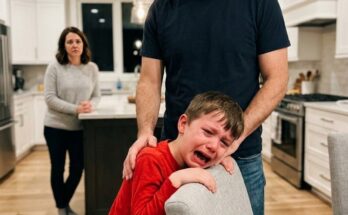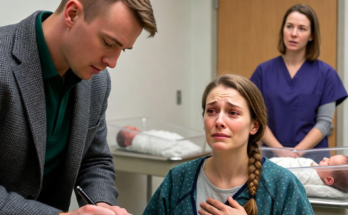
The first thing I noticed was the quiet.
Ruby Holloway was never quiet.
At eight years old she was usually a burst of motion—bare feet thumping down hardwood stairs, a running monologue about slime videos and spelling tests and how her unicorn, Princess Starbeam, absolutely refused to eat imaginary broccoli. She was the kind of kid who made a house feel alive even when the adults were tired.
But when I walked into my brother’s colonial in Metobrook that afternoon, the house felt… staged. Like a showroom.
Max stood in the kitchen, crisp button-down, Rolex catching the light as he checked the time for the third time in thirty seconds. The granite counters were spotless. The smell of lemon cleaner hung faintly in the air, sharp and artificial.
“Avery,” he said, pulling me into a quick hug. “Thanks for coming over on such short notice. The investor call can’t be moved, and Cassandra has pottery.”
“Of course,” I said, dropping my tote bag on the counter. “Where’s my favorite niece?”
n noodle soup in the fridge if she gets hungry. Cassandra says no snacks before dinner.”
I made a sound that was supposed to be a laugh. “Got it. Go nail your pitch. I’ve got her.”
Max looked relieved—too relieved—and grabbed his keys. A minute later his Tesla whispered out of the driveway like it didn’t want to disturb the perfect neighborhood.
I stood there for a moment, alone in the shining kitchen, listening to the hum of the refrigerator. My pulse did that small, familiar lift it always did at work when my instincts whispered before my brain caught up.
Something was off.
Not dramatic off. Not ambulance off.
Just… wrong.
I climbed the stairs and knocked on Ruby’s bedroom door.
“Aunt Avery?” Her voice came thin, a thread stretched too tight.
I pushed the door open and my stomach dropped.
Ruby was curled up on her bed under a pink comforter, clutching her stuffed unicorn so hard it bent at the neck. Her cheeks were pale in a way that wasn’t just “I’m tired.” Her lips looked dry. The skin under her eyes had that faint shadow that made her look older than eight.
The room smelled like old medicine and stale air, like a sickroom that had been closed up too long.
“Hey, sweetheart,” I said, softening my voice the way you do with kids so your worry doesn’t become their fear. “Your dad said you’re not feeling great.”
“My stomach hurts again,” she whispered. “And I’m… so tired.”
I sat on the edge of her bed and brushed her hair back. Her forehead was warm—not blazing, but warm enough to make my nurse-brain start sorting possibilities like cards in a deck.
“Have you told your mom your stomach hurts?” I asked.
Ruby’s eyes dropped to the bedspread. “She says I’m being overdramatic. That I need to toughen up and stop complaining.”
A chill went straight down my spine.
There are parents who get frustrated. There are parents who get exhausted. There are parents who say the wrong thing once.
But there was something practiced in Ruby’s tone. Like she’d heard those exact words enough times that they were part of the script.
I kept my face calm. “Does your stomach hurt a lot? Like… most days?”
Ruby nodded, barely. “Almost every day after lunch. And sometimes I get really dizzy at school. Mrs. Henderson had to take me to the nurse twice last week.”
After lunch.
Okay.
“What do you usually have for lunch?” I asked.
Ruby’s voice got quieter, like the walls could hear. “Mom makes me special wraps. She says they’re super healthy and will help me grow stronger.”
“Special ingredients?” I asked, trying to sound casual.
Ruby nodded. “She says other moms don’t know about them.”
My stomach tightened.
“When did it start?” I asked.
Ruby thought for a moment. “After my birthday party. Remember? When I got sick from too much ice cream cake.”
I remembered. Five months ago. Cassandra had laughed it off as Ruby “being dramatic,” and Max had believed her because Max believed Cassandra about everything. Max believed Cassandra the way golden boys believe in their own good judgment—like trusting her was proof he’d chosen well.
But no kid stays sick from cake for five months.
“Can you show me where it hurts the most?” I asked.
Ruby lifted a small hand and pointed to her lower right abdomen, just above her hip.
Not where kids usually point when they mean “tummy ache.”
My nurse training kicked into gear so fast it almost felt like flipping a switch.
“Does it hurt when I press here?” I asked, touching lightly.
Ruby winced, sharp and immediate. “Ow—yeah.”
I moved my hand slightly. Less pain.
Appendix? Inflammation? Something GI? Something systemic?
Or—something else.
“Do you feel worse after certain foods?” I asked.
Ruby swallowed. “I feel worst after Mom’s wraps. And sometimes her smoothies.”
“Ruby,” I said gently, “I want you to tell me the truth, okay? You’re not in trouble.”
Her eyes filled with tears. “Don’t tell Mom I said that. She gets really, really mad when I don’t finish.”
“What happens when she gets mad?” I asked.
Ruby’s tears spilled over. “She says I’m ungrateful. She makes me sit at the table until I finish everything. Even if it takes hours. Once I sat there until bedtime.”
I felt my jaw tighten.
“Does your dad know?” I asked.
Ruby shook her head. “Mom says Daddy doesn’t understand nutrition. And he works a lot. So we don’t bother him with silly stuff.”
She paused, voice tiny.
“Aunt Avery… am I dying?”
The question hit me like a freight train.
Every instinct in my body screamed to pick her up, run, and never look back.
But you can’t panic in front of a child. Panic becomes their reality.
“No,” I said firmly, leaning close so she could see my face. “Absolutely not. But I am going to help you feel better.”
Ruby sniffed. “How?”
“I’m going to start by checking something,” I said. “Can I look in your backpack?”
She nodded.
I grabbed her purple backpack from by the desk and opened the insulated lunch bag inside.
The wrap looked… normal. Whole wheat tortilla. Pale slices of turkey. Lettuce. Maybe a smear of something that could’ve been hummus.
But then the smell hit me.
Not spoiled food.
Not sour milk.
Something faintly bitter and chemical, like old pennies and cleaning solution.
My throat tightened.
I wrapped the sandwich in tissues and tucked it into my tote bag without letting Ruby see my hands shake.
“Aunt Avery?” she whispered. “Am I in trouble?”
“Never,” I said, and meant it so hard it hurt. “You’re not in trouble. You’re the bravest kid I know.”
I forced brightness into my voice. “How about we go downstairs and watch a movie? Frozen?”
Ruby’s eyes lit weakly. “Can we?”
“Absolutely.”
While she settled on the couch, I made plain crackers and ginger ale—things that wouldn’t complicate the picture—and watched her nibble like her stomach didn’t trust anything anymore.
Then I stepped into the hallway and called Naomi Rodriguez, my friend in the lab at Riverside Medical Center.
She answered on the second ring. “Avery? You good?”
“I need a favor,” I said, lowering my voice. “No questions asked.”
Naomi sighed the sigh of someone who knows me well enough to know I don’t ask that way unless I’m already halfway into trouble. “Okay. What?”
“I need you to test a food sample.”
“Avery—”
“It’s about Ruby,” I said quickly. “Max’s daughter. I’m worried Cassandra might be… doing something.”
Naomi went quiet.
“Say that again,” she said, voice suddenly careful.
“I’m not accusing lightly,” I whispered. “Ruby’s been sick for months. Worse after food Cassandra makes. There’s a smell. And Ruby’s scared.”
The pause on the line felt like a door opening.
“Bring it,” Naomi said finally. “I’ll stay late.”
“Thank you,” I breathed. “I really hope I’m wrong.”
“I hope you’re wrong too,” Naomi said. “But if you’re not… Avery, you know what this means.”
“I know,” I said. And my mouth tasted like metal when I said it.
I dropped the wrapped sandwich at Riverside after my shift, walking through the staff entrance like I belonged there—which I did—but feeling like everyone could see the secret burning in my hands.
Naomi met me in the hallway by the lab door, her hair pulled back, face serious.
She didn’t joke. Naomi always joked.
She took the sample like it was radioactive.
“What exactly am I testing for?” she asked softly.
“Anything that shouldn’t be there,” I said. “Start broad. Poison panel if you can.”
Naomi’s eyes narrowed. “This is not off-the-books anymore, Avery.”
“I know,” I said, voice tight. “Just—please. Give me something solid before I blow up my brother’s life.”
Naomi nodded once. “Go. I’ll call you when I have results.”
When I got back to Max’s house, Ruby had fallen asleep on the couch curled into a little ball, like her body didn’t know how to relax without bracing.
My phone buzzed.
CASSANDRA.
I answered, keeping my voice neutral.
“Is Ruby behaving?” Cassandra asked without greeting. Her tone had that sharp edge it always carried—like kindness was something she rationed.
“She’s asleep,” I said. “She’s really not feeling well, Cassandra. I think she needs to see a doctor.”
Cassandra’s voice went cold. “Don’t start with that again. She’s fine. She just likes the attention you give her when she acts sick.”
“She has significant abdominal pain and chronic fatigue,” I said, the nurse in me refusing to soften facts into comfort. “That’s not acting.”
“I’m her mother, Avery,” Cassandra snapped. “Not you. Never you. Stay in your lane.”
“I’m not trying to—”
“Oh please,” Cassandra cut in. “You’ve always been jealous Max chose me. That we have this family and you don’t.”
I went still.
My fertility struggles weren’t a secret, but they weren’t Cassandra’s weapon to swing. And yet, she swung it like she enjoyed the sound of it.
“Don’t use my daughter as a substitute for the children you can’t have yourself,” she added, sweetly cruel.
My hand tightened around the phone.
“This isn’t about me,” I said, voice low. “It’s about Ruby’s health.”
“Don’t test me,” Cassandra hissed. “I decide what’s best for my daughter. Are we clear?”
The call ended.
I stared at Ruby’s sleeping form and felt something settle in my chest.
Decision.
The next morning, I picked Ruby up from Pinewood Elementary while Max was at work and Cassandra was at Pilates—Pilates that, if I had to bet my nursing license, was not strictly about core strength.
Ruby ran to me, ponytail bouncing, then stopped short.
“Aunt Avery?” she asked, confused but clearly relieved. “What are you doing here? Where’s Mom?”
“We’re going on an adventure,” I said, forcing lightness into my voice.
“Does Mom know?”
A lie rose in my throat and I swallowed it into shape. “Yes. She knows.”
Ruby’s face softened into trust, and guilt stabbed me so sharply I almost faltered.
But then she winced, hand drifting to her stomach, and I remembered why I was doing this.
“We’re going to see a doctor,” I said gently. “Just to check on that tummy.”
Ruby’s face fell. “But Mom says doctors give shots.”
“Sometimes they do,” I admitted. “But only to help. And I’ll hold your hand the whole time.”
Ruby considered this like a tiny lawyer weighing evidence.
“The whole time?” she asked.
“The whole time,” I promised.
Dr. Brandon Foster was an old college friend and one of the best pediatricians I knew. He agreed to see Ruby as a personal favor, squeezing her in between appointments at Riverside.
He greeted Ruby with a warm smile and a cartoon frog on his badge.
“So, Ruby,” he said, crouching to her eye level. “Your aunt tells me your tummy’s been bothering you.”
Ruby nodded, clutching her unicorn.
Dr. Foster listened as she described the pain. The fatigue. The dizziness.
As she spoke, his expression shifted from friendly concern to something heavier.
He examined her gently—pressing, listening, checking reflexes.
Then he stepped into the hallway with me and closed the door.
“Avery,” he said quietly, “how long has this been going on?”
“Five months,” I whispered. “Her mother hasn’t brought her in.”
Dr. Foster’s jaw tightened. “I want comprehensive labs. Blood work. Now.”
My pulse jumped. “You think it could be—”
“I’m not going to speculate yet,” he said, but his eyes were already doing it. “Her symptoms could be multiple things. But the pattern you described—worse after food she eats at home—makes me uneasy.”
Uneasy. Dr. Foster wasn’t a man who used that word lightly.
Ruby looked small sitting on the exam table while the phlebotomist tied a tourniquet around her arm. She squeezed my hand so hard my fingers went numb.
“Just a pinch,” I murmured, kissing the top of her head. “You’re doing amazing.”
Ruby blinked back tears, brave in the way only children can be—brave because they have no choice.
While we waited for labs, my phone started buzzing with Cassandra’s texts like a siren.
WHERE IS RUBY?
ANSWER ME RIGHT NOW.
I’M CALLING THE POLICE. THIS IS KIDNAPPING.
I typed back one line:
She’s safe. She’s getting medical care.
The response came instantly.
YOU HAVE NO RIGHT. I’M HER MOTHER.
My hands trembled as I typed:
Being a mother is protecting your child. Not hurting her.
Three dots appeared. Then:
YOU ARE DEAD TO ME. MAX WILL NEVER FORGIVE YOU.
I didn’t reply.
Because I wasn’t doing this for Cassandra’s forgiveness.
I was doing it for Ruby’s survival.
Twenty minutes later, Dr. Foster returned with a manila folder.
His face was different.
Not worried.
Not concerned.
Cold.
Like something inside him had snapped into protocol mode.
“Avery,” he said, voice low, “can I speak to you privately?”
My stomach dropped so hard I felt it in my teeth.
In his office—surrounded by cheerful posters of smiling cartoon organs that suddenly felt obscene—Dr. Foster closed the door and opened the folder.
“Ruby’s bloodwork shows unmistakable signs of chronic arsenic exposure,” he said.
The words didn’t land at first. My brain tried to reject them like a foreign object.
“Arsenic?” I repeated, stupidly.
Dr. Foster nodded, grim. “Low-level poisoning over an extended period. Not immediately fatal at these levels, but continued exposure can cause permanent organ damage. Or worse.”
The room tilted.
My vision narrowed.
I grabbed the back of the chair in front of me like I might fall.
“How sure are you?” I whispered.
“Beyond doubt,” he said. Then he paused, and his eyes flicked toward my tote bag, like he knew there was more.
“And there’s something else,” he added.
My chest tightened. “What?”
“The lab called,” he said. “A technician—Naomi Rodriguez—ran a test on a food sample tied to Ruby.”
My heart stopped.
“Naomi found the same substance in the wrap you brought,” Dr. Foster said quietly. “Traces consistent with Ruby’s exposure.”
A sound came out of me—half breath, half sob.
Dr. Foster’s voice softened, but his eyes stayed hard.
“I’m legally obligated to report this,” he said. “CPS. Police. Immediately.”
I nodded, numb.
“Call Max,” Dr. Foster said firmly. “Now. He needs to be here.”
I pulled my phone out with shaking hands.
Max answered on the first ring, breathless. “Avery? What the hell is going on? Cassandra’s losing it. She says you kidnapped Ruby.”
“Max,” I said, and my voice cracked. “You need to come to Riverside. Now. It’s Ruby.”
There was a beat of silence.
Then Max’s voice dropped. “Is she—”
“She’s alive,” I said quickly. “But you need to get here. Please.”
I hung up and sat down hard in the chair, my legs finally remembering gravity.
Dr. Foster opened the door and spoke to a nurse at the desk in that calm, clipped tone doctors use when they’re about to change someone’s entire life.
“Call security,” he said. “And get Detective Harris from the unit on standby.”
My skin went cold all over.
Because now it wasn’t just a suspicion in my chest.
It was a case.
And somewhere out there, Cassandra was about to realize we had proof.
Ruby’s hospital room was too bright.
Not “clean and reassuring” bright—interrogation-room bright, the kind of fluorescent light that makes everything feel sharper, uglier, more real.
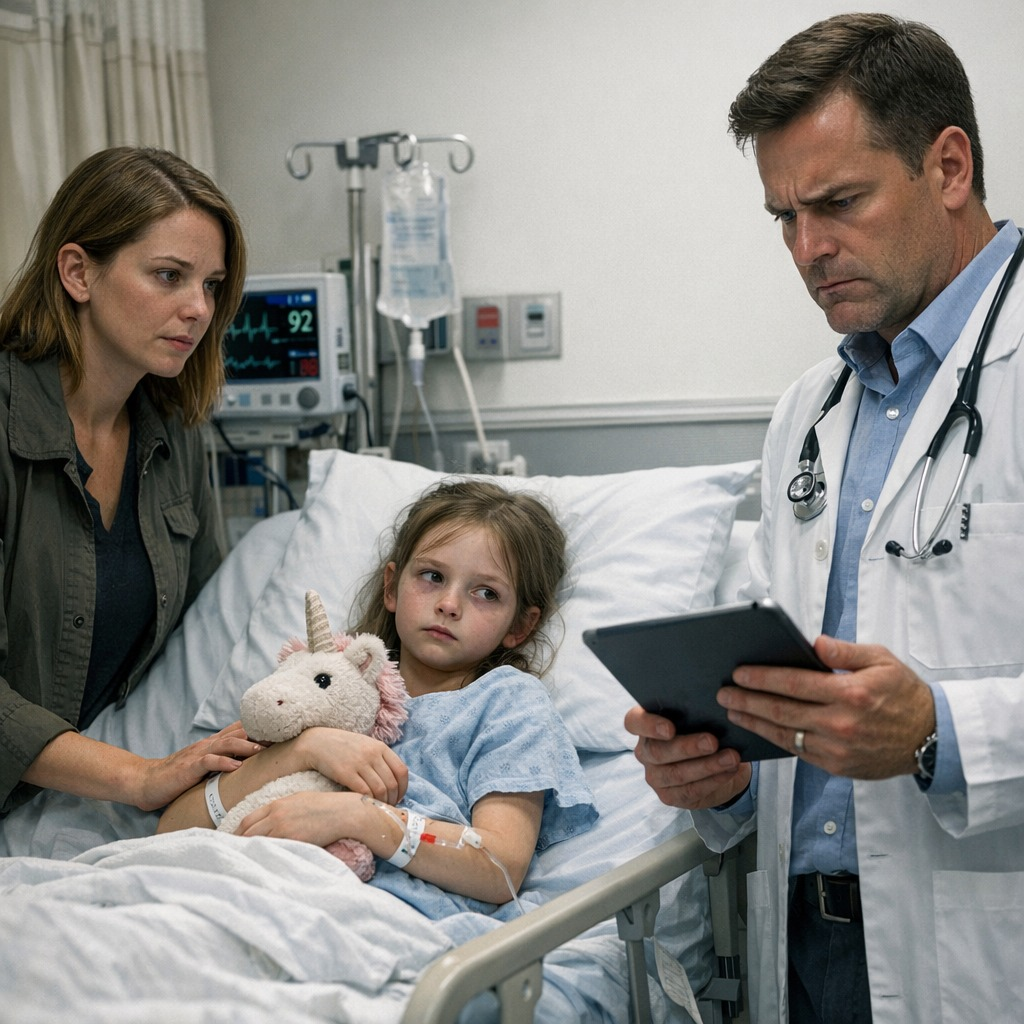
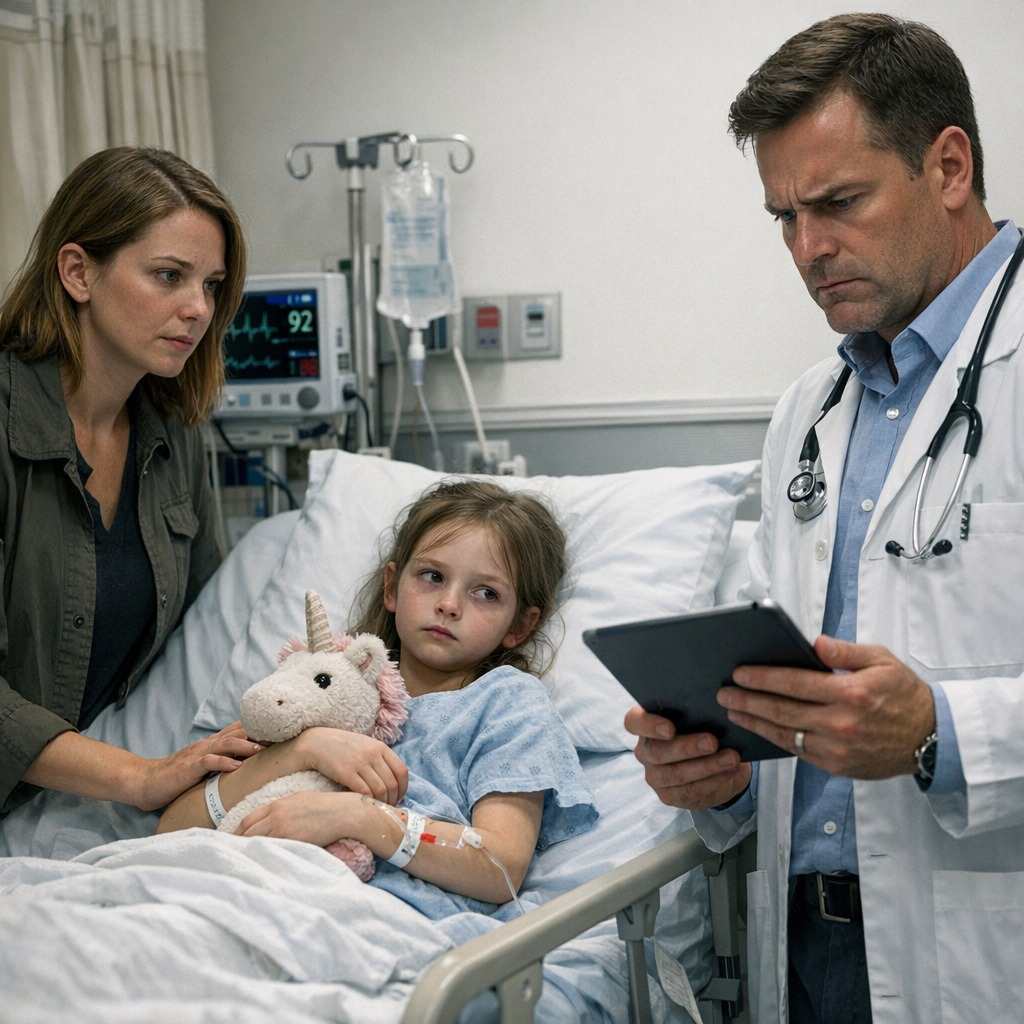
She sat propped in bed with a pediatric IV taped to her arm, stuffed unicorn tucked under her elbow like it was guarding her. A nurse had wrapped her in a warm blanket, but Ruby still looked small, like her body was trying to fold in on itself.
When I stepped back into the room, she lifted her head.
“Aunt Avery?” Her voice shook. “Did I do something bad?”
My throat tightened so fast it hurt.
“No,” I said immediately, crossing to her bed. “No, baby. You didn’t do anything wrong. Not one thing.”
Ruby’s eyes flicked to the IV. “Is that… medicine?”
“It’s fluids,” I said, keeping my voice gentle and steady. “Your body’s been working really hard. We’re helping it.”
She nodded like she understood, but her fingers clenched the unicorn’s mane.
“Is Mom mad?” she whispered.
That question was worse than the bloodwork.
Because it told me Ruby already knew the rules in her house: Mom gets mad. Mom decides what you deserve. Mom decides what’s real.
I leaned in and brushed hair off Ruby’s forehead. “Right now, your only job is to rest. I’m here. Your dad is coming. You’re safe.”
Ruby’s bottom lip trembled. “Promise?”
I held her hand—small and cold and too light.
“I promise,” I said, and meant it like an oath.
In the hallway, Dr. Foster stood near the nurses’ station speaking quietly with a social worker. Security lingered by the entrance to the pediatric wing, and the sight of them—the fact that they were there because of my niece—made my stomach twist.
Dr. Foster caught my eye and motioned me over.
“Detective Harris is on his way,” he said under his breath. “CPS has been notified. And Avery… Max needs to hear this in a controlled setting.”
I nodded. My mouth was too dry for words.
“Is Ruby stable?” I asked.
“She’s stable,” he confirmed. “But this is serious. Her levels indicate ongoing exposure. The priority is stopping access.”
My phone buzzed again.
Cassandra.
I didn’t even open it. I could practically hear her voice through the screen. You jealous, barren woman. You don’t get to touch my daughter.
Dr. Foster’s voice lowered. “Do you feel safe if she shows up?”
I swallowed. “I don’t know.”
“That’s why security is here,” he said. “And why we’re documenting everything.”
Then, from the far end of the hall, I heard running footsteps.
A man’s voice, loud, frantic.
“Where is she? Where’s Ruby?”
Max.
He rounded the corner like a man chased by fire, suit jacket unbuttoned, hair slightly disheveled, eyes wide with panic. His face was drained so pale it made him look sick.
He saw me and grabbed my shoulders.
“Avery, what’s going on?” he demanded. “Cassandra is blowing up my phone. She says you kidnapped Ruby. She says she’s calling the police.”
“Max,” I said, forcing calm into my voice because if I let my fear leak, he’d drown in it. “You need to breathe. You need to listen to me. And you need to hear this from a doctor, not from me.”
His jaw clenched. “Where is Ruby?”
“In a room,” I said. “Getting treated. She’s awake. She’s scared. But she’s here.”
Max exhaled sharply, like his lungs had been clenched for miles. “Okay. Okay. Why—why is she here?”
Dr. Foster stepped forward, his presence suddenly filling the space with authority.
“Mr. Holloway?” he asked.
Max nodded quickly. “Yes.”
“I’m Dr. Brandon Foster. I examined Ruby today and ran comprehensive labs. I need to speak with you privately.”
Max’s eyes darted between us. “Is she… is she seriously sick?”
Dr. Foster didn’t soften it. “Yes.”
Max’s face tightened like he was bracing for the worst.
I reached for his hand without thinking, the way you do when someone’s about to fall off a cliff.
“Come with us,” I said quietly.
We walked into the consultation room Dr. Foster had prepared. It was small, with a round table and a box of tissues and a poster on the wall about childhood vaccinations that suddenly felt like a cruel joke. The air smelled faintly like disinfectant and coffee.
Max sat down hard, elbows on the table. He looked at Dr. Foster like his life depended on the next sentence.
Dr. Foster opened the manila folder.
“Ruby’s bloodwork shows chronic arsenic exposure,” he said plainly.
Max blinked once.
Twice.
And then he laughed—a sharp, disbelieving sound.
“Arsenic?” he repeated. “That’s… that’s impossible. That’s—like—poison.”
“Yes,” Dr. Foster said, voice steady. “Poison. Low-level, over months.”
Max’s face shifted from confusion to something like panic.
“No,” he whispered. “No. That can’t be right. There’s no—there’s no way. Cassandra would never—”
“Avery brought me a food sample,” Dr. Foster continued, gentle but firm. “A lab technician at Riverside tested it independently. It contained traces consistent with Ruby’s exposure.”
Max’s mouth opened and closed. His eyes flicked to me.
I hated that I was the one holding the match to his reality.
“Max,” I said softly, “Ruby told me she feels worst after Cassandra’s wraps and smoothies.”
Max’s eyes squeezed shut.
He shook his head once like he could physically shake the information loose.
“She… she wouldn’t,” he whispered. “Cassandra loves Ruby. She’s obsessed with her. She—she does everything—”
“Sometimes,” Dr. Foster said carefully, “a parent’s obsession isn’t love. It’s a disorder.”
Max looked up sharply. “What does that mean?”
“It means there are conditions where a caregiver induces illness to gain attention,” Dr. Foster said. He paused. “It’s rare, but it’s real. And Ruby’s medical pattern is consistent with deliberate exposure.”
Max’s breathing turned shallow.
“How could I miss this?” he whispered, voice breaking. “How could I not see—”
“Because you trusted your wife,” I said, squeezing his hand. “Because you never imagined—”
The door opened.
A security guard leaned in, face serious.
“Dr. Foster,” he said. “She’s here.”
My entire body went cold.
Max’s head snapped up. “Who?”
The guard didn’t need to clarify.
“She’s screaming at the front desk,” he said. “Demanding her daughter.”
Then, like the universe wanted this to happen at maximum volume, Cassandra’s voice cut down the hallway.
“THERE SHE IS! THAT WOMAN KIDNAPPED MY CHILD!”
Max stood so fast his chair scraped the floor.
“No,” he said, voice low, like something deep inside him was trying to climb out. “No. Not here.”
I moved toward the door.
Dr. Foster grabbed my arm gently. “Stay behind me,” he murmured.
We stepped into the hallway.
Cassandra barreled toward us in heels that clicked like gunshots. Her hair was perfectly styled. Her makeup flawless. She looked like a woman walking into a charity gala—except her eyes were wild.
A hospital security guard tried to intercept her. Cassandra shoved past him like he was furniture.
“Ruby!” she screamed, scanning the hallway. “Where is she? Where is my daughter?”
Then Cassandra saw me.
Her face twisted with rage.
“There!” she shouted, pointing directly at me. “Arrest her. Arrest her right now. She kidnapped Ruby!”
Max stepped forward.
And the look on his face stopped Cassandra mid-sentence.
Because Max was calm.
Not “I’m trying to be reasonable” calm.
Predator calm.
The kind of calm that means the anger is so big it has nowhere left to go except straight through you.
“Cassandra,” Max said, voice quiet and terrifying, “what have you done to our daughter?”
Cassandra blinked rapidly, switching masks so fast it was almost impressive.
“What are you talking about?” she snapped. “Avery kidnapped her. She’s unstable. She’s jealous. She—”
“Mrs. Holloway,” Dr. Foster interrupted, stepping forward in his doctor voice. “I’m Dr. Brandon Foster. I have been treating your daughter for acute arsenic poisoning.”
For half a heartbeat, Cassandra’s face slipped.
It was tiny. Almost invisible.
But it was there.
Fear.
Pure, naked fear.
Then she recovered, snapping her chin up.
“That’s ridiculous,” she spat. “This is insane. Where is Ruby? I’m taking her home.”
“No,” Max said.
Cassandra’s eyes flashed. “Excuse me?”
“You are not taking her anywhere,” Max repeated, voice still calm. “Not until someone explains why our daughter has arsenic in her bloodstream.”
Cassandra’s lips parted, and for the first time, she didn’t have a script ready.
Then she turned on me, like rage was easier than thinking.
“You went through her things?” she hissed. “You had no right. No right at all.”
I stepped forward, heart hammering.
“I had every right,” I said, voice shaking but steady. “Someone had to protect her.”
“Protect her from what?” Cassandra snapped. “From a tummy bug? From a dramatic child who wants attention?”
Ruby’s voice, small and trembling, floated from behind us.
“Aunt Avery?”
Cassandra spun toward the sound like a shark smelling blood.
Ruby stood in the doorway of her room holding her unicorn, eyes huge. A nurse hovered behind her, hands ready to intervene.
“Ruby!” Cassandra lunged forward.
The security guard stepped in front of her. “Ma’am, you need to—”
“Get out of my way!” Cassandra screamed.
Then another voice cut through the hallway—calm, authoritative.
“Mrs. Holloway?”
A man in a suit approached with a badge clipped at his waist.
Detective Lawrence Harris.
He looked like someone who had seen too much and stopped being surprised.
“Mrs. Holloway,” he repeated, “I’m Detective Harris. Child Protective Services has been notified, and a report has been made regarding Ruby’s medical condition.”
“I don’t have to talk to you,” Cassandra snapped instantly. “I want my lawyer.”
“Of course,” Harris said. “But we also have emergency probable cause and a search warrant being executed at your home as we speak. We’ll be seizing any substances, food products, and preparation materials relevant to Ruby’s exposure.”
Cassandra’s face went completely white.
Then flushed red.
“This is absurd!” she shrieked. “Avery is jealous! She can’t have kids—she’s bitter—she wants my daughter!”
Max’s voice cracked.
“Stop,” he said, louder now. “Stop talking about Avery. Stop talking about anything except the fact that Ruby has poison in her body. Cassandra, why?”
Cassandra whipped her head toward him, eyes blazing.
“You don’t understand,” she hissed, and something in her voice changed—less polished, more raw. “You never understood anything.”
Max took a step toward her.
“She took everything from me,” Cassandra said, voice rising. “My body, my freedom, my entire life. It was always Ruby this and Ruby that. What about me? What about what I needed?”
The hallway went silent.
Even Ruby stopped breathing for a second, eyes wide.
Max’s face crumpled like someone punched him.
Cassandra realized what she’d said too late.
Detective Harris stepped closer.
“Mrs. Holloway,” he said quietly, “you are under arrest for felony child abuse and attempted murder.”
Cassandra’s eyes went wild.
“This isn’t over,” she snarled, twisting toward me as Harris pulled handcuffs from his belt. “You think you’ve won? You ruined my life. I’ll ruin yours.”
“Save it for your attorney,” Harris said, snapping cuffs around her wrists.
Cassandra screamed as they led her away, her voice echoing down the hallway like a siren.
Ruby started shaking.
I moved to her instantly, crouching down.
“It’s okay,” I whispered, pulling her gently against my shoulder. “It’s okay. You’re safe.”
Max stood frozen, watching his wife being led away like his brain couldn’t process the scene.
Then his legs gave out and he collapsed into a chair by the wall.
“How did I not see it?” he whispered, voice breaking. “How did I not—”
I knelt beside him, still holding Ruby.
“Because you trusted her,” I said softly. “Because you loved her. Because this is… hard to imagine.”
Max pressed his hands to his face.
Dr. Foster spoke quietly to Detective Harris, coordinating next steps.
A CPS worker arrived—a woman with kind eyes and a clipboard, moving with calm efficiency like she did this every day and still hated it every time.
Ruby’s treatment began that night.
Chelation therapy. Monitoring. A pediatric toxicology consult.
I stayed until Max forced me to go home and sleep.
“You saved her,” he said at 2 a.m., eyes red, voice raw. “You saved Ruby.”
I shook my head. “I did what any aunt would do.”
Max laughed bitterly. “No. You did what I should’ve done.”
The next forty-eight hours were a blur of paperwork and grief.
CPS initiated an emergency safety plan: Ruby would be discharged into Max’s custody with strict protective orders. Cassandra would have no contact. Not by phone. Not through family. Not through school.
Max moved like a man underwater, still trying to breathe through betrayal.
The search of the house turned up what we feared: a container of arsenic-based substance hidden behind baking supplies in the pantry, and trace residues on the blender Cassandra used for “special smoothies.” They found printed articles about “safe dosing” and “symptoms that mimic illness.” They found browser history full of searches no normal parent ever makes.
Max stared at the evidence in Detective Harris’s office like it was written in a language he didn’t understand.
“She… she made Ruby sick on purpose,” he whispered.
Detective Harris nodded once, grim. “That’s what it looks like.”
Max’s mouth opened and closed, like he was trying to speak but the words wouldn’t form.
I watched my brother—my golden boy brother—collapse in slow motion.
For nine years, he’d married Cassandra’s mask.
He hadn’t married the person underneath.
And now the person underneath had almost killed his child.
Cassandra’s defense started immediately.
From jail, she told her attorney Avery kidnapped Ruby. Avery tampered with food. Avery was jealous. Avery had always wanted Max’s life.
The accusation hit me like cold water.
Because Cassandra’s last weapon was narrative.
If she could make me the villain, she could salvage her own image.
Detective Harris sat me down and asked for a statement.
I gave him everything: Ruby’s symptoms, Ruby’s comments about forced meals, the smell of the wrap, Naomi’s test, my decision to bring Ruby to Dr. Foster.
He listened, then said, “You did the right thing.”
But right and safe aren’t the same thing.
For a week, my phone buzzed with unknown numbers and blocked caller IDs. Cassandra’s friends—if she had any real ones—left voicemails calling me a homewrecker, a liar, a jealous aunt who “wanted attention.”
One message chilled me enough that I saved it as evidence:
“You took her family. Wait until people find out what you did.”
Max filed for an emergency protective order not just for Ruby, but for me.
When he told me, his voice cracked. “She’s targeting you because you stopped her.”
I wanted to say, “I’m fine.”
But I wasn’t.
Because I’d spent my whole career believing hospitals were safe, that documentation protected people, that truth mattered.
And Cassandra was proving what I already knew from nursing: truth matters, but power matters more, and desperate people weaponize lies like knives.
Two months later, Cassandra’s case went to court.
The hearing for bail was chaos.
Cassandra appeared in orange scrubs, hair pulled back, eyes sharp. She looked smaller without her curated clothing, but her presence still filled the room like a storm.
Her attorney argued she was a devoted mother. That the poisoning could’ve been environmental contamination. That the tests were “misinterpreted.” That Avery—me—had “motive.”
The judge didn’t look impressed.
The prosecutor laid out the toxicology reports, the food residues, and Cassandra’s browser history.
Bail denied.
Max sat beside me in court with his hand clenched so tight his knuckles stayed white for an hour.
Ruby wasn’t there.
Max refused to let her step into that building.
“She’s healing,” he told the court advocate. “I won’t drag her into this unless I have no choice.”
The judge granted Max full emergency custody.
Cassandra was barred from contact.
When Cassandra heard that, her face twisted into something ugly.
She leaned toward Max and hissed, loud enough for me to hear:
“You’ll regret this.”
Max didn’t flinch.
He leaned in and whispered something back that I didn’t hear.
But whatever he said made Cassandra’s eyes flash.
Good.
Let her fear for once.
Ruby recovered physically faster than any of us expected.
Kids are resilient in the most unfair ways.
Within three weeks of treatment, her color returned. Her appetite stabilized. Her energy started to creep back in like sunlight.
She still had nightmares.
Still flinched when someone raised their voice.
Still asked strange questions that broke my heart:
“Is food supposed to taste like metal sometimes?”
“Did I make Mom mad?”
“If I’m good, will she come back?”
Max enrolled Ruby in therapy with a pediatric trauma specialist. He took a leave from work. He installed new locks. He removed everything Cassandra had touched from the kitchen like he was trying to scrape poison out of the house itself.
One evening, I came over with groceries and found Max sitting at the kitchen table staring at a stack of printed photos.
Cassandra with Ruby at the park.
Cassandra smiling at birthday parties.
Cassandra kissing Ruby’s forehead.
Max’s eyes were hollow.
“How can someone look like that,” he whispered, “and do what she did?”
I set the groceries down softly.
“They don’t see it the way you see it,” I said. “They see the role. The attention. The identity. The child becomes… a tool.”
Max’s hands shook.
“I let Ruby sit at that table,” he murmured. “I let Cassandra force her to finish food. I thought she was just… strict. Healthy. Organized.”
“You believed your wife,” I said gently. “That’s normal.”
Max shook his head violently. “No. I ignored my gut. I ignored Ruby.”
He looked at me, eyes wet.
“How did you know?”
I hesitated.
Because the honest answer wasn’t just medical training.
It was distance.
It was not being seduced by Cassandra’s mask.
It was seeing Ruby’s fear and believing it.
“I trusted Ruby,” I said simply.
Max’s face crumpled.
“I didn’t,” he whispered.
I sat down across from him and took his hand.
“You will now,” I said. “And she’ll feel that. It’ll matter.”
The trial happened in early spring.
It lasted eight days.
It felt like eight years.
The prosecution was brutal and methodical. They didn’t need theatrics. The evidence was heavy enough to crush anyone.
They showed Ruby’s tox screens. They showed Naomi’s lab results on the wrap. They showed the search history—terms that made jurors visibly recoil. They showed photographs of the arsenic container found behind the baking supplies, and residue on the blender blade.
They brought in Ruby’s teacher, Mrs. Henderson, who testified Ruby had been dizzy and pale for months, and that Cassandra always brushed off calls from the school nurse.
They brought in the pediatric toxicologist who explained chronic exposure patterns—how the levels in Ruby’s body couldn’t be accidental over that timeframe.
They brought in Dr. Foster, who testified with that calm pediatric voice that somehow made the horror worse because he refused to dramatize it.
“This was deliberate exposure,” he said. “The pattern is consistent with repeated administration.”
Cassandra’s defense tried to paint her as misunderstood.
They said she had “health anxiety.” That she was “overly concerned.” That she followed internet advice that “went wrong.”
But then the prosecutor held up Cassandra’s searches, and the tone shifted.
“How to make someone sick without killing them.”
“How long before arsenic leaves the body.”
“Can doctors detect chronic poisoning.”
The courtroom went cold.
Max testified on day five.
He walked to the stand like a man carrying his own spine in his hands.
He looked directly at Cassandra.
And his voice was steady.
“I loved you,” he said. “I trusted you completely with our daughter. With everything. And you used that trust to hurt her.”
Cassandra’s face twisted. For a moment, she looked like she might cry.
Then she laughed.
A sharp, bitter sound.
“You never loved me,” she snapped, loud enough the judge warned her. “It was always Ruby this and Ruby that. What about me? What about what I needed?”
The jury stared at her like she’d just spoken a language they didn’t recognize.
The judge ordered her to remain silent or be removed.
Cassandra’s attorney asked if she wanted to testify.
Cassandra insisted she would.
When she took the stand, she tried to perform.
She cried at the right moments. She called Ruby “my baby.” She called me “obsessed.”
She said the arsenic was for gardening.
Then the prosecutor asked a simple question that split her performance down the middle.
“Mrs. Holloway,” she said, holding up a printed photo of the pantry shelf, “why was the arsenic stored directly behind your almond butter?”
Cassandra blinked.
“I—”
“And why,” the prosecutor continued, “was almond butter found in your daughter’s lunch wrap?”
Cassandra’s lawyer objected. The judge overruled.
Cassandra’s eyes darted.
“I don’t remember—”
The prosecutor didn’t raise her voice. She didn’t need to.
“Do you understand,” she asked calmly, “that your daughter could have died?”
Cassandra stared straight ahead.
And then she said the thing that ended her.
“She wouldn’t have died,” Cassandra replied, voice flat. “Not if everyone did what I told them.”
The room went silent.
Max made a sound—half sob, half choke.
The jury looked horrified.
The prosecutor nodded, like Cassandra had just handed her the final piece.
“Nothing further,” she said.
The verdict came back fast.
Guilty.
Attempted murder. Felony child abuse. Aggravated poisoning.
Cassandra’s sentence was eighteen years, with mandated psychiatric treatment.
When the judge read it, Cassandra didn’t cry.
She stared at me across the courtroom with hatred so pure it felt like heat.
As deputies led her away, she twisted her head toward Max.
“This is your fault,” she hissed.
Max didn’t flinch.
He stared at her with a calm I had never seen in him before.
“No,” he said quietly. “This is who you are.”
And then she was gone.
The heavy doors shut.
The air changed.
Like a storm finally leaving the sky.
Seven months later, Ruby cartwheeled across Max’s backyard like she’d never been sick a day in her life.
“Watch this, Aunt Avery!” she shouted, ponytail flying.
She landed with both feet, arms thrown up in victory, cheeks flushed with life.
I clapped so hard my hands stung.
Max stood beside me with two glasses of sweet tea, his eyes following Ruby like she was the sun.
“She’s… herself again,” he murmured.
I nodded, throat thick. “Yeah.”
Ruby ran toward us, grabbed Max’s hand, and tugged him. “Dad, you try!”
Max laughed—actually laughed—and attempted a cartwheel that ended in a graceless tumble onto the grass.
Ruby shrieked with giggles.
Max laughed harder, lying on the lawn, looking up at the sky like he couldn’t believe he was allowed happiness again.
I watched them and felt something unclench inside me.
Because for months, my body had been stuck in fight-or-flight—waiting for Cassandra’s shadow to reach us.
But Ruby was alive.
Ruby was safe.
Ruby was laughing.
That was the only justice that mattered.
Later, when Ruby went inside to show her cousin her unicorn collection, Max handed me a tea and sat down on the porch steps.
He looked tired, but different.
Not hollow.
Grounded.
“I got a letter,” he said quietly.
My stomach tightened. “From her?”
Max nodded. “Her attorney. She wants to ‘apologize’ to Ruby. Says she’s getting help. Says she realizes what she did was wrong.”
I stared out at the yard, at Ruby’s abandoned jump rope in the grass.
“What did you say?” I asked.
Max’s jaw tightened. “No.”
His voice cracked. “Some things can’t be forgiven, Avery. She tried to kill our daughter slowly. And I was blind.”
I reached for his shoulder.
“You weren’t blind,” I said gently. “You were trusting.”
He shook his head. “I was absent. I was busy being the provider. I let Cassandra run the house like a kingdom, and Ruby was her—” He swallowed hard. “Her project.”
I didn’t correct him.
Because the guilt was part of his healing, too, and you don’t heal by pretending you never bled.
Max exhaled. “Ruby’s therapist says she’s doing well. Better than expected. Kids… adapt.”
“They do,” I agreed. “Especially when they’re safe.”
Max looked at me, eyes wet again. “You saved her life.”
I shook my head. “I listened.”
Max nodded slowly. “That’s the same thing.”
I didn’t tell him about the letter Cassandra tried to smuggle out—how it had been full of threats aimed at me, how it called me jealous, barren, destructive. I didn’t tell him because I refused to let Cassandra’s poison seep into our new life.
Some toxins don’t need to be analyzed.
They need to be burned.
I’d already lit mine on fire.
That night, Ruby curled up next to me on the couch with a blanket and whispered, “Aunt Avery?”
“Yeah, sweetheart?”
“Can we have a sleepover next weekend?” she asked. “Dad says it’s okay if you are.”
My chest tightened.
“Absolutely,” I said. “We’ll do pancakes in the morning and a movie marathon at night.”
Ruby beamed. “Can we watch Frozen and Moana?”
“As many times as you want,” I promised.
She leaned in and hugged me hard around the waist.
Her little arms were strong.
Warm.
Alive.
And in that moment, I knew something with absolute certainty:
If I had to be the villain in Cassandra’s story for the rest of my life, I’d wear that title like armor.
Because Ruby got to live.
Because Ruby got to laugh.
Because Ruby got to grow up and forget what poison tasted like.
And that was worth any reputation, any relationship, any risk.
When Ruby finally drifted off on the couch, Max stood in the doorway watching her, his expression soft and haunted all at once.
“I keep thinking about the signs,” he whispered. “How Cassandra always insisted on making her meals. How angry she got when anyone else fed her. How… excited she seemed when Ruby got sick.”
I nodded. “That’s part of the disorder. They crave the attention. They get to be the heroic parent.”
Max swallowed hard. “Except you saw through it.”
“I had distance,” I said. “And training. You had love. Love is a blindfold sometimes.”
Max nodded slowly, then looked at Ruby again.
“I won’t be blind again,” he said.
And I believed him.
Because this time, his love wasn’t a blindfold.
It was a shield.