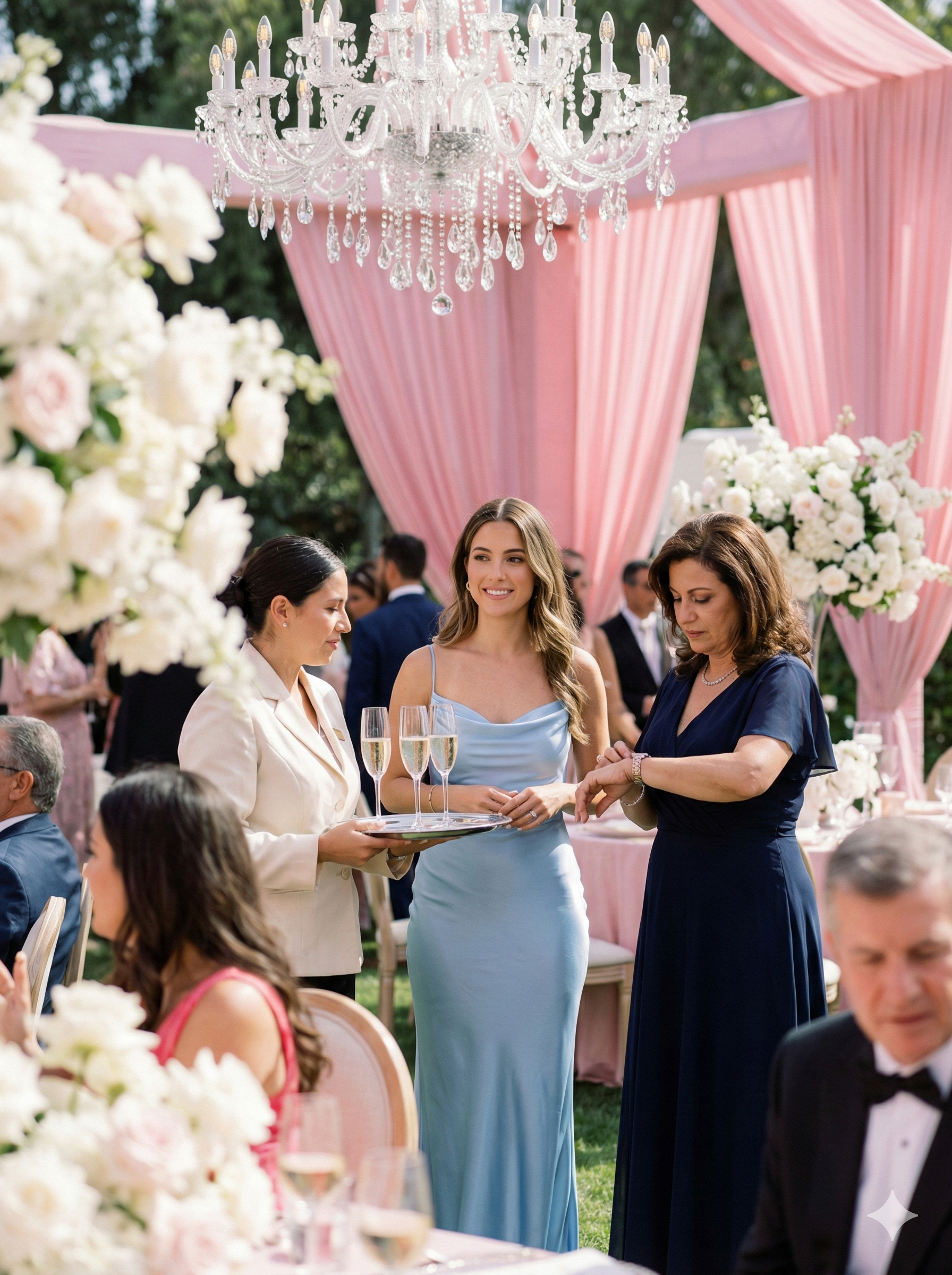
The service elevator always smelled the same—like bleach, metal, and other people’s evenings.
It was a smell I hadn’t forgotten, no matter how many boardrooms I’d sat in since. Ammonia clung to the air, sharp enough to sting the back of my throat. Someone had left a rolling rack of linen napkins too close to the door; they brushed my arm when the elevator lurched, soft cotton against the smooth fabric of my navy dress.
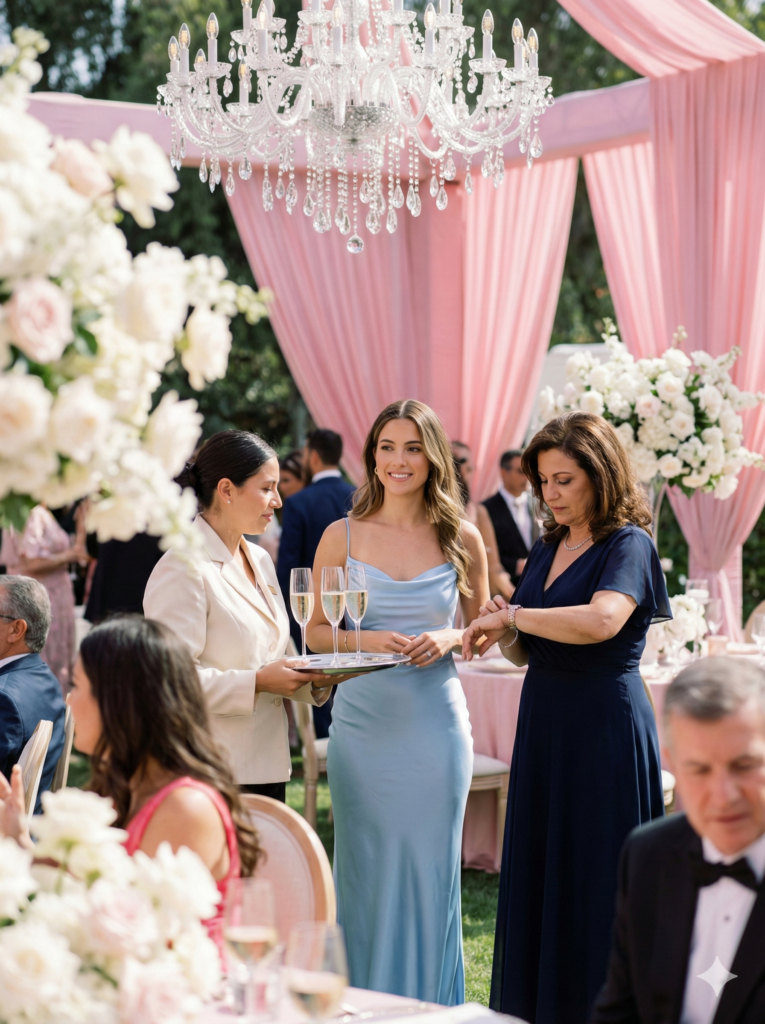
Around me, the staff moved in a restless choreography. A bartender with sleeves rolled to his elbows steadied a crate of liquor with his foot. A florist’s assistant held a vase against her chest as if it were a newborn, petals trembling with every bump. A line cook in a faded black T-shirt leaned against the corner, scrolling something on his phone, eyes glazed with that particular tiredness that comes from working your fifth double shift in a row.
Nobody looked at me twice.
That was the funny thing about power: if you didn’t wrap it in a logo or a ballgown, people rarely recognized it. Tonight, I looked like what they expected to see. Simple dress, no name badge, comfortable low heels. The only hints were my jewelry and my watch, but those only meant something if you knew what you were looking at.
“First time up to the rooftop, ma’am?” a young server asked beside me.
He couldn’t have been more than twenty-two. There was still a softness in his face that hospitality hadn’t yet scraped away. The name tag pinned crookedly to his vest read LUCAS.
I realized my hand was resting against the rail a little too tightly, fingers whitening at the knuckles. Old instinct, I thought. Old rooms. Old elevators.
“Something like that,” I said, smoothing my grip and forcing my hand to relax.
The elevator shuddered to a stop at the service landing for the rooftop suite. The doors slid open with that particular metallic groan that told me the maintenance team hadn’t yet implemented the repair schedule I’d approved last quarter.
“The hallways can be a lot,” Lucas offered with a sympathetic smile as we stepped out. “Especially with… you know. Them.” He jerked his chin toward the direction of the main suite. “The daughter already made the florist cry twice.”
I let out a quiet breath through my nose, the closest I’d allow myself to a laugh. “Did she, now?” I asked.
“Yeah.” He winced. “She wanted the blush roses to be barely blush, not ‘aggressively pink,’ and… sorry. I shouldn’t be gossiping.”
“You shouldn’t,” I agreed mildly.
His shoulders slumped a little.
“But I appreciate the warning,” I added, and his head snapped up. “It’s always good to know the lay of the land.”
He smiled, relieved, and hurried off, balancing a tray of champagne flutes as if he’d been born doing it.
I stayed where I was for a moment at the threshold between the service corridor and the back entrance to the Pacific Ember Resort’s crown jewel: the rooftop event suite. Tonight, it glowed with soft light and expensive intentions. Tonight, it hosted my only son’s engagement party.
And tonight, apparently, I was staff.
I adjusted the vintage diamond studs in my ears—small, old-fashioned, nothing like the loud stones that sparkled in Napa’s society pages. I’d worn these on a very different day: the day I’d signed the final papers to acquire the Pacific Ember Hotel Group.
It had been hot that afternoon, the kind of heat that made glass towers feel like ovens. The lawyers had sweated in their suits, loosening ties as the ink dried. The previous owners had tried to smile. Their faces had held the look I’d seen a hundred times: the brittle pleasantness of men who believed they were losing to someone who didn’t look like they should be winning.
I’d sat at the end of the table in a tailored but unremarkable blazer, hair twisted into a low bun. Only my watch—a discreet Patek Philippe—hinted at what I really was.
Isabelle Romero: founder of Romero Urban Design.
Majority shareholder of Pacific Ember Properties.
And tonight, according to every glossy Napa Valley lifestyle magazine, importance level: barely worth a mention.
They loved to talk about my son, though.
Brilliant young architect Daniel Romero, the articles cooed, attached to photographs that captured him in golden light. They wrote about his projects, about the way he was “reimagining urban hospitality experiences” in collaboration with the most exciting design firms on the West Coast. They devoted whole paragraphs to his fiancée, Charlotte Holloway—her lineage, her impeccable taste, the texture of her dresses, the brands of her handbags.
Of his mother, I was sometimes “a single mom who raised him alone after immigrating from Mexico.” Sometimes I was “from humble beginnings.” Often, I was simply not mentioned at all.
I’d been called worse. I’d been seen less.
I pushed open the door to the suite.
It was like stepping into the inside of a champagne bottle. Golden light spilled from crystal fixtures, catching the shimmer of glassware and silver. The largest floral arrangements I’d ever seen outside of a hotel lobby framed the windows, pale roses and hydrangeas arranged in curated chaos that had likely cost more than my first semester of college.
At the center of the room, chaos reigned in softer colors.
“No, absolutely not,” a voice snapped. “These napkins look cheap.”
I followed the sound. Charlotte Holloway stood at the head of a long, gleaming table, a bolt of pale blue silk and chiffon and beadwork poured over the chair beside her. The dress probably cost more than my first car. The way she wore it, she might have believed it cost more than the building.
She pointed at the table linens with a manicured finger, her expression caught halfway between horror and fury. The event planner, a woman whose smile looked like it had been glued on hours ago, nodded too quickly, fingers trembling around her clipboard.
“The linens are supposed to be blush,” Charlotte said, enunciating as if she were instructing a particularly dim child. “This is… rose. Or salmon. It’s wrong. And these folds.” She reached down and crushed the corner of a napkin between two fingers. “It’s giving… budget wedding. Do we look like a budget wedding?”
I cleared my throat.
“Is there a problem with the linens?” I asked.
She turned sharply, hair swinging over one bare, sculpted shoulder. In person, she was exactly what the magazines promised: luminous, poised, striking. Her skin glowed, her makeup was flawless, and she had the aura of someone who had spent her life walking into rooms that rearranged themselves around her.
Her gaze slid over me the way you skim over a menu item you know you’re not going to order.
“Who are you?” she asked, brows knitting. “You’re not in uniform.”
A small, wicked part of me wanted to answer the way everyone in this building should have: I own the place, sweetheart.
Instead, I smiled. “I’m Isabelle,” I said. “Daniel’s mother.”
For a heartbeat, something like recognition flashed in her eyes. Perhaps she had seen a photograph. Perhaps I was supposed to look more… something. Polished. Tamed. Less like myself.
Then her expression cooled by several degrees.
“Oh.” She drew the word out, smoothing it with practiced politeness. “Right. He mentioned you might… arrive early to assist.”
“Assist,” I repeated, tasting the word like a foreign dish.
“Mm.” Her gaze dropped to my dress again, cataloging and categorizing. No designer label she recognized, no sequins, no dramatic silhouette. Just clean lines, good tailoring, and fabric that pooled when it moved. “The staff should have directed you to the staging area. Looks like they got it right indeed.”
There it was. The little twist of condescension, wrapped in sugar.
I smiled wider.
“I admit,” I said, “I assumed I’d be on the welcome line with my son. But I can be flexible.”
Her confusion flickered deeper now, faint lines appearing between her brows, but before she could respond, another voice floated into the room like the tinkling of ice in crystal.
“Charlotte, darling, the guests are beginning to arrive. We can’t keep them standing in the hallway, it’s vulgar.”
Vivien Holloway swept into the center of the chaos the way a ship cuts through a harbor it believes it owns. I’d seen her picture a hundred times: charity galas, museum openings, benefit dinners. In person, she was a study in deliberate perfection. Not a hair out of place, not a smudge in sight. Her dress—champagne-colored, of course—matched the event’s color palette, because of course it did.
Her eyes landed on me.
“And this must be…” Her voice trailed off for half a heartbeat as she took in my dress, my lack of jewels, my hair pulled simply back. “You must be Daniel’s mother.”
The sliver of silence between must and be was surgical. Fifteen years ago, it might have sliced me clean in half.
These days, it barely nicked the surface.
“Mrs. Holloway,” I said, inclining my head. “The venue looks beautiful. The redesign really honors the original architecture.”
It did. The Pacific Ember had been a sad thing when I first toured it: outdated chandeliers, tired carpets, a sense of faded grandeur that felt more resigned than romantic. I’d run my hand along the banister then and thought: I could love this place back to life.
Vivien waved a dismissive hand, the diamonds on her wrist catching the light.
“The new ownership spared no expense,” she replied. “Though I preferred the last group. They understood standards.”
I had to bite the inside of my cheek to keep my smile from turning sharp. The last group had understood how to overspend and underperform. They had understood how to draft impassioned letters begging me not to gut their precious “brand identity” as we negotiated the buyout.
They had not understood that the quiet Latina architect sitting at the conference table’s end—taking notes, listening more than she spoke—wasn’t a consultant.
She was their replacement.
“Mother,” Charlotte said, cutting a glance at me. “We should revisit the seating arrangements. Given… the circumstances.”
“Of course, darling.” Vivien’s voice turned syrupy. “We want everything to feel just right.”
She shifted her gaze back to me, smile stretching but not quite reaching her eyes.
“Mrs. Romero,” she said. “We’ve arranged a charming spot for you in the private dining area, with the staff.” She paused delicately, as if searching for the gentlest words to gild a brick. “You’ll feel more comfortable there.”
“In the kitchen,” Charlotte added sweetly, as if clarifying something that might have slipped past me. “Closer to the servers.”
I glanced at my watch, more out of habit than anything. The slim, understated Patek hugged my wrist, its face small, its significance enormous. Its price tag could have paid for the entire flower budget five times over.
“How considerate,” I said.
Charlotte’s smile widened the way a cat’s does when it thinks it has done something clever.
Before any of us could say anything else, a familiar voice cut through the air.
“Mom.”
I turned. There he was.
Daniel had always carried himself like someone who’d grown used to straddling two worlds. As a boy, he’d known how to charm the children of the families whose houses I cleaned, just as easily as he’d known how to share a plate of tacos with my coworkers in a cramped back hallway. As a man, he now wore suits tailored to his shoulders, not his insecurities.
Tonight, he looked every inch the man the magazines adored. Charcoal suit, white shirt, tie just loose enough to look effortless yet respectful. There was a steadiness in his dark eyes that hadn’t been there at twenty. Life had sanded off his arrogance and left conviction in its place.
He crossed the room in quick strides.
“Mom, you’re here,” he said, leaning down to kiss my cheek.
“As ordered,” I replied.
He pulled back and looked between me, Charlotte, and her parents. The subtle tightening around his mouth told me he’d walked in at precisely the wrong moment.
“I was just helping your mother find her seat in the kitchen,” Charlotte said lightly, looping her arm through his. “We want her to be… comfortable. We thought something more… informal would be better. For her background.”
She didn’t see the way his jaw clenched at that word. Background. She didn’t know the years that lived between us and that word.
Vivien chuckled, brittle and bright. “Well, given where you come from, Mrs. Romero, we assumed you’d prefer something a little less stiff.”
Daniel’s posture changed in an instant. The easy charm evaporated, replaced by a tension I recognized from the first time he’d had to fire someone who thought his last name meant he’d be a pushover.
“Charlotte,” he said quietly, “we talked about—”
“It’s fine,” I cut in, laying a hand on his arm.
He looked at me, and I gave him the smallest shake of my head. The same signal I’d given him in a hundred different situations: when landlords had spoken down to us, when teachers had assumed he was in the wrong, when other parents had made snide comments about “those people” while looking straight at me.
Not yet, my eyes said. Not here. Not this way.
“I’m very comfortable,” I said calmly. “I’ve been in nicer kitchens than ballrooms, if I’m being honest.”
Charlotte laughed, mistaking my comment for a joke. Vivien tittered in response. Douglas lingered near the bar, already holding a drink, his cheeks flushed with the early warmth of alcohol and attention.
“Perhaps,” I added, eyes flicking to my son, “we should focus on welcoming the guests. I believe they’re arriving.”
Right on cue, the chime of the main elevator echoed through the suite. Voices swelled from the hallway—polished, practiced laughter; heels tapping unevenly on marble; greetings layered over greetings.
“Go,” I said, reaching up to straighten Daniel’s tie. “Be the charming fiancé. I’ll find my little corner of the empire and amuse myself.”
“You don’t have to take this,” he murmured. “Just give me the word and I—”
“And ruin the surprise?” I teased.
The corner of his mouth twitched. He knew me too well.
“Mom…”
“I’m fine,” I said. “Besides, I’m curious.”
“Curious?”
“How far people will go when they think the power in the room belongs to them.”
He studied my face for another second, then nodded. “Don’t have too much fun.”
“No promises.”
He kissed my forehead and let Charlotte pull him toward the front doors, where the first wave of Napa’s carefully curated elite was already spilling into the suite.
I slipped toward the back of the room, blending into the half-shadow near the bar and the kitchen swing doors. From there, I could see everything.
Charlotte became the sun around which the room orbited. She floated from group to group, gown whispering over the tiles, offering hugs and air kisses, laughing just brightly enough to be charming without being shrill. Vivien shadowed her like a well-trained publicist, redirecting conversations, steering certain people together while keeping others apart.
Near the terrace, which overlooked the vineyard-laced hills glowing in the last light of the day, Douglas held court. His voice boomed above the rest, peppered with phrases I’d heard a hundred times from men who’d done well enough to think of themselves as self-made but not well enough to make anyone truly important nervous. “Deal flow.” “Upside.” “Leverage.”
He laughed loudly at his own jokes. His companions laughed slightly quieter, glancing around to see who was watching.
I sipped the champagne a passing server had offered me and let the bubbles glide over my tongue.
“More champagne, ma’am?” a familiar voice asked near my elbow.
I turned and found the same young woman from the elevator—Lucas’s counterpart in grace under pressure. Her name tag read CLARE. Up close, she had that particular kind of poise I recognized immediately: the kind you earn by swallowing a hundred small indignities and choosing not to spit them back out.
“Thank you, Clare,” I said, allowing her to refill my glass. “How long have you worked here?”
She blinked, caught off guard by the question. “Uh—three years, ma’am.”
“And how are you finding things these days?”
She hesitated. In hospitality, you learned quickly when not to speak honestly. Saying the wrong thing to the wrong guest could mean a complaint, which could mean a write-up, which could mean fewer shifts, which could mean not being able to pay rent.
“There are a lot of… changes,” she said carefully. “With the new ownership. People are nervous. Lots of rumors.”
“Good ones, I hope,” I replied, watching her face.
“Some.” Her lips twitched, as if fighting the urge to smile. “They say whoever bought the place is… making improvements. Better benefits. Talking about safety and, um, respect. For staff.”
“Sounds promising,” I said.
She nodded, though doubt pinched her brows. “It’s just… for people like us, rumors don’t always mean much. We’ll believe it when we see it.”
“Fair enough,” I said. “For what it’s worth, I—”
“Where’s the mother of the groom?” Douglas’s voice boomed across the room, cutting through the hum of conversation. “Hiding in the kitchen? We can’t have that.”
The room hushed.
Even in the low light, I saw Charlotte’s shoulders stiffen. Vivien’s smile froze, turning brittle.
I exhaled gently. So much for subtlety.
“I suppose that’s my cue,” I murmured to Clare, handing her the now-empty flute.
She stared at me, confused, but stepped back to let me pass.
I walked toward the center of the room, the way I walked into boardrooms: unhurried. The heels of my shoes clicked softly on the marble, an unremarkable sound compared to Douglas Holloway’s laughter.
“There you are,” he said when he spotted me. “Come, come, we can’t have you hiding back there. What do you think of all this?” He spread his arms, nearly sloshing scotch from his glass. “Quite a leap from your usual surroundings, I’d imagine.”
Conversations around us quieted. The circle widened as faces turned toward me. Some were curious, some politely blank, some faintly amused, as if expecting entertainment.
Out of the corner of my eye, I saw my son. He stood near the terrace, his body angled toward us, watchful.
I let the silence stretch just enough to make some of them shift in their shoes.
“You’re right,” I said, swirling the remaining champagne in my glass. “It is different from my usual surroundings.”
Douglas smirked, mistaking agreement for submission. “I’d imagine so,” he said. “Quite the upgrade from… Where was it again? Fresno? Stockton?”
“Daniel grew up in Oakland,” I said mildly. “I cleaned houses in all three at one point or another.”
A tiny wrinkle appeared between his brows, as if he hadn’t expected me to answer so plainly.
“But you know,” I continued, “I’ve grown very accustomed to penthouses. They’re rather comfortable.” I tipped my head slightly. “Although this one’s east-wing renovation is behind schedule. Permits.” I clicked my tongue softly. “Always a nightmare.”
His smirk faltered.
“How would you know that?” he asked.
Around us, the air shifted, charged now with curiosity rather than casual cruelty. Phones appeared in hands with that surreptitious speed people had perfected in the age of online spectacle.
“The same way I know about the unresolved health code issues in the kitchen,” I said, my voice still gentle. “And the unpaid overtime complaints from staff. Or the fact that your standing reservation was nearly declined last month because the deposit bounced.”
The silence thickened.
Vivien took a step closer, fingers tightening around the stem of her glass. “Who are you?” she asked, the politeness stripped from her tone now. “Exactly?”
I smiled.
Sometimes, power is loud. It arrives in motorcades and headlines. Tonight, I let mine arrive the way I preferred it: quiet, unexpected, edged in steel.
“I’m just the help,” I said. “Some people call me the owner.” I paused. “Others prefer ‘landlord.’ But my legal signature reads: Isabelle María Romero. Chief Executive Officer of Pacific Ember Properties. And the majority shareholder of the company that bought this resort last summer.”
The sound of glass shattering snapped through the silence. Vivien’s champagne flute had slipped from her hand, crashing onto the marble. Bubbles and shards spread across the floor.
“That’s impossible,” Douglas said. He laughed, a short, disbelieving bark. “Pacific Ember is owned by IR Group.”
I turned toward him, head tilted slightly.
“It is,” I agreed. “Isabelle Romero Group.”
I caught Clare’s eye at the edge of the crowd and handed her my empty glass. Her mouth hung open slightly as she took it.
“I do enjoy an acronym,” I added lightly. “It keeps things more… anonymous.”
The wave moved through the room like a physical thing—shock, realization, recalibration. People who had barely registered my presence earlier now stared as if I’d grown another head. One of the older women near the terrace suddenly looked delighted, her eyes sparkling with mischief.
Beside Daniel, Charlotte looked as though someone had cut the strings that held up her spine. Her posture drooped, then stiffened again in an awkward mimicry of composure. Her lip trembled once before she forced it back into line.
“You knew?” she whispered, turning to my son. “All this time? You knew and you never said—”
“Of course he knew,” I said calmly. “He was there when I signed the contracts. He was the one who ordered takeout for me and my lawyers when negotiations ran late.”
“He let me treat you like—” She cut herself off, the word catching in her throat.
Like the help, I thought. Like the staff you sent to the kitchen.
Like I had been.
I let her sit with that.
“You know, Charlotte,” I said, “what’s revealing isn’t that you treated me this way without knowing. It’s that you think you would have treated me better with that knowledge.”
Her cheeks flushed a blotchy, furious red.
Vivien finally found her voice again. “This is outrageous,” she said. “You have humiliated us.”
I lifted a shoulder. “I haven’t done anything,” I said. “You’ve simply introduced yourselves.”
A ripple of laughter, quickly stifled, moved through the guests.
“Isabelle,” Daniel said softly, coming to stand beside me. “Maybe we should take this somewhere private.”
“Yes,” Douglas snapped. “We should. We’ll discuss this like civilized adults, not…” He gestured vaguely at the room, as if it were a courtroom of peasants.
I studied his face for a moment.
“By all means,” I said. “Let’s step into the private dining room.” I smiled faintly. “After all, that’s where I was supposed to sit, wasn’t it?”
The crowd parted as we walked. Daniel remained at my side. Charlotte moved ahead, her dress dragging slightly behind her, the shimmer dulled. Vivien clung to her husband’s arm, her earlier poise unraveling thread by thread.
We passed Clare and Lucas by the kitchen doors. Their eyes were wide, their faces a portrait of the careful neutrality staff wore when guests were fighting within earshot. I caught Clare’s gaze.
“Could you let the team know,” I said, “that whatever happens tonight, their pay is safe?”
Her lips parted. “Yes, ma’am,” she whispered.
“Good,” I said. “And then take a moment to enjoy the show.”
The private dining room was just down the hall, tucked behind a discreet door. When we stepped inside, there was a brief, ridiculous moment in which I almost laughed. This was the room they’d tried to relegate me to—small, elegant, with a polished wooden table and a tasteful arrangement of flowers at the center.
Now, it felt like the courtroom where their illusions had been called to stand trial.
Douglas rounded on me before the door had even closed.
“What is it you want?” he demanded. “A board seat? A payout? To show us up in front of our friends? You’ve made your point, Mrs. Romero. You don’t need to drag this out.”
I watched him with a kind of detached fascination. Men like him always assumed conflict was about leverage. They assumed everyone wanted something from them. It rarely occurred to them that they could be in a position where they had nothing to bargain with.
“What could you possibly offer me,” I asked softly, “that I don’t already have?”
He opened his mouth, then shut it again.
“I have controlling interest in three hotel chains,” I continued, the words matter-of-fact rather than boastful. “I co-own two regional airlines. I own the marina where you dock your yacht each summer, Mr. Holloway. I’m on the board of the St. Helena Club. Your club membership is… under review.”
Vivien paled. “You can’t—”
“I can,” I said simply. “But that isn’t the point.”
“Then what is the point?” she demanded, voice cracking. “If this isn’t about money, if you’re not trying to—”
“It’s about memory,” I said.
They stared.
“Twenty-five years ago, a different family invited me into their world.” I stepped closer to the table, my fingers trailing over the smooth wood. I could smell the polish, the faint tang of lemon oil. “They asked me to design a small expansion for their business. They showed me their house. Their boat. They told me about their plans. And then, one evening, over dinner, the matriarch of that family smiled at me and said she was very impressed that someone with my… background had gone to architecture school.”
The word carried the same sting it always had, but I no longer flinched from it.
“She asked me if I understood the expectations of their social circle,” I continued. “She wanted to make sure that if I married her son, I knew I’d never be presented as his equal in public. That it would be better if, when they had parties, I stayed in the kitchen with the staff.” I tilted my head. “So that I would be… comfortable.”
Vivien swallowed.
“I remember hearing those words,” I said. “I remember going home that night, scrubbing the restaurant bathrooms on my cleaning shift until my hands bled.” I met Charlotte’s eyes. “I remember promising myself that one day, one way or another, I would never again be the person someone felt they could bury with a smile.”
“What happened to them?” Charlotte asked quietly.
“I bought their company,” I said. “Used it as the foundation for my own. I treated their employees better than they ever did. And every time their last name appears on a building now, it’s because I decided to keep it there.”
Daniel watched me, eyes dark, jaw tight with a kind of fierce pride.
“And you know what I did not become, Charlotte?” I asked.
She shook her head.
“I did not become them.”
The room was very still.
“So no,” I said, returning my attention to Douglas and Vivien. “I don’t want your money. I don’t want your board seats. I don’t want invitations to your parties. I already have everything you can offer and more. What I do want is for you to understand something very simple.”
“And what is that?” Douglas asked hoarsely.
“That titles don’t measure worth,” I said. “That wealth doesn’t guarantee class. And that how you treat people when you think they’re beneath you says more about you than any gala, any photograph, any donation ever could.”
I turned to Charlotte.
“And you,” I said. “You say you love my son. That this isn’t about money.”
“It isn’t,” she whispered. “I… I swear it isn’t.”
“So tell me,” I said. “If you had met him when he was still living with me in that cramped Oakland apartment—if he had been working two jobs to pay his way through school, if he’d been dropping off his little cousins at daycare between classes—would you have introduced me at your parties? Would you have seated the woman who cleaned bathrooms at your parents’ fundraisers at the main table?”
Her eyes filled with tears.
“Would you have taken pictures with the housekeeper who raised him while I studied?” I asked softly. “Or would you have preferred that I stay in the kitchen, out of sight, where you wouldn’t have to be embarrassed?”
The silence that followed said more than any protest ever could.
“I…” Charlotte’s voice broke. She covered her mouth with her hand, mascara already smudging. “I don’t know. I—”
“That’s honest,” I said. “Honest is a start.”
Daniel stepped forward, hands buried in his pockets. “The irony,” he said quietly, “is that Mom hasn’t cleaned houses in decades. But if she did, I’d still be proud to be her son.”
His voice was steady. “She taught me that real class is how you treat the people who can’t do anything for you.”
Douglas sank into one of the chairs, the fabric of his jacket crinkling. He looked older in that moment than I’d ever seen him appear in photographs.
“The club memberships,” I said. “The hotel accounts. The marina slips. All of them are under review. So is every interaction your family has had with my staff, across every property we operate.”
“We can explain,” Vivien said quickly. “There have been… financial challenges. A few misunderstandings. The checks—”
“You can explain,” I agreed. “You can explain why you commissioned custom gowns while your vendors’ invoices went unpaid. Why you posed as philanthropists while snapping your fingers at servers. Why you wore borrowed diamonds to events hosted by people you were quietly defaulting on.”
Daniel’s lips twitched. I suspected he was replaying some of the stories he’d shared with me about their lavish vacations, their chronic “late payment issues,” the way they’d bragged about being “asset-rich, cash-flow light” as if it were charming rather than irresponsible.
“You have two options,” I said.
They stared at me like defendants waiting for a sentence.
“I can go back into that room right now,” I continued. “In front of all those people who hang on your every move. I can announce the immediate termination of every privilege your family enjoys at my properties. Your club membership. Your marina slip. Your resort accounts. I can add that the reasons include bounced checks, mistreatment of staff, and ongoing investigations into improprieties at your foundation.”
Vivien swayed slightly, one hand flying to her throat.
“Or,” I said, my tone sharpening just slightly, “you can spend the next year proving that you deserve any of it.”
Douglas blinked. “Prove—”
“You start tonight,” I said. “You go upstairs and apologize individually to every staff member you’ve spoken down to. Every florist, every server, every line cook who has ever borne the brunt of your temper. And then, with your own funds—not donations collected in your name—you establish a foundation for hospitality workers. Education, emergency support, legal aid for those facing abuse.”
I held up a hand as Douglas opened his mouth. “Not a vanity project with your names in gold. A real fund. Transparent. Audited.”
“You can’t dictate—” he began.
“I can,” I said. “You are free to refuse, of course. I am also free to double your interest rates, call in loans, and let the world know why certain doors are suddenly closing to you.”
“I…” Vivien looked at Charlotte, desperate. “Douglas…”
“Isabelle,” Daniel said quietly, “what about…”
“My engagement?” Charlotte finished, her voice cracking. She turned to him, eyes wide. “Danny, please. I didn’t know. About your mother. About any of this. I swear, I didn’t.”
He flinched at the nickname. I noticed. So did she.
“That’s the problem,” he said softly. “You didn’t need to know my mother was wealthy to treat her with respect. That you think you might have if you’d known… that’s worse, Charlotte.”
Tears spilled over now, tracking uneven lines through her perfect makeup.
“This,” I said gently, “is the one thing I won’t decide for you.” I looked between them. “That’s between my son and the woman who thought his mother wasn’t good enough to greet her guests.”
For a moment, everything hung in the air like a held breath.
Then Charlotte surprised me.
She straightened.
“I don’t deserve him,” she said quietly. “Or you.” She wiped her cheeks with the back of her hand, ruining her mascara completely. “But if you’ll let me, I want to earn your respect.”
I studied her face. Underneath the panic and the shame, something else was taking root. Determination.
“How?” I asked.
“By starting where I went wrong,” she said. She drew in a shaky breath. “I’m going upstairs. I’m going to apologize. Not just to the staff I’ve yelled at. To everyone.” She swallowed. “And I’ll start by helping in the kitchen I wanted to shove you into.”
“Charlotte,” Vivien gasped. “You can’t possibly be serious. You’ll be—”
“Working,” Charlotte said, turning to her mother. For the first time since I’d met her, there was steel in her voice that wasn’t sharpened into cruelty. “Which is more than we’ve been doing lately, if we’re honest.”
Douglas stared at her as if seeing his daughter for the first time.
Charlotte looked back at me. “Not because of your threats, Mrs. Romero,” she added, voice softening. “Because I was wrong. And I hate that I was wrong more than I hate being embarrassed.”
I nodded once.
“Very well,” I said. “Let’s go back up.”
The hallway seemed longer on the way back. Maybe it was the weight of new knowledge pressing down on all of us. The music from the suite swelled as we approached, a jazzy, polished playlist that suddenly felt too smooth for the roughness in the air.
Conversation dipped again when we re-entered. Eyes followed us. Rumors traveled faster than room service.
Charlotte didn’t hesitate. She walked straight to the nearest staff member—a tired-looking man in a crisp white jacket arranging canapés—and touched his elbow.
“Chef?” she said, voice trembling slightly. “I… owe you an apology. For earlier. For… many earlier’s, if we’re honest.”
His expression went blank, then wary, then puzzled as he glanced past her to me. I gave him a slight nod.
One by one, she moved through the room. Servers. Florists. The event planner who still clutched her clipboard like a life raft. Her words stumbled at first, then steadied. Guests whispered behind their hands. Phones recorded. No amount of PR management could fully contain what was happening, and I didn’t particularly want it contained.
I made my way back to the bar area, where Clare stood, eyes wide.
“So the rumors are true,” she said faintly. “You’re…”
“Me,” I agreed.
“We’ve all worked hundreds of these fancy events,” she said, voice shaking. “Served some of the richest people in the state. But you’re the first one…” Her throat worked. “You’re the first who talked to us like we mattered.”
I touched her arm lightly. “That’s because I was you,” I said. “A lifetime ago. I scrubbed hotel bathrooms between business school lectures. I burned my hands on dishwater hauling plates to pay for textbooks. I ate leftover bread rolls in stairwells because I couldn’t afford dinner.”
Her eyes glistened.
“Never let anyone convince you that what you do is less than,” I said. “Honest work is never small. The things people build on your backs, however…” I glanced across the room at the Holloways “…those can be very fragile.”
Later, when the worst of the tension had settled into something else—curiosity, perhaps, or the cautious thrill of having witnessed something that would be told and retold over lunches for months to come—Charlotte came to find me again.
Her hair had escaped its perfectly arranged waves, stray strands sticking to her cheeks. Someone had given her a kitchen apron to tie around her waist. It clashed magnificently with her couture gown. There was a smear of something—sauce? lipstick?—near her collarbone. Her feet, I noticed, were no longer encased in diamanté heels. She wore a pair of worn black flats that had clearly lived their lives on tile, not red carpet.
“I’ve been awful, haven’t I?” she said without preamble.
“Self-awareness,” I said, “is an excellent first step.”
Her laugh came out half-sob. “I thought I was… cultured. Refined. I thought the way I treated staff was just… normal. Expectations. Standards. I didn’t realize…” She trailed off, looking down at her hands. They were red at the fingertips, nails chipped from carrying trays without thinking.
“What matters isn’t who you were this morning,” I said. “It’s who you choose to be tomorrow.”
“I want to do something that doesn’t just… fix optics,” she said. “I want to set up scholarships. For staff. For their kids. For people who do the work we pretend not to see. If you’ll help me do it right, I… I want to help.”
It would have been easy to dismiss her as performative. To assume this was another performance, this time of humility. But there was something different in her posture now—a slump she didn’t bother to correct, the way her eyes didn’t skim past the people in uniform anymore but lingered.
“One condition,” I said.
She straightened, bracing.
“You’ll spend one month working in this hotel,” I said. “Not shadowing. Not posing for photos. Working. Training with housekeeping. Doing breakfast shifts with the servers. Helping front desk at three in the morning when someone’s room key stops working and they decide you’re the reason their life is falling apart. Then we’ll talk about scholarship structures.”
Her throat bobbed. “When do I start?”
“Tomorrow,” I said. “Five in the morning. Wear flats. You own some now, apparently.”
She looked down at her borrowed shoes, then back up again.
“I’ll be here,” she said.
As she hurried off to break the news to her parents, Daniel joined me by the window. Outside, the vineyards lay in neat, dark rows under the moonlight, the kind of view that made people sigh and drop small fortunes on tasting tours.
“You’re seriously putting her on hotel duty?” he asked.
“I’m giving her a free education,” I said. “The kind I paid for with blisters and tips.”
“And her parents?”
“They have their own homework,” I replied. “Tomorrow morning, my auditors will start going through every transaction linked to their accounts across our properties. Quietly. Thoroughly. We’ll see how much of their lifestyle still stands when it has to meet regulations.”
He let out a low whistle. “Remind me never to get on your bad side.”
“Too late,” I said affectionately, bumping his shoulder. “Remember when you were thirteen and told me you wanted to drop out of school to become a DJ?”
He groaned. “Okay, fair. You were scarier then.”
“I had less to lose,” I said.
He fell quiet for a moment, watching Charlotte across the room as she fumbled with a tray of appetizers, cheeks flushed as she apologized to yet another staff member.
“You knew this would happen,” he said finally. “You let them treat you like that. You walked into that elevator and you… chose to let them think you were staff. You set it up.”
“I set nothing up,” I said. “I simply didn’t correct their assumptions.”
“Same thing,” he said.
“Not exactly,” I said. “If you want to see who someone really is, Daniel, you give them the illusion of power and watch what they do with it. Tonight, your future in-laws introduced themselves to me in the language they speak most fluently. Entitlement.”
“And Charlotte?” he asked.
“That remains to be seen,” I said. “She is, however, the first Holloway I’ve met who volunteered for a 5 a.m. shift.”
“And if she fails?” he pressed, voice soft.
“Then she fails,” I said. “Better to fail while trying to grow than succeed with a rotten heart.”
The band shifted into a slower number. A few couples drifted toward the makeshift dance floor. The tension in the room loosened, though the undercurrent remained—excitement, speculation, the thrill of a story people knew they’d tell later beginning with, “You’ll never believe what I saw…”
We stayed until the last of the guests had left, until the florists were boxing up leftovers and the band was packing up instruments. Charlotte was still in the kitchen, helping stack chairs. Vivien, to her credit, had spent the last two hours circulating with a tray in her hands, offering canapés and apologies to staff and guests alike. Her lipstick had worn off. Her eyes looked hollow, but she hadn’t fled.
Douglas had grown unusually quiet. He’d signed checks that night—real ones, not promises—pocketing his pride with each signature. I saw something unfamiliar in him: the dawning realization that consequences were not just for other people.
At the end of the night, as staff wiped down the last tables and the hum of the dishwasher vibrated faintly through the floor, Charlotte emerged from the kitchen. Her gown was wrinkled, apron crooked, cheeks streaked with mascara and fatigue. And still, she walked toward me.
“Mrs. Romero—” she began, then corrected herself. “Ms. Romero.”
“Yes?” I said.
“I know I don’t deserve another chance,” she said. Her voice was hoarse. “But I want to earn a place in your family. Not because of your status or your wealth. Because… because Daniel deserves someone who understands what matters.”
I studied her closely—every tremble, every twitch, every flicker.
“Twenty-five years ago,” I said, “another polished family told me I wasn’t enough. That I’d never belong in their world. They were wrong about my potential. But they were right about one thing: I didn’t belong in a world that needed to shrink me to feel comfortable.”
I let the memory rise up—sharp, clear, then fade.
“I built my own world instead,” I said. “Stone by stone. Brick by brick. Bathroom by bathroom.”
“What happened to them?” she asked.
“I bought their company,” I replied. “Renamed it. Hired their employees at better wages. And every time I sign a bonus check, I remember the night they told me I was lucky they let me sit at their table.”
Her lip trembled. “I don’t want to be like them.”
“Then don’t be,” I said. “Remember this feeling. The shame. The sting. The realization that you hurt people because you didn’t think you were capable of it. Remember it when your alarm goes off at 4:30 a.m. and you don’t want to get up to change linens for guests who will never learn your name. Remember it when you see how hard my staff works for tips that barely cover their rent.”
She nodded, swallowing hard.
“And remember,” I added, “that you are not entitled to my forgiveness. Or my respect. You have to earn those, just like everyone else. But I am willing to give you the opportunity.”
“Thank you,” she whispered.
I turned toward the exit. The valet lights outside blinked in the distance, tiny beacons in the night.
As Daniel and I stepped into the cooler air of the hallway, he slipped his arm around my shoulders.
“Did you plan all of this?” he asked. “Letting them think you were just another staff member. Waiting until the whole room was watching before you told them who you were.”
“I didn’t plan the timing,” I said. “That was your future father-in-law’s ego. But I knew something like this would happen.”
“Because of them?”
“Because of the world they live in,” I said. “I know that world like I know the lines on my own hands. I’ve built its hotels. I’ve cleaned its bathrooms. I’ve been invisible to its guests and essential to its workings. People like the Holloways believe the universe has a natural order. Tonight, they discovered it doesn’t.”
We reached the elevator bank—the guest elevators this time, not the service one. The silence between us was comfortable, laced with shared history.
“Sometimes,” I said slowly, “the sweetest revenge isn’t parading your success in front of people who doubted you. It’s living in a way that proves they were wrong to doubt you in the first place—and giving others the chances no one gave you.”
He squeezed my shoulder. “You’re amazing, you know that?”
“That’s what mothers do,” I said lightly. “We clean up messes, teach hard lessons, and occasionally buy the buildings where the messes happen.”
He laughed, tension easing from his shoulders.
“Come on,” I said as the elevator doors opened. “Let’s get out of here. I know a place that makes a decent late-night taco.”
“In Napa?” he asked skeptically.
“In Napa,” I said. “They’re new. The chef is from Oaxaca; his mole is nearly as good as your grandmother’s.” I stepped into the elevator, turning to face him. “I bought the building last week. Figured I should have some say in the menu.”
He shook his head, smiling. “Of course you did.”
As the doors began to slide shut, I caught one last glimpse of the rooftop corridor. Clare stood near the end, gathering a stack of folded tablecloths. She looked up, met my eye, and gave the tiniest nod.
I nodded back.
In another life, I might have been the woman standing there, folding linens in the half-light while the wealthy slept off their wine. In this one, I owned the laundry room.
But the truth—the quiet, stubborn truth I had carried with me from the moment I stepped into my first hotel bathroom with a scrub brush in hand—was that I was not more valuable now than I had been then. I simply had more leverage.
Leverage I intended to use.
For every Clare. Every Lucas. Every line cook and bellhop and housekeeper who had ever been told, in word or in glance, that they were small.
The elevator slid downward, carrying us away from the glittering suite and into the rest of the night. Outside, the world of wine and wealth and expectation kept turning. Inside, a different kind of work was just beginning—the slow, difficult kind. The kind that changes people, not buildings.
“Mom?” Daniel said as we descended.
“Yes?”
“What if Charlotte doesn’t make it? Through the month. Through… us.”
“Then she’ll have learned something valuable,” I said. “And so will you.”
He nodded, thoughtful.
“And if she does?” he asked.
“Then,” I said, feeling the corners of my mouth curve upward, “we might just have grown something worth keeping.”
They always thought they were burying us, I reflected. The families like the Holloways. The employers who underpaid, the landlords who sneered, the patrons who snapped their fingers. Every time they tried to push us down—to kitchens, to back entrances, to service elevators—they forgot something important.
Seeds grow in the dark.
And I had spent my whole life learning how to blossom exactly where they never expected me to.
THE END.