By the time I turned onto my parents’ street, my jaw already ached from clenching it. My hands were locked around the steering wheel so tight my knuckles were chalk white, and I had to remind myself—out loud—to loosen my grip.
“Remember,” I muttered under my breath, mimicking the voice I used in therapy. “Be neutral. Be calm. Keep your distance. Keep your guard up.”
From the back seat, Haley’s small voice floated forward, soft and hopeful. “Do you think there’ll be balloons, Mom?”
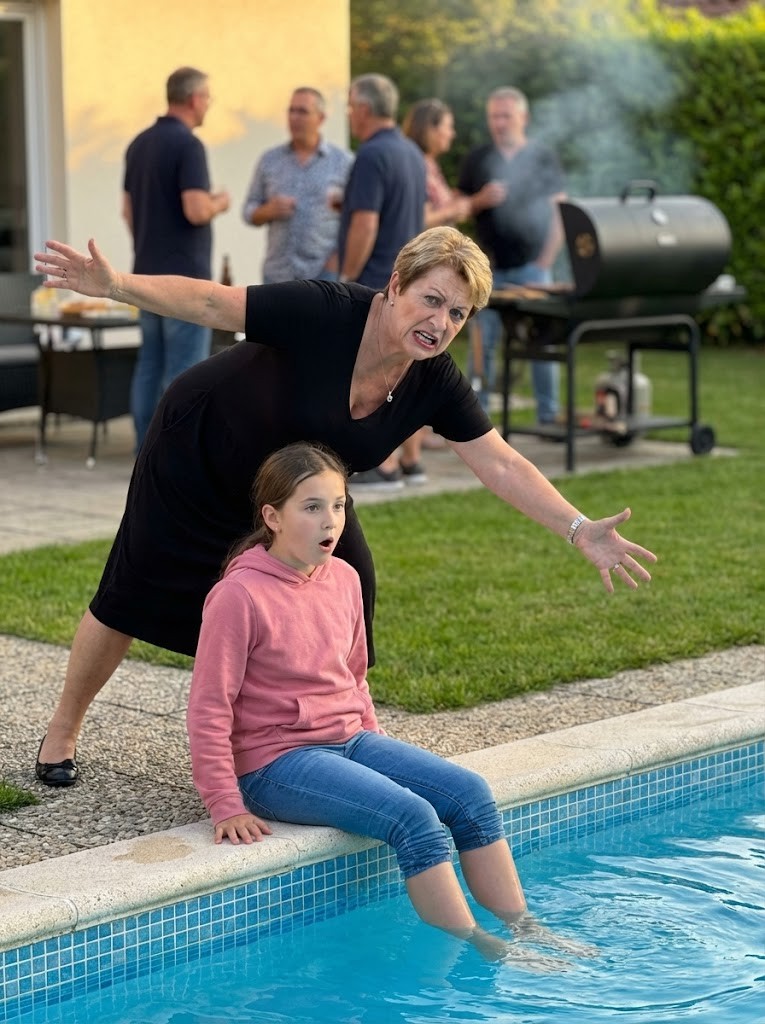
I glanced at her in the rearview mirror. Eight years old, hair pulled into a slightly crooked ponytail from dance practice, still in her pink hoodie and faded jeans. She had a smudge of glitter on her cheek, a neon star from some craft they’d done in class. Her eyes were wide and excited. Somehow, she always managed to stay excited.
“I don’t know, baby,” I said, trying to curve my mouth into something like a smile. “Grandpa usually does the grill, not balloons. But there’ll be burgers. And your cousins.”
“Yay,” she said softly, and leaned her forehead against the glass, watching the tidy, familiar houses roll by.
It always amazed me—how none of these houses knew. How each perfectly trimmed lawn and carefully arranged flower pot could sit there, unaware that one of the homes on this quiet, sunny street was a minefield. Every time I turned onto it, it felt like walking into a childhood nightmare with adult-sized shoes on.
I parked a few houses down. I never parked right in front of my parents’ place anymore. Old habit—leave yourself an escape route. I killed the engine and watched the house for a moment, the way someone might watch an animal that’s wounded but still dangerous.
The backyard fence peeked over the sides of the house, and I could see the top of the old oak tree Dad used to brag about planting “with my bare hands” when I was born. He always left out how many times he’d told me I was a disappointment while we sat under it.
“Mom?” Haley said again. “Are we late?”
“No, we’re right on time.” I inhaled slowly, letting the air expand my lungs, then pushed the breath out. “Okay, Haley, remember what I said.”
She sat up straighter. “If anyone says something mean, I tell you. I don’t have to hug anyone I don’t want to. I can stay by you. And if I feel weird, I say so.”
“Exactly.” Pride flickered in my chest. “You don’t have to be polite if you’re uncomfortable. Polite is optional. Safe is not.”
“Safe is not,” she echoed, like it was the tagline to a commercial.
I reached back and squeezed her small hand. “Let’s do this quick, okay? Burgers, cousins, then home.”
She nodded, hair bobbing. “Home,” she repeated, the word warm and certain.
We walked up the paved path, the same path I’d run along barefoot as a kid when Mom called us in for dinner. The front door was already open, screen door latched, letting the smell of grilled meat and chlorine drift out. Laughter floated from the backyard, that loud, easy laughter my family perfected in public.
I could hear my father’s voice above the rest, booming and confident. Rachel’s sharper, higher tone followed like an echo. The familiar duo.
We stepped inside. The air-conditioned chill hit us first, then the faint scent of my mother’s perfume—powdery floral and something sharp underneath, like alcohol. Family photos lined the hallway walls: Dad holding a fishing rod; Mom in a sequined dress at some banquet; Rachel with a sparkler in hand; Rachel at graduation; Rachel’s wedding photo with her perfect white dress and airbrushed smile. If I was in a photo, I was in the background, half-turned, mid-laugh, blurred. I’d always been the incidental presence in my own house.
Haley’s eyes caught one of the frames. “Is that you, Mom?” she whispered, pointing at a sun-bleached photo of me at fourteen, standing off to the side while Rachel blew out birthday candles.
“Yeah,” I said quietly. “That’s me.”
“You look sad,” she observed.
I swallowed. “I was just… thinking,” I lied. “Come on, sweetheart.”
We followed the voice and smoke trail toward the backyard. Before we could even reach the sliding glass door, my mother swept in from the kitchen like a storm in heels.
“There she is,” she announced, her arms wide in a theatrical gesture that never reached her eyes. “The elusive Danielle, gracing us with her presence. And Haley, of course. My, my, look at you. Still in… that.”
Her gaze slid over Haley’s hoodie and jeans with the same disdain she might reserve for a stain on her rug.
“Hi, Mom,” I said, because old habits don’t die, they just put on makeup. “Traffic was light.”
My mother’s lips curved into something like a smile but not quite. “People are starting to notice, you know,” she said in a low, conspiratorial tone, as if the neighbors were conducting a study on my attendance rate. “You skipping events. Keeping to yourself. It’s making us look bad.”
There it was. Not “We miss you.” Not “Are you okay?” Just “You’re embarrassing us.”
“I’m here now,” I replied.
She flicked her eyes over Haley again. “At least you brought the child. That’s something. Try to act normal today, please. No scenes. And for heaven’s sake, can you just move on from childhood nonsense? You’re pushing thirty, Danielle.”
Childhood nonsense. The phrase landed on me like an old coat I’d been forced to wear. The nights of screaming, the slammed doors, Dad’s handprint on my cheek, Rachel’s smug little smirks—nonsense, apparently.
Haley slipped her hand into mine. I squeezed it. “We’ll be outside,” I said flatly.
We stepped through the sliding glass door into the backyard. The sun was bright, glancing off the blue water of the pool. Dad stood at the grill, spatula in hand, beer balanced on the edge. Uncles and cousins filled patio chairs, some already half-drunk, laughter too loud. The smell of lighter fluid, charcoal, and overcooked meat mixed in the air.
And then came Rachel.
She emerged from the sliding door beside us like she was stepping onto a stage. Designer romper, cinched at the waist, legs bare and smooth. Her hair was styled in loose, deliberate waves, nails manicured, lips glossed. Every inch of her said, Look at me.
She scanned the backyard quickly, clocking who was watching, then let her gaze rest on Haley. It slid from the hoodie to the jeans to the slightly scuffed sneakers, and her mouth curved into a smirk that made my stomach twist.
“Wow,” she drawled, loud enough for the nearest relatives to hear. “Still doesn’t dress her like a girl that matters.”
Haley’s shoulders hunched, her chin dropping. That little spark in her eyes flickered.
I felt something inside me flash white-hot, the kind of energy that started as heat in my chest and shot down into my fists. I saw myself stepping forward, heard myself spitting all the comebacks I’d rehearsed in the shower for years.
Not today, I told myself. No traps. No explosions. That had become my mantra. They wanted reaction. They fed on it. Without it, they had to sit alone with themselves, and they hated that.
I forced my jaw to unclench and said nothing.
Rachel stepped closer, invading my space like she always had. Her perfume—something expensive and suffocating—filled my nose.
“You seriously think that kid’s going to become anything special?” she whispered, just for me, voice dripping with false concern. “You’re raising a downgrade of yourself. Didn’t think that was possible, but here we are.”
My mother, who’d drifted out behind us with her drink, barked out a laugh that made a few heads turn. “That’s what happens when you don’t pick the right men,” she said, clinking her glass against Rachel’s. “Trash breeds trash.”
The words hung in the air like smoke.
Haley’s small fingers tightened around mine. Without looking at her, I squeezed back, pulsing a silent message: I see you. I have you. They’re wrong.
Dad chose that moment to stroll over, the grill sizzling behind him. He gave me one long, assessing look, eyes landing pointedly on my faded jeans, my simple t-shirt, my hair pulled back in a no-nonsense ponytail.
“You look miserable, Danny,” he said, taking a swig of his beer. “Maybe if you’d tried being more feminine growing up, you wouldn’t have ended up a single mother. But hey, you made your bed.”
“This is psychological hunting,” my therapist had called it once. I’d laughed at the phrase then, thought it was too dramatic. But standing there, with three pairs of eyes trained on me like weapons, I realized it fit perfectly. They circled and prodded, waiting for me to bleed so they could blame me for the stain.
“I’m gonna fix us some plates,” I told Haley softly. “You wanna sit by the pool and watch the water?”
Her face lit up at the word water. “Can I dip my feet?”
“Not yet,” I said. “You don’t have your swimsuit. Just sit and watch for now, okay? I’ll be right there. Five seconds.”
She nodded, trusting. Always trusting. “Okay, Mom.”
She padded over to the edge of the pool and sat down, pulling her knees close, sneakers near the coping but not touching the water. The sun shimmered on the surface, sending bright reflections onto her face.
I turned toward the folding table where the food was laid out. Hot dog buns, burger patties, plastic tubs of potato salad, a bowl of chips already going stale. I picked up a plate and started assembling one for Haley—burger with cheese, no onions, just ketchup. I could hear laughter behind me, clinking bottles, the hiss of the grill.
Five seconds, I thought. I’ll be back in five seconds.
When I turned around, my world split clean down the middle.
Rachel was standing behind Haley, closer than she had any right to be. Haley didn’t even see her. My sister looked down with that same smirk, that cruel little twist of her lips I’d grown up with. And in one smooth, deliberate motion, she put both hands on my daughter’s back and shoved.
It happened so fast and yet in slow motion. Haley pitched forward with a small, surprised yelp that was cut off by a splash as her body hit the water. The impact was louder than it should’ve been—the smack of jeans and hoodie and socks taking on weight all at once.
The plate slipped from my hand and crashed to the ground, plastic cracking, food scattering. The sound that ripped from my throat didn’t even feel like it belonged to me. It was primal, animal. I didn’t think. My body just moved.
“HALEY!”
The world blurred at the edges. The blue of the pool, the green of the grass, the white glare of the sun, the cluster of faces turning toward the sound—it all smeared together. All I could see, all that was sharp and real, was my daughter’s body underwater.
Her hair fanned out around her head like black ink spilled in the pool. For a terrifying moment, she didn’t come up. Fully clothed, heavy denim and cotton dragging her down. She was small, but panic weighs as much as concrete.
I bolted toward the edge, heart punching in my chest. I was three steps away from the pool when something slammed into me from behind.
An arm hooked hard around my neck, forearm crushing into my windpipe. My body lurched backward. My feet scrabbled against the wet concrete, slipping. The world tilted. The bright blue of the pool vanished from my sight line.
My father’s breath was hot and sour in my ear. “Stop,” he barked, voice low and furious. “She needs to learn. If she can’t survive water, she doesn’t deserve life.”
For a second, I thought I’d misheard him. The words were so grotesque my brain refused to file them anywhere. But he said it again, slower, squeezing his arm tighter.
“If she can’t survive water, she doesn’t deserve life.”
My vision narrowed. Colors sharpened and then bled at the edges. Haley. The world shrank to the knowledge that my child—my child—was underwater, and I was being held back from her by the man who was supposed to be my father.
My hands flew to his arm, nails digging into his skin. I clawed, twisted, kicked. My lungs screamed for air, my throat burning. I tried to wrench his arm away, but he was still big, still strong, still the man who’d towered over me my whole life.
“Let me go!” I gasped, but it came out as a strangled, broken sound. My voice felt like it was being ground into dust. “Haley—”
From the corner of my eye, through the suffocating pressure, I saw Rachel standing by the pool, arms crossed, watching. She was laughing. Actually laughing. My mother stood beside her, drink in hand, body perfectly still. No rush toward the pool, no gasp of horror, no dropping of the glass. Just quiet, observational detachment, like she was watching a mildly interesting TV scene.
Haley’s body barely broke the surface, a small, flailing shape, then disappeared again. Her arms waved underwater, bubbles rising, hair a dark cloud around her face. She was not a strong swimmer. We’d done a couple of classes, and she’d loved splashing in the shallow end, but jeans and hoodie were anchors, not clothes.
Something in me cracked. It was like the floor of my chest split open, and whatever had been politely contained inside spilled out—every humiliation, every insult, every time I’d been told I was overreacting, dramatic, too sensitive. Every time I’d swallowed rage in the name of peace. It all detonated at once.
My legs remembered being fourteen and kicked out from under me on the stairs. Sixteen and pinned against the wall for talking back. Twenty-three and pregnant, being told I’d ruined my life. They remembered more than my brain did.
I drove my heel backward, hard, into my father’s shin. Then again, higher, into his knee. All my weight, all my terror, all my fury focused into that one movement.
He grunted, his balance shifting. For half a second, his grip slackened. It was enough.
I wrenched myself sideways, ducking my head out from under his arm. The skin on my neck burned where his forearm had been. My lungs dragged in one precious breath of air before my legs launched me forward.
I didn’t think about my phone, my shoes, my clothes. I didn’t think about the way the concrete bit into my feet or how the world might look to the people watching from their loungers. I dove.
The water was a shock—a cold slap that punched the breath from my chest. But beneath the surface, everything became strangely quiet. The thumping music from someone’s Bluetooth speaker muffled to a distant, hollow beat. The shouts and gasps above were muted. All I heard was the rush of blood in my ears and the echo of my own pounding heart.
And then, there she was.
Haley’s eyes were wide and glassy, mouth open in a silent scream as bubbles burst from her lips. Her arms flailed, but the weight of her clothes pulled her downward. Her hoodie billowed around her like a parachute, jeans dragging her legs down.
I lunged towards her, arms slicing through the water. I wrapped one arm around her chest, hooking just beneath her arms like they’d taught us in the mom-and-baby swim class from years ago. Her little hands clutched at me, fingers digging into my arm in pure blind panic.
“It’s okay, baby, I’ve got you,” I tried to say, but underwater it came out as a stream of bubbles.
I kicked hard, pushing us upward. The surface felt far away, like swimming toward a warped, shimmering sheet of glass. My lungs burned, begging for air, but I held onto her, kicking, kicking, kicking until finally we burst into the sunlight.
Haley coughed, sputtering, choking. I shifted my grip and pulled her closer, water streaming from her hair and hoodie. With my free hand, I grabbed the edge of the pool and hauled us toward the ladder. Someone finally moved—a cousin reaching down to help me lift Haley up onto the deck.
She was shaking, lips pale, teeth chattering. Water poured from her clothes onto the concrete, soaking her sneakers, forming a spreading puddle around us. She coughed again and again, each one a sharp, wrenching sound that made my heart twist.
I knelt beside her, hands moving without conscious thought—tilting her to her side, rubbing her back, pushing wet hair away from her face. “Breathe, baby, just breathe. You’re okay. You’re okay. You’re safe.”
Her eyes rolled, unfocused, then finally found me. For a moment, sheer terror stared back. Then recognition. Then she sobbed, a broken, hiccuping sound that cut me deeper than any insult I’d ever received.
I pulled her into my arms, cradling her, feeling all that cold soaking into me. She was solid and real and breathing. That was all that mattered.
And then I looked up at them.
Rachel stood a few feet away, arms still crossed, one hip cocked, as if she’d merely made a witty comment instead of shoving a child into the deep end of a pool. Her mouth was curled into that same smug half-smile, like she’d pulled off some legendary prank.
My father stood near the grill, adjusting his shirt, smoothing his hair like he’d just stepped out of a wind gust instead of nearly strangling his own daughter. His face was almost bored.
My mother watched us with an expression I recognized from years of scraped knees and tears—impatience. Annoyance.
She rolled her eyes, lifting her drink to her lips. “Oh, for heaven’s sake, Danielle,” she said, voice dripping with disdain. “Drama queen. Over one dip.”
“Over one dip.”
They weren’t pretending they didn’t see. They weren’t horrified or remorseful. They were irritated that I’d disrupted the party. That I wasn’t playing my assigned role—quiet scapegoat, permanent punching bag.
Something inside me hardened with a final, echoing click. A door closing. A lock sliding into place.
This wasn’t a family anymore. Maybe it never had been. This was a threat. A danger zone disguised as a backyard barbecue. And right there, kneeling on the sun-warmed concrete, soaked, shivering, with my daughter coughing in my arms, I made a decision.
Their world was going to break next, not mine.
I stood up slowly, Haley clinging to me like a limpet, her arms tight around my neck. My legs shook, both from the cold and the adrenaline crash. My throat throbbed where Dad’s arm had been. I could already feel the bruise blooming under my skin.
“I’m taking her to the hospital,” I said, voice low but steady. “Get out of my way.”
Dad laughed, a harsh, dismissive sound. “She’s fine,” he said. “She just swallowed water. Builds character. We did stuff like that to you all the time, and look—you survived.”
Yeah, I thought, looking him dead in the eye. I survived. And I’m about to make sure she never has to.
One of my cousins, eyes wide and unsure, stepped aside. Mom opened her mouth like she wanted to say something else, but for once, nothing came out. Maybe it was the look on my face. Maybe it was the way Haley was clutching me, shaking.
I didn’t wait for permission. I walked through them, holding Haley tight, feeling their eyes follow me. I didn’t see Rachel’s expression as I passed; I didn’t care to. She’d lost the right to have a face in my world.
Once we reached my car, I strapped Haley into the back seat with shaking hands. Her clothes were dripping; the seat belt instantly soaked. I grabbed an old blanket from the trunk—a faded one we used for picnics—and wrapped it around her shoulders.
“Mom, am I in trouble?” she whispered.
The question stabbed me. “No, baby,” I said, cupping her wet cheek. “You’re not in trouble. You didn’t do anything wrong. You hear me?”
She nodded, a tiny jerk of her chin.
“I’m going to call some people to help,” I said. “We’re going to get you checked out, just to be safe. That’s my job. Okay?”
“Okay,” she said, voice small.
I shut the door and leaned against the car for a second, my body trembling so hard I thought my knees might give out. I pressed my forehead against the hot metal and fumbled for my phone.
My thumb hovered over the screen, instincts battling each other. One voice—a younger version of myself—begged me to let it go, smooth it over, downplay it. That voice sounded suspiciously like my mother.
Another voice, newer, sharper, sounded like my therapist. Like the women in support groups. Like the nurse who’d once asked me quietly, “Is everything okay at home?” That voice said, Call.
I dialed 911 before I could talk myself out of it.
The operator’s voice was calm, practiced. I spilled everything in clipped, shaking sentences: child pushed into a pool, fully clothed, difficulty breathing, relative tried to stop me from rescuing her, emotional abuse, I’m taking her to the hospital, I’m scared.
The operator asked questions. I answered. She told me what to watch for: confusion, vomiting, breathing difficulty. She told me to keep Haley warm and to head straight to the ER, that paramedics would meet us there if needed. She kept her voice steady and reassuring, anchoring me while my thoughts spun like a tornado.
We drove.
At the hospital, fluorescent lights and the smell of antiseptic replaced the chlorine and charcoal. A nurse took one look at Haley—her soaked clothes, her pale lips, the foam at the corner of her mouth from coughing—and whisked us into an exam room.
They cut away her hoodie and jeans fast, apologizing as she flinched. I stood there holding her hand, feeling each snip of the scissors like a small betrayal of normalcy, but knowing it was necessary. They wrapped her in warm blankets, checked her oxygen levels, listened to her lungs. I watched the monitor like it held my entire future.
The nurse had that look I recognized—something beyond professional concern. A quiet, knowing sadness, like she’d seen this pattern before. The way she glanced at the finger-shaped bruises forming on my neck told me she was seeing more than just a near-drowning.
The doctor came in, asked careful questions: How long was she underwater? Did she lose consciousness? Has she vomited? Any medical conditions? I answered, my voice steadying with each fact I recited.
Then came the questions that cut deeper.
“Who was with her?” he asked, pen poised.
“My parents,” I said. “My sister. Cousins.”
“Who pushed her?” he asked.
I hesitated just long enough to feel it. That familiar tug. The instinct to play it down, to protect them so they wouldn’t turn around and accuse me of exaggerating. Years of being told I was too dramatic seemed to press a hand over my mouth.
Then I looked at Haley, wrapped in blankets on the hospital bed, her eyelashes damp, cheeks flushed. She was watching me, trusting me.
“My sister,” I said. The word came out firmer than I expected. “Rachel. She pushed her, on purpose, into the deep end. Fully clothed.”
The pen moved. “And when you attempted to help?” he asked quietly.
“My father held me back,” I said. “He grabbed me by the neck and pinned me. Told me she ‘needed to learn.’ Told me if she couldn’t survive water she didn’t deserve life.”
The doctor’s hand paused for just a fraction of a second before continuing. “We’ll document that,” he said. “Thank you for telling me.”
They recorded my statement. They took photos of Haley’s damp hair, her small body wrapped in hospital blankets, the redness around her eyes. They took photos of the bruises forming on my neck. Everything organized, timestamped, categorized.
A social worker came in later—a woman named Maria with kind eyes and a spine of steel. She listened as I told the story again, this time with years attached to it. Not just the pool, but the words, the patterns, the way my parents had pivoted all their cruelty toward me and now, slowly, toward my child.
Maria didn’t flinch. She didn’t tell me I was overreacting. She didn’t ask what I’d done to provoke it. She just nodded, occasionally taking notes.
“I’m going to make the report that needs to be made,” she said finally, voice calm. “We will involve Child Protective Services. This is not safe. For your daughter or for you. Are you okay with that?”
Am I okay with that? I thought, staring at her. Was I okay with someone finally seeing what I’d been screaming into a void about for years? Was I okay with someone stepping in on my side?
“Yes,” I said. It felt like opening a door and letting fresh air in. “Yes. Please.”
Police officers came, too—two of them, one older, one younger. They asked the same questions in different ways, cross-referencing my answers, testing for consistency. I had nothing to hide.
They took my statement and then, later, took statements from others who’d been at the barbecue. From cousins who, maybe for the first time in their lives, realized they had to pick a side. Some of them told the truth: They saw Rachel push Haley. They heard Dad’s words. They saw my mother laugh.
Those words went into a report. The report turned into a case number. The case number turned into a small cardboard card the officer handed me on our way out.
“We’ve filed a report and referred this to Child Protective Services,” he said. “You’ll be contacted within twenty-four hours by a caseworker. They’ll walk you through safety planning and next steps. In the meantime, do not let your parents or sister be alone with your daughter. If they try to force contact, call us.”
Call us.
It was the opposite of everything I’d grown up with. Don’t air dirty laundry. Family stays in the family. What happens under this roof stays under this roof. If you tell, you’re betraying us. You’re dramatic. You’re ungrateful.
I took the card and slipped it into my wallet like it was made of glass.
Haley and I spent the night in a cheap motel, the kind with buzzing neon and floral bedspreads that had seen too much. I watched her breathe as she slept, counting each rise and fall of her chest. Every time she shifted, my heart skipped. When she whimpered in her sleep, I gently stroked her hair until she settled.
At dawn, my phone rang. The number was unfamiliar.
“Hello?” I whispered, careful not to wake Haley.
“Danielle?” a calm voice asked. “This is Maria from CPS. We met at the hospital. I’d like to come by and talk with you in person. Is that okay?”
I looked around the small motel room, the suitcases, the scattered clothes, the half-eaten vending machine snacks. It didn’t look like much. It looked like running. It looked like survival.
“Yes,” I said. “That’s okay.”
An hour later, Maria knocked on the door. She walked in with a clipboard and a tote bag, but more importantly, with the kind of energy that made my shoulders drop a fraction of an inch. Not all the way, but enough.
“We’re going to talk about options,” she said, taking a seat in the uncomfortable armchair. “About an emergency safety plan, supervised visitation, and protective orders. We’re going to make sure Haley is safe.”
She explained the process, breaking it down into steps. Emergency safety plan first: where we’d stay, who we could trust, who needed to be notified. Then she outlined the possibility of an emergency protective order preventing my parents and Rachel from contacting or going near Haley. She mentioned school protocols—how we could add notes to Haley’s file to ensure she would never be released to anyone without my explicit permission.
It wasn’t dramatic or flashy. It was paperwork. Phone calls. Boxes ticked on forms. But it felt like building a wall, brick by brick, between us and them.
I signed papers with shaking hands. I handed over my phone so Maria could photograph and upload evidence I’d collected over the years—screenshots of nasty texts, recordings of my mother screaming, voicemails from my father threatening, belittling. All the little pieces I’d kept “just in case,” not really believing “just in case” would ever arrive.
“It helps,” Maria said, confirming the uploads. “Patterns matter. This shows it’s not a one-time event. It shows escalation.”
She called Haley’s school from the motel room, put it on speaker so I could hear. Calmly and without drama, she explained the situation to the principal: the near-drowning, the report filed, the protective measures being put in place.
“There will be a note in Haley’s file effective immediately,” the principal said. “She will only be released to Danielle or the individuals specifically listed in writing. No grandparents, no extended family, unless authorized. We’ll also create a safety code for pickup so Haley knows when it’s truly her mom and not someone pretending. And her teachers will be informed discreetly.”
Bureaucracy, which I’d always despised as slow and impersonal, moved like a shield around us.
The social worker wasn’t done.
“Do your parents attend a church or community group?” she asked.
“Yes,” I said slowly. “They’re… very involved. Dad volunteers with the youth group. Mom runs some of the event planning. They like being seen as the perfect family.”
“Would you like to inform leadership?” she asked. “You don’t have to. But if there’s a risk to other children…”
The thought of my father around other children, joking about “toughening them up,” made my stomach turn. “Yes,” I said. “I’ll talk to the pastor myself.”
Later that week, I sat in the pastor’s office, the old wooden desk between us, Haley in the church daycare down the hall drawing pictures of unicorns. I told him what happened. Not with venom, not with theatrics, just facts.
He listened. Really listened. Lines appeared around his mouth that I’d never noticed before. When I was done, he rubbed a hand over his face and let out a slow breath.
“We cannot allow children to be at risk in our fellowship,” he said quietly. “Thank you for telling me.”
He didn’t drag it into the Sunday sermon. He didn’t make a show of it. Instead, he started making phone calls. To the ministry board. To the youth leaders. To whoever handled volunteer approvals. Within days, my father’s name quietly disappeared from the volunteer roster. He was no longer trusted in roles that gave him access to children. No big announcement. Just doors closing.
I started reaching out to people in my parents’ social circle too, the ones who loved their barbecues and game nights. I wasn’t looking for revenge; I was looking for protection.
A cousin, one who’d previously giggled along with my mother at every jab thrown my way, surprised me. When I told her, voice calm, about what had happened, she went quiet on the other end of the line.
“I didn’t know,” she said finally. “I mean, I knew they were… sharp. But this? No. That’s not okay. I’ll keep my kids away from their house. And if anyone gives you trouble about it, you send them to me.”
It was something small, but it was also huge. A tiny shift in the tide.
While the external systems moved—police, CPS, church, school—I built our own fortress. Not a dramatic one, not an Instagrammable one. A practical, boring, necessary one.
I changed my phone number, memorizing the new digits like an incantation. I got a P.O. box and gave that address to the school. I installed new locks on our apartment door and a peephole camera I’d bought on sale. I arranged with my friend Elena to be Haley’s emergency contact and pickup person if anything happened while I was at work.
I enrolled Haley in a swimming class run by the community center—this time choosing a program known not just for teaching strokes but for teaching safety, boundaries, and voice. The instructors talked to the kids about body autonomy, about yelling “no” loudly, about finding trusted adults.
“Do I have to get in the water?” Haley asked when we first pulled up to the pool, anxiety tightening her little shoulders.
“No,” I said firmly. “Not until you’re ready. We’ll start by just watching, okay? You get to decide.”
We sat on the sidelines the first day, her hand wrapped around my wrist. She watched other kids squeal and splash and kick. The second session, she dipped her toes in. By the third, she slid into the shallow end, eyes wide but determined.
“Remember the dinosaur?” I whispered to her at night when she woke from a nightmare. A story I made up of a brave little dinosaur who’d fallen into a lake once and thought she’d never want to see water again, but who learned to swim slowly, at her own pace, until lakes weren’t terrifying anymore.
“Brava-saurus,” Haley mumbled, already half-asleep.
“Yeah,” I said. “Brava-saurus. Just like you. You get to decide when and how you get back in. And this time, no one’s allowed to push you.”
As Haley slowly reclaimed water, inch by inch, my parents lost something they’d always taken for granted: access.
They tried to call, of course. From new numbers, through relatives, through “concerned friends.” My mother left voicemails dripping with outrage: “How dare you drag our name through the mud?” My father tried a different tactic: “You’re being brainwashed. CPS always overreacts. Take it back. Fix it.”
I didn’t engage. If communication was necessary, it went through my lawyer or my CPS caseworker.
My lawyer, a woman with sharp eyes and a softer tone, helped turn my instinct for revenge into something more surgical. “We don’t want chaos,” she said, flipping through the file. “We want structure. Supervised visits only, no-contact orders where necessary, clear boundaries. They thrive on drama. We won’t give it to them.”
So we gathered records. Hospital reports. Police statements. Photos of bruises. Witness testimonies. Screenshots of texts where my parents called me unfit, called Haley names, threatened to “straighten her out.” It all went into a folder.
When the emergency no-contact order went through, it came as a plain stack of papers, not a fanfare. But when I held them in my hands, I felt like I was holding a shield.
They are not allowed within 300 feet of Haley. They are not allowed to contact her directly or indirectly. They are not allowed to show up at her school, activities, or our home.
For the first time in my life, the law wasn’t something hovering vaguely above my world. It was a line on the ground with their names and my daughter’s name on opposite sides.
A week after the barbecue, it was time to go back to that house one last time.
Not alone.
Maria met us at the curb, her car parked behind mine. She wore a plain blouse, slacks, and a badge clipped to her belt. A police officer arrived shortly after, his presence quiet but undeniable. Haley stayed with Elena at a nearby park; she’d never set foot in that backyard again if I could help it.
My parents’ front door opened before we could knock, as if they’d been watching from the window. My mother appeared first, lips already pursed.
“Oh, for God’s sake, Danielle,” she snapped. “You’re dragging this out. Are you happy? Making a spectacle? You always did love drama.”
The officer stepped forward, body blocking her from crowding me. “We’re here to collect the child’s personal belongings,” he said calmly. “This is not a negotiation.”
My father came into view behind her, his face caught somewhere between anger and confusion. Like he couldn’t quite process that the script had changed. That he wasn’t the one dictating the terms.
Rachel appeared on the stairs, arms folded, eyes narrowed. She started to move toward the hallway leading to Haley’s old room, but Maria lifted a hand.
“You are not permitted to be involved in this process,” Maria said, voice firm enough to cut through the tension. “Please return to the living room.”
For once in her life, Rachel froze. She looked at my parents, waiting for them to override this stranger’s authority. They didn’t. Or couldn’t.
I walked past them, up the stairs I’d once trudged up as a teenager after being told I was ungrateful, lazy, too much, not enough. Each step felt like walking through layers of old versions of myself.
Haley’s room was almost exactly as we’d left it after her last overnight visit: bedspread neat, stuffed animals lined up in a row, her backpack hanging on the closet door. A drawing she’d made still taped to the wall—a crooked house with a badly proportioned tree and two figures holding hands: me and her.
I moved quickly, packing her favorite dolls, sketchbooks, the pajamas with the stars she loved, the small unicorn nightlight she sometimes brought when she slept over. Every object I put into the bag was one less tether between her and this house.
When I came back downstairs, the air in the living room felt thicker. My parents stood side by side, stiff, their confidence cracking around the edges.
“You will never have access to my child again,” I said, holding the bag at my side, my other hand wrapped around the strap like it was the handle of a shield. My voice didn’t shake. It rang. “Not unsupervised, not at school, not at church events, not at holidays. Not ever.”
My father barked out a short, disbelieving laugh. “You don’t get to decide that,” he said. “We’re her grandparents. We have rights. You’re hysterical now, but you’ll calm down. You always do. You’ll crawl back like you always have.”
The officer stepped forward again, a stack of papers in his hand. “Mr. and Mrs. Thompson,” he said calmly, holding the documents out. “These are your copies of the emergency no-contact order issued by the court this morning. You are to remain at least 300 feet away from Haley at all times. Any violation will result in immediate arrest. You will also refrain from attempting to contact her indirectly through third parties.”
My father’s mouth snapped shut, whatever speech he’d been about to deliver dying on his tongue. His hand hovered in the air before he finally took the papers, eyes scanning the text like he could erase the words by glaring at them.
My mother’s face went white, then flushed a mottled red. “You can’t do this,” she hissed. “We’re her family. We’ve done everything for you. This is how you repay us? With police? With strangers in our home?”
“You are not safe around my daughter,” I said. I felt tired. Bone-tired. “You proved that. You did this. I’m just putting it on paper.”
Rachel scoffed from the couch. “All this because the kid got wet?” she muttered. “You’ve always been insane. Always. You’re seriously cutting us out of your life because of a little swim?”
I turned my head slowly and looked at her, really looked at her. The girl who’d been handed everything—praise, gifts, attention—and taught that cruelty was just honesty with better branding. The golden child whose shine came from all the light that had been taken from me.
“No,” I said quietly. “I’m cutting you out because you shoved an eight-year-old into a pool while she was fully clothed and watched her sink. And then laughed. There’s a difference.”
She opened her mouth, then snapped it shut. I watched, with an odd kind of detached curiosity, as the realization settled over her face that there would be consequences this time. That her actions had moved beyond the safe zone of “sibling rivalry” and into something resembling accountability.
We walked to the front door. Maria on one side of me, the officer on the other, like bookends to this final chapter. My parents didn’t move to hug me, to stop me, to plead. Maybe they thought silent treatment would win this one, like it had when I was sixteen and begged to be seen.
I stepped outside. The air felt lighter, even though the weight of everything we’d set in motion pressed against my ribs.
At the curb, I paused and looked back just long enough to see them standing framed in the doorway. Three figures I used to orbit around like distant planets. They looked smaller now. Not physically, but spiritually. Like the space they took up in my life had finally been resized to match reality.
They didn’t lose a fight that day. They lost access. They lost the automatic right to call themselves grandparents and parents like it was a shield against scrutiny. They lost us.
And we gained something.
That night, in our little apartment with its new locks and borrowed furniture, I tucked Haley into bed. Her room looked different from the one in my parents’ house—smaller, yes, but warm in a way the other never had been. Her dolls were lined up on a thrift-store shelf. Her unicorn nightlight glowed soft purple on the wall.
“Are we going back there?” she asked suddenly, lying on her side, one arm curled around her favorite stuffed bear.
“No,” I said, without hesitation. “We are not going back there.”
“Ever?” she asked, trying to decide if she believed me.
“Ever,” I said. “You are safe. We have people helping us make sure of that. Teachers, police, Maria… and me. You don’t have to see them again.”
She thought about this, forehead scrunching. “But… they’re your mom and dad.”
“I know,” I said softly. “But being someone’s mom or dad or grandma or grandpa doesn’t mean you’re allowed to be mean or dangerous. It just means you’re supposed to take care of your kids. They chose not to. So I chose to protect you. That’s my job.”
She was quiet for a moment. “Are you sad?” she whispered.
I was. In ways I knew would come out in odd places—in the grocery store aisle when “Dad’s BBQ Sauce” caught my eye, in random Tuesday afternoons when a memory of sitting under the oak tree would surface uninvited. Grief for something I’d never actually had but always wanted: a safe family home.
“Yeah,” I said honestly. “A little. And also… relieved.”
She nodded, accepting that. “I’m glad you got me out of the water,” she murmured, half-asleep. “You were like… like a superhero.”
I smiled, something loosening in my chest. “You know what superheroes do?” I asked.
“What?” she yawned.
“They use their power to protect people,” I said. “And sometimes… they use it to walk away from bad places and build better ones. That’s what we’re doing. Okay?”
“Okay,” she whispered. Within seconds, her breathing deepened.
I sat there for a long time, watching her sleep. Counting each rise and fall of her chest like a prayer. Outside, the world went on—traffic humming, someone’s dog barking, a siren in the distance. Inside, in that small, imperfect space, something new was taking root.
It would not be quick. It would not be clean. There would be court dates and paperwork and moments when I’d question everything. There would be nights when I’d miss the idea of a family more than the reality of mine. There would be whispered gossip about me at church potlucks, probably, speculation at neighborhood gatherings, stories where I was the villain or the unstable one.
Let them talk.
They hadn’t seen Haley’s hair underwater, spreading like ink. They hadn’t felt my father’s arm crushing my throat while my child sank. They hadn’t watched my mother roll her eyes as I pulled Haley, choking, from the pool.
I had. And once you see that clearly, you can’t unsee it.
So I chose. I chose my daughter’s future over my family’s denial. I chose paperwork over pleading, structure over spectacle. I chose to believe the nurse’s concerned eyes and Maria’s steady words over my mother’s gaslighting and my father’s scoffing.
I chose us.
And in the quiet of that choice, beneath the roar of the past and the static of what people might say, another voice started to grow. My own. Steadier now. Stronger.
It said, You did the right thing.
It said, She’s safe.
It said, You are not dramatic. You were in danger. And you got out.
As the glow of the unicorn nightlight painted soft shapes on the wall, I finally understood something I’d never been allowed to believe as a kid: walking away isn’t betrayal when the house is on fire.
It’s survival.
THE END.