I’ve spent most of my adult life cleaning up after my sister Jill.
Financial messes. Emotional messes. Babysitting messes.
She’d call crying because she “had to get away for a weekend” and somehow that became my emergency. She’d dump her kids on my porch with a diaper bag and a rushed kiss, promising she’d be back Sunday night—then show up late Monday morning with a coffee in hand like nothing happened.
And every single time I hesitated, my parents hit me with the same line:
“She’s going through a lot.”
As if I wasn’t.
As if my life didn’t count because I wasn’t dramatic about it.
Jill is two years younger than me, and she’s always been the one who “lands softly.” Somehow the universe always catches her. If not my parents, then me. If not me, then some “friend” or “boyfriend” or “opportunity” that mysteriously pays her bills for a month before collapsing.
And when it collapses?
She calls me.
I’m the stable one.
The reliable one.
The one who doesn’t “need” help, so people feel entitled to take from me without even calling it taking.
I’m also a single mom.
My son Mason is eleven, quiet in that observant way kids get when they’ve learned to read a room before they speak in it. He’s sweet. Helpful. The kind of kid who doesn’t ask for much—because he already knows not to.
And that breaks my heart, because kids shouldn’t know that.
When my parents’ 40th anniversary rolled around, I wanted one night that felt normal.
One night where we sat down like a family and acted like one.
So I offered to pay for the dinner.
I booked the best steakhouse in town. I reserved a private room. I even paid to have an old wedding photo restored—one of those faded, cracked prints from the early days. I framed it, wrapped it, and carried it in with me like it meant something.
It wasn’t about showing off.
It was about trying.
Trying to give my parents a moment.
Trying to give Mason a memory that didn’t end with him feeling “less than.”
We got there five minutes early.
Mason held my hand as we walked in, excited in his shy way, the kind where he doesn’t bounce around—he just keeps asking the same question like he needs the reassurance.
“Mom… is dessert really okay?”
“Whatever you want,” I told him. And I meant it.
When we stepped into the private room, Jill and her family were already seated.
Doug—her husband—had a drink in his hand.
Their boys were loud, glued to their tablets, fingers sticky like they’d already been into something sweet.
Jill didn’t stand.
She just glanced over her shoulder and said, “Oh. Hey.”
My mom gave me a distracted hug. My dad didn’t even look up right away. Nobody asked how Mason was. Nobody asked about school. Nobody even looked at the gift bag in my hand.
I sat down anyway.
Because I kept telling myself, It’s one dinner. Don’t ruin it. Don’t be the problem.
Mason unfolded his napkin with careful little hands. He scanned the menu like it was a treasure map.
He pointed at the chicken tenders and smiled. Just a small smile—hopeful.
I was about to flag down the waiter when Jill leaned toward Mason, pulled the bread basket closer, and said it.
“We didn’t order for your son.”
The words landed like a slap.
I blinked, thinking maybe I misheard.
Because who says that?
At a dinner I paid for?
To a child?
But before I could even speak, my dad added, like it was obvious:
“You should’ve packed him something.”
I looked at Mason.
His face didn’t crumple dramatically.
He didn’t cry.
He just… went still.
That tiny shift where a kid learns something about their place in a room.
My mom didn’t even glance up. Jill had that little smirk, like she’d scored a point.
And in my head, something finally clicked into place:
They are never going to change.
So I stopped waiting for them to.
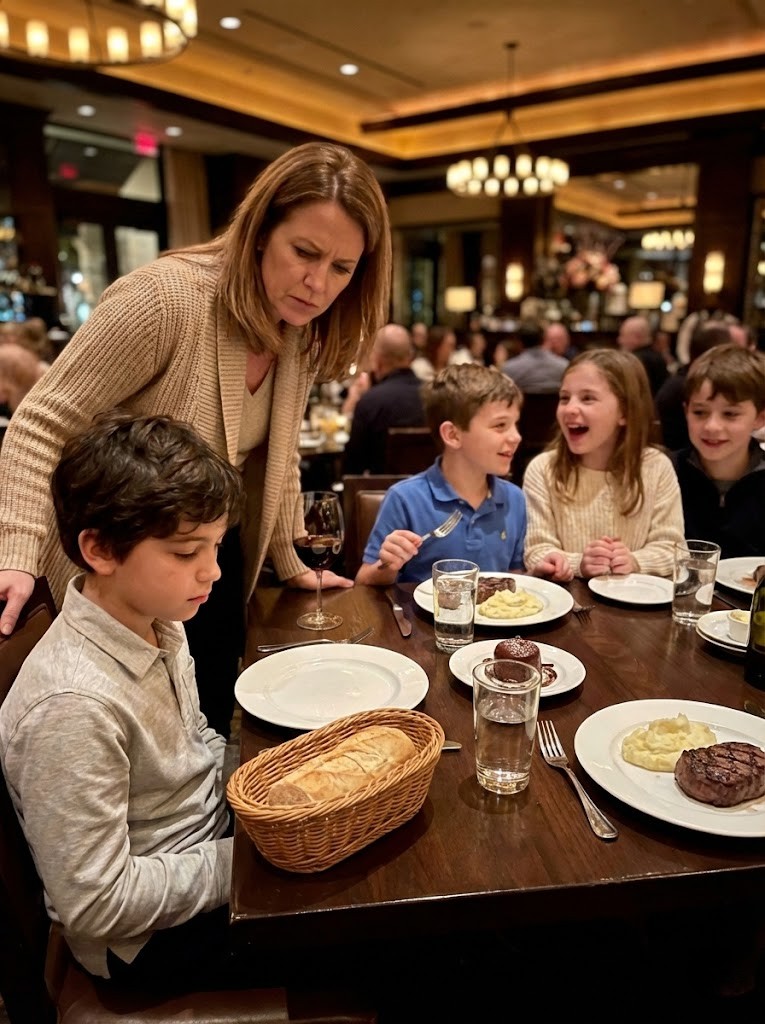
I waved the waiter over.
He came with that polite professional smile, pen poised.
I stood up.
The chair scraped slightly against the floor, and the sound felt louder than it should’ve.
“Please cancel any orders that haven’t been sent to the kitchen,” I said calmly.
The whole room froze.
“And put everything that’s already on the way on my father’s bill,” I added, looking directly at the waiter. “It’s his anniversary after all.”
You could’ve heard a pin drop.
Jill stared at me like I’d slapped her.
Doug coughed like he’d swallowed wrong.
My mom opened her mouth, then closed it like her brain couldn’t decide which script to use.
My dad’s face changed—confusion first, then anger, then that familiar look of how dare you.
I didn’t give him the satisfaction of explaining.
I kept my voice steady.
“And my son will have the ribeye, medium rare, with the truffle mac,” I said. “And a Coke. Please make it quick.”
The waiter didn’t even flinch. He nodded once, like he’d seen family dinners go sideways before, and walked out.
Mason stared at me like he didn’t understand what just happened.
So I handed him a breadstick anyway, gently.
Not because that’s what he deserved.
Because I wanted him to have something to hold while the room tried to swallow him.
Dinner continued, but it was a different dinner now.
Jill’s kids started whining that their orders were delayed. Doug leaned in and whispered to Jill like they were plotting damage control. My parents kept glancing at each other, trying to decide if they should scold me in front of everyone or wait until we were alone.
I didn’t care anymore.
When the steak arrived, Mason’s eyes widened.
He didn’t act spoiled.
He didn’t gloat.
He just looked… surprised. Like he hadn’t expected anyone to choose him in that room.
And I hated that he felt surprised.
Because a kid should expect their mom to protect them. It shouldn’t feel like a rare event.
When we got up to leave, I didn’t hand my parents the framed wedding photo.
I gave it to the waiter.
“Would you set this on the table after we’re gone?” I asked quietly.
My dad stared at the frame like it was an insult.
No thank you. No gratitude.
As we walked out, I bumped the dessert tray by accident.
A plate shattered.
I didn’t apologize.
Not because I’m proud of that, but because in that moment… I was done shrinking.
That night, my phone blew up.
Calls.
Texts.
Voicemails.
All anger.
Jill demanding to know what my problem was. My mom saying I embarrassed them. My dad demanding I reimburse him.
I didn’t answer a single message.
Then the next day, they showed up at my house.
No text.
No “are you home.”
Just pulled into my driveway like they owned the place and marched up my steps.
Mason saw them through the window before I did.
He didn’t say anything.
He just looked up at me with that same tired expression I’d started to recognize in myself.
I didn’t panic.
Didn’t clean.
Didn’t rehearse a speech.
I picked up my phone and called Uncle Gary.
“They’re here,” I said.
“We’ll be there in ten,” he replied.
No questions.
No drama.
Just… support.
I opened the front door before my mom could ring.
She walked in first like she owned the air.
Jill followed, arms folded, jaw tight.
My dad came in last holding a manila envelope like he was about to serve me court papers.
Nobody said hello.
Nobody looked at Mason on the couch—pretending to play his Switch but listening to every word.
Jill launched immediately.
“You embarrassed the entire family last night.”
My mom jumped in.
“You made a scene. You disrespected your father.”
My dad set the envelope on my counter and tapped it like it was proof I owed him.
“That’s the invoice for the private room,” he said. “One thousand dollars. Since you bailed on your responsibility, we expect you to pay your share.”
I stared at him.
The entitlement was almost impressive.
I didn’t touch the envelope.
I just said, “Wait here,” and walked away.
Two minutes later, the side door opened.
Uncle Gary and Aunt Denise walked in like a front line.
No greetings. No small talk.
They took one look at my parents and Jill, and you could feel the temperature change.
My mom’s face tightened.
Jill muttered something under her breath.
My dad looked like he swallowed something sour.
I came back into the kitchen, stood across from all of them, and said the truth out loud for the first time.
“I’m done supporting Jill.”
No build-up.
No apology.
Just the line.
Jill’s head snapped toward me.
“What?”
“I’ve been covering half your rent for almost a year,” I continued. “That ends today. You’re not my child. I’m not your safety net.”
Jill started to raise her voice, but I didn’t even look at her.
My mom tried to pivot to Uncle Gary, like he was going to scold me back into place.
Denise stepped forward instead.
Calm. Cold. Surgical.
She listed everything I’d done for Jill—money, childcare, emotional labor—and then asked one question so quiet it felt like a blade:
“When’s the last time any of you helped Linda?”
Linda.
Me.
Nobody answered.
Not one word.
I picked up the envelope, opened it, scanned the invoice.
A clean, round $1,000.
Here’s what I said:
“I’ll give you five hundred. Not out of obligation—out of pure pettiness, so I can sleep tonight knowing you didn’t get the whole thing.”
My dad slammed his hand on the counter.
My mom looked like she wanted to cry and scream at the same time.
Jill looked like she might actually lunge.
I opened my front door and stood there.
Silent.
Uncle Gary stood too.
That was enough.
They left—muttering, slamming doors, angry at the fact that I wasn’t folding.
I locked the door behind them and stood there for a long moment.
It wasn’t joy.
It wasn’t relief.
It was… clean silence.
A break.
And I honestly thought that would be the end of it.
I was wrong.
Because when guilt and anger don’t work on people like my sister… they reach for something else.
They reach for power.
And a week later, my son’s school called.
Anonymous report.
Concerns about his emotional well-being.
And the moment I heard the words “we have to follow protocol,” I knew exactly who did it.
PART 2 — The School Call
A week after that steakhouse dinner, my son’s school called.
And the second I saw the number, my stomach dropped—because I already knew this wasn’t going to be about a missed homework assignment or a late pickup.
It was going to be about control.
Because when people like Jill don’t get their way, they don’t just sulk.
They don’t just complain.
They retaliate.
Quietly at first.
Then all at once.
After my parents and Jill stomped out of my house, the phone calls started the way they always do—like I’m supposed to crack under volume.
My mom called. I didn’t answer.
Jill texted. I didn’t answer.
My dad left a voicemail, this long, angry lecture about “respect” and “gratitude.” I didn’t listen past the first ten seconds.
Because I’d heard that speech my entire life.
It always goes the same way:
- They do something cruel.
- I react.
- Then suddenly I’m the one who “ruined everything.”
So I stopped reacting.
I stopped explaining.
I stopped apologizing for refusing to let my son be treated like a stray dog at a table I paid for.
And that silence?
It drove them insane.
You wouldn’t think the people who say “stop being dramatic” would be so allergic to being ignored, but apparently they are.
Because when they couldn’t get a response out of me privately, Jill went public.
A vague Facebook post. Long paragraph. No names, but everyone knew.
Something about “certain family members who think they’re better than everyone else.”
Something about “being raised by real parents who taught love, not pride.”
It got likes. Sympathy comments. The usual “you’re so strong” nonsense from people who had no clue what she’d actually done.
A few people messaged me privately: What happened? Are you okay?
I didn’t answer.
Not because I was afraid.
Because I wasn’t interested in playing Jill’s favorite game: drag Linda into the mud and make her defend herself while I sit back and pretend I’m innocent.
I’m not doing that anymore.
Then came the call from Mason’s school.
The office secretary was polite—too polite, the way people get when they’re trying not to alarm you.
“Hi, Ms. ____,” she said. “We received a concern. Anonymous.”
I felt my whole body go cold.
“A concern about what?” I asked.
She hesitated. “About Mason’s emotional wellbeing.”
My hands started shaking, but my voice stayed steady because Mason was sitting five feet away at the kitchen table working on a worksheet.
“Is Mason okay?” I asked.
“Yes,” she said quickly. “He’s fine. We just… we have to follow protocol. The counselor would like to meet with him briefly.”
Protocol.
That word makes your throat dry, because you realize how easily someone can weaponize systems that exist to protect children.
And I knew exactly who did it.
Anonymous, my ass.
Jill.
Because I dared to say no.
Because I embarrassed her.
Because I stopped paying her rent.
And now she wanted to remind me that she could still reach into my life whenever she wanted—through fear.
I drove to the school anyway.
Not panicking.
Not yelling.
Just… present.
The counselor was professional, calm, and honestly? She looked tired in that way that said she’s seen family mess before.
She met with Mason.
Twenty minutes later, she brought him out.
He was fine. Quiet, as usual, but fine.
She pulled me aside.
“Your son is respectful, bright, and emotionally appropriate for his age,” she said. “He doesn’t show any red flags.”
I nodded, holding my breath.
She softened her tone slightly.
“I’m not accusing you of anything,” she said. “But I want you to understand… even unfounded reports stay in the system.”
That sentence hit harder than anything Jill posted online.
Because it meant Jill didn’t just take a cheap shot.
She left a mark.
A file. A record. A possible future problem if she decided to “anonymous report” again.
I thanked the counselor.
I took Mason’s hand.
And when we got in the car, he looked at me and asked, quietly:
“Mom… did I do something wrong?”
That question.
That question is what Jill doesn’t understand she’s playing with.
Kids don’t interpret adult cruelty as “adult drama.”
They interpret it as their fault.
“No,” I said immediately, voice tight. “You didn’t do anything wrong.”
He nodded like he wanted to believe me.
But I saw it in his face—he was already doing what he always does.
Making himself smaller.
Trying not to be the reason adults get angry.
And I swear something in me hardened into steel right then.
That night, my mom created a new group text.
Extended family.
Aunts. Uncles. Cousins.
People who never talk to me unless someone needs something.
My mom didn’t name me directly, of course.
She didn’t have to.
She wrote about how she was “deeply heartbroken” that one of her daughters was “cutting off family for no reason.”
No reason.
Like my son being handed bread while her grandkids ate steak was “no reason.”
Like Jill mocking him publicly was “no reason.”
Like the anonymous school call was “no reason.”
I watched the messages roll in.
Cousins dropping sad emojis.
An aunt saying “I’m praying.”
Somebody saying “family is family.”
And then Uncle Gary responded with one sentence:
“We know exactly what’s going on.”
That’s it.
No long speech.
No debate.
Just truth.
Jill left the chat ten minutes later.
And I know that made her furious.
Because she didn’t want the truth.
She wanted a dogpile.
She wanted me isolated.
Then Doug called.
Out of nowhere.
I didn’t even have his number saved. I only recognized it because his area code is weird and I’d seen it pop up before.
I let it go to voicemail.
His message was the most cowardly thing I’ve ever heard in my life.
He said he didn’t agree with how “everyone” was handling things.
He said he wanted to “stay neutral.”
He said he hoped this didn’t mean the kids had to be cut off from each other.
Like Mason was the problem.
Like my son was the “complication.”
I deleted the voicemail.
Then I blocked his number.
Because neutrality in a situation like this isn’t peace.
It’s permission.
Ten days after the dinner, my dad showed up at my work.
That’s when I realized they weren’t just angry.
They were desperate.
Because they couldn’t get me to respond at home, so they decided to corner me somewhere I’d have to keep my composure.
He walked into my office lobby like he was dropping off a package.
Told the receptionist he just needed a minute.
By the time I came down, he was standing there holding a printed photo.
A candid photo from the restaurant.
Me standing.
Mason looking up at me.
Everyone else in the background frozen.
My dad had circled himself in red marker—like a child doing an assignment—and wrote:
“THIS IS WHO YOU EMBARRASSED.”
He tried to hand it to me.
I didn’t take it.
I looked at him and felt… nothing.
Not sadness.
Not guilt.
Just a flat, clear understanding.
“You need to leave,” I said.
His mouth tightened.
“This is your fault,” he said quietly. “You humiliated me.”
I didn’t raise my voice.
“I protected my son,” I replied. “If that humiliated you, that’s on you.”
And then I turned around and walked back through the security doors without looking back.
He didn’t follow.
Because he didn’t come to fix anything.
He came to make me feel small again.
And it didn’t work.
That night, after Mason was asleep, I sat on the edge of my bed and finally let myself feel it.
Not just anger.
Disbelief.
The kind that makes you stare at the ceiling and think:
These are my people.
These are the ones who raised me.
This is how they react to me defending my child.
I could have gone scorched-earth right then.
I could have posted the screenshots, told everyone exactly what Jill did, dragged the whole family into daylight.
But I didn’t want war.
Not yet.
I wanted one thing first:
A last chance for them to be human.
So I wrote a letter.
Handwritten. Simple.
I mailed one to my parents and one to Jill.
I said I wanted peace.
I wasn’t interested in dragging this out, but I wouldn’t be guilted, blamed, or manipulated anymore.
If we moved forward, it had to be mutual, respectful, honest.
No excuses.
No rewriting history.
No blaming my kid.
No punishing me for boundaries.
I waited.
A week passed.
No response.
Then I saw it.
Another post from my mom’s account.
A photo of her and Jill and Jill’s kids smiling, hugging, like a perfect little family portrait.
Caption:
“Family is everything. Even if some forget what that means.”
And when I tell you something went empty inside me—I mean it.
Not anger.
Not tears.
Just… hollow.
Like I’d been watching a movie where I finally realized I was never actually in the cast.
That’s when I decided I wasn’t going to fight with feelings.
I was going to fight with facts.
Because facts don’t get twisted as easily.
I emailed my landlord and asked for documentation of every rent payment I’d made toward Jill’s apartment.
He sent it within the hour.
Line by line.
Month by month.
Seven months of partial rent.
Total: $5,700.
I printed it.
Highlighted every payment.
Attached a short summary.
And mailed it to Jill in a plain manila envelope.
No note.
No “please.”
No explanation.
Just receipts.
Twelve minutes later, she texted me a screenshot of her Venmo balance—$34—and wrote:
“Take me to court then.”
I didn’t respond.
Instead, I went somewhere she couldn’t control.
A private parenting group I’m in.
Real moms. Real stories.
I posted anonymously:
“Would you forgive your sister if she took money from you for months, lied about it, and publicly humiliated your kid for setting a boundary?”
The responses came in like a flood.
Hundreds.
Women furious on my behalf.
Women sharing their own stories.
One woman wrote:
“I forgave mine. I’m still cleaning up her mess ten years later.”
And then, late that night, I got a private message from someone I didn’t recognize.
She said she used to work with Jill at a marketing firm.
She said Jill filed a false HR complaint to get her demoted after a minor disagreement.
She said Jill was fired three months later.
I didn’t know what to believe—until she sent me a photo.
Jill.
Poolside.
Wine glass in hand.
Designer dress.
Timestamp from the same weekend Jill told me Doug was rushed to the ER and begged me for money.
I’d sent her $200 that day.
My stomach turned.
I saved everything.
The next day, I was cleaning out the garage, trying to make space, trying to clear my head, when I found an old box from childhood.
Dusty photo albums.
Crayon drawings.
Birthday cards my mom saved.
At the bottom was an envelope that didn’t belong.
Addressed to my dad.
From my mom.
Date: 22 years ago.
A week after Jill was born.
My hands started shaking as I opened it.
It was handwritten.
And it was raw in a way I’d never seen from my mother.
She wrote about being exhausted.
Overwhelmed.
And then it got darker.
She wrote:
“I don’t want another child. I was content with one.”
And then:
“I don’t think I’ll ever bond with this new baby. I feel like I’m faking it. I’m too tired to try.”
My chest went tight.
Because she wasn’t talking about Jill.
She was talking about me.
I sat down on the garage floor and stared at the paper until my vision blurred.
Every memory came back like a chain snapping into place.
Every time I felt like I had to earn her love.
Every time I was “the responsible one.”
Every time Jill’s chaos got attention and my stability got ignored.
It wasn’t in my head.
It had been written down.
From the beginning.
That night, after Mason went to sleep, I poured a glass of wine and opened my laptop.
I wrote one email.
No rant.
No insults.
Just facts.
I listed the money I paid.
The lies.
The manipulation.
The humiliation of my son.
Then I attached a photo of that paragraph from the letter.
Just one paragraph.
“I don’t think I’ll ever bond with this new baby.”
I hit send.
No subject line.
No signature.
Just truth.
Then I blocked all of them.
Every number.
Every email.
Every account.
I didn’t do it for revenge.
I did it for peace.
And I thought—naively—that would finally be the end.
But peace was never their goal.
Because less than 48 hours later… they came for me in a way I didn’t see coming.
The knock on my door didn’t sound urgent.
It wasn’t banging.
It wasn’t shouting.
It was calm.
Professional.
I opened it expecting a package.
Instead, two women stood there in plain clothes with badges.
“Child Protective Services,” one said.
And my blood turned to ice.
PART 3 — The CPS Visit
When you hear “Child Protective Services,” your brain does this weird thing.
It tries to reject the words.
Like if you stare hard enough, the badge will turn into a pizza flyer and the woman on your doorstep will laugh and say, Oops, wrong unit.
But the badge didn’t change.
And neither did the way Mason’s footsteps stopped inside the apartment—like he could sense something was wrong even before I said a word.
“Hi,” one of the women said, professional, calm. “We’re here because we received a report.”
A report.
Anonymous, of course.
Because that’s how people like Jill operate. She doesn’t show her face when she swings.
She throws rocks from behind a curtain, then cries victim when the glass breaks.
I took a breath and stepped onto the threshold so they couldn’t see my whole apartment immediately, not because I had anything to hide, but because my instinct was to protect Mason from being watched like an exhibit.
“What is this about?” I asked, keeping my voice steady.
The taller woman looked down at her clipboard.
“There were concerns raised about Mason being left alone for long stretches,” she said, “and concerns about emotional neglect.”
I felt my stomach twist so hard it almost made me dizzy.
Not because I was scared they’d “find” something—
But because I realized how easy it is for someone to try to destroy you with a phone call.
Someone can lie.
And even if the lie collapses, it still leaves fingerprints on your life.
“Okay,” I said, forcing calm. “Come in.”
Their eyes flicked over me like they were reading my face.
I didn’t give them panic.
I didn’t give them anger.
I gave them the truth.
They walked in.
They didn’t act rude. They weren’t villains. They were doing a job.
And honestly… that made it worse.
Because their calm professionalism meant Jill’s lie worked well enough to trigger protocol.
They asked to speak with Mason.
He came out of his room slowly, holding his little handheld game like a shield.
He looked at me first.
That look kids do when they’re asking, Am I safe? Am I in trouble?
I knelt down and whispered, “You didn’t do anything wrong.”
He nodded, but his eyes stayed wide.
The caseworker spoke gently.
“Hi Mason. We’re just here to ask a few questions. Is that okay?”
Mason nodded again, barely.
He’s quiet with strangers, but he’s polite. He’s always polite.
Because he learned early that being “good” keeps adults from getting irritated.
And that made my chest ache in a way I can’t describe.
They asked him basic things.
Do you feel safe at home?
Do you have food?
Does your mom help you with school?
Does anyone ever hurt you?
Mason answered honestly, in that soft voice that makes you lean in.
“No.”
“Yes.”
“Yes.”
“No.”
He wasn’t scared of me.
He was scared of this.
The situation.
The idea that grown-ups can show up and ask if your home is real.
While they talked to him, the other caseworker walked through the apartment.
Not snooping.
Observing.
Fridge. Pantry. Bedrooms. Bathroom.
They looked at his room—books stacked neatly, his school backpack hung on a hook, his bed made in that imperfect kid way.
They looked at the fridge—milk, eggs, fruit, leftovers.
The pantry—cereal, pasta, peanut butter, snacks.
They asked me about my work schedule.
I showed them.
They asked about childcare.
I showed them the school pickup list.
They asked about support.
I told them my friend and my uncle were my emergency contacts now.
The caseworker’s eyes softened, just slightly.
“Do you have any idea who would file something like this?” she asked carefully.
I stared at her.
The part of me that used to keep the peace wanted to say, “No.”
The part of me that was tired of being attacked in silence said the truth.
“Yes,” I said. “My sister.”
I didn’t explain the whole story.
I didn’t go on a rant.
I just said it like a fact.
Because it was.
They left an hour later.
At the door, the taller caseworker said something that hit harder than the whole visit.
“This report doesn’t match what we’re seeing,” she said quietly. “So we’ll close it.”
Relief should’ve flooded me.
Instead, it was rage.
Not at the caseworkers.
At Jill.
Because she knew what she was doing.
And she did it anyway.
Before they left, the other woman added:
“I do need to tell you… unfounded reports can still remain as documentation.”
There it was.
The permanent smudge.
Even when you’re innocent, someone else can still force your name into a system.
Mason stood behind me, half hidden by my leg.
When the door closed, he asked in the smallest voice:
“Am I… in trouble?”
I crouched down, hands on his shoulders.
“No,” I said firmly. “You are not in trouble. You did nothing wrong.”
He blinked hard.
“Why did they come then?”
How do you explain that to an eleven-year-old?
How do you explain that some people get so angry when they don’t get their way, they start pulling levers?
I chose the simplest truth.
“Because someone lied,” I said. “And sometimes adults make bad choices.”
Mason looked down at his hands.
“Like… Aunt Jill?”
I didn’t lie to protect her.
“Yeah,” I said. “Like Aunt Jill.”
His shoulders sagged, like the last bit of hope he still had about her just… fell off him.
Then he asked the thing that made my throat close.
“Did I make her mad?”
Oh, baby.
“No,” I said, pulling him into my arms. “You didn’t make anyone mad. You didn’t cause any of this. Adults are responsible for their own choices.”
He nodded slowly, but I could feel the tremble in him.
He was learning too early.
He was learning that adults can be cruel.
Even family.
And that was my fault for keeping him around those people for so long.
That night, I didn’t cry first.
I got organized.
Because if someone files one false report, they can file another.
And now I understood what the counselor had meant when she said the first one stays in the system.
So I did what I should’ve done months earlier.
I called Mason’s school.
I asked for a meeting with the principal the next morning.
I told them there’s family conflict, and I need to lock down the pickup list and access.
I removed my parents.
Removed Jill.
Removed Doug.
Removed everyone except me, Uncle Gary, and Denise.
Then I asked for a password system.
Not a “what’s his birthday” password.
A real phrase that no one outside my trusted circle would know.
Because I wasn’t letting anyone surprise-pickup my son like he was luggage.
The principal was kind but serious.
“We can do that,” she said, and then she added, “I’m glad you’re being proactive.”
Proactive.
That word made me feel sick.
Because I shouldn’t have to be proactive against my own family.
But here we were.
Then I called Uncle Gary.
And I told him everything.
The anonymous report.
The questions.
The fact that Mason’s file now had documentation.
Uncle Gary didn’t get dramatic.
He didn’t say “I’ll talk to them.”
He said one sentence, flat and certain:
“That was the warning shot.”
Then he said the second sentence that changed everything:
“You need to move.”
I sat there in my kitchen with the phone pressed to my ear, staring at the wall.
Move.
Uproot my son.
Change schools.
Leave the only neighborhood he’s known.
And my first instinct was to say no—because I always choose stability.
But then I imagined Jill doing this again.
And again.
And again.
Until someone finally “finds” something.
Or until the system gets tired of “false reports” and decides, Well maybe there’s smoke here.
And I realized:
Staying wasn’t stability anymore.
It was risk.
Uncle Gary said quietly:
“You don’t have to stay near people who are willing to weaponize your child.”
I swallowed.
“Okay,” I said.
And once I said it, I felt something strange.
Relief.
Because a part of me had been waiting for permission to escape.
Over the next week, I built a folder.
A real one.
Not in my head.
Not “I remember.”
A folder.
Screenshots of Jill’s posts.
Proof of rent payments.
The steakhouse incident.
The school call log.
The CPS closure notice.
Every text.
Every voicemail.
I stopped being emotional and started being prepared.
Then my lawyer drafted a cease-and-desist letter.
One for Jill.
One for my parents.
No threats.
Just facts.
Harassment.
Defamation.
False reporting.
And a clear statement: another incident, and we escalate legally.
I didn’t want to go legal.
But Jill forced me there.
The weirdest part?
Doug broke first.
Two days after the letter went out, I got a text from a number I hadn’t blocked yet.
A screenshot of a bank transfer.
$2,850.
Exactly half of the money I’d paid toward their rent.
Then another text:
“I told her to stop. I moved out. Do what you have to do.”
I stared at it.
Doug was spineless, but even he had a limit when things got real.
He didn’t apologize.
He didn’t acknowledge Mason.
But he did one thing:
He stopped standing behind Jill.
And that mattered more than he probably realized.
Because it meant Jill was losing allies.
And when people like Jill lose allies, they get more dangerous.
Two weeks later, a letter arrived.
Not from Jill.
Not from my parents.
From an attorney.
One page.
Clean language.
Legal tone.
And one sentence that made my skin go cold:
They were pursuing visitation rights for Mason.
Grandparent visitation.
Court.
My son.
They were trying to make it official.
Trying to force access through the system the way Jill tried to force fear through CPS.
I called my lawyer immediately.
She didn’t even sound surprised.
“They don’t have grounds,” she said. “But they’re trying to scare you. Trying to wear you down.”
She was right.
This wasn’t about Mason.
Because if it was, they would’ve cared about him at that dinner.
They would’ve looked at him.
They would’ve ordered him food.
They would’ve apologized for humiliating him.
This was about one thing.
Control.
And I was done giving it.
That night, Mason walked into the kitchen while I was reading the letter.
He saw my face.
“Is something wrong?” he asked.
I looked at him—my sweet, quiet boy who’d been mocked for being kind—and I made a promise I knew I’d keep.
“No,” I said softly. “Nothing’s wrong.”
Then I knelt down and said the truth:
“I’m protecting us.”
And for the first time, Mason nodded like he understood.
Not fully.
But enough.
Because he’d seen what happens when I don’t.
PART 4 — The Letter That Made Me Dangerous
The envelope wasn’t thick.
It wasn’t dramatic.
It didn’t come with a bombastic warning or a red stamp.
It was just… ordinary paper.
Which is what made it so terrifying.
Because ordinary paper is how people like my parents and Jill try to make their cruelty look “reasonable.”
Legal.
Clean.
Adult.
I stood in my kitchen with the letter in my hand, feeling my pulse in my throat.
And when I read the line—
“We are pursuing visitation rights for Mason.”
—something inside me went very quiet.
Not soft.
Not sad.
Quiet like a locked door.
Quiet like a switch flipping.
Quiet like: Oh. So this is what you’re doing now.
You didn’t care enough to order him dinner.
You didn’t care enough to defend him when Jill mocked him.
You didn’t care enough to ask if he was okay after the school call.
But you cared enough to drag him into court.
Because court isn’t about love.
Court is about leverage.
I called my lawyer immediately.
She read the letter while I sat there staring at the cracks in my countertop like they were suddenly fascinating.
When she finished, she said, flat and calm:
“They don’t have a case.”
I exhaled, but it didn’t feel like relief.
It felt like the first inch of oxygen after being underwater too long.
“Arizona law is clear,” she continued. “Grandparent visitation rights aren’t granted just because someone wants them. There are requirements. And your parents don’t meet them.”
“Then why do this?” I asked.
She didn’t hesitate.
“Because it’s not legal. It’s personal.”
I closed my eyes.
“That’s what I thought.”
“They’re trying to scare you,” she said. “Wear you down. Make you think you have to come back to the table to make it stop.”
I looked toward the hallway where Mason’s bedroom door was shut.
My kid in there doing homework, building Lego cities, trying to be good, trying to be quiet.
Trying to not “cause problems.”
And my family was using the court system to yank him back into their mess.
I swallowed hard.
“I’m not going back,” I said.
“I know,” my lawyer replied. “So let’s treat this like what it is.”
A threat.
That weekend, I stopped thinking like a daughter.
And I started thinking like a parent.
Step one: we answered the legal threat.
Not with a sob story.
Not with “please understand.”
With evidence.
My lawyer drafted our response, and we attached everything.
The rent payments.
The screenshots of Jill’s messages.
The posts.
The “take me to court then” text.
The CPS visit note showing the case was closed with no findings.
The documentation from the school counselor confirming Mason was stable, cared for, and thriving.
And then—because I was done being polite—we included the part no one likes acknowledging:
The pattern.
Harassment.
Smears.
False reporting.
The fact that their “love” only showed up when they wanted something.
Step two: I locked down Mason’s world.
Monday morning, I went to his school in person.
Not because they demanded it.
Because I refused to ever let a phone call put my son at risk again.
I met with the principal.
I handed her a formal list of restricted individuals.
My parents.
Jill.
Doug.
Anyone connected to them.
“No pickups,” I said. “No access. No volunteer sign-ins. Nothing.”
The principal didn’t argue.
She nodded like she understood more than she said out loud.
She added the names.
She updated the pickup list.
She changed the security password.
And when she looked at me, her expression was gentle but firm.
“You’re doing the right thing,” she said.
I held it together until I walked back to my car.
Then I sat behind the wheel for a full minute, shaking.
Not because I doubted myself.
Because I hated that I had to do this.
Step three: my home became a fortress.
I changed the locks.
Not because I thought my parents would break in like movie villains.
Because I’d already learned they don’t need to break in.
They just need access.
A spare key.
A code.
A “we’re family.”
I removed every old copy.
I updated the security camera settings.
I made sure the footage auto-saved to the cloud.
I changed the garage code.
I changed the Wi-Fi password.
If they couldn’t respect a boundary, they didn’t get access to it.
Step four: I rewrote the future.
That part sounds dramatic, but it wasn’t.
It was paperwork.
A living will.
A guardianship designation.
Because if there’s one thing Jill proved, it’s this:
If something happened to me, she would absolutely try to take Mason—not because she loves him, but because he’s leverage.
So I updated everything.
Uncle Gary and Aunt Denise became the only designated guardians if anything ever happened to me.
Not my parents.
Not Jill.
Not anyone who ever watched my son get humiliated and called it “a joke.”
I gave Gary and Denise copies of everything.
Not hidden in a drawer.
Not “somewhere safe.”
In their hands.
Legally filed.
Because I didn’t trust hope anymore.
I trusted documentation.
Then I made one more call.
Not to my family.
To a friend of mine who works in social media moderation—someone who understands how “anonymous” actually works.
I asked a question I’d been afraid to ask:
“Is it possible to trace where a tip came from?”
Not officially.
Not in a “here’s the name” way.
But in a… pattern way.
She didn’t promise anything.
But she said something that was enough:
“Let’s just say… it came from a familiar neighborhood.”
I felt my jaw tighten.
Jill.
Of course.
Because Jill doesn’t just throw punches.
She throws daggers and smiles while you bleed.
And in that moment, the last bit of confusion I’d been carrying evaporated.
This wasn’t a family conflict.
It was a campaign.
A few days later, Doug’s payment hit my account—$2,850.
Half.
No note.
No apology.
Then the text:
“I told her to stop. I moved out. Do whatever you have to do.”
I stared at it for a long time.
Doug had always vanished when things got real.
He’d been “neutral” when my son was treated like nothing.
But now that Jill was escalating into legal threats and CPS calls?
Now he wanted out.
Spineless, yes.
But still… it confirmed what I already knew:
Even the people closest to Jill eventually realize she’s not “dramatic.”
She’s destructive.
And once that realization hits, they run.
Then the stories started coming in.
Not from my parents.
From everyone else.
Cousins I hadn’t heard from in years.
An aunt who sounded hesitant, like she was nervous to say the truth.
A family friend who admitted Jill borrowed $600 and never paid it back.
Another relative who said Jill once told her, laughing, “I just ask people until someone caves.”
Piece by piece, I realized something:
I wasn’t the first person Jill drained.
I was just the last one with enough stability to keep giving.
And when I stopped?
She panicked.
Because she didn’t just lose money.
She lost the easiest target.
My lawyer sent the cease-and-desist letters.
Clear.
Firm.
Not cruel.
Just boundaries with teeth.
And then we waited.
The grandparent visitation filing didn’t go anywhere.
Like my lawyer said, it had no legs.
It was fear tactics.
But I knew something now:
Even when fear tactics fail, people like my family don’t stop.
They just look for a new door.
So I built doors that lock.
The night before the court response was officially processed, I wrote one last message.
Not a text.
Not an email.
Not something they could screenshot and twist into “look how mean she is.”
I printed it.
I signed it.
I mailed it.
One copy to my parents.
One to Jill.
It said, in plain language:
This is the last time you’ll hear from me.
I gave you decades of chances.
You repaid me with betrayal, lies, and legal threats aimed at my child.
You are no longer my family.
If you contact me or Mason again, I will pursue a restraining order.
If you show up at my door, I will call the police.
If you attempt to involve yourself in my life again, I will make every detail public.
We are done for good.
Then I blocked everything.
Numbers.
Emails.
Social media.
Mutual contacts.
Not in a rage.
In a calm, surgical way.
The way you remove a tumor.
You don’t negotiate with cancer.
You cut it out.
That weekend, I took Mason camping.
Just the two of us.
No screens.
No buzzing phone.
No family group chat.
Just trees, a little cold wind, and the quiet that doesn’t demand anything from you.
Mason roasted a marshmallow like it was serious science.
He grinned, chocolate on his lip, and said something that hit me straight in the ribs:
“You seem happier.”
I froze.
Because kids don’t say things like that unless they’ve noticed you weren’t happy before.
And suddenly, I saw myself through his eyes.
The constant tension.
The constant phone checking.
The constant swallowing of anger.
The constant “be polite, be quiet, don’t start anything.”
All of it was teaching him that peace means letting people hurt you.
And he didn’t want that lesson.
Neither did I.
I reached over and wiped the chocolate off his face.
“I am happier,” I admitted.
He nodded like that made sense.
“Good,” he said simply, and went back to his marshmallow like life was supposed to be this simple.
That night, in the tent, Mason fell asleep fast.
Safe.
Warm.
Breathing steady.
And I lay there listening to the wind and thinking about everything.
How I spent years trying to earn love from people who only loved what I provided.
How I kept calling it “help” when it was really a contract I never agreed to.
How the moment I defended my son, they turned on me like I was the villain.
How Jill mocked my child, and my parents laughed, and then demanded money like I was a vending machine.
And how the second I stepped back, they escalated from insults to institutions—school, CPS, court.
Not because they cared about Mason.
Because they couldn’t stand losing control.
I stared into the dark and realized the truth I wish someone had told me years ago:
Some people don’t want you to be happy.
They want you to be available.
And I was done being available.
In the morning, Mason woke up early, crawled out of the tent, and said:
“Can we make pancakes on the fire?”
I laughed.
“Yeah,” I said. “We can.”
And as the sun came up over the trees, I knew one thing for certain:
Whatever came next…
They weren’t getting him.
They weren’t getting me.
Not ever again.
THE END