Part 1: The Impossible Choice
I was standing in the marble foyer of one of Manhattan’s most expensive private residences, holding a sobbing five-year-old boy in my arms while two immaculately dressed women glared at me and a billionaire stared at me like I’d just set his entire world on fire.
Which, I suppose, I had.
My name is Emma Harris. I’m twenty-nine years old. I teach kindergarten at PS 234 in Brooklyn. I live in a fifth-floor walk-up with a roommate who steals my yogurt. My annual salary is $54,000 before taxes. The dress I’m wearing right now cost forty-eight dollars from Target three years ago, and it has a small stain near the hem from a coffee spill I’ve never been able to get out.
And somehow, impossibly, I’d ended up in a competition to marry James Montgomery—tech billionaire, venture capitalist, and the father of Oliver Montgomery, the sweetest, most anxious little boy I’d ever taught.
The competition was supposed to end today.
James had called it “Oliver’s Choice.”
For four weeks, three carefully selected women—myself included—had been paraded through this mansion, spending structured time with Oliver while James observed from the background like we were interviewing for a corporate position.
Which, in a way, we were.
The position: Wife. Stepmother. Partner to one of the most eligible bachelors in New York.
The interview process: Win over a traumatized five-year-old who’d watched cancer take his mother two years earlier.
It was the most insane thing I’d ever been part of. And I’d said yes.
Not because I wanted James’s money. Not because I dreamed of living in a penthouse or wearing designer clothes or attending charity galas.
I said yes because I loved Oliver.
And somewhere in the chaos of the past six months, I’d fallen in love with James too.
But standing here now, watching Oliver shake in my arms, clutching a crayon drawing of his dead mother because that’s who he actually wanted, I realized how deeply wrong all of this had been from the start.
“Miss Emma,” Oliver hiccuped against my shoulder. “I don’t want them here. I want you. But I want my mommy too. Can I have both?”
My throat closed. “Oh, sweetheart.”
Victoria Chen, standing to my left in her cream Chanel suit and five-inch Louboutins, cleared her throat pointedly. “This is very touching,” she said, her voice cool. “But perhaps we should let Oliver calm down before making any decisions. Children are emotional. He’ll feel differently once he’s had a snack and a nap.”
I felt Oliver tense in my arms.
“I’m not a baby,” he whispered.
“Of course not,” Victoria amended quickly, but the damage was done. She’d talked over him. Again. Like she’d been doing all month.
Margot Beaumont, on my right, checked her diamond-encrusted Cartier watch with barely concealed impatience. “James, darling, perhaps Emma is right. This has become… uncomfortable. Why don’t we reschedule? Give the boy some time to compose himself.”
“Stop calling him ‘the boy,'” I said sharply. “His name is Oliver.”
Margot’s perfectly sculpted eyebrows rose. “I’m aware.”
“Are you?” I challenged. “Because you’ve been here a dozen times and I’ve never once heard you use his name. It’s always ‘the child’ or ‘the boy’ or ‘your son.’ Like he’s some abstract concept instead of an actual person.”
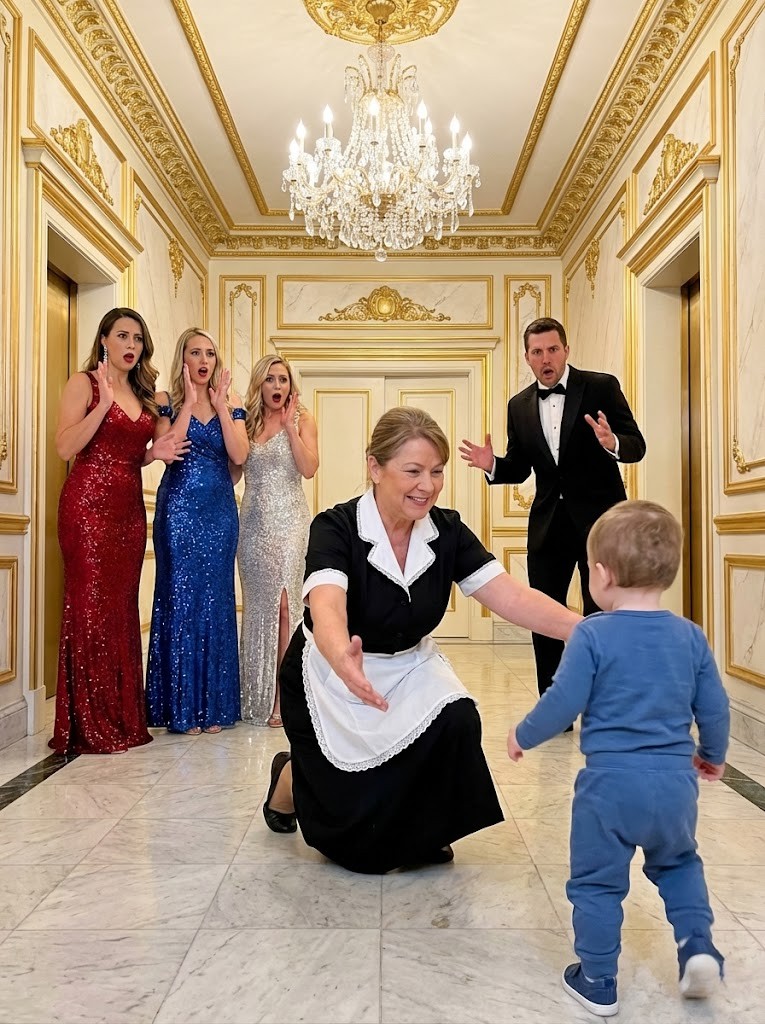
“That is absolutely—”
“It’s true,” James said quietly.
Everyone turned to look at him.
He was standing near the fireplace, hands in his pockets, looking more exhausted than I’d ever seen him. James Montgomery was thirty-seven, tall and lean, with dark hair just starting to grey at the temples and sharp grey eyes that usually sparkled with intelligence. Today, they looked haunted.
“Emma’s right,” he said. “About a lot of things.”
Victoria stiffened. “James—”
He held up a hand. “Victoria, you’ve known me since college. You were Sarah’s roommate, her best friend. You’ve been incredibly supportive since she died. But Emma’s right. You talk to Oliver like he’s a miniature adult you can negotiate with, not a five-year-old who’s still learning to process his feelings.”
Victoria’s composure cracked. “I’m trying to challenge him. Sarah would have wanted—”
“Sarah would have wanted someone who listens to him,” James interrupted gently. “Not someone who tries to mold him into a more convenient version of himself.”
He turned to Margot. “And Margot, you’ve been generous. The gifts, the offers to help with my business expansion in Europe, your family’s connections—all appreciated. But you’ve spent more time networking with me than connecting with Oliver. He told me last week that he thinks you’re ‘pretty but scary.’ That should have been my wake-up call.”
Margot’s expression hardened. “I see. And Emma? The underpaid schoolteacher with the off-the-rack wardrobe? She’s the perfect choice?”
“Yes,” Oliver said, his small voice cutting through the tension. “She is.”
Everyone froze.
Oliver pulled back from my shoulder, his face blotchy and wet, but his expression determined in a way I’d never seen before.
“I don’t want Victoria because she makes me do worksheets when I’m sad,” he said. “And I don’t want Margot because she doesn’t let me touch anything in case I break it.”
“Oliver—” James started.
“I want Miss Emma,” Oliver continued, his voice strengthening. “Because when I told her I missed my mom, she didn’t say ‘don’t be sad.’ She said ‘tell me about her.’ And when I cried because I couldn’t fold the paper crane right, she didn’t do it for me. She helped me try again. And when I said I was scared of the dark, she didn’t tell me to be brave. She gave me a nightlight with stars on it.”
Tears were streaming down my face now.
“She asks me questions,” Oliver said. “She remembers my answers. She knows my favorite color is yellow because of my mom’s garden. She knows I don’t like loud noises. She knows I’m afraid of forgetting my mom’s voice.”
He turned in my arms to face his father directly.
“You said I could pick,” he said. “So I pick Miss Emma. Not because you made me. Because I want to.”
The silence that followed was absolute.
Then Victoria laughed—a sharp, brittle sound. “Well,” she said. “I suppose that settles it. The kindergarten teacher wins the billionaire.” She grabbed her clutch. “Good luck, Emma. You’ll need it. James isn’t looking for a partner. He’s looking for a replacement. And when you can’t fill Sarah’s shoes, he’ll move on to the next candidate.”
“Victoria,” James said sharply. “That’s out of line.”
“Is it?” She turned on him. “I loved Sarah too. I watched her die. I held your hand at her funeral. I’ve spent two years trying to be there for you, waiting for you to see me as more than your late wife’s friend. And you choose her? A woman you’ve known six months?”
“A woman who sees my son as a person, not a problem to solve,” James replied. “Yes.”
Victoria’s face crumpled. For a moment, I almost felt sorry for her. Then she straightened, smoothed her suit, and walked out without another word.
Margot watched her go, then turned to James with a cool smile. “Well, I suppose I should also take my leave. For what it’s worth, James, I think you’re making a mistake. But it’s yours to make.”
She glanced at me, and for just a moment, something like sympathy flickered in her eyes. “Bonne chance,” she murmured. “You will need it.”
Then she, too, was gone.
The massive front door clicked shut, leaving just the three of us in the cavernous foyer: a billionaire, a kindergarten teacher, and the little boy who’d somehow chosen between them.
Oliver looked up at me anxiously. “Did I do it wrong?” he whispered. “Are you mad?”
I kissed the top of his head. “No, sweetheart. You didn’t do anything wrong. You were so brave.”
“Emma,” James said. “I need to talk to you.”
“I need to talk to you too,” I replied. “But first, Oliver needs to calm down. And honestly, so do I.”
He nodded. “Fair. Oliver, why don’t you go find Maria and ask her for some apple slices?”
Oliver hesitated, looking between us. “You’re not leaving, right, Miss Emma?”
“I’m not leaving,” I promised.
“You said that’s what you were doing,” he pointed out. “Earlier. You said you were leaving.”
Smart kid.
“I was leaving the competition,” I clarified. “But I’m not leaving you. Okay?”
He studied my face for a long moment, then nodded and slid down from my arms. He walked toward the kitchen, still clutching his drawing of Sarah.
Once he was out of earshot, James turned to me.
“Thank you,” he said.
“For what?” I asked, still shaking with residual adrenaline. “Sabotaging your bizarre wife audition?”
“For being honest,” he said. “For caring more about Oliver than about winning.”
I laughed bitterly. “I wasn’t trying to win, James. I was trying not to lose my mind. This whole thing has been surreal.”
“I know,” he said quietly. “And I owe you an explanation.”
“You owe me a lot more than that,” I replied. “But yeah, an explanation would be a good start.”
Part 2: The Backstory – How Did We Get Here?
To understand how a Brooklyn schoolteacher ended up in a billionaire’s mansion competing for his affection like a contestant on a deranged episode of The Bachelor, you have to go back six months.
To the first day of kindergarten.
I’d been teaching at PS 234 for five years. I loved my job despite the low pay, the lack of resources, and the bureaucratic nonsense. I loved watching five-year-olds discover that reading unlocked entire worlds. I loved the honest way kids saw the world before society taught them to pretend.
That September morning, I stood at my classroom door greeting students as they arrived: shy ones hiding behind their parents, bold ones running straight to the toy bin, crying ones clinging to legs and arms.
Then a little boy with dark hair and enormous grey eyes walked in holding a tall man’s hand.
The boy’s expression was neutral—not happy, not sad, just carefully blank in a way that made my teacher instincts immediately activate.
The man looked exhausted. Designer suit, expensive watch, the kind of polished appearance that screamed money and stress in equal measure.
“Good morning,” I said brightly, kneeling down to the boy’s level. “I’m Miss Emma. What’s your name?”
The boy looked at the man, who nodded encouragingly.
“Oliver,” he whispered.
“It’s nice to meet you, Oliver,” I said. “Do you want to see our reading corner? We have books about dinosaurs and space and dragons.”
Oliver’s eyes lit up slightly. “Dragons?”
“So many dragons,” I confirmed.
He followed me tentatively to the corner, and the man—his father, I assumed—approached my desk.
“I’m James Montgomery,” he said, offering his hand. “Oliver’s father. I wanted to give you some context before the chaos starts.”
“Of course,” I said, standing and shaking his hand. His grip was firm and warm.
“Oliver lost his mother two years ago,” James said quietly, glancing over to make sure Oliver was out of earshot. “Brain cancer. It was… fast. He still struggles with anxiety and transitions. I’ve informed the school counselor, but I wanted you to know directly. If he seems withdrawn or has trouble focusing, it’s not defiance. He’s just processing a lot.”
My heart clenched. “I’m so sorry for your loss,” I said. “And thank you for telling me. I’ll keep an extra eye on him.”
James nodded. “I appreciate it. I’m trying to give him as much stability as possible, but…” He trailed off, looking at his son with an expression of helpless love I recognized from a hundred parent-teacher conferences.
“Parenting is hard,” I finished gently. “Parenting while grieving is impossible. But you’re doing great. He’s here, he’s fed, he’s clearly loved. That’s what matters.”
Something in James’s expression softened. “Thank you,” he said. “That’s… generous.”
Over the next few weeks, I watched Oliver carefully.
He was a smart kid—could already read simple books, loved math patterns, had an incredible memory. But he was also deeply anxious. He flinched at sudden noises. He struggled in group activities. He cried silently during music class when the teacher played a song his mother had apparently loved.
I adapted. I gave him quiet spaces when he needed them. I let him keep a small stuffed bear in his cubby that “smelled like home.” I checked in with him multiple times a day: “How’s your heart feeling, Oliver? Big feelings today or medium feelings?”
He started to open up.
He told me about his mom’s garden, full of yellow flowers.
He told me she used to read him stories every night, doing different voices for every character.
He told me he worried he was forgetting what she looked like.
I gave him drawing paper and crayons. “Draw her,” I said. “Every time you’re afraid you’re forgetting. Draw what you remember.”
He did. Dozens of pictures of a blonde woman with a bright smile.
His father, James, noticed the change.
He started arriving early for pickup, lingering in the doorway to watch Oliver engage with the other kids. He asked me questions about strategies for anxiety and sensory regulation. He treated me like a professional, not a babysitter, and I appreciated that more than he knew.
One Friday afternoon in October, he asked if I’d be willing to meet him for coffee to discuss Oliver’s progress.
I said yes. It was a normal parent-teacher meeting. Except it was at a cafe, not the school. And it lasted two hours. And we talked about Oliver, yes, but we also talked about books and travel and what we’d wanted to be when we were kids.
“I wanted to be an astronaut,” James admitted. “Until I discovered I get motion sickness on elevators.”
I laughed. “I wanted to be a marine biologist. Until I discovered I’m afraid of deep water.”
“So we both settled for our backup dreams?” he teased.
“Teaching wasn’t my backup,” I said. “It’s my calling. Just took me a while to realize it.”
He looked at me for a long moment. “Oliver’s lucky to have you.”
“I’m lucky to have him,” I replied honestly.
That coffee became a regular thing. Every Friday after school. We talked about Oliver’s progress, but also about everything else.
I learned that James had built his tech company from scratch, selling it for billions at thirty-five and now focused on venture capital. That he’d met his wife, Sarah, in college. That her death had nearly destroyed him, and the only thing that kept him going was Oliver.
He learned that I’d grown up in Ohio, middle-class family, put myself through college. That I’d dated a few men but never seriously. That I loved teaching but sometimes felt invisible in a city full of people chasing grander dreams.
“You’re not invisible,” James said one evening in November. “You’re one of the most present people I’ve ever met.”
Something shifted between us then.
The meetings became less about Oliver and more about us.
In December, he invited me to the company holiday party. “Oliver will be there,” he said. “We do a family-friendly thing in the afternoon. He’d love to see you.”
I went. Oliver was delighted. James introduced me to his colleagues as “Oliver’s teacher” but stayed by my side all afternoon, his hand occasionally brushing against my back in a way that felt deliberate.
At the end of the party, he walked me to the car he’d insisted on calling for me.
“Emma,” he said. “I’d like to take you to dinner. A real dinner. Not a parent-teacher meeting. If you’re interested.”
My heart raced. “I’d like that.”
We went to a small Italian restaurant in the West Village. We talked for hours. At the end of the night, he kissed me goodnight—soft and tentative, like he was afraid I’d disappear.
I didn’t disappear.
For two months, we dated. Quietly. He was still a parent at my school, and I didn’t want to complicate things. We went to small restaurants, walked through museums after hours (money has perks), talked on the phone every night after Oliver went to bed.
He was thoughtful. Funny. Deeply wounded by Sarah’s death but trying hard to heal.
I fell for him. Hard.
Then, in early February, his sister called a family meeting.
I didn’t know about it until James called me after, his voice strained.
“My sister thinks I’m moving too fast,” he said. “She reminded me that Sarah’s been gone less than three years. That Oliver’s still vulnerable. That I need to think about what’s best for him, not just what I want.”
“What do you want?” I asked.
“You,” he said simply. “But she’s right. Oliver has to come first. And I can’t just… bring someone into his life without being certain it’s the right fit.”
“James, we’ve been dating for two months,” I said. “We’re not talking about moving in together or getting married—”
“But we could be,” he interrupted. “Eventually. If this works. And I need to know it will work for Oliver before I let myself…” He trailed off.
“Before you let yourself what?” I pressed.
“Fall any further,” he admitted. “I’m already halfway there, Emma. But if this isn’t sustainable—if Oliver doesn’t adjust, if you decide my life is too complicated, if my family is too much—I need to know now before I’m too far gone to walk away.”
I should have ended it there.
I should have said, “James, this is too much pressure. Let’s just see where things go naturally.”
Instead, I said, “Okay. What do you need?”
That’s when he told me about Victoria.
“She reached out last week,” he said. “Sarah’s college roommate. She’s been around since we lost Sarah, helping with Oliver, offering support. My sister thinks she’d be a good fit. That Oliver already knows her.”
“Are you interested in her?” I asked, my stomach twisting.
“No,” he said. “Not romantically. But my sister made a good point. If I’m going to seriously date someone, I need to be sure they can handle my life. The money, the attention, the pressure. And Oliver’s needs.”
“So you want me to… what? Compete with your late wife’s best friend?”
“I want to be fair,” he said. “I want Oliver to spend time with both of you—structured time—and see who he gravitates toward.”
I almost said no.
But then I thought about Oliver’s small hand in mine during recess. His smile when I praised his drawings. The way he’d started calling me “Miss Emma” with real affection.
“Okay,” I said. “I’ll do it. For Oliver.”
A week later, Margot entered the picture.
James’s business partner introduced them at an investor dinner. Margot was elegant, sophisticated, connected—the kind of woman who belonged in James’s world in a way I never would.
“She’s interested,” James told me after meeting her twice. “And my partner made a good point. Oliver needs stability. Someone who understands this lifestyle.”
“So now I’m competing with two women?” I asked.
“Emma, it’s not a competition—”
“It absolutely is,” I cut in. “You’ve created a tournament bracket for your heart.”
“I’m trying to be responsible,” he said. “Oliver’s been through hell. I can’t bring someone into his life without being absolutely certain.”
And somehow, I stayed.
Maybe because I loved Oliver. Maybe because I’d already fallen for James and couldn’t walk away. Maybe because a small, stubborn part of me wanted to prove that I belonged despite coming from a different world.
For four weeks, the three of us rotated through James’s mansion on scheduled visitation days.
Victoria brought academic enrichment and adult conversations.
Margot brought lavish gifts and promises of a glamorous life.
I brought construction paper and glue sticks and the ability to sit with a sad five-year-old without trying to fix him.
And today was supposed to be the day Oliver decided.
Except Oliver didn’t want to decide.
Oliver wanted his mom.
And I’d finally, finally, realized how cruel it was to make him try.
Part 3: The Truth Comes Out
After Margot left, James led me to his study—a wood-paneled room lined with books that probably cost more than my car.
He poured himself a scotch. Offered me one. I declined.
We sat on opposite ends of an expensive leather sofa.
“I didn’t tell Oliver he had to choose or I’d be alone forever,” James said quietly. “That’s not what I said.”
“Then what did you say?” I asked.
He sighed. “I told him that I wanted to start dating again. That I’d met some nice women. That I wanted to find someone who could be part of our family. And I asked him if he’d be okay with that.”
“And?”
“And he said yes. But he looked scared. So I told him he didn’t have to worry, because I’d only date someone he liked. That he got a say.”
“And somehow that translated into ‘if you don’t pick someone, Dad will be alone forever,'” I said.
James closed his eyes. “He’s five. He hears things in absolutes. I should have realized.”
“You should have,” I agreed. “But you were so focused on making sure Oliver was comfortable that you didn’t see you were putting enormous pressure on him.”
“I was trying to do the right thing,” James said. “Sarah and I promised each other—if something happened to one of us, we’d find love again. We’d give Oliver a full family. I thought including him in the process would make him feel safe.”
“You made him a referee,” I said gently. “Not a participant. There’s a difference.”
He looked at me, and the raw pain in his expression nearly broke me.
“I miss her,” he whispered. “Every day. And some days I can function and some days I can’t get out of bed. But Oliver needs stability. He needs a mother figure. I thought I was giving him a choice. I was really just… trying to fill the hole Sarah left as quickly as possible so it would hurt less.”
There it was. The truth Victoria had guessed.
“James,” I said carefully. “I can’t replace Sarah. No one can.”
“I know that—”
“I don’t think you do,” I interrupted. “Because the way you’ve approached this—auditions, scheduled visits, asking Oliver to choose—it’s not dating. It’s casting.”
He flinched.
“You want someone to step into Sarah’s role,” I continued. “Someone to co-parent Oliver, to host your events, to fill the space she left. And I understand why. But you can’t build a relationship that way. You’ll always be comparing whoever you’re with to her, and they’ll always fall short.”
“Is that why you were leaving?” he asked. “Because you didn’t think you could measure up?”
“I was leaving,” I said, “because watching Oliver sob on the floor while clutching a picture of his dead mother made me realize we were torturing him for our own benefit.”
James set down his scotch and put his head in his hands.
“What do I do?” he asked. “How do I fix this?”
I took a breath. “You let go of the timeline. You stop trying to fast-track a family. You accept that Oliver might not be ready for you to date seriously for a while. And you definitely stop making him choose between women like he’s picking a puppy from a litter.”
“What about you?” he asked, looking up. “Oliver chose you. Not because I forced him to—because he wants you in his life.”
“I want to be in his life too,” I said. “But not like this. Not as a prize he won or a role I’m auditioning for.”
“Then how?” James asked.
I thought about it.
“Let me keep being his teacher,” I said. “Let’s have dinner occasionally—the three of us, no pressure. Let’s see if this can be organic instead of orchestrated. And if, in six months or a year, we both still want this, we can revisit.”
“That’s a long time,” James said.
“Sarah was the love of your life,” I replied gently. “If I’m going to follow her, I need to be more than a convenient replacement. And you need to be ready to actually be with me, not just with the idea of having a partner again.”
He was quiet for a long moment.
Then he nodded. “Okay. We do it your way.”
Relief flooded me. “Okay.”
“But Emma,” he added. “For the record? I’m not halfway in love with you because you’re convenient. I’m halfway in love with you because when my son is hurting, you protect him even from me. That’s not something I can fake or force. That’s real.”
My throat tightened. “I’m halfway in love with you too,” I admitted. “But I need to know you’re ready for this. Really ready. Not just trying to check a box on your healing journey.”
“Fair,” he said. “So we slow down.”
“We slow down,” I agreed.
We sat there for a while, not touching, just existing in the same space.
Finally, James said, “I need to apologize to Oliver.”
“Yes,” I agreed. “You do.”
We found him in the kitchen with Maria, the housekeeper, eating apple slices and drawing another picture of Sarah.
“Buddy,” James said, sitting next to him. “Can we talk?”
Oliver nodded warily.
“I made a mistake,” James said. “I asked you to do something that was too hard. You shouldn’t have to choose who I date. That’s not your job. You’re five. Your job is to be five.”
“But you said—”
“I know what I said,” James interrupted gently. “And I’m sorry. I made it sound like if you didn’t pick someone, I’d be sad forever. That’s not true. I’m sad sometimes because I miss your mom. But that’s not your fault, and it’s not your job to fix. Okay?”
Oliver’s eyes filled with tears. “I miss her too.”
“I know,” James said, pulling him into a hug. “And that’s okay. We can miss her together.”
They held each other for a long moment.
Then Oliver pulled back. “Is Miss Emma leaving?”
“No,” I said, stepping forward. “I’m staying. But not because you picked me. Because I want to be your friend. Is that okay?”
Oliver nodded. “Can we still do origami?”
“Absolutely,” I said.
He smiled—a small, tentative thing—and returned to his drawing.
James walked me to the door an hour later.
“Thank you,” he said again.
“Stop thanking me,” I replied. “Just… be Oliver’s dad. That’s all he needs right now.”
“And what do you need?” he asked.
I smiled. “Time. And maybe dinner in two weeks. Somewhere quiet. Just us.”
“I can do that,” he said.
He kissed my forehead gently, and I left.
Part 4: Six Months Later
Six months after what I now refer to as “The Day of the Terrible Choice,” I stood in James Montgomery’s living room again.
But this time, I wasn’t competing.
This time, I’d been invited to Oliver’s sixth birthday party.
The house was full of children running wild, hopped up on cake and chaos. Parents mingled near the snack table. James stood near the makeshift stage where a magician was pulling scarves from his sleeve.
Oliver spotted me immediately and launched himself into my arms.
“Miss Emma! You came!”
“Of course I came,” I said, hugging him tight. “Wouldn’t miss it.”
“Did you bring the thing?” he whispered.
“I brought the thing,” I confirmed, pulling a small wrapped package from my bag.
He tore it open immediately to reveal a bound collection of drawings—every picture he’d made of his mother over the past two years, compiled into a memory book.
“Now you’ll never forget,” I said softly. “Even when you’re old and grown up, you can look at these and remember.”
His eyes filled, but he was smiling. “Thank you,” he said. Then he ran off to show his friends.
James appeared at my side, holding two glasses of wine.
“You made him a book,” he said.
“I did,” I confirmed, taking the glass.
“Emma Harris, you are extraordinary.”
I blushed. “I’m really not.”
We’d spent the past six months doing exactly what I’d suggested: moving slowly.
James and I went on dates—real ones, without Oliver as a buffer. We talked about our childhoods, our fears, our dreams. We fought occasionally, usually about his tendency to try to solve my problems with money when I just wanted him to listen.
We kissed on date five. We said “I love you” on date twelve. We spent our first night together last month, and it was awkward and wonderful and nothing like I’d imagined.
Most importantly, James had backed off the pressure on Oliver.
No more auditions. No more women paraded through the house. No more asking a five-year-old to make adult decisions.
Oliver relaxed. His anxiety decreased. He started playing more freely. He stopped asking if James was sad.
And slowly, carefully, I became a regular part of their lives.
Not as a replacement for Sarah.
As Emma.
I still taught kindergarten. Still lived in my fifth-floor walk-up (though James kept “accidentally” leaving luxury groceries in my fridge).
But two or three times a week, I’d come to their house for dinner. Or James and Oliver would come to my apartment, and we’d make simple meals together.
Oliver started calling me “Miss Emma” without the formality—just “Emma” when he felt like it.
And one night, three months ago, he’d asked, “Are you my dad’s girlfriend?”
James and I had looked at each other.
“Yes,” I’d said. “If that’s okay with you.”
Oliver had thought about it. “It’s okay. But you can’t replace my mom.”
“I would never try,” I’d promised.
“Okay,” he’d said. “Can we have mac and cheese for dinner?”
And that had been that.
Now, at the party, James leaned close to me. “Can we talk after this? Somewhere private?”
“Sure,” I said, heart fluttering.
Two hours later, after the guests had left and Oliver was being bathed by Maria, James led me to the rooftop terrace.
The city sprawled below us, glittering in the twilight.
“I’ve been thinking,” James said.
“Dangerous,” I teased.
He smiled. “I’ve been thinking about that day. Six months ago. When you told me I was making Oliver choose a replacement.”
“James, we don’t need to—”
“Let me finish,” he said gently. “You were right. I was trying to fill a role instead of building a relationship. I was so focused on giving Oliver a ‘complete’ family that I forgot what that actually means.”
“And what does it mean?” I asked.
“It means being present,” he said. “It means letting things unfold naturally. It means choosing each other every day, not once in a grand gesture. It means—” He took my hand. “It means falling in love with someone who sees my kid as a person, not a problem. Someone who tells me when I’m screwing up. Someone who makes terrible coffee and laughs at my bad jokes and fits into my life not because she’s trying to, but because she already does.”
Tears pricked my eyes.
“I love you, Emma Harris,” James said. “And I’m not asking you to be Sarah. I’m asking you to be you. With us. For as long as you’ll have us.”
“Is this a proposal?” I asked, half-joking.
“Not yet,” he said, smiling. “I need at least another six months before I’m confident I won’t screw that up. But it’s a promise. That I’m all in. If you are.”
I kissed him. Long and deep and full of six months of patience and hope and slowly-built trust.
When we pulled apart, I said, “I’m all in.”
From behind us, a small voice said, “Does this mean Emma’s staying forever?”
We turned to find Oliver standing in the doorway in his dinosaur pajamas, hair damp from the bath.
“I told you to stay in bed, buddy,” James said, but he was smiling.
“I wanted to know,” Oliver said simply. He looked at me. “Are you?”
“Do you want me to?” I asked.
He nodded seriously. “Yeah. You make good mac and cheese. And you help me with my feelings. And Daddy smiles more when you’re here.”
My heart melted. “Then yeah. I’m staying.”
“Forever?” he pressed.
I looked at James, who was watching me with more love than I’d ever seen in anyone’s eyes.
“Forever,” I said.
Oliver nodded, satisfied. “Okay. Can I have more cake tomorrow?”
“No,” James and I said in unison.
Oliver giggled and ran back inside.
James pulled me close. “Welcome to the family, Miss Emma.”
“I thought you said this wasn’t a proposal,” I teased.
“It’s not,” he said. “But when it is, I promise—no competition. No auditions. Just me, you, and a ring I’m absolutely going to overspend on because I’m told that’s romantic.”
I laughed. “I’m a kindergarten teacher. You could propose with a Ring Pop and I’d say yes.”
“Don’t tempt me,” he murmured against my lips.
We stood there on the rooftop, the city alive around us, and I thought about the past six months.
About Victoria and Margot, who’d both moved on. (Victoria was dating a philosophy professor. Margot was engaged to a French diplomat. Both were, by all accounts, happy.)
About the terrible, wonderful day Oliver had chosen not to choose.
About the slow, patient work of building something real.
Three women had wanted to win the heart of a billionaire.
But in the end, the only way to win was to stop competing and start listening to the tiny human who needed love more than any of us needed validation.
Oliver didn’t choose me because I was the best candidate.
He chose me because I was the only one who told him he didn’t have to choose.
And somehow, that made all the difference.