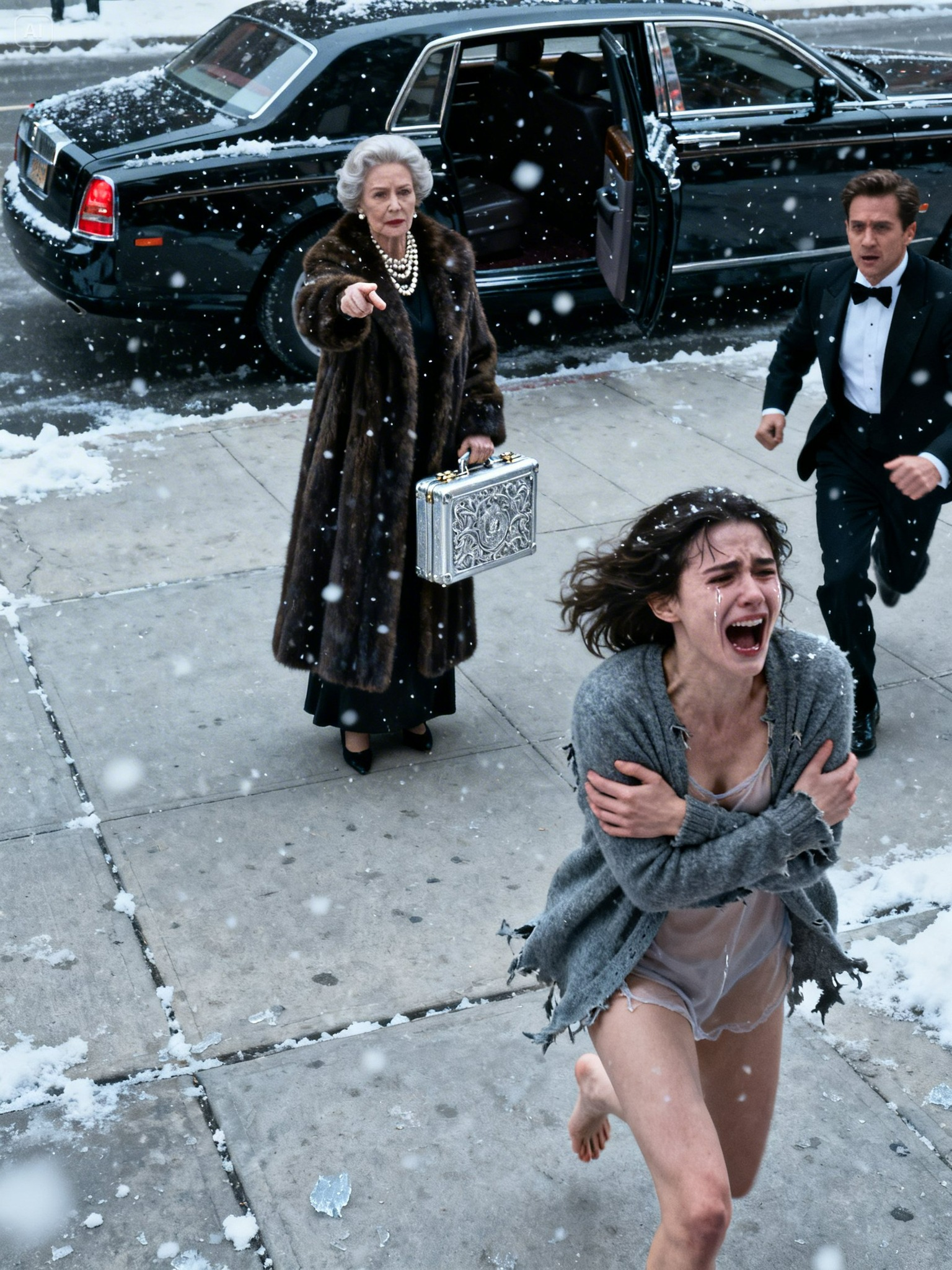
Thrown Into the Snow, I Made One Call—And Rolls-Royces Arrived to End My Marriage for Good
The first thing I noticed wasn’t the cold.
It was the sound.
A zipper screaming down too fast. Fabric tearing like paper. My own breath punching out of me in short, panicked bursts as I tried to cover myself.
“Get out,” my husband, Derek Caldwell, snapped, his face flushed with the kind of anger that didn’t burn out—it settled in and lived there. “Right now.”
I gripped the collar of my sweater, or what was left of it. One sleeve hung by threads. The buttons of my blouse were scattered somewhere inside the foyer like tiny white teeth.
“Derek—please—” My voice trembled. Not from fear of him, not exactly. From the humiliation that crawled under my skin like frostbite.
He shoved me again, harder this time, and my bare feet slid on the polished wood floor. I caught the edge of the console table, knocking over the framed wedding photo—my smile frozen behind glass, perfect and obedient.
“You wanted to play hardball?” he hissed. “Fine. Here’s hardball.”
Behind him, his mother, Lorraine, stood near the staircase like she owned the air in the house. Her pearls were flawless. Her lipstick was the same sharp shade of red she wore to every family dinner, the kind that said I bite. She wasn’t shocked. She wasn’t concerned.
She was entertained.
I tried to speak again, to say something reasonable, to remind him I was his wife, not a dog to be kicked outside. But my words got swallowed by the roar of blood in my ears.
Derek jerked open the front door.
Night rushed in.
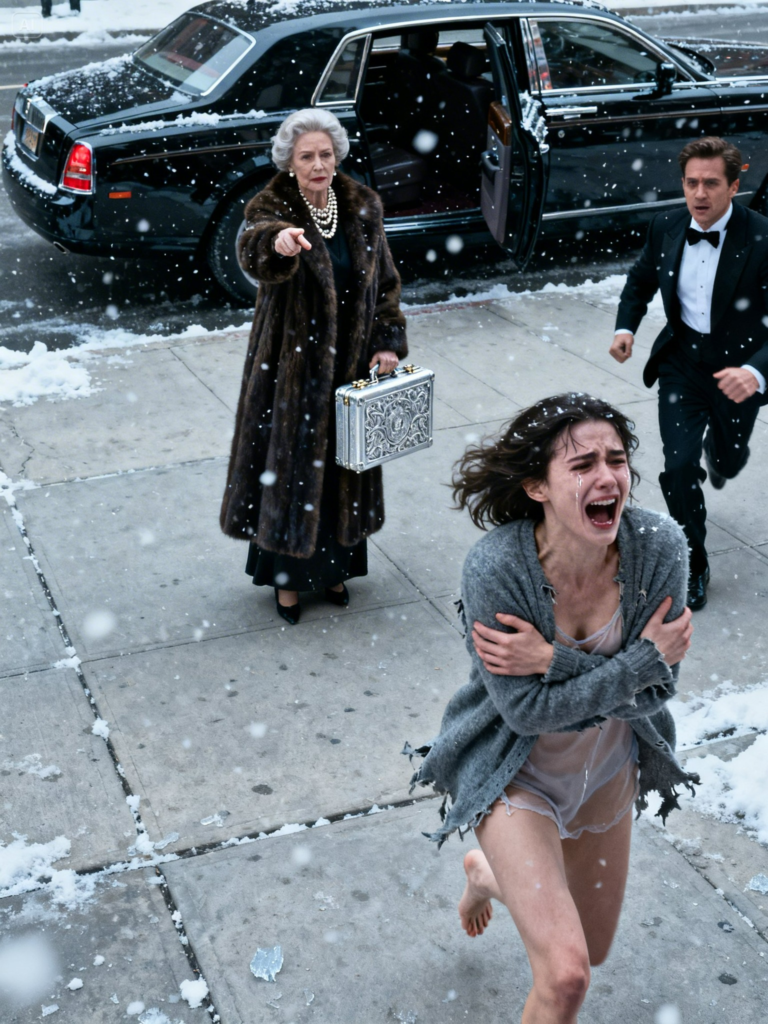
The dead of winter in Chicago doesn’t welcome you. It assaults you. Wind shoved itself into the foyer, carrying needles of snow that stung my cheeks. Somewhere across the street, a streetlamp buzzed like it was tired of watching human beings ruin each other.
Derek grabbed my arm, hauled me forward, and threw me out.
I hit the front steps hard. My palms slapped ice. Pain shot up my wrists. Snow soaked into my skin instantly, melting for a second before it turned numb.
The door slammed.
For a heartbeat, I just sat there, stunned, half-dressed, shaking like a leaf caught in an electrical current.
Then the door opened again.
Lorraine stepped out, careful not to scuff her boots. She didn’t bring a coat for me. Didn’t toss me a blanket. She just leaned down close enough that I could smell her perfume—expensive, floral, cruel.
Her smile formed slowly, like a knife being drawn from a sheath.
“Let’s see,” she whispered, voice syrup-sweet, “if any beggar will pick you up.”
Then she straightened, satisfied, and closed the door again.
The lock clicked.
That tiny sound was louder than thunder.
I stared at the carved wood of the door like it was a stranger’s face. I stared at the wreath Lorraine insisted on hanging every year—perfect pine and silver ribbon, a symbol of warmth I wasn’t allowed to touch.
My teeth clattered. My skin prickled. My breath came out in foggy bursts.
I should’ve been terrified.
I should’ve been helpless.
But somewhere beneath the shaking, something else rose up.
Not rage. Not panic.
Clarity.
I pushed myself up, wincing as my knees protested. Snow clung to my bare legs. My fingers were already stiffening, but I forced them to move.
My phone was still in my hand.
One call.
That’s all it would take.
I wiped my palm on the ruined sweater, swiped the screen with a numb thumb, and scrolled to a contact Derek didn’t know existed.
R.
I hesitated for half a second, my thumb hovering above the name.
Then I tapped.
The phone rang once.
Twice.
On the third ring, a calm male voice answered.
“Alex Rivera.”
My lungs unlocked.
“Alex,” I rasped. “It’s Hannah. I’m cashing in.”
A beat of silence. Then, “Where are you?”
“Home,” I said, the word sour in my mouth. “Or… outside of it.”
“Stay put,” he said. “Don’t talk to anyone. Don’t sign anything. I’m on my way.”
The line went dead.
I stared at the phone, the cold beginning to seep through the clarity, and laughed once—a sharp, broken sound that fogged the air in front of me.
I had no idea yet that when Alex arrived, he wouldn’t be alone.
Rolls-Royces would be, too.
And this house, this marriage, this entire performance Derek and his mother had built?
It was about to crumble.
The Setup: How I Became Mrs. Caldwell
The first time I saw Derek, I was carrying coffee I couldn’t afford through a lobby I didn’t belong in.
It was one of those glass skyscrapers downtown where the doors whisper when they close and the marble is so polished you’re afraid to breathe on it. I was a junior marketing assistant at a mid-tier agency that had just landed a pitch meeting with Caldwell Strategic Capital. Derek’s name was on the deck, on the brief, on the lips of every senior partner who talked about him like he was the sun.
I was there to take notes and keep my mouth shut.
He was there to decide whether or not he’d let our agency touch his precious brand.
He walked into the conference room five minutes late, no apology, navy suit cut like sin, hair that probably had its own line item in his budget. He didn’t look at me. People like Derek didn’t see people like me.
Not yet.
He sat, tossed his phone on the table, and within ten minutes, he’d charmed everyone over forty and intimidated everyone under thirty. He was good at that—making people feel small and grateful at the same time.
After the meeting, I spilled my coffee in the lobby. Literally. Right down the front of my shirt.
He saw that.
Instead of walking past, he stopped, handed me a monogrammed handkerchief like we were in some 1950s movie, and said, “Here. Can’t have the genius of your notes ruined.”
I remember blinking at him. “I just… typed what everyone said.”
His mouth curved. “Exactly. You listened. Most people don’t.”
That was Derek in a nutshell. He could make you feel seen in one sentence and then invisible in the next.
We bumped into each other twice more in that building. The third time, he invited me to a rooftop event. “You don’t belong in that cubicle farm,” he said. “Come breathe with the sharks for a night.”
I should’ve run.
Instead, I bought a dress on a credit card and said yes.
The rooftop was a different planet—glass and steel and money wearing cocktail dresses. Derek stuck close, introducing me as “Hannah, the only person in the room who actually reads the data.” It sounded like a compliment. It felt like a spotlight.
By the end of the night, I understood two things:
- Derek liked collecting things that made him look smarter, sharper, more unexpected.
- I had just become one of those things.
Six months later, we were dating seriously. A year after that, he proposed in Paris, on a bridge, with a photographer Lorraine had “casually” recommended.
I should’ve been suspicious that his mother was involved in the proposal before I was.
The Backstory: A Marriage Built on Control
Lorraine Caldwell was old Chicago money. Her father had owned half the steel that built the skyline. Her husband—Derek’s father—had turned that into a quiet investment empire and then died early, leaving his wife and son with a fortune and a narrative: We are special. We are smarter. We are owed.
I was not old anything. I was a scholarship kid from Indiana with a deadbeat father and a mother who cleaned houses. My last name used to be Lane. Lorraine liked “Caldwell” better.
She made that clear the first time I stepped into their family townhouse in Lincoln Park. It was the same one I’d later be thrown out of—the one with the carved wooden door and the wreath I wasn’t allowed to touch.
Lorraine looked me up and down slowly, like she was checking the label on a dress she hadn’t ordered.
“Pretty,” she said finally. “And clever, Derek tells me. We can work with that.”
We.
As if I were a joint project. A fixer-upper in need of design.
Things moved fast. Engagement parties, bridal showers, a wedding that looked like it had been ripped from a lifestyle magazine. At each event, I felt more and more like a prop in a tableau someone else had planned.
But Derek could be so sweet in private. He’d hold my face in his hands and say, “You’re the only person who really knows me, Han.” He’d talk about how hard it was growing up with expectations instead of parents, and I’d feel this ache in my chest for the little boy he’d been.
That’s how it happens, you know. Abuse doesn’t walk in the door kicking. It arrives with flowers, with stories, with vulnerability that hooks into your empathy and uses it as a chain.
The first time he raised his voice at me, we were six months married. I’d forgotten to RSVP to a charity gala Lorraine was co-hosting.
“You made me look careless,” he’d snapped. “Do you know how that plays in this city? We can’t afford mistakes like that, Hannah.”
“We?” I’d repeated, stung. “It was an email, Derek. I can fix it. I’ll call—”
He’d slammed his hand down on the counter. The sound made me flinch.
“Don’t fix it. Don’t fix me.” His eyes had gone cold. “Just don’t screw up next time.”
He apologized an hour later. Brought me tea. Sat on the couch and cried about how stressed he was at work, how he felt like he was drowning in numbers and deals.
I held him. I told myself everyone snapped sometimes.
Patterns don’t look like patterns when you’re standing inside them. They look like isolated storms.
The storms got more frequent.
He criticized what I wore to his events. He rewrote my emails before I sent them. He “joked” about how I’d never make it on my own with “my little salary” and “that bleeding heart.”
When I got a promotion at my agency, he scoffed. “They’re just terrified you’ll cry if they don’t reward you.”
Lorraine was no better. She would call, unannounced, soften her voice into something almost maternal, and say things like, “Sweetheart, men like Derek are under so much pressure. You can’t take it personally when he’s short with you. It’s the markets, not you.”
The markets.
As if the stock exchange had grabbed my wrist hard enough to leave bruises once when I’d disagreed with Derek in front of friends.
He always apologized after. Always with jewelry, or trips, or elaborate dinners.
People talk about golden cages like they’re obvious. They’re not. From the inside, all you see is the gold.
The Hidden Secret: My Quiet Insurance Policy
The turning point came two years into our marriage.
We’d been trying to have a baby. Or rather, I had. Derek vacillated between “sure, someday” and “my schedule is insane right now.” Every time I brought it up, his jaw tightened. Lorraine, on the other hand, brought it up constantly.
“Oh, I can’t wait for a little one running around this house,” she’d say, patting my arm. “It will settle Derek. Give him perspective.”
As if my uterus was a mood stabilizer.
I went to my OB-GYN alone. Derek claimed he had a board meeting. Tests came back normal. The doctor mentioned, gently, that we might want to have Derek checked, too.
Derek did not like that suggestion.
When I brought it up at dinner, he laughed. “You think there’s something wrong with me? Please, Hannah.”
“It’s standard,” I said. “It’s just data. You love data.”
His eyes sharpened. “What I love is not being accused of being defective in my own home.”
I dropped it.
But the seed was planted.
Around the same time, I started noticing oddities in our finances. I wasn’t on most of the main accounts—that was “simpler,” Derek had said—but I handled some household bills. Statements would arrive with balances that made no sense. Charges to clubs we’d never visited. Wire transfers to entities with bland names like “Northbridge Holdings.”
When I asked Derek, he smiled in that tight way that meant I was approaching a line.
“Investments,” he said. “Above your pay grade. Don’t worry about it.”
If there’s one thing I’ve learned, it’s this: when someone tells you not to worry, that’s usually when you should start.
I quietly took pictures of every statement that crossed my hands. I saved them to an encrypted folder in the cloud. I forwarded them to an email I’d created before the wedding under a different last name.
It made me feel disloyal.
It also made me feel sane.
The real shift came the night I met Alex Rivera.
Alex: The Man Derek Underestimated
My agency picked up a new client—a boutique law firm that specialized in corporate litigation and high-net-worth divorces. They wanted a rebrand. I was part of the team.
At the kickoff meeting, their lead partner walked in five minutes late, set his coffee down, and said, “Sorry. Judges don’t care about your schedule.”
Everyone laughed.
His name was Alex Rivera. Early forties, sharp suit that hadn’t forgotten how to move, eyes that missed nothing. He was the opposite of Derek’s slick charm. Less sparkle, more gravity.
We worked together for weeks. I learned the firm’s positioning, their case studies, their client profiles. I learned exactly what kind of men and women walked into their offices when their lives were burning down.
And I learned one statistic that lodged in my brain like a splinter: in high-asset divorces, the outcome favored whoever had done their homework before the first lawyer was ever called.
One night, after we’d finished a late strategy session, I lingered as everyone packed up.
“Can I ask you something?” I said.
Alex glanced at me over his laptop. “Sure.”
“Hypothetically,” I began, “if someone suspected their spouse was moving money around, would it matter if they… kept records?”
His expression didn’t change, but something about his attention did. It sharpened.
“In this hypothetical scenario,” he said, “I’d tell them to keep everything. Emails, statements, text messages. Take pictures. Make backups. And keep it somewhere their spouse can’t access.”
I swallowed. “And if they don’t… yet… want a divorce? They just… want insurance?”
“Then I’d say they’re smart,” he replied quietly. “And that insurance is only useful if it’s thorough.”
Our eyes met.
He knew.
I didn’t confirm it. I didn’t have to.
At the end of the project, Alex handed me his card.
“If you ever need help outside of marketing,” he said, tone light, “call me. I’m good at disaster management.”
I tucked the card into my wallet.
Three months later, I saved his number into my phone as R, like some cliché spy. It made me feel ridiculous.
It also made me feel a little less trapped.
The Betrayal: “You Wanted to Play Hardball”
By the time that December storm rolled into Chicago, my marriage was held together with beautiful photos and carefully curated silence.
I had more bruises than friends. More dresses than boundaries.
The week before Derek threw me out, I found the final piece of the puzzle.
He left his laptop open on the kitchen island when he went to take a call—a habit he usually didn’t have. He was obsessive about closing tabs, logging out, keeping things “secure.”
Maybe he was distracted. Maybe he was arrogant.
Either way, I walked past and saw my own name on the screen.
I don’t know what possessed me, but I sat down.
An email thread was open between Derek and Lorraine. The subject line: “Pre-nup leverage.”
My stomach dropped.
I had signed a prenup, of course. Lorraine would never have allowed the marriage without one. At twenty-five, blinded by love and flowers, I hadn’t understood the legalese. Derek had framed it as protective for both of us. “Just in case, Han. My lawyers insist. You know how it is.”
In the emails, I finally saw how it really was.
Lorraine had written:
If she files, we position her as unstable and ungrateful. We push the narrative that her background predisposes her to financial anxiety and emotional volatility. Judges eat that up.
Derek had replied:
She won’t file. She thinks she needs me. But if she ever threatens to, we have the clinic records.
Clinic records.
My vision blurred.
I scrolled.
Screenshots were attached—my OB-GYN visit notes, my therapy intake form where I’d admitted to “periods of anxiety,” a bank statement from my mother’s account showing an overdraft fee from years ago.
They had pulled everything.
For leverage.
Lorraine again:
If we can demonstrate she’s emotionally fragile and financially irresponsible, we can argue for minimal spousal support. With the prenup, she’ll walk away with almost nothing. She’ll fold rather than risk public humiliation.
Derek:
Perfect. Honestly, if she keeps pushing about kids, I might accelerate the timeline.
The timeline.
My heartbeat roared in my ears.
I took pictures of everything. Every email. Every attachment. My hands shook so badly I had to steady my phone on the counter.
When Derek walked back in, I was washing dishes, hands in soapy water, face calm.
Inside, something had snapped.
That night, I didn’t sleep. I lay awake staring at the ceiling, counting every lie I’d swallowed.
In the morning, I called the OB-GYN and requested copies of my full records. “For my files,” I said.
That afternoon, when Derek berated me for buying the “wrong” brand of olive oil, I didn’t apologize.
He noticed.
That evening, when Lorraine called and launched into one of her monologues about “how lucky you are, dear,” I cut her off.
“Lorraine,” I said evenly, “I know about the emails.”
There was a pause. Then, in that smooth, dangerous tone she used when she was about to draw blood, she replied, “I think you’re confused.”
“I think you’re scared,” I said.
Silence.
I hung up.
Two hours later, Derek came home early.
His eyes were flat.
“You wanted to play hardball?” he said, advancing on me. “Fine. Here’s hardball.”
You know the rest.
The zipper. The tearing sweater. The door.
The snow.
The Climax: The Night the Rolls-Royces Arrived
So there I was: bare-legged, half-dressed, thrown onto the front steps like trash in a blizzard, with my phone in my hand and my breath turning to ghosts in the air.
I called Alex.
“Stay put,” he’d said. “Don’t talk to anyone. Don’t sign anything. I’m on my way.”
The cold started to seep into my bones. Minutes stretched. My fingers went numb around the phone. My lips felt thick.
I thought about getting up, going to the neighbor’s, calling an Uber. But every time I shifted, I heard Alex’s voice in my head: Don’t talk to anyone. Don’t sign anything.
So I stayed.
Lights flickered behind the Caldwell windows. Silhouettes moved—Derek pacing, Lorraine gliding like a vulture in pearls. I imagined them rehearsing their story already.
She’s unstable.
She overreacted.
She tried to hit him.
Abusers don’t just hurt you physically. They run PR campaigns.
Twenty-seven minutes after I called, I saw headlights at the end of the block.
Not just one set.
Three.
They turned the corner slowly, tires moving carefully over new snow, engines purring. As they came closer, the badges on the hoods caught the streetlamps.
The Rolls-Royce Spirit of Ecstasy gleamed on all three.
I blinked.
Three identical black Rolls-Royces pulled up in front of the Caldwell townhouse like a fleet of silent judgment. The doors opened almost simultaneously.
From the first stepped Alex, coat collar up, scarf dark against the snow. From the second and third stepped two other men and a woman, all in tailored overcoats that screamed “we bill in six-minute increments.”
Behind them, drivers in caps remained at attention.
Lorraine’s curtains twitched upstairs.
Alex climbed the steps to me first. His face, usually composed, flashed with something close to fury when he saw my torn clothes and reddened skin.
“Are you hurt?” he asked, shrug stripped of all lawyerly distance.
“My pride,” I said, my teeth chattering. “He—he threw me out.”
“I see that.” His jaw clenched. “Can you stand?”
He shrugged off his coat and wrapped it around my shoulders before I could answer. It was still warm. The wool scratched my cheeks and felt like the safest thing I’d touched in years.
One of his colleagues approached, carrying a thick envelope and what looked like a tablet in a rugged case.
“Ms. Caldwell,” Alex said formally now, raising his voice just enough for it to carry toward the front door. “My name is Alexander Rivera. I represent you.”
The door flew open.
Derek stood there, color high in his cheeks, tie loosened like he’d been pacing.
“What the hell is this?” he demanded. “Hannah, get inside. You’re making a scene.”
Alex didn’t even look at him.
“Correction,” he said coolly. “You made the scene when you assaulted my client and threw her onto your front steps half-dressed in subzero windchill. We’re just the cleanup crew.”
Derek’s eyes darted between the cars, the lawyers, the neighbors who were starting to crack their blinds open down the street.
Lorraine appeared behind him, face composed, pearls gleaming. “This is a misunderstanding,” she said. “Our family doesn’t air personal matters in public, Ms.—?”
“Rivera,” Alex supplied. “And this isn’t a misunderstanding, Mrs. Caldwell. It’s documentation.”
He nodded to his colleague, who tapped the tablet and turned it toward Derek.
“Timestamped call record,” Alex said. “Photographic evidence of Ms. Caldwell’s condition when we arrived. Ambient temperature readings from the nearest weather station. Witness statements from your neighbors, which we will be collecting shortly.”
Derek laughed, a brittle sound. “You can’t prove anything.”
“Oh, Derek,” I said, my voice surprising even me with how steady it sounded. “You really should stop underestimating my ability to keep receipts.”
His gaze snapped to me.
For years, I’d seen only one emotion in his eyes when he looked at me: contempt, occasionally softened by possessiveness.
For the first time, I saw something else.
Fear.
The Reveal: Every Secret on the Table
Alex handed me a pen and a clipboard. “Hannah, this is a preliminary retainer and emergency protective filing,” he said. “It authorizes us to act on your behalf immediately. I’ll walk you through the rest when you’re warm and safe.”
Warm and safe.
Two words I hadn’t associated with myself in a long time.
I signed.
Lorraine stepped forward, voice dropping into that oily sympathy she used when she wanted to rewrite reality. “Hannah, be reasonable. You’re upset. Derek is upset. We can discuss this tomorrow, quietly, with family.”
Alex smiled without warmth. “You’re welcome to discuss it with her legal counsel present,” he said. “In the meantime, Ms. Caldwell will be leaving.”
“Leaving where?” Derek snapped. “This is her home.”
“Not anymore,” I said softly. “You made that clear when you threw me out of it.”
The woman lawyer—short, sharp-eyed, hair pulled back—spoke up for the first time. “We’ve already filed an emergency motion with the judge on call,” she said. “Given the circumstances, we anticipate a temporary restraining order will be granted within the hour. You will not contact Ms. Caldwell directly. All communication goes through us.”
Lorraine’s composure cracked. “This is absurd,” she hissed. “Do you have any idea who we are?”
“Yes,” Alex said. “And we have every idea what you’ve been doing.”
He tapped his phone. Another colleague stepped forward, holding a slim folder.
“Copies of emails between you and your son discussing strategies to weaponize Ms. Caldwell’s medical records and background against her in potential divorce proceedings,” Alex said calmly. “Screenshots attached. Metadata verified. Oh, and while we’re on the subject of records, Derek—how’s Northbridge Holdings doing these days?”
Derek went very still.
“You have no right—” he began.
“We have every right,” Alex cut in. “Because when you used marital funds to funnel money into undisclosed accounts under shell corporations, you crossed from ‘run-of-the-mill jerk’ into ‘actionable misconduct.’”
I watched the color drain from Derek’s face.
The neighbors watched, too.
Lights glowed in windows up and down the street. Curtains moved. Phones recorded.
Lorraine’s voice dropped. “We can handle this privately, Mr. Rivera. There’s no need to drag everyone’s name through the mud.”
Alex’s gaze flicked to me. “That’s up to Ms. Caldwell.”
Every eye swung to me.
Snow fell between us in thick, lazy flakes, softening the edges of the street, catching in my hair.
For a moment, I saw my life if I chose the path Lorraine dangled.
We’d go back inside. There would be apologies, maybe even tears. A new agreement. A quiet settlement that left me with enough to rent an apartment and buy furniture that didn’t have any of their history embedded in it.
And in ten years, Derek would still be on magazine covers. Lorraine would still be hosting fundraisers. They’d tell the story as if I’d been fragile, ungrateful, unstable.
Or.
I could choose something else.
I could choose myself.
“I don’t want quiet,” I said.
Lorraine flinched like I’d slapped her.
“I’ve been quiet for years,” I went on. “I’ve swallowed every insult, every bruise, every time you weaponized my past against me. And you were planning to use my medical records, my therapy records—” my voice cracked, then steadied again—“to paint me as unfit. So no. We’re not keeping this in the family. We’re taking it to court.”
Derek’s mask shattered.
“You ungrateful—” he started.
Alex lifted a hand. “Careful,” he warned. “You’re on at least five cameras right now. Maybe ten.”
Derek looked around, really looked, and saw his empire of image collapsing in real time.
It’s funny, what power looks like when you’re used to being under someone’s thumb. For years, I thought power was money, status, the ability to cut someone off mid-sentence.
Standing there in the snow, wrapped in a stranger’s coat, watching my abuser scramble, I realized something.
Power is choice.
And I was finally making mine.
The Resolution: Ending a Marriage, Rewriting a Life
They didn’t let me back into the house that night.
They couldn’t, legally, once the emergency filings went through and the TRO was granted. The irony was almost poetic: Derek had thrown me out to humiliate and destabilize me, and instead, he’d locked himself in with his own mess.
Alex ushered me into the back of the middle Rolls-Royce. The leather seats were warm. The door closed with a soft, expensive thud.
I burst into tears.
Not delicate, cinematic tears. Ugly sobs that shook my whole body.
Alex sat across from me, giving me space, hands folded loosely. When I finally hiccuped myself into silence, he handed me a bottle of water and a clean handkerchief.
“You did well,” he said.
“I was shaking,” I admitted. “I didn’t know whether to scream or laugh.”
He smiled faintly. “Both are valid responses.”
We drove to a hotel he assured me was used to situations like this—discreet, secure, comfortable without being flashy. His firm had a corporate rate.
In the suite, wrapped in a robe, finally warm, I signed more papers. We filed for divorce that night. We filed motions for financial discovery, spousal support, punitive damages where applicable.
“What are my chances?” I asked.
Alex’s answer was simple. “If what you’ve shown us is everything you have, and if we can track all the accounts we think we can, your chances are excellent. Especially after tonight.”
“Tonight?”
He shrugged. “Judges are human. They don’t like men who throw their wives into the snow.”
The months that followed were brutal.
Divorces like this always are.
Derek’s lawyers came out swinging, just like the emails had predicted. They tried to paint me as unstable, money-hungry, manipulative. They hinted at “emotional fragility.” They dredged up my mother’s overdraft fee like it was a crime.
But they hadn’t accounted for two things:
- The receipts I had.
- The fact that their opponents were better at this game than they were.
Alex’s firm dismantled every argument. They presented the emails. The financial records. The attempt to weaponize my private medical information. The judge’s expression hardened with every exhibit.
Lorraine took the stand and tried to perform concern. Under cross-examination, it slipped. When pressed about the emails, she snapped, “Of course we had to protect ourselves. These girls see a last name like Caldwell and think they’ve hit the jackpot.”
These girls.
Alex let the words hang in the air like smoke.
The judge noted them.
By the time we reached mediation, Derek’s side was bleeding credibility. Their best option was to settle before the court handed down something worse.
In the end, I walked away with more than I had ever expected.
Half of certain assets.
A percentage of others going forward.
Enough to start over without looking over my shoulder.
But the money wasn’t the victory that mattered most.
The real victory came the day the final papers were signed.
Not in a courtroom, but at a charity gala.
Lorraine’s charity gala.
The Final Scene: When I Arrived in Style
It was exactly one year after the night in the snow.
Chicago was in December again, but the storm had stayed away this time. The sky was clear, the air sharp. The Caldwell Foundation’s Winter Promise Gala was the event of the season for people who cared deeply about being seen caring about things.
A mutual friend sent me a ticket.
“You don’t have to go,” Alex had said when I showed him the embossed invitation. “You’ve already won.”
“I know,” I said. “This isn’t about winning.”
He raised an eyebrow.
“It’s about closure.”
He didn’t try to talk me out of it.
We arranged transportation.
When the night came, I stood in the lobby of my new apartment building—smaller than the townhouse, older, with creaky floors and neighbors who said hello in the hallway—and smoothed my hand over the front of my dress.
It wasn’t designer. It wasn’t dripping crystals. It was simple, black, beautifully cut, bought with my own money.
I checked my reflection. The woman in the mirror looked like me, but more.
More solid.
More present.
More herself.
My phone buzzed.
Alex: Your chariot awaits.
I smiled and headed downstairs.
Outside, on the curb, a familiar car was waiting.
A black Rolls-Royce.
“Seriously?” I said as Alex stepped out from the other side, in a tux that fit too well for someone who claimed to hate events.
He shrugged. “Poetic symmetry.”
As we pulled up to the hotel hosting the gala, cameras flashed. Reporters clustered near the entrance, hungry for photos of donors and minor celebrities.
The Caldwell car arrived just in front of us—Derek and Lorraine stepping out, Lorraine in a gown that probably cost more than my first car, Derek in the same posture of entitled ease I’d once found magnetic.
They turned when our driver opened my door.
For a split second, no one reacted.
Then the nearest photographer realized who I was.
The sound of camera shutters was like rain.
I stepped out, one hand on the door frame, as if I’d done this my entire life. Alex offered his arm. I took it.
Lorraine’s face went through three expressions so fast they almost blurred: disbelief, fury, calculation.
Derek’s jaw tightened.
“Hannah,” he said as we approached on the carpeted path. “I didn’t realize you were attending.”
“Invitation must have gotten lost in the snow,” I said lightly.
A reporter leaned in. “Ms. Lane—sorry, Ms. Caldwell—can we ask—”
“Lane,” I corrected him.
I watched Derek flinch at that.
“Hannah Lane,” I repeated, savoring it. “And yes, you can ask. I’m just here to support a good cause.”
The reporter’s eyes gleamed. “Rumor has it the good cause tonight is also your ex-husband’s reputation. Any comment on that?”
Lorraine’s smile turned glacial. “Our family doesn’t comment on gossip,” she said.
I looked directly into the nearest camera.
“Mine does,” I said. “Sometimes gossip is just the truth no one wanted to hear out loud.”
Alex squeezed my arm, a subtle reminder not to say anything that would jeopardize the legal clean finish we’d fought for.
So I didn’t.
I didn’t need to.
The story had already been told—in court, in filings, in the quiet conversations that ripple through cities like Chicago where everyone pretends not to care about scandal until it’s someone they know.
Inside the ballroom, people who used to look through me now approached with hesitant smiles. They said things like, “You’re so brave,” and “If you ever need anything, call me.”
I smiled back.
Bravery wasn’t what got me here.
Documentation did.
Choices did.
The willingness to make one call when I was half-naked in the snow, humiliated and shaking, and say, Enough.
At one point in the evening, I stepped out onto the balcony to get some air. The city glittered below, a grid of lights and lives.
Alex joined me, two glasses of champagne in hand.
“Regrets?” he asked.
“About the marriage?” I said. “Plenty. About calling you? None.”
He clinked his glass gently against mine.
“To not touching the snow when someone else tries to bury you in it,” he said.
I laughed, surprised. “That’s oddly specific.”
He smiled. “You’d be surprised how many stories start with winter and end with women deciding they’re done being cold.”
I looked out at the city. At the life I’d rebuilt—not in a mansion I was only ever borrowing, but in an apartment that was wholly mine. At the career I’d returned to on my own terms. At the friends I’d made who liked me for something other than how well I could play the perfect hostess.
“I used to think leaving meant losing,” I said.
“And now?” he asked.
“Now I know,” I replied, “that sometimes leaving is the only way to win.”
Down on the street, cars flowed through the night, headlights carving paths through the dark.
Somewhere, in a different version of my life, a younger me was still standing on a set of frozen steps, shaking, phone in hand, wondering if she should make that call.
I wished I could reach through time and tell her what I’d learned.
You’re not crazy.
You’re not too sensitive.
You’re not ungrateful.
You are allowed to want more than survival.
You are allowed to step into the snow and still demand the world come to you.
That night, as I left the gala in my own Rolls-Royce, cameras flashing and whispers following me, I realized something simple and powerful.
They had thrown me into the snow to break me.
All they’d done was give me a clean, white page to start over on.
And this time, I was writing my story myself.