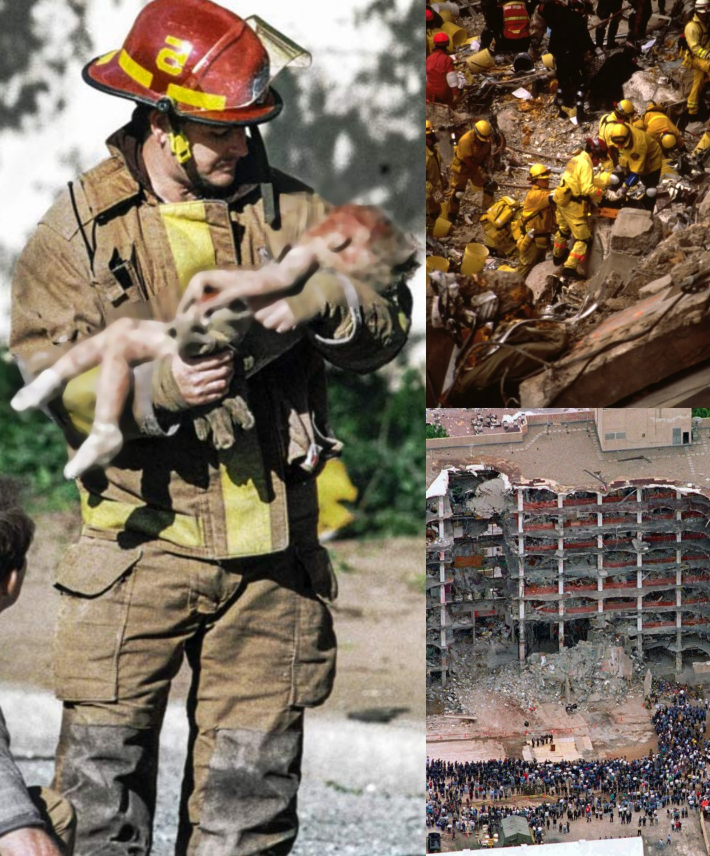
On the morning of April 19, 1995, Oklahoma City stirred to life like any other day.
Children laughed as they walked to school, neighbors exchanged greetings, and office workers sipped coffee while reviewing their schedules.
The Alfred P. Murrah Federal Building, a nine-story structure in the heart of downtown, held offices of federal agencies including the DEA, the Secret Service, and the Bureau of Alcohol, Tobacco, Firearms and Explosives.
For many, it was a place of work, of routine, of ordinary life.
For 168 people, it became a place of death.

At 9:02 a.m., a Ryder rental truck parked outside the Murrah Building exploded with terrifying force.
The blast ripped through the north side of the building, sending concrete, glass, and twisted metal flying into the streets.
Windows shattered in nearby buildings, cars were crushed under debris, and a choking cloud of smoke and dust enveloped the area.
The sound was deafening, shaking the city to its core.
Screams erupted as people ran in every direction, some seeking safety, others desperately trying to help those trapped under rubble.

Emergency personnel responded immediately, navigating through fallen beams and shattered glass to reach survivors.
Firefighters crawled into collapsed spaces, risking their own lives to pull people from under concrete slabs.
Paramedics treated victims on the street, their hands shaking as they worked against time to save lives.
Two weeks later, the death toll stood at 168.
Among the dead were 19 children who had been in the building’s day care center.
More than 650 others were injured, many permanently.
Over 300 surrounding buildings were damaged or destroyed.

The city had been left with not just physical devastation but a scar on its collective psyche.
The perpetrator of this atrocity was Timothy McVeigh, a former U.S. Army soldier.
McVeigh had been radicalized by a deep-seated hatred of the federal government, fueled by events such as Ruby Ridge and the Waco siege.
He had enlisted in the Army in 1988 and served in the Persian Gulf War, where he was decorated for his service.
After leaving the Army in 1991, McVeigh’s ideology shifted toward domestic suspicion, particularly targeting the federal government under President Bill Clinton.

Terry Nichols, older and experienced in survivalist ideology, became McVeigh’s co-conspirator.
Together, they meticulously planned the attack, renting a truck, filling it with a deadly combination of diesel fuel and fertilizer, and parking it outside the Murrah Building on April 19, the second anniversary of the Waco tragedy.
Minutes after leaving the truck, McVeigh drove away, leaving chaos in his wake.
The city struggled to comprehend the scale of the attack, stunned that such destruction could occur on its own streets.
Investigators launched a nationwide manhunt.

McVeigh was arrested on April 21 for a traffic violation, unaware that he had been identified as the prime suspect.
Nichols surrendered soon after.
The two were linked to a radical right-wing survivalist group based in Michigan.
In the courtroom, the world saw the meticulous planning and cold calculations behind the attack.
McVeigh was convicted on all 11 counts and sentenced to death.
On June 11, 2001, he was executed by lethal injection at the U.S. Penitentiary in Terre Haute, Indiana, at the age of 33.

Nichols received 161 consecutive life sentences for his involvement.
Yet the story of Oklahoma City is not just about perpetrators and justice.
It is about ordinary people faced with unimaginable horror.
Survivors described the explosion as a “wall of fire” and “the earth shaking beneath their feet.”
Parents rushed to find their children, many of whom had been at the day care center.
Some families lost members in the blink of an eye.

One woman remembered carrying her son, bloodied and dazed, down a street filled with debris, as a volunteer handed her a blanket.
Firefighters and paramedics worked tirelessly for hours, some for days, with little rest, their adrenaline carrying them through exhaustion.
Neighbors opened their homes to displaced families, offering food, shelter, and comfort.
Strangers comforted strangers, forming a web of solidarity that stretched across the nation.
Letters poured in from across the country.
Donations arrived.
Communities held vigils, lighting candles for those who could not be saved.

The Alfred P. Murrah Federal Building was eventually demolished for safety reasons.
On its site, the Oklahoma City National Memorial and Museum now stands, honoring victims, survivors, and rescuers.
The memorial includes the Field of Empty Chairs, each representing a life lost, carefully arranged to reflect the age of each victim.
Every year, the city holds remembrance ceremonies, ensuring the stories of those who died are never forgotten.
Among the stories are those of children, office workers, and first responders whose lives were forever altered.

Some survivors carried shrapnel in their bodies for decades, while others struggled with the emotional trauma of witnessing such horror.
Yet amid the despair, moments of heroism shone brightly.
A teacher led her students to safety moments before the building collapsed.
A father carried his daughter over debris-laden streets, refusing to let go even when he was exhausted.
Rescuers dug through rubble, finding life in places that seemed impossible.
The bombing also sparked a national dialogue on domestic terrorism and security.

It revealed vulnerabilities in government facilities and prompted legislation to better protect public spaces.
But more than policy, it highlighted the strength of human compassion.
Oklahoma City’s citizens refused to let hate define them.
They transformed grief into action, volunteering, rebuilding, and remembering.
Families established foundations in memory of lost loved ones, supporting survivors of trauma and promoting community resilience.

The museum now houses artifacts, personal stories, and photographs that convey both horror and hope.
Visitors can see the twisted remains of the Ryder truck, items recovered from the rubble, and the heartfelt letters of condolence sent from around the globe.
Each artifact tells a story, a life interrupted, a family changed forever.
Though McVeigh and Nichols faced justice, the real victory lay in the spirit of Oklahoma City.
The city healed, slowly, painfully, but with determination.
Neighbors became friends.
Communities became families.

And through every act of kindness, every moment of courage, the memory of those lost was honored.
The Oklahoma City bombing remains a stark reminder of the fragility of life, the dangers of radicalization, and the extraordinary courage that ordinary people can summon in the face of disaster.
It is a story of loss, yes, but also of resilience, of unity, and of the enduring human spirit.
Even decades later, when visitors walk the memorial’s Field of Empty Chairs, they feel both the weight of tragedy and the strength of survival.
The names etched in stone are not just reminders of those gone, but symbols of lives lived, love shared, and a community that refused to break.
Oklahoma City’s story is a testament to humanity’s capacity to endure, to rebuild, and to honor those who came before.
Two-Year-Old Comforted with Cartoons Before Life-Saving Surgery.291

Two-year-old Xin Er was terrified. She was about to undergo major heart surgery at Zhejiang University Hospital in China, and the weight of her small body and fragile heart seemed to press even heavier under the bright lights of the hospital. Already living with a congenital heart condition, the unknowns of the operating room were overwhelming. The monitors, the beeping machines, the masked faces—it was all too much for a little girl who just wanted the comfort of home.
As the medical team prepared her for the operation, Xin Er could not stop crying. She clung to her fear, her tiny hands gripping at her clothes, her sobs echoing in the sterile room. Her parents tried to console her, but even their warm reassurances seemed powerless against the sheer panic in her wide, frightened eyes.
That’s when Dr. Shi Zhuo, the Deputy Director of Cardiac Surgery, noticed the depth of her distress. A veteran surgeon with countless procedures under his belt, he had seen fear many times—but in children, it was always different. Their worry is raw, unfiltered, and contagious. Without hesitation, Dr. Shi stepped forward.
In a gesture that spoke volumes, he gently picked Xin Er up, lifting her into his arms as if he could carry away her fear along with her trembling body. But he didn’t stop there. Reaching for his phone, he opened a familiar cartoon—something bright, cheerful, and playful—and showed it to her. Slowly, her crying subsided. Her wide eyes focused on the moving colors and friendly characters, and the tension in her little body began to ease. For a brief moment, the sterile hospital walls faded, replaced by a tiny pocket of comfort, laughter, and distraction.
The moment was captured by anaesthetist Jin Ziying, who snapped photos that perfectly encapsulated the tenderness of the scene. Dr. Shi, usually seen in surgical scrubs with a focused, serious demeanor, was there simply as a human being—a caretaker, a protector, a bridge between fear and safety. The images quickly went viral, resonating with people across the globe who could see not only the courage of Xin Er, but the empathy of those who care for children in moments of vulnerability.

Dr. Shi later explained that preoperative anxiety is entirely natural, especially for children, and as parents themselves, he and his team understand the mix of fear and helplessness families feel. By taking a moment to hold Xin Er, to meet her where she was emotionally, and to bring a bit of lighthearted distraction into a tense situation, the team allowed her to relax just enough to proceed safely with the operation.
Thanks to their skill and compassion, Xin Er’s surgery went as planned. She recovered well, and her parents say that her bravery, bolstered by the kindness of her surgeons, will never be forgotten.
It’s a simple gesture, but one that reminds us of the human side of medicine. Behind every procedure, every mask, and every monitor are people who choose not only to heal bodies but to soothe hearts. For a tiny girl facing one of the scariest experiences of her life, Dr. Shi’s gentle touch and a cartoon on a phone turned fear into trust, panic into calm.
Moments like these, quiet yet profound, remind us that compassion in medicine is as crucial as skill. The world’s medical professionals don’t just save lives—they restore hope, comfort, and humanity.
