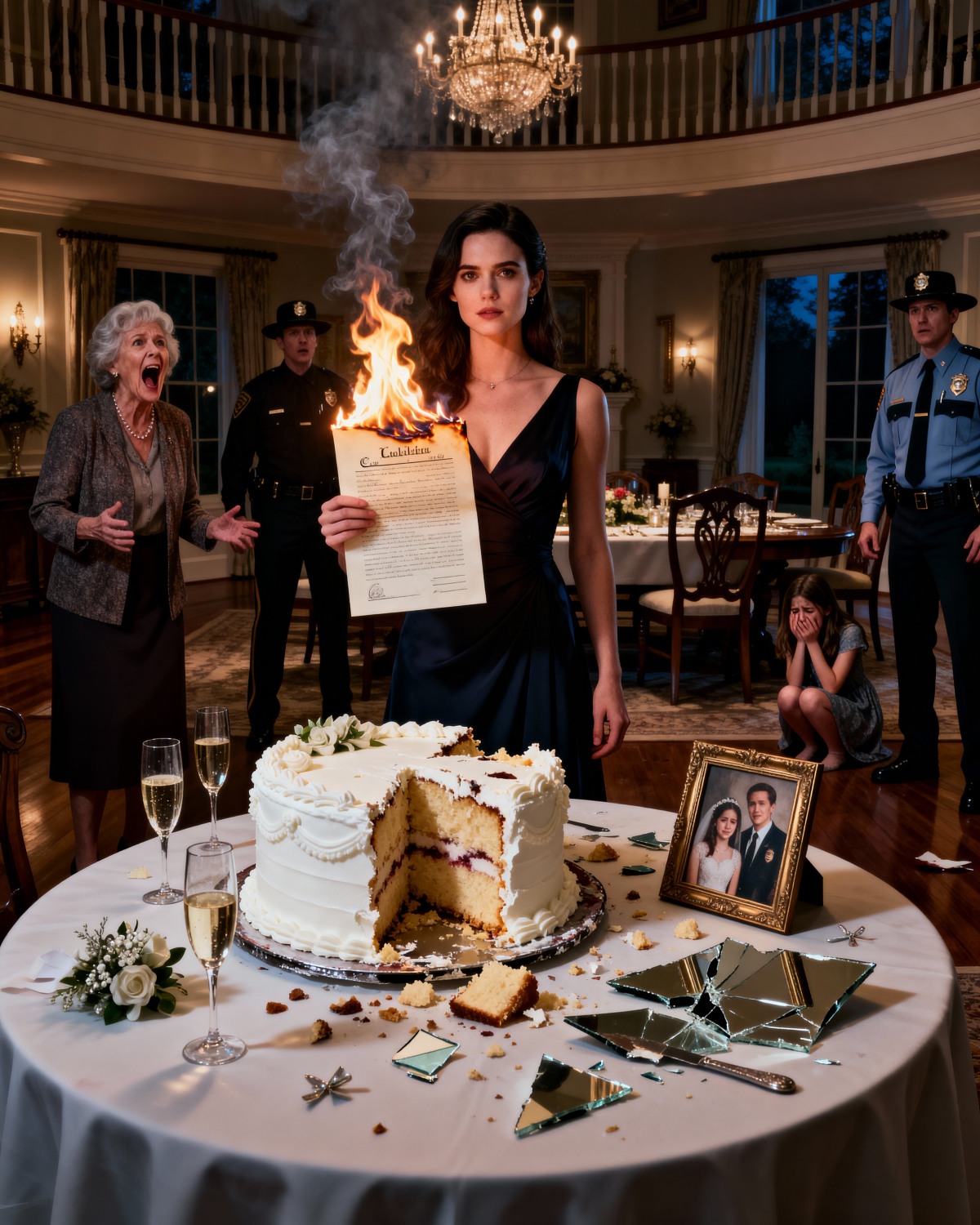
The bill arrived before the cake, and that was how I knew this night was never meant to celebrate me. It slid across the table at exactly seven minutes past seven, the leather binder making a soft, deliberate sound against the white linen, as if even gravity had been instructed to behave politely.
For a moment, no one spoke. One hundred relatives sat frozen beneath the chandeliers of the Manhattan ballroom, their laughter cut off mid-breath, forks hovering above porcelain plates, champagne bubbles still climbing the sides of crystal flutes. Outside the floor-to-ceiling windows, the city glowed in orderly grids of light, unaware that a quiet execution was about to take place.
“Happy birthday,” my mother said, her voice perfectly modulated, devoid of warmth, affection, or even pretense. She did not look at me when she spoke. Instead, she rested two manicured fingers on the binder and pushed it forward with the calm precision of someone finalizing a deal.
I stared at it, at the unmarked cover, at the faint crease near the spine where it had clearly been opened and closed many times. Something cold crept up my spine. “What is this?” I asked, though my chest already felt tight, as if my body understood the danger before my mind allowed itself to.
My father took his time answering. He always did when he wanted to assert control. He lifted his glass of bourbon, a single cube of ice catching the light, and swirled it slowly. The scent of oak and smoke drifted toward me. He drank, then set the glass down carefully. “It’s an invoice,” he said. “Every dollar we wasted raising you. Pay it—and disappear.”
The word invoice struck me like a foreign object, something sharp and misplaced inside a sentence where it had no right to be. I opened the binder. The metal rings snapped apart with a sound that seemed far too loud in the hushed room. At the top of the page, bold and merciless, was the total.
TOTAL DUE: $248,000.00
The number blurred for a moment. Then my vision sharpened, and I saw the details beneath it, line after line of my childhood reduced to transactions. Braces from 2006, itemized down to the last appointment. Piano lessons I had quit because Ashley needed the time slot more than I did. Tuition payments, extracurricular fees, medical co-pays, school trips I never wanted to attend.
My prom dress. My graduation gown. Even a broken vase from when I was six years old, the same vase Ashley had knocked over while running through the living room, the same vase I had taken the blame for because she was crying and I didn’t want her punished.
They had charged me for protecting her.
“We ran the numbers,” my mother continued, her tone untroubled, almost bored. “Raising you was not a small investment. And given the outcome…” She paused, finally turning to look at me, her eyes cool and evaluative. “Well. You didn’t meet expectations. Compared to your sister’s potential, you were a poor return.”
Across the table, Ashley smiled.
Not the polite smile she wore for donors and colleagues, but the one she reserved for moments when she knew she was winning. She reached across the table, snatched my car keys from beside my plate, and dropped them into her glass of red wine. The liquid splashed, staining the metal red. “They’re mine now,” she said lightly. “Consider it a down payment. I need something new anyway.”
I looked around the table then, searching for a face that might soften, for a relative who would object, protest, even flinch. There was nothing. My aunts stared at their plates. My uncles pretended to sip their drinks. Cousins checked their phones. One hundred witnesses, and not a single one willing to acknowledge that something irreparable was happening in plain sight.
Then my boss stood.
He cleared his throat, eyes fixed somewhere over my shoulder. “Due to recent restructuring,” he said, voice flat, rehearsed, “your position has been eliminated. Security will collect your badge on Monday.”
That was when I understood. This had been planned. Not just the bill. Not just the humiliation. The timing, the audience, the execution—it had all been arranged so I would leave with nothing, stripped clean in one efficient motion.
I stood. My legs felt unsteady, but I forced myself upright. I smoothed my dress, ignoring the tremor in my hands, and walked out without saying a word. The elevator doors closed behind me, reflecting my face back in cold steel. They believed they had destroyed me.
They forgot one thing.
Three months earlier, Ashley had shown up at my apartment after midnight, mascara streaked, hair unbrushed, hands shaking so badly she could barely hold her phone. She didn’t knock. She never did. She had always treated my space as an extension of hers, something borrowed, something temporary.
“I messed up,” she whispered the moment I opened the door.
I let her in. I always had.
She collapsed onto my couch, burying her face in her hands, and finally said the number out loud. Five hundred thousand dollars. Gambling debts. Deadlines. People who did not accept apologies or excuses. She begged me not to tell our parents, her voice cracking as she swore she would fix it, that she just needed time.
I didn’t tell them. Not because I believed her, but because something in her desperation triggered a different instinct in me, one I had never listened to before. Survival.
She didn’t tell me everything that night. She didn’t mention the deed. She didn’t mention Phoenix Holdings LLC. She didn’t realize that when she left, I was already planning for the day she would need a shield again—and that I would no longer offer myself.
Phoenix Holdings LLC was born out of quiet preparation, not vengeance. I chose the name because it sounded generic, forgettable, the kind of company people skim past in legal documents. Setting it up was easier than I expected.
Money moves quickly when it knows where it’s going. When Ashley came back weeks later, frantic and pale, asking if I knew anyone who could help her “temporarily,” I listened without interrupting.
When she asked if I could handle the paperwork, I agreed.
She never asked who owned the company.
The deed transfer was completed in less than forty-eight hours. Ashley signed everything in a haze of panic and denial. When it was done, she hugged me, crying into my shoulder, thanking me for saving her life. I said nothing. Some truths don’t need to be spoken until they are unavoidable
Four days after my birthday, I stood across the street from the house I had been ordered to vacate, the house I had grown up in, the house my parents believed was untouchable. A county sheriff stood beside me, eviction papers in hand. The lawn was immaculate. The windows glowed warmly. Inside, they were laughing.
We knocked.
My mother opened the door with a practiced smile that collapsed the moment she saw the badge. Confusion flickered across her face, then irritation, then something closer to fear. My father appeared behind her, demanding explanations. The sheriff spoke calmly, professionally, explaining the transfer of ownership, the legality of the deed, the timeline for eviction.
Ashley screamed.
She denied everything, accused everyone, cried until her voice broke. My parents turned to me, realization dawning too late. I met their gaze without flinching.
“You billed me for my childhood,” I said quietly. “This is payment in full.”
I walked away as their world began to dismantle itself behind me.
The first letter arrived two days after the sheriff’s visit, thick cream paper stamped with a law firm’s crest so ornate it felt performative. My parents’ attorneys wasted no time. They alleged fraud, emotional manipulation, undue influence, coercion, theft, conspiracy.
In one particularly creative paragraph, they suggested I had been psychologically unstable for years and had orchestrated everything as an act of revenge against a loving family that had done nothing but support me.
I read the letter in my new office—the former bedroom they’d planned to turn into Ashley’s walk-in closet—while morning light spilled across the hardwood floors. I didn’t feel angry. I felt almost amused. They were still telling the same story they always had, only now it was written on expensive paper.
I hired my lawyer that afternoon. She was younger than I expected, sharp-eyed, precise in her language, and utterly unimpressed by my parents’ reputation. When I showed her the invoice binder, she didn’t react outwardly, but her jaw tightened almost imperceptibly. “
They handed you motive,” she said. “And documentation. People usually hide those things.” She explained the process calmly: discovery, depositions, hearings. Time. Pressure. Exposure. I nodded, absorbing it all, realizing that for the first time in my life, I was not reacting. I was planning.
Ashley tried to call me that night. Then the next morning. Then every few hours after that. I didn’t answer. Her messages shifted in tone rapidly, cycling through panic, anger, pleading, and finally accusation. She blamed me for everything.
For her debt. For the house. For our parents’ humiliation. It was easier than blaming herself, and easier than admitting she had built her life on borrowed ground. I deleted the messages without listening to them all the way through.
The media caught wind of the situation before the first court date. It started small, whispers on finance blogs, speculation in society columns. A prominent couple facing eviction. A mysterious shell company.
A daughter disowned on her birthday. Stories like that don’t stay quiet. They multiply. Each retelling added a new layer of embellishment, but the core remained intact, sharp and undeniable. My parents issued a statement claiming misunderstandings and family disputes blown out of proportion. It fooled no one.
The deposition room was smaller than I expected, windowless, fluorescent-lit, designed to strip drama from even the most explosive truths. My mother sat across from me, posture immaculate, expression carefully neutral. My father leaned back in his chair, arms crossed, projecting disdain as if it were armor. Ashley wasn’t there yet. Her lawyer had requested a delay, citing emotional distress.
When they questioned me, I answered plainly. Dates. Documents. Transactions. No emotion. No justification. Just facts. When my mother’s attorney asked why I had not informed my parents of Ashley’s debt, I looked at him steadily. “Because my sister asked me not to,” I said. “And because it wasn’t my responsibility to protect them from her decisions.”
My mother’s mask slipped then, just for a second. It was the first crack I had ever seen in her composure, and it startled her as much as it did me. She recovered quickly, but something fundamental had shifted. Control, once lost, is almost impossible to reclaim.
Ashley’s deposition was postponed twice. When it finally happened, she arrived pale, thinner than I remembered, her confidence replaced by something frantic and brittle.
She contradicted herself repeatedly, tangled timelines, claimed ignorance where documents proved otherwise. By the end of it, her lawyer looked exhausted. I felt nothing. Sympathy requires acknowledgment, and she still refused to acknowledge anything beyond her own suffering.
The courtroom smelled like old wood and paper, a place built to absorb human conflict without reacting. My parents arrived early, flanked by attorneys, dressed impeccably. They still believed presentation mattered more than truth. Ashley sat behind them, eyes fixed on the floor. When the judge entered, the room stilled.
My lawyer spoke first. She laid out the timeline with precision, moving from Ashley’s debt to the creation of Phoenix Holdings LLC to the deed transfer. She presented bank records, signed documents, correspondence. There was no drama in her voice, no flourish. She didn’t need it. The facts were devastating enough on their own.
My parents’ attorney argued manipulation, betrayal, emotional abuse. He painted me as calculating, resentful, opportunistic. I watched my parents as he spoke. My father nodded along, convinced. My mother’s lips pressed into a thin line, her eyes never leaving the judge.
When it was my turn to speak, I stood slowly, feeling every eye in the room settle on me. I didn’t raise my voice. I didn’t defend my character. I didn’t attack theirs. “They taught me how to keep accounts,” I said simply. “They just didn’t expect me to apply the lesson.”
The judge ruled in my favor before lunch
Losing the house was only the beginning. Wealth creates ecosystems, and when a central figure falters, everything around it destabilizes. My parents’ donors withdrew quietly, politely, citing scheduling conflicts and shifting priorities. Business partners stopped returning calls. Invitations dried up. People who had once crowded around them at events suddenly found reasons to be elsewhere.
Ashley vanished from social media overnight, her curated life dissolving in silence. Rumors followed her anyway. Gambling debts have long shadows. My parents turned on each other. I heard it from relatives who suddenly wanted to talk, who framed their curiosity as concern. I didn’t indulge them. Distance had taught me discernment.
I moved into the house after the eviction process was complete. Walking through it alone for the first time felt unreal. The rooms echoed differently without their voices, their expectations. I repainted walls that had always felt too pale, too careful. I replaced furniture chosen to impress rather than comfort. I turned my old bedroom into an office, a deliberate reclaiming of space they had planned to erase
Some nights, guilt found me anyway. Not guilt for what I had done, but for what I had lost. Family, even broken family, leaves marks. I wondered who I might have been if love hadn’t been conditional, if worth hadn’t been measured in potential and performance. I wondered if Ashley would ever confront herself, or if denial would remain her refuge. These questions had no answers. Only weight.
But there was something else too. Freedom. It arrived quietly, without ceremony, settling into my life like a steady rhythm. I stopped apologizing for existing. I stopped shrinking myself to make room for others. The world didn’t collapse because I chose myself. It expanded.
Months later, standing in the kitchen I had redesigned, sunlight pouring across the counter, I realized something that surprised me. The greatest victory wasn’t ownership. It wasn’t the court ruling or the headlines or the silence from people who once dismissed me. It was authorship. For the first time, my life belonged to me—not as a ledger of debts, but as a story I could finally write without asking permission.
They had handed me a bill and told me to disappear. Instead, I learned how to collect what was owed—and how to walk away richer than any of them ever were.
The first apology came by mail. Not an email, not a call, but a handwritten letter on thick stationery embossed with my parents’ initials, as if presentation could soften the words. I didn’t open it right away. I left it on the kitchen counter for two days, watching sunlight move across the envelope like a slow clock.
When I finally broke the seal, I read it standing up, prepared to put it down the moment it veered into familiar territory. My mother wrote that families make mistakes, that emotions run high, that misunderstandings spiral.
She wrote about forgiveness without once naming what needed to be forgiven. There was no acknowledgment of the invoice, the public humiliation, the coordinated dismantling of my life. The letter ended with an invitation to talk, framed as generosity. I folded it carefully and placed it back in the envelope. Some silences are answers.
My father tried a different approach. He showed up unannounced one afternoon, standing on the porch like a man visiting a museum exhibit that used to belong to him. He looked older. Smaller. Power, I had learned, carries people when they stop carrying themselves.
“We need to resolve this,” he said when I opened the door, his voice clipped, still authoritative out of habit. I didn’t invite him in. I listened. He spoke about reputation, about legacy, about how this situation reflected poorly on everyone involved. Not once did he ask how I was. When he finally stopped talking, I thanked him for coming and closed the door gently. The sound echoed through the house, firm and final.
Ashley didn’t reach out for weeks. When she did, it was late at night, her voice message barely audible beneath the tremor in her breathing. She said my name like it was a question, then apologized in fragments, excuses tangled with regret.
She admitted she hadn’t meant for things to go this far, that she had never imagined losing everything. Listening to her, I felt a strange, distant sorrow—not for what she had lost, but for the person she still refused to become. I didn’t return the call. Forgiveness cannot be negotiated by voicemail.
The house changed slowly, not through renovation alone, but through use. I filled it with sound—music I chose, laughter I invited, conversations that didn’t require me to prove my worth. Friends came over without needing to impress anyone.
Dinners stretched late into the night without agendas. For the first time, the space felt alive rather than curated. I hosted a small gathering on my birthday the following year, nothing extravagant, just a handful of people who knew me beyond résumés and potential. When the cake arrived, no one slid anything across the table except plates.
In quiet moments, I found myself rediscovering parts of who I had been before I learned to measure myself through others’ expectations. I wrote more. I slept better. I stopped flinching when my phone rang. Healing, I realized, wasn’t dramatic. It was repetitive. It showed up in small choices made consistently in my own favor.
The news reached me indirectly, through a mutual acquaintance who hesitated before telling me. Ashley had entered a treatment program. Not a quiet retreat, but a mandatory one, the result of legal pressure and mounting debts she could no longer outrun.
The story made its way through our extended family like a cautionary tale, stripped of context and compassion. Some framed it as tragedy. Others as inevitability. I felt neither satisfaction nor vindication. Only a tired understanding. Consequences, like gravity, operate whether we believe in them or not.
Months later, a second letter arrived, this one from Ashley. It was shorter, messier, written without polish. She admitted fault without qualifiers. She didn’t ask for forgiveness. She thanked me for not exposing her earlier, even though it hadn’t saved her.
She wrote that she was learning how to sit with herself without distractions, and that it was harder than she had imagined. I read the letter twice, then placed it in a drawer. Some bridges can be rebuilt. Others are meant to remain as they are, reminders of distance earned.
Time softened the story in public discourse. Headlines moved on. New scandals replaced old ones. My parents’ names still surfaced occasionally, usually accompanied by words like “former” and “once.” They retreated from visibility, from spaces where they had once commanded attention. I saw them only once after everything ended, across a crowded street, waiting at a crosswalk. They didn’t see me. I watched them from a distance, two figures paused in motion, and felt nothing sharp enough to hurt.
I learned then that closure doesn’t always come with confrontation. Sometimes it arrives quietly, in the absence of reaction, in the realization that someone no longer has the power to define your emotional weather.
On the anniversary of the court ruling, I took the black binder out of storage. The invoice. The artifact of a night that had once felt like the end of my life. I flipped through the pages slowly, noting the absurdity of the details, the cruelty disguised as arithmetic. Then I closed it, carried it outside, and dropped it into a fire pit in the backyard. The paper curled and blackened, numbers dissolving into ash. I watched until there was nothing left to read.
That night, sitting alone beneath the open sky, I understood something essential. They had tried to reduce my existence to a balance sheet. In doing so, they taught me the value of refusing to be quantified by anyone else’s terms.
I never sold the house. People assumed I would, that I’d convert it into profit and move on. But some places are worth more as foundations than assets. From that house, I built a life that didn’t require performance to sustain itself. I changed careers. I traveled. I loved without bargaining. I failed occasionally without catastrophe. I succeeded without witnesses.
The story people remember is about the invoice, the house, the downfall. That’s fine. Stories simplify. The truth is quieter. The truth is that I stopped asking to be chosen and chose myself instead.
They told me to pay and disappear. I paid attention. I disappeared from their control. And in that absence, I finally appeared to myself.
