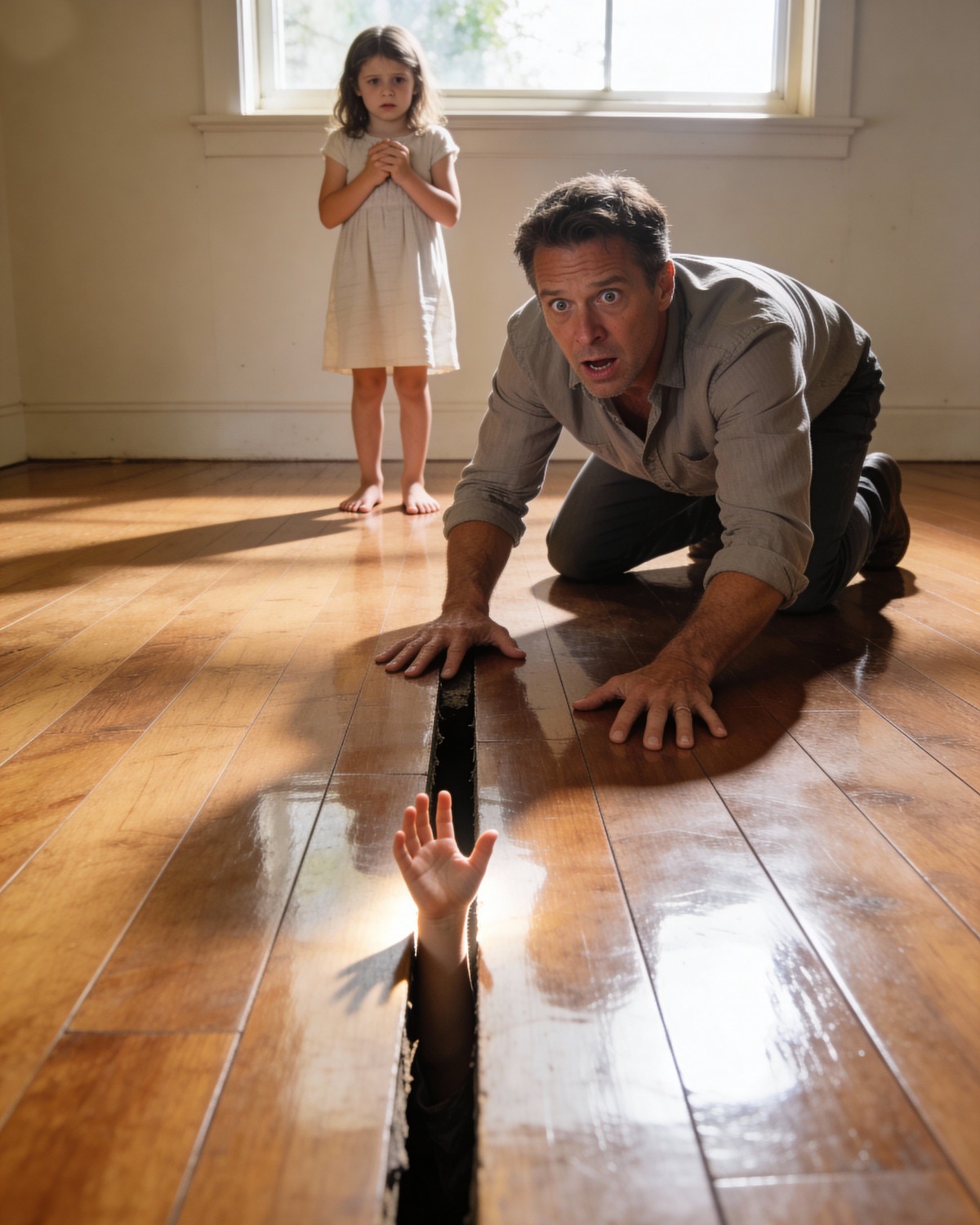
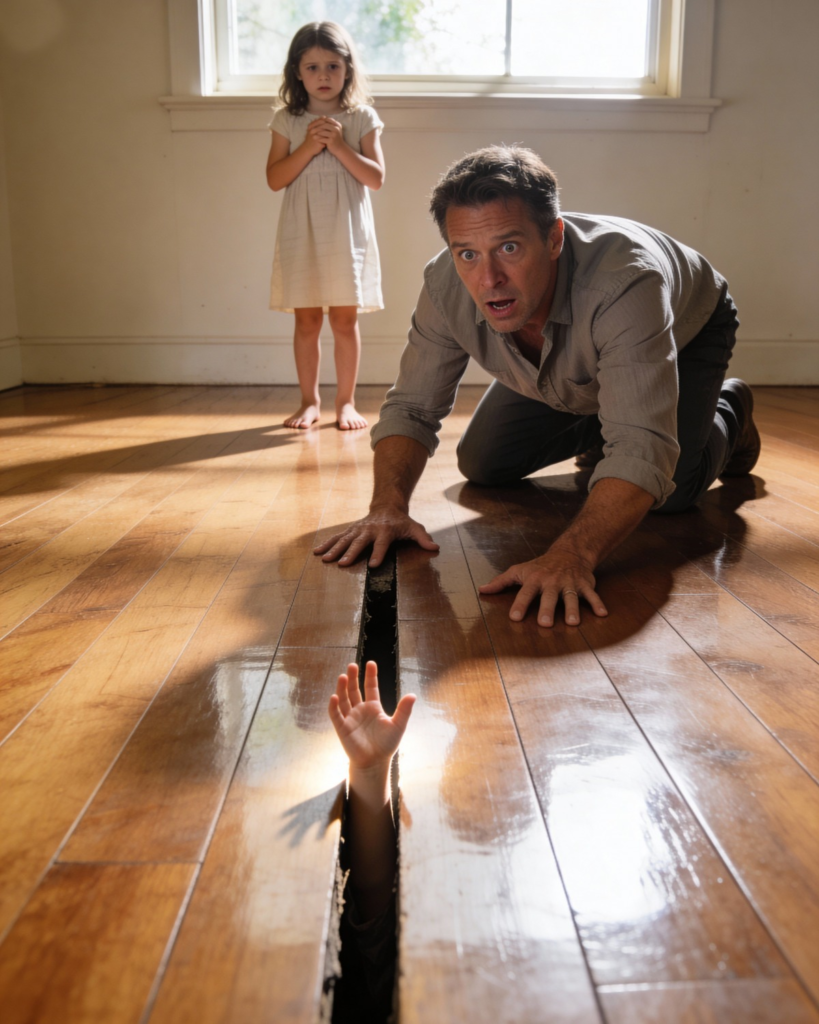
The moment my daughter pressed her ear to the floor, I knew something was wrong.
It wasn’t the way she knelt—children kneel all the time, curious about dust and ants and imagined secrets—but the way her body went completely still, as if the world above the hardwood had vanished. Lily was five years old, small and soft-spoken, the kind of child adults often underestimated because she didn’t demand attention. She simply absorbed everything around her, quietly, intensely.
We were standing in my sister Laura’s living room on a gray Sunday afternoon. The house was new—too new. Fresh paint clung to the air, sharp and clean, and the floorboards gleamed with the sterile perfection of something never meant to hold secrets. Laura had been proud of this place. A fresh start, she’d called it. After the divorce. After the long, ugly years that had drained something essential from her voice.
I wanted to be proud for her. I wanted to believe in fresh starts.
But Lily didn’t lift her head.
She pressed her cheek harder against the floor and began to cry.
Not loudly. Not theatrically. She cried the way people do when they’ve already understood something terrible and are waiting for the rest of the world to catch up.
“My brother is crying,” she whispered.
The sentence slid into the room like a blade.
I laughed before I could stop myself. A short, sharp sound that didn’t belong to me. “Sweetheart,” I said, forcing calm into my voice, “Ethan isn’t—”
She shook her head so hard her hair came loose from its clip. Tears soaked into the hardwood. “He’s under here, Daddy. He’s scared. He keeps calling you.”
Laura stood frozen near the kitchen doorway, her coffee mug trembling in her hands. I watched it slip from her fingers and shatter on the tile, the sound echoing too loudly in the quiet house.
That was when the sense I’d built my life on—order, logic, reason—began to fracture.
Ethan had been missing for a year.
A full year of police interviews, flyers stapled to telephone poles, search dogs, late-night phone calls that made my heart race and then collapse again. A year of his bed untouched, his shoes still by the door because I couldn’t bring myself to move them. A year of Lily asking why her brother didn’t come home anymore, and me lying because the truth was unbearable.
I knelt beside her, my knees protesting against the hard floor. “Lily,” I said quietly, “tell me what you hear.”
She closed her eyes, listening with a focus that made my chest tighten. “He says it hurts,” she whispered. “He says it’s dark. He says… please don’t leave.”
Something inside me snapped.
I didn’t stop to think. I didn’t call the police. I didn’t ask Laura for permission. I grabbed the nearest floor vent and ripped it free, splintering wood and skin alike. Cold air rushed out, stale and wrong, carrying a smell that didn’t belong in a living room.
I turned on my phone’s flashlight and aimed it into the darkness.
At first, there was nothing. Dirt. Dust. A crawlspace no one mentioned in the inspection reports.
Then the light caught movement.
A face.
Too thin. Too pale. Too familiar.
Ethan.
The world didn’t shatter. It vanished.
He squinted against the light like someone waking from a nightmare into something worse. His hair was longer than I remembered, matted and filthy. His cheekbones jutted sharply beneath skin that had forgotten what sunlight felt like. A metal cuff clamped around his wrist, a chain bolted into a beam like an afterthought.
“Dad,” he whispered.
I don’t remember screaming, but Laura told me later that I did.
I tore at the floorboards with my bare hands, pain registering somewhere far away as splinters dug into my palms. Lily clung to my arm, shaking but unafraid, as if she had always known this moment was coming.
“I’m here,” I kept saying. “I’m right here.”
Ethan’s body trembled when I climbed down into the crawlspace, the cold earth soaking through my jeans. The smell was overwhelming now—rust, sweat, fear trapped in wood and soil for months. I cupped his face, my hands shaking so badly I could barely feel him.
“Don’t let them take me back,” he whispered.
That single word—back—rewrote everything.
Police sirens arrived fast, slicing through the quiet neighborhood. Officers flooded the house, radios crackling, voices overlapping. Someone pulled me away, gently at first, then firmer when I resisted.
“He’s chained!” I shouted. “My son is chained!”
They saw it then. The cuff. The bolt. The undeniable evidence of captivity.
They cut the chain. Wrapped Ethan in a thermal blanket. Lily screamed when they lifted him, her small body rigid with panic.
“It’s okay,” Ethan whispered hoarsely to her. “You saved me.”
She nodded solemnly, as if this were simply a fact.
The investigation detonated like a bomb.
Laura’s house became a crime scene within hours. Forensics combed through every inch. Dogs barked and whined, confused by the scent of a living child buried like the dead. The media arrived by morning, their headlines hungry and merciless.
Laura sat on the curb, wrapped in a blanket, repeating the same words over and over.
“I didn’t know. I swear I didn’t know.”
I wanted to believe her.
But belief had become dangerous.
Ethan spent days in the hospital. Dehydrated. Malnourished. Infected. Silent. He slept only when I held his hand. When he finally spoke again, his voice barely carried the weight of truth.
“It was Uncle Mark,” he said.
Laura’s ex-husband.
The man who had helped us search. Who had cried with me. Who had driven Ethan away with promises of ice cream and safety.
The betrayal cut deeper than fear ever could.
Mark was arrested two days later. He confessed calmly, methodically, as if explaining a financial transaction instead of a crime. He had planned everything. The crawlspace. The soundproofing. The lies.
The trial took six weeks.
He was sentenced to life.
But sentences don’t erase scars.
A year later, we moved. New city. New floors. Lily still pressed her ear down sometimes, just to listen. Ethan slept with the light on.
And I learned a truth I never wanted to know:
Some houses don’t hide secrets.
They listen.
CHAPTER THREE: THE SILENCE AFTER THE SCREAMS
The house was empty again within forty-eight hours.
Not quiet—the pipes still hummed, the refrigerator clicked on and off, the wind brushed against the siding—but empty in the way places become after something unspeakable has happened inside them. Laura never went back. She couldn’t. The police sealed the property, then released it, then the bank took over, and eventually it became just another listing with professionally staged photos that hid everything beneath the floor.
Ethan didn’t ask about the house.
He didn’t ask about Mark either.
That frightened me more than any question ever could.
At the hospital, doctors spoke in careful layers. Physical recovery was possible. Psychological recovery would take time. Maybe years. Maybe a lifetime. Trauma didn’t obey schedules, they said. It rewired the brain. Especially in children.
Especially in children who had learned to survive in silence.
At night, Ethan woke screaming.
Not every night. That would have been easier to understand. It came without warning—two calm nights, then one where his body locked up like he was bracing for pain that hadn’t arrived yet. I slept on the floor beside his bed, my hand resting where he could find it in the dark.
Sometimes he grabbed it so hard my fingers went numb.
“I thought you forgot me,” he whispered once, staring at the ceiling. “He told me you stopped looking.”
My chest tightened so sharply I had to turn away.
“I never stopped,” I said. “Not for one second.”
Ethan nodded, but I could see he didn’t fully believe me yet. Trust, once broken, didn’t snap back into place. It had to be rebuilt slowly, piece by piece, like something fragile pulled from the dirt.
Lily stayed close to him, closer than she’d ever been before. She brought him toys, her favorite stuffed rabbit, her crayons. She climbed into his bed during visiting hours and pressed her head against his shoulder.
“I heard you every night,” she told him seriously. “You were crying, but you were also talking to me. That’s how I knew.”
Ethan looked at her with something like awe. “You heard me?”
She nodded. “The floor listened.”
The therapists didn’t know what to do with that.
They asked Lily gentle questions, tested her hearing, her cognition, her imagination. Everything came back normal. She was bright. Empathetic. Sensitive in a way that bordered on unsettling if you didn’t want to believe in anything beyond charts and explanations.
One doctor pulled me aside and lowered her voice. “Children sometimes express intuition in symbolic ways,” she said carefully. “It doesn’t mean—”
“I know,” I interrupted, more sharply than I meant to. “It doesn’t mean anything you can write down.”
She watched me for a moment, then nodded. “No. It doesn’t.”
The trial came faster than I expected.
Mark didn’t fight it.
That was the cruelest part.
He sat in court wearing a pressed suit, hands folded, listening as evidence was laid out piece by piece. The crawlspace. The chains. The soundproofing material he’d installed during renovations. The receipts. The lies.
When asked why, he shrugged.
“I needed control,” he said calmly. “And no one was watching.”
The words echoed through the courtroom like a verdict on all of us.
Laura testified through tears, her voice breaking when she admitted how little she’d questioned anything. How she’d trusted him. How she’d believed that a fresh start erased old patterns.
“I didn’t know,” she said again and again. “I didn’t know.”
I believed that she hadn’t known.
But belief didn’t erase consequence.
Mark was sentenced to life without parole.
No appeals.
No second chances.
When the gavel fell, Ethan didn’t react. He stared straight ahead, his face blank, his small hand tucked into mine.
“Is it over?” he asked quietly as we stood to leave.
“Yes,” I said. “It’s over.”
He nodded, accepting the answer the way children do when they’re too tired to argue with the shape of reality.
But trauma doesn’t end when a door closes.
It follows you home.
CHAPTER FOUR: WHAT WE BUILD AFTER
We moved three months later.
New city. New school. New house.
I chose a place without crawlspaces.
The first night, Lily pressed her ear to the floor out of habit. She frowned, then smiled.
“It’s quiet,” she said. “That’s good.”
Ethan slept with the light on for a long time. Then with the door open. Then, eventually, with the door closed but unlocked.
Progress didn’t arrive all at once. It came in moments so small they were easy to miss if you weren’t paying attention. Ethan laughing at a joke he didn’t force. Lily letting go of his hand for a full hour at school. A night without screams.
One afternoon, months later, Ethan asked if he could help me fix a loose floorboard in the hallway.
I froze.
He noticed immediately. “We don’t have to,” he said quickly. “I just—I want to know what’s under there.”
We lifted the board together.
Nothing.
Just space. Clean. Empty.
Ethan exhaled slowly, like someone laying down a weight he’d been carrying without realizing it.
“I think,” he said after a moment, “that monsters like dark places because people don’t look there.”
I nodded. “I think you’re right.”
Laura wrote to us from therapy. Long letters. Apologies without excuses. She didn’t ask for forgiveness. She said she was learning how not to look away from discomfort. How to question silence instead of trusting it.
Ethan read the letters when he was ready.
Lily drew pictures and taped them to the fridge—houses with windows and floors that smiled, stick figures holding hands, a little boy standing in the light.
One night, as I tucked them both in, Lily looked up at me.
“Daddy,” she said, “sometimes people think being quiet means being safe.”
I waited.
“But it’s not,” she continued. “Safe is when someone listens.”
I kissed her forehead, my throat tight.
“Yes,” I said. “That’s exactly right.”
Years from now, when people ask me how I found my son, I tell them the truth.
I didn’t.
My daughter did.
And I learned something I will carry for the rest of my life:
The world doesn’t always announce where evil hides.
Sometimes it waits beneath polished floors, counting on silence.
And sometimes, if you’re lucky, a child is brave enough to listen.
FINAL CHAPTER: THE FLOOR THAT REMEMBERS
Some houses forget.
They forget laughter, footsteps, arguments shouted down hallways. They absorb lives the way dry soil absorbs rain, leaving no trace once the surface dries. I used to believe that was mercy. That forgetting was how places healed.
I was wrong.
The house we moved into after everything was modest, almost aggressively ordinary. Beige siding. A narrow porch. Floors that creaked just enough to remind you they existed. The kind of place no one would ever write about. That was exactly why I chose it. I wanted walls that didn’t whisper. I wanted silence that didn’t hide anything underneath.
For a while, it worked.
Ethan went back to school with a quiet determination that broke my heart daily. He didn’t talk much about the year he lost, but he didn’t avoid it either. When teachers mentioned “time away,” he corrected them calmly. “I wasn’t away,” he said once. “I was trapped.” No drama. No self-pity. Just truth, delivered like a fact that no longer had teeth.
Lily remained Lily—watchful, gentle, unsettlingly perceptive. She stopped pressing her ear to the floor at night, but she started asking questions instead. Questions adults didn’t like because they arrived without warning and demanded honest answers. Why do people pretend they don’t hear things? Why do grown-ups ignore bad feelings? Why did no one come when Ethan was calling?
Those questions followed me into the quiet hours, into the moments when the house was asleep and I was left alone with the echo of my failures. Because love doesn’t erase guilt. It sharpens it. It reminds you of what you missed.
There were nights I sat on the hallway floor outside Ethan’s room, my back against the wall, listening to his breathing through the door. Not because I thought he would disappear again, but because some part of me needed proof that he was still there. That floors, this time, were only floors.
Therapy helped. Not in the miraculous way movies promise, but in the slow, grinding way real healing happens. Ethan learned words for sensations he had never named before. Fear that didn’t look like fear. Anger that disguised itself as exhaustion. Lily learned that listening didn’t mean carrying everyone else’s pain. That she could set it down.
I learned something harder.
That protecting children isn’t about watching them constantly. It’s about believing them immediately.
The trial faded into memory the way disasters do once the danger passes. News cycles moved on. Mark’s name became another file number, another story people half-remembered and misquoted at dinner parties. But the damage didn’t vanish with the headlines. It lived in Ethan’s reflexive flinch when a door slammed. In Lily’s sudden silence when adults laughed too loudly.
One afternoon, nearly two years after we moved, Ethan asked me something that stopped me cold.
“Do you think he knew I’d survive?” he asked.
“Knew who would survive?”
“Him,” Ethan said. “Do you think he thought I wouldn’t last a year?”
I didn’t answer right away. Some questions deserve space.
“I think,” I said finally, “he thought no one would look.”
Ethan nodded. “That makes sense.”
He went back to his homework, satisfied. I sat there longer, understanding something new. Evil doesn’t rely on strength. It relies on neglect. On the assumption that silence equals safety. That floors can hide anything if no one bothers to listen.
Lily learned to dance that year. Ballet, then contemporary. She loved movement, loved the way sound traveled through wood when she leapt and landed. One evening after a recital, she pressed her bare foot to the stage floor and closed her eyes.
“It’s happy here,” she said.
“What is?” I asked.
“The floor,” she replied simply. “It remembers good things.”
That was when it finally occurred to me that listening wasn’t about fear. It was about presence.
Years passed.
Ethan grew taller than me. Lily lost her baby teeth, then her awkwardness, then her patience for adults who dodged responsibility. We didn’t become a “stronger” family in the inspirational sense people like to use. We became quieter. More precise. We learned to pause when something felt wrong instead of talking ourselves out of it.
On the anniversary of Ethan’s rescue, we started a tradition. No speeches. No candles. We pulled up one loose floorboard in the garage—the only place I allowed one to remain unfinished—and looked underneath together.
Nothing was ever there.
That mattered.
The final letter from Laura came years later. She didn’t ask to be part of our lives. She didn’t ask for absolution. She wrote about accountability, about the cost of choosing comfort over curiosity. About how she now volunteered at shelters, listening instead of fixing.
“I thought love meant trust without questions,” she wrote. “Now I know love means asking even when you’re afraid of the answers.”
I never replied. Some letters don’t need answers. They need witnesses.
The night Ethan left for college, Lily pressed her ear to his empty bedroom floor. She smiled, then stood.
“He’s okay,” she said. “He’s loud now.”
I laughed—really laughed—for the first time in a long while.
When people hear our story, they ask about Lily’s gift. They want explanations. Labels. A way to categorize what saved my son so they can file it neatly under something safe.
I don’t give them one.
Because the truth is simpler and harder to accept.
Children speak in ways adults train themselves not to hear. They notice shifts, silences, wrongness. They listen without bias. And when they say something is wrong, they are almost always right.
The world didn’t change because I tore up a floor.
It changed because, for once, I listened.
And now, every time I walk into a room, I ask myself a single question—one that will follow me for the rest of my life:
If someone were crying beneath this place, would I hear them?
And more importantly—
Would I act?
