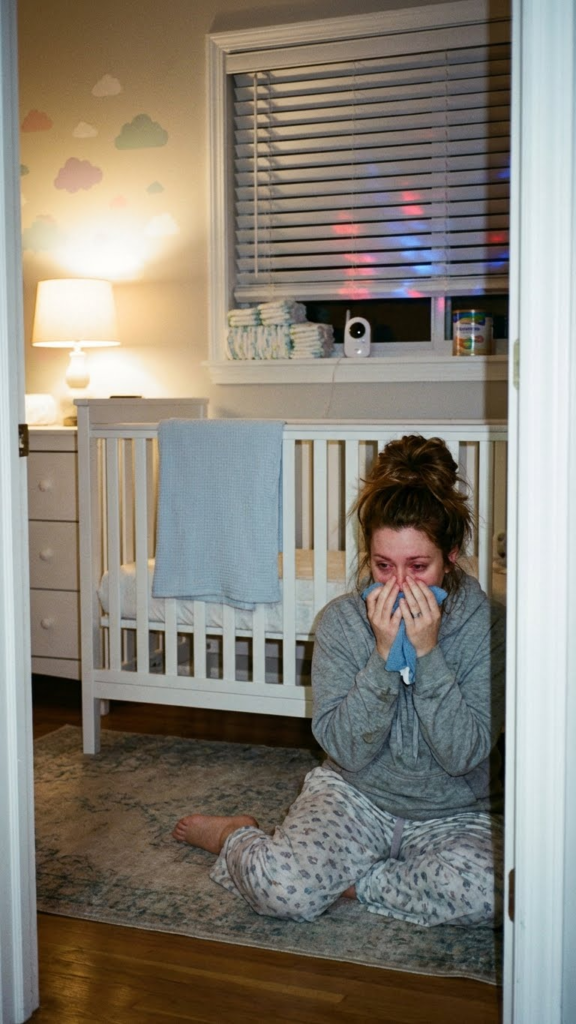
I used to think the worst thing that could happen to a parent was watching your child suffer.
I was wrong.
The worst thing is believing your baby went to sleep peacefully… only to have someone look you in the eye and ask a question that makes you doubt your own memories.
I still remember the night the way people remember the smell of rain or the sound of their childhood home settling. It’s not sharp anymore. It’s blurred at the edges, like an overexposed photograph.
Noah was three months old.
Three months of midnight feedings, of pacing the living room with him pressed against my chest, of Googling every rash and hiccup. Three months of learning how to love a human being more than my own lungs.
That night was nothing special.
That’s what haunts me.
I fed him at 10:43 p.m. I remember because I checked my phone while he nursed. There was a notification from my sister about her baby shower planning. I remember thinking how unfair it was that she was complaining about balloon colors when I hadn’t slept more than four hours in a row since Noah was born.
I changed his diaper. I kissed the soft place above his eyebrow that always smelled like milk. I laid him in his crib, swaddled, the same way I had every night since we brought him home.
Then I went to bed.
When I woke up at 3:17 a.m., the house felt wrong.
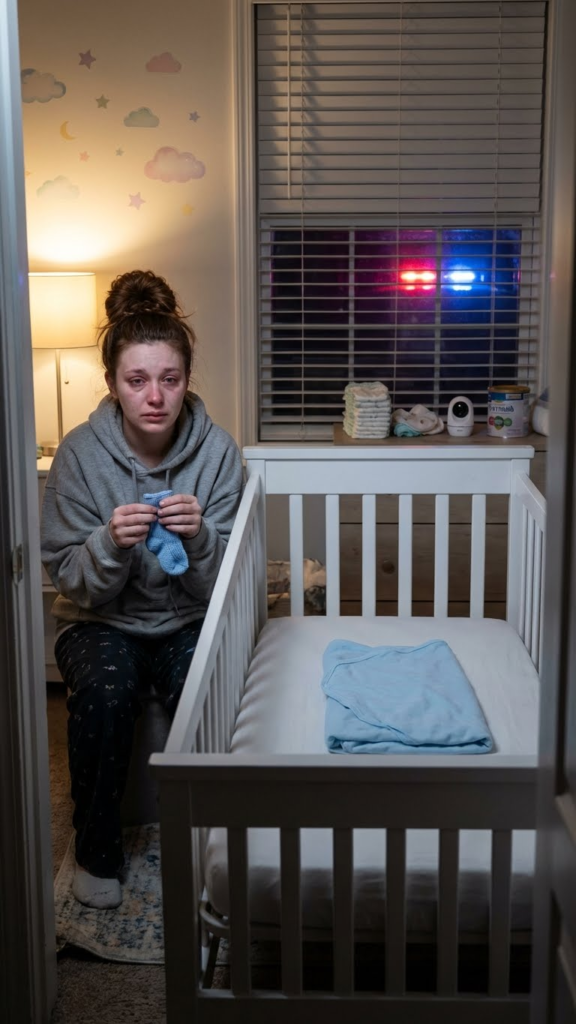
Mothers know what I mean. There was no sound on the baby monitor. No snuffling, no soft baby grunts. Just static.
I remember whispering, “Noah?” even though I was alone in my bedroom.
I walked into his nursery still half-asleep, already forming excuses in my mind. The monitor probably glitched. He was probably sleeping deeply for the first time in his life.
He was lying exactly where I left him.
Only he wasn’t breathing.
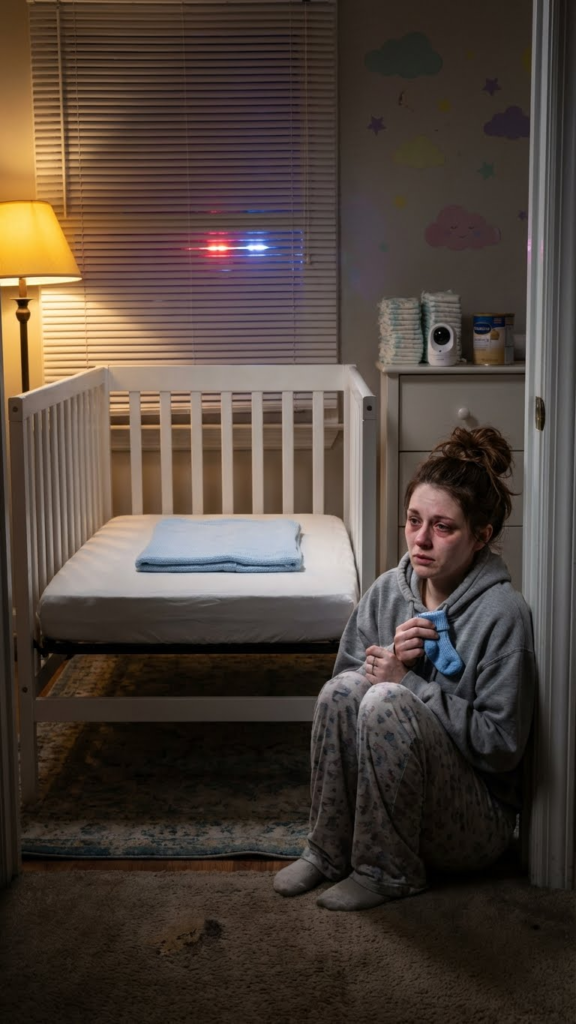
At first, my brain refused to understand what my eyes were seeing. I picked him up, annoyed more than afraid, thinking he’d just rolled onto his side or gotten tangled in the swaddle.
His body was warm.
That was the part that fooled me.
Warm meant alive. That’s what I thought. I pressed my face into his neck and said his name louder.
“Noah. Hey. Noah, baby.”
Nothing.
I started screaming before I realized I was screaming.
I don’t remember calling 911. I don’t remember what I said. I only remember that my voice didn’t sound like it belonged to me.
The paramedics were kind. That’s the only word I can use. They were fast, and gentle, and professional, and it still wasn’t enough.
They worked on him in my living room while I sat on the floor holding his tiny sock in my fist, whispering promises I couldn’t keep.
When they finally stopped, one of them shook his head.
I didn’t hear anything after that. My ears were ringing. My chest felt hollowed out like a tree after lightning strikes it.
They said the words “SIDS” before they said anything else.
Sudden Infant Death Syndrome.
No warning. No explanation. No one to blame.
It was the kindest lie they could offer me in that moment.
The police came later.
I didn’t understand why they needed to. My baby had died. Wasn’t that enough? Didn’t that tragedy stand on its own?
Two officers sat at my kitchen table while a neighbor held my hand so tightly her knuckles turned white.
They asked about Noah’s birth. His health. My pregnancy. His feeding schedule. Where he slept. What he wore.
It felt like an interview for the worst job in the world.
I answered everything automatically, like I was reciting facts about a stranger.
Then one of them looked up from his notebook and asked:
“Did anyone else have access to Noah tonight?”
The room tilted.
I said no, of course not. It was just me. My husband was on a business trip. He’d left that morning. He wouldn’t be back until the weekend.
The officer nodded slowly.
Then he asked the question.
“Are you sure no one else was in the house?”
I actually laughed. A hysterical, broken sound ripped out of me before I could stop it.
“Are you saying someone broke in and killed my baby?” I asked.
He didn’t say yes.
He didn’t say no.
He just said, “We have to ask.”
They let me go to the hospital to see Noah.
I wasn’t prepared for how small he looked under those bright white lights. He didn’t look like my baby anymore. He looked like a doll someone had forgotten to wind.
I held his hand and told him I was sorry.
I didn’t know what I was apologizing for. Everything, I guess.
When I got home, the house felt radioactive. I couldn’t step into the nursery. I couldn’t throw away the pumped milk in the fridge. I couldn’t move the swing still swaying faintly from where the paramedics had bumped it.
That night, I slept on the couch with all the lights on.
At 2:41 a.m., my phone buzzed.
It was my husband.
I stared at his name on the screen for a full thirty seconds before answering. I didn’t know how to say the words. There’s no script for that phone call.
I finally said, “Noah’s gone.”
He made a sound like something breaking inside his chest.
The next morning, he flew home on the first available flight.
When he walked through the door, I expected to collapse into his arms. Instead, we just stared at each other like strangers who shared a crime scene.
The police came again that afternoon.
This time they were less gentle.
They asked the same questions, but differently. More precise. More pointed.
What position was Noah in when I found him?
What was I wearing?
Had I been drinking?
Had I taken any medication?
I started shaking halfway through. My husband interrupted, his voice suddenly sharp, asking why this was necessary.
One of the officers cleared his throat and said, “The autopsy is standard procedure.”
Standard procedure.
Like an oil change. Like renewing your license.
They took Noah away for it.
I screamed into a pillow until I couldn’t breathe.
Two days later, the officer called.
He said the medical examiner hadn’t finalized the report yet, but there were “inconsistencies.”
That was the word.
“Inconsistencies.”
I asked what it meant. He said they’d explain in person.
When they arrived, they didn’t sit at the kitchen table this time. They stood in the living room like they didn’t want to touch anything.
The same officer who had asked about other people being in the house looked at me with something I couldn’t name. Pity, maybe. Or suspicion.
He said, “We’re having trouble confirming SIDS as the cause of death.”
My heart started hammering so hard I thought I might faint.
“What do you mean trouble?” I asked.
He flipped open his notebook.
“Based on the preliminary findings, there were no indicators of respiratory distress prior to death.”
I didn’t know what that meant, so I said, “Isn’t that what SIDS is?”
He hesitated.
“There are usually signs of struggle,” he said carefully. “Or at least signs the infant attempted to breathe.”
I looked at my husband. His face had gone gray.
The officer inhaled slowly, then asked:
“Did Noah ever sleep in your bed?”
I felt something cold crawl up my spine.
“No,” I said too fast. “Never.”
The word echoed in the room like a dropped glass.
He didn’t write anything down.
He just looked at me.
And that’s when I knew the question he’d asked wasn’t about Noah at all.
It was about me.
That night, I lay awake replaying every moment of the past week. Every night feeding. Every time I’d held him while I was half asleep. Every time I’d felt his warm weight against my chest at 2 a.m. and thought, Just five more minutes.
I started remembering things I didn’t want to remember.
Like how exhausted I’d been the night before he died. How I’d brought him into bed with me while I scrolled my phone, telling myself I’d move him back to the crib when my eyes stopped burning.
I didn’t remember doing it that last night.
But I couldn’t remember not doing it either.
I walked into the nursery at 4 a.m. and stood over his empty crib, trying to picture him there. Trying to force the memory into place.
All I could see was the blur of his blanket against my sheets.
The next day, the police came back.
They asked me to walk them through the night again. Minute by minute.
I did.
They asked me why I’d said “never” so quickly when they asked about co-sleeping.
I said because I was scared.
They asked me what I was scared of.
I didn’t answer.
By the end of the week, my friends had stopped bringing casseroles. My family stopped calling. Everyone was waiting to see which version of the story would win.
The grieving mother.
Or the negligent one.
The officer called again on Friday.
He said they’d need me to come down to the station for a formal statement.
I asked if I was in trouble.
There was a long pause before he said, “We’re just trying to understand what happened to your son.”
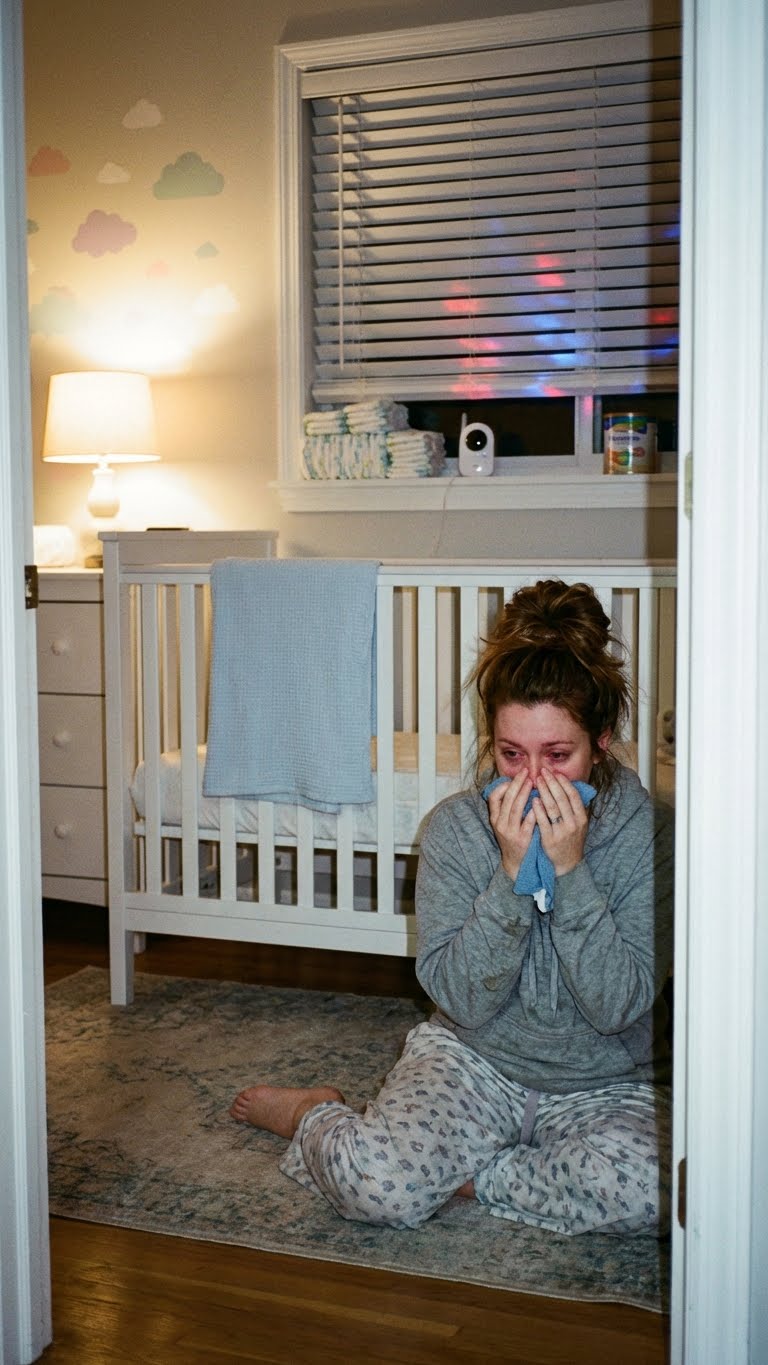
I hung up and slid down the wall until I was sitting on the floor, my back pressed against the nursery door.
I finally opened it.
The room smelled like baby lotion and dust.
I picked up his swaddle and pressed it to my face.
That’s when I realized something.
The swaddle was folded.
I always left it crumpled in the crib.
Always.
I stared at it, my pulse roaring in my ears, as the officer’s first question replayed in my head:
Are you sure no one else was in the house?
And for the first time since Noah died, I didn’t know the answer.