I didn’t know fog could be loud until that morning.
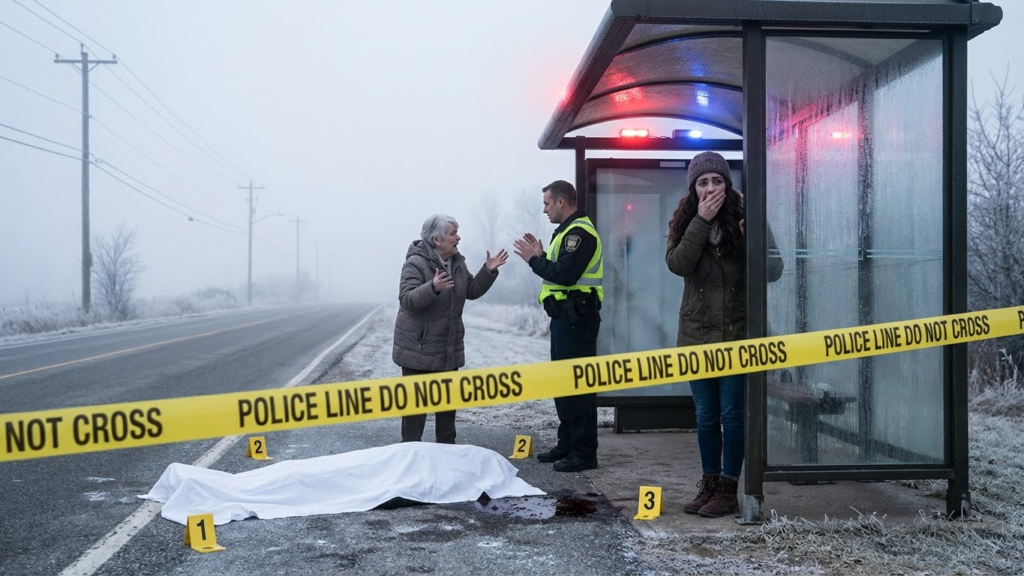
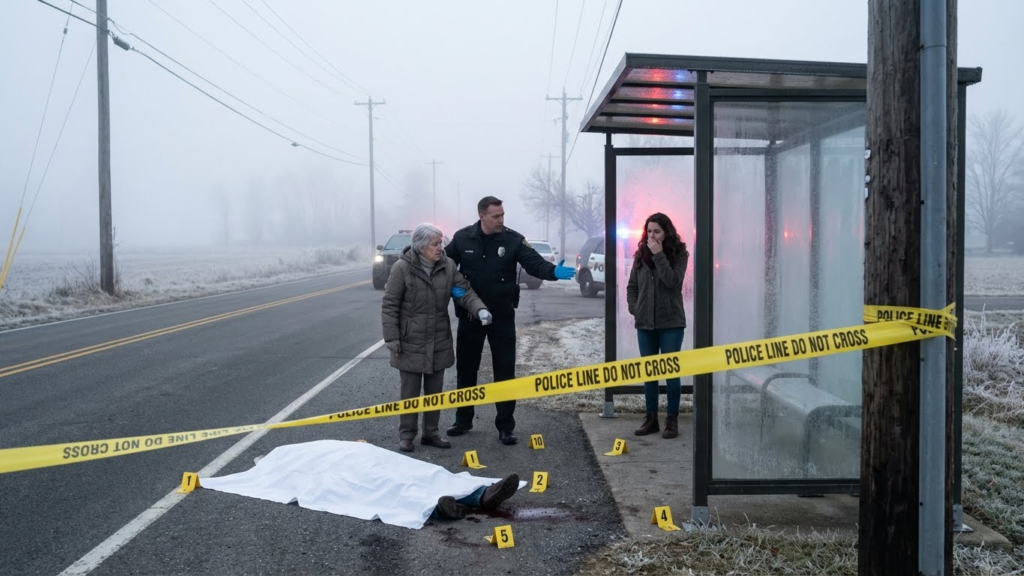
It swallowed everything—sound, color, common sense. Even the police lights didn’t look real, just pale red and blue ghosts sliding over the metal roof of the bus stop like reflections in a dream you can’t wake up from.
My mother was screaming.
Not crying. Not sobbing quietly the way people expect old women to do in tragedy. She was yelling, hoarse and furious, at a police officer half her age, jabbing her finger into the cold air as if she could stab the fog itself.
And I stood behind the bus shelter’s glass wall, hands shoved into my jacket pockets so hard my knuckles went numb, pretending I didn’t know what was under the white sheet twenty yards away.
Because I did.
I knew exactly who it was.
And I knew why he was there.
And if I said a single word, my family would never recover.
I should probably explain how I ended up watching my mother unravel in front of a crime scene at 7:18 a.m. on a Tuesday in November.
This wasn’t even my bus stop.
I don’t live out on County Route 6. I live ten minutes away, closer to town, where there are sidewalks and coffee shops and cell service that doesn’t vanish when the weather turns moody. I only came here because my mother insisted on riding with me that morning.
“Just this once,” she said, already putting on her coat. “My car’s making that noise again.”
It wasn’t. She’d had the transmission replaced six months earlier and wouldn’t stop bragging about it to anyone who would listen. But my mother has never liked being alone with her thoughts, especially not lately.
So I let her tag along. We were supposed to stop at the diner afterward for pancakes. She’d been talking about it since Sunday.
I pulled off to the side of the road because she suddenly grabbed my arm and told me to stop.
“There’s something wrong up there,” she said.
At first I thought she meant a deer. Fog like that messes with depth perception. You see shapes where there aren’t any. But then I saw the tape.
Yellow. Stretched across the shoulder like a line someone had drawn in a panic.
And beyond it—
I didn’t get a clear look at the body. Not really. I didn’t need to.
The way the sheet lay uneven, heavier at the feet. The way the road around it was darker. The way my mother sucked in a breath that sounded like a cracked bell.
I should have driven away.
That was my first mistake.
The officer arrived fast, as if he’d been hiding in the fog waiting for us. He told us to step back, to stay behind the tape. He was doing that calm-cop voice, the one that sounds reasonable but doesn’t leave room for argument.
My mother argued anyway.
She demanded to know what happened, demanded to know why the road was blocked, demanded to know why no one had told her anything.
She’s always been like that—loud, unfiltered, fearless in the way only people with nothing left to lose can be.
But this wasn’t her normal bluster. This was panic dressed up as anger.
And the whole time she was yelling, I was staring at the sheet and thinking about a man named Ray.
I met Ray last spring.
I hadn’t planned to. I wasn’t looking for new friends. I’d just gotten out of a relationship that left me allergic to the word “trust.” But he was there every morning at the coffee counter at Murphy’s, already paid, already smiling like he’d been waiting just to see me.
He wasn’t handsome in the way men on dating apps are handsome. He had crow’s feet and thinning hair and a limp he never talked about. But he was kind. Patient. He remembered the name of my dog even though I only mentioned it once.
He started sitting at my table.
I should have said no.
I didn’t.
We talked about nothing at first—weather, traffic, the way the town was shrinking. Then about our families. Then about the things you only tell people when you don’t expect to keep them in your life.
Ray told me he used to work construction, that his back was shot, that he took buses now because driving hurt too much.
I told him my mother was living alone since my dad died, that I checked in on her more than I wanted to admit, that sometimes I felt like I was raising the woman who raised me.
We didn’t exchange numbers for weeks.
And when we did, it felt like something small.
It wasn’t.
The officer kept trying to calm my mother down, hands open, voice raised just enough to carry through the fog.
“Ma’am, I need you to lower your voice.”
“I have a right to know what happened on my road!”
“This is an active investigation.”
“Active investigation? My God, you’d think you’d tell people when there’s a dead man by the bus stop!”
I flinched.
Because she said it like she already knew.
And maybe she did.
My phone buzzed in my pocket.
I didn’t have to look to know who it was from.
Ray.
The last text he sent me was at 5:42 a.m.
I’m sorry. I shouldn’t have dragged you into this. Please don’t come looking for me.
I hadn’t replied.
I’d started seeing Ray outside the coffee shop.
Not dates, exactly. Walks. Rides on the bus when my car was in the shop. He never invited me to his place. He never came to mine. It was like he was careful not to leave fingerprints on my life.
I didn’t realize that’s what he was doing.
One night in September, he asked me to meet him at the bus stop on County Route 6.
I laughed.
“That place is in the middle of nowhere.”
“That’s why,” he said.
We stood under that same shelter, mosquitoes buzzing even though it was cold, the road empty except for the occasional semi howling through the fog.
He told me he’d been getting calls.
From my mother.
My stomach dropped.
He showed me the voicemails. Not threatening. Not cruel. Just… desperate.
She asked him questions about me. Where I was working. Who I was seeing. Whether I seemed happy.
She said she was just worried.
“I didn’t give her anything,” he said. “I swear.”
I believed him.
But that wasn’t the worst part.
The worst part was when he told me he knew my father.
Not socially. Not well. But enough.
Enough to know things I’d spent my entire adult life pretending weren’t real.
My dad died three years ago from what everyone called a “sudden cardiac event.”
He was mowing the lawn, collapsed, and that was that.
Except Ray said he’d been at a bar with my father the night before he died.
And my father had been drinking like a man trying to erase something.
Ray said my father told him he was scared.
Scared because someone was going to come asking questions about a woman who used to live down on County Route 6.
A woman who disappeared in the late nineties.
A woman whose name I recognized immediately because it was burned into my childhood like a fairy tale gone wrong.
I’d asked my mother about her once, when I was twelve.
She slapped me.
Not hard. But hard enough to tell me I’d crossed a line that didn’t exist anywhere else.
The officer finally told my mother she needed to step away or he’d escort her to the car.
She laughed in his face.
“I’m not going anywhere until someone tells me what happened to him.”
“Him?” the officer asked.
My heart stopped.
She realized what she’d said and covered it with another outburst, waving her hands and complaining about how everyone in this town thinks they can keep secrets from her.
But the damage was done.
He looked at me then.
Really looked at me.
And I knew he saw something I hadn’t meant to show.
Ray had said he was trying to make things right.
That he’d been carrying this weight since the night my father drank himself stupid and talked about a woman in a yellow jacket who wouldn’t stop screaming.
I didn’t want to hear it.
I didn’t want to believe my father had anything to do with someone disappearing.
And I definitely didn’t want to believe my mother knew more than she ever told me.
But Ray kept digging.
He filed a request for old records. Asked questions. Stirred things up in places that had settled into silence decades ago.
And then my mother started calling him.
I think she recognized his name.
I think she knew exactly who he was the moment she saw it.
Standing there in the fog, watching her fall apart, I understood something I’d been too afraid to admit:
She wasn’t screaming because a stranger was dead by the bus stop.
She was screaming because the past had finally found us.
And it was wearing a white sheet.
The officer asked me if I knew the victim.
I shook my head.
It was the easiest lie I’ve ever told.
Because it wasn’t really a lie.
I didn’t know the man under that sheet anymore.
I knew the man who laughed with me at Murphy’s, who saved me a seat on the bus, who apologized for things I didn’t understand until it was too late.
I didn’t know the one who decided to die where my mother couldn’t avoid him.
And I’m terrified of what happens when they lift that sheet and start asking the right questions.
Because the truth I’m hiding isn’t just about Ray.
It’s about a woman who vanished twenty-five years ago.
It’s about a father who drank himself into an early grave.
And it’s about a mother who is screaming at the police because she knows this time, there won’t be anywhere left to hide.