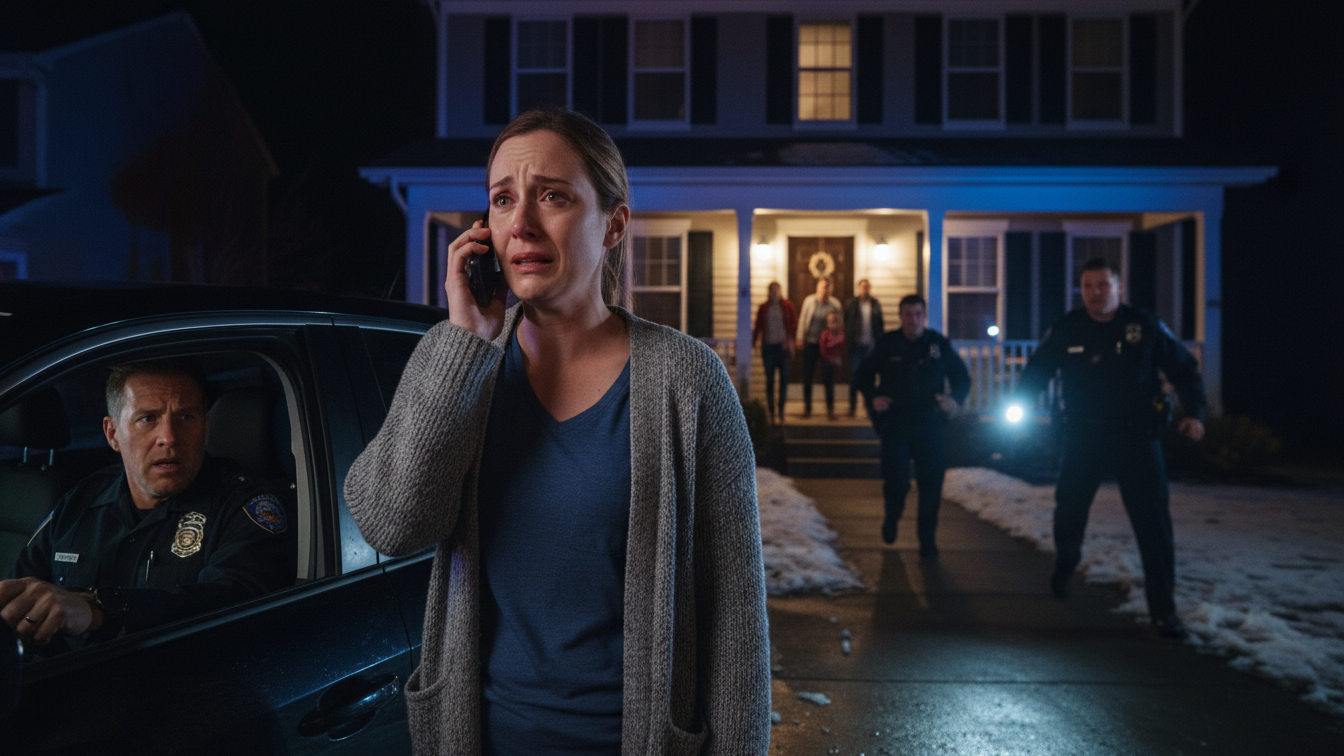
I was already crying before he said the words.
We were sitting in my parents’ driveway, the engine still running, the headlights cutting two pale cones across the dead winter grass. Snow from last week’s storm had melted into gray slush along the curb. The house looked exactly the way it always had—beige siding, white porch rails, warm lights glowing like everything inside was normal.
It wasn’t.
My husband, Mark, was in the driver’s seat, gripping the steering wheel so hard his knuckles had turned white. His jaw was tight, his eyes fixed on the front door.
“You need to call 911,” he said quietly.
I shook my head, my phone already slippery in my hand. “You don’t understand.”
He turned to me. “Your mom said something’s wrong. Your dad isn’t answering. Your sister is screaming in the background. What else is there to understand?”
Because I knew.
Or at least, I knew enough to be terrified.
The phone buzzed in my palm again. A missed call from Mom. Then a text.
Please hurry. Don’t tell anyone yet.
Don’t tell anyone yet.
That sentence had been the unofficial motto of my childhood.
I grew up in this house. Every birthday, every holiday, every forced family photo happened under that porch light. From the outside, we were the perfect suburban family—church on Sundays, matching pajamas on Christmas morning, my dad coaching Little League, my mom baking casseroles for sick neighbors.
But there were things we never talked about.
Like how my dad would disappear into the basement for hours, and if anyone tried to follow him, Mom would snap, “Leave your father alone.”
Or how certain doors in the house were always locked, even when no one was inside.
Or how my younger sister, Emily, stopped sleeping in her bedroom when she was thirteen and started camping out on the couch instead.
When I asked her why, she just said she liked the TV noise.
We learned early: questions made things worse.
The call finally connected. My mother’s voice came through, thin and frantic.
“He locked himself in again,” she whispered.
My stomach dropped. “Mom… what does that mean this time?”
“I shouldn’t have said anything,” she said. “Just—just come inside. Don’t call the police. We can handle it.”
Mark leaned closer. I put the phone on speaker.
“Mrs. Harris,” he said, trying to keep his voice steady. “You’re asking my wife to come into a situation you won’t explain. That’s not okay.”
There was shuffling on the other end. A door slamming. Then Emily’s voice, shrill with panic.
“He broke it, Mom! There’s blood everywhere!”
The line went dead.
I stared at the screen. Mark was already opening his door.
“That’s it,” he said. “We’re calling.”
I grabbed his sleeve. “Wait. Please. You don’t know my dad.”
“That’s the point,” he snapped. “I don’t know him, and right now I don’t trust him.”
My chest tightened. I pressed the phone to my ear, trying to call back, but it went straight to voicemail.
I could already see the porch light flickering as shadows moved behind the frosted glass.
My family was inside that house.
My family — the same people who had trained me my entire life to pretend nothing was wrong.
When we finally stepped out of the car, the cold hit me like a slap. The air smelled like wet leaves and exhaust. I walked a few steps toward the house, my heart hammering so loud I could hear it in my ears.
“Call,” Mark said again, more urgently.
I lifted my phone. My hands were shaking so badly I almost dropped it.
But then the front door creaked open.
Mom stepped onto the porch. Her hair was half-falling out of its clip, mascara streaked down her cheeks. Behind her, I saw Emily clinging to the banister, her hoodie splattered with something dark.
Blood.
Mom raised a trembling hand. “Don’t,” she mouthed.
I couldn’t move. Couldn’t breathe.
Mark didn’t hesitate. He hit the call button.
While the phone rang, memories flooded back — memories I’d spent years pretending were normal.
The time Dad punched a hole through the pantry door and Mom told us it was “just stress.”
The night Emily slept in my bed, shaking, refusing to say why.
The locked basement door.
The way Mom would clean for hours whenever Dad had one of his “episodes.”
I always thought the worst thing about my family was silence.
I was wrong.
The operator answered. Mark took the phone and started explaining, his words tumbling over each other. Domestic disturbance. Possible injury. Children in the house.
Mom rushed down the steps toward us, slipping on the icy concrete.
“Why did you do that?” she cried. “You don’t know what you’ve done.”
“What he’s done?” Mark shot back. “Your daughter is covered in blood!”
“That’s not—” She stopped herself, glancing back at the door.
Emily let out a sob.
Then we heard it.
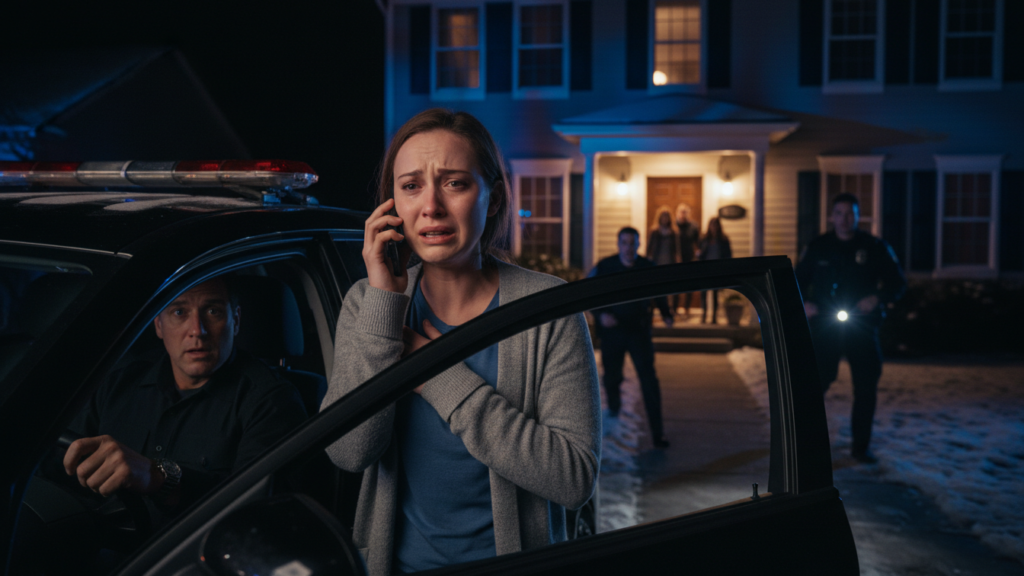
A crash from inside the house. Something heavy being thrown. A muffled roar of rage that made my skin prickle.
Mom grabbed my arm. “Your father is sick,” she said desperately. “If the police come, they’ll take him. You know what that will do to him.”
My throat closed. “Mom, what is happening in there?”
She opened her mouth — and then the basement door slammed so hard the porch railing rattled.
That was when I realized something was very, very wrong.
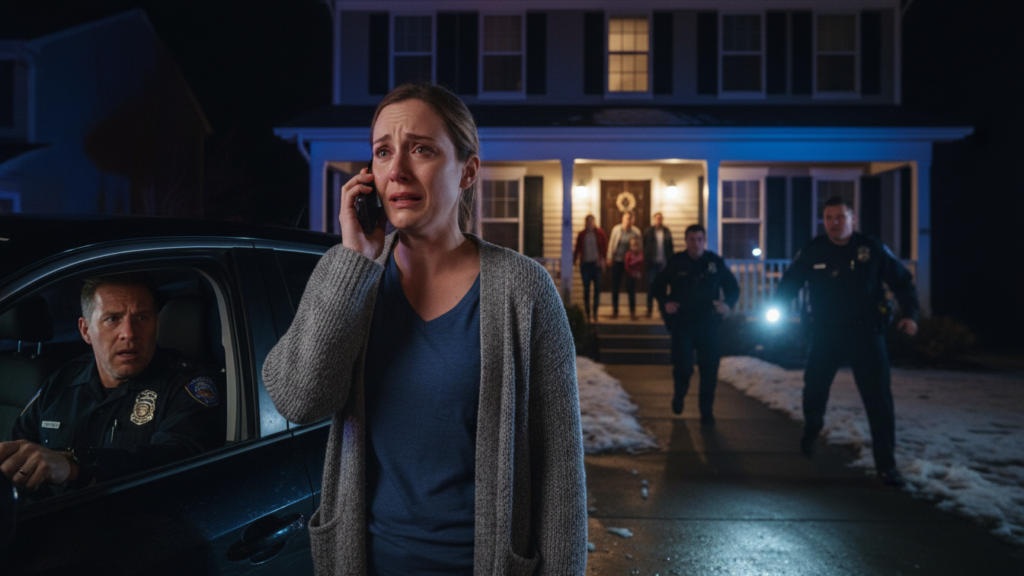
The police arrived faster than I expected. Red and blue lights flooded the yard, bouncing off the windows, turning our beige house into something unreal.
Two officers jumped out of the cruiser and sprinted toward the porch, flashlights already raised.
Mom started screaming. Emily collapsed against the wall. Mark pulled me behind him.
I was still crying into my phone, even though the call had ended.
Because I knew what was waiting inside that house.
And I knew that once those officers crossed the threshold, there would be no more pretending.
No more silence.
No more “don’t tell anyone yet.”
Whatever my father had been hiding in the basement was about to come out — and it was going to tear my family apart.