The Night Everything Unraveled
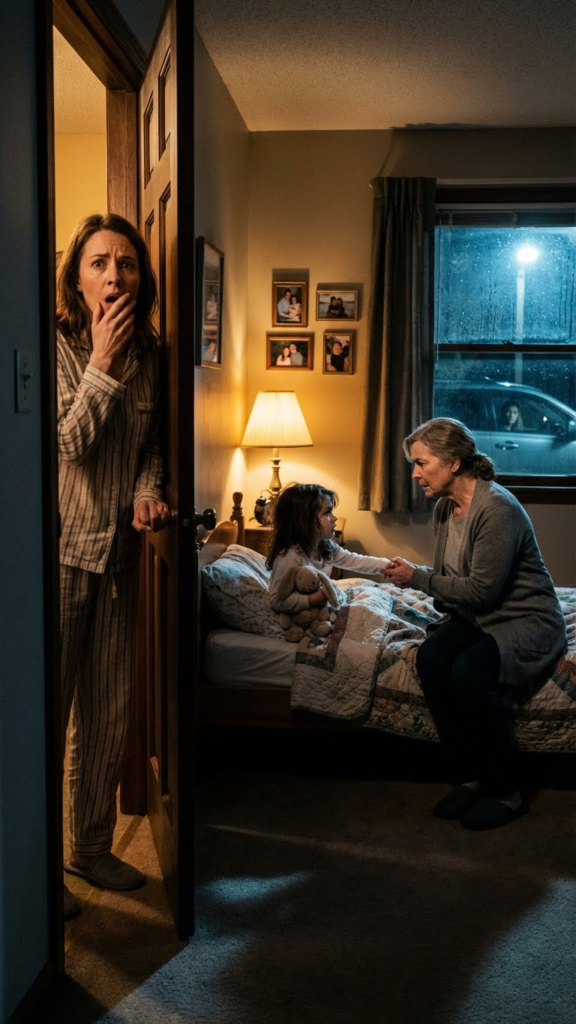
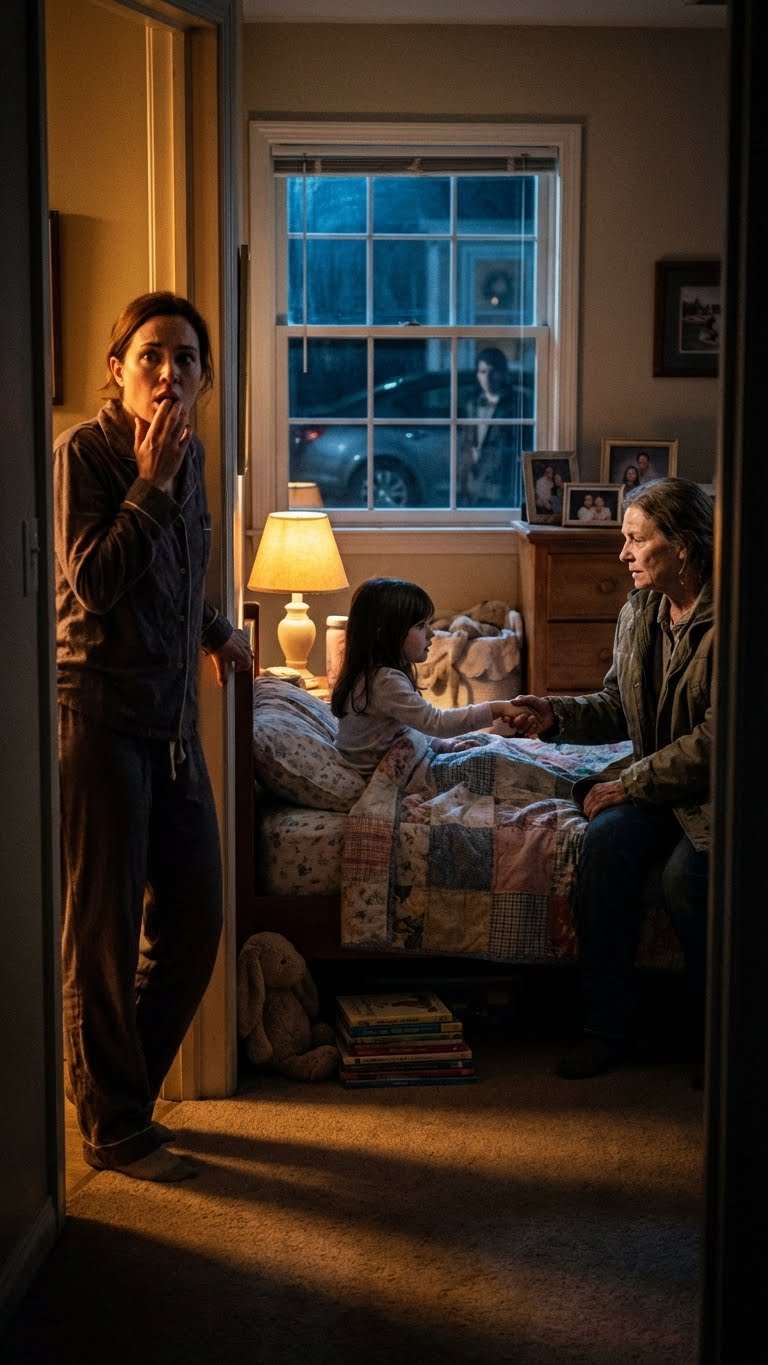
I stood frozen in my daughter’s doorway at 2 AM, watching a homeless woman I’d hired out of desperation three weeks ago do something that made my blood run cold.
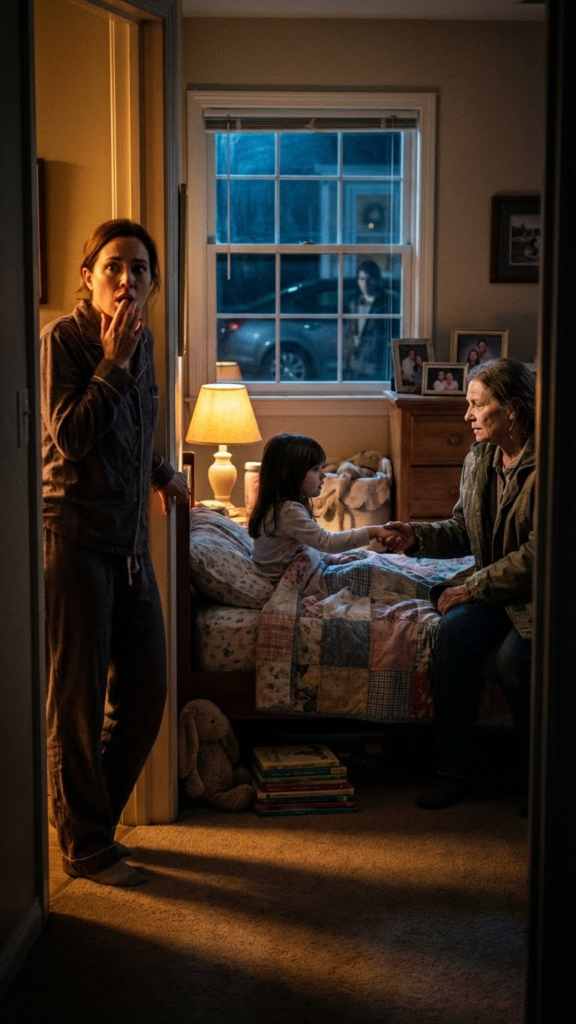
Emma—my five-year-old daughter who hadn’t spoken a word since her father died eight months ago—was sitting up in bed, talking. Actually talking. Her small voice filled the room as she whispered to Margaret, our new nanny, who sat on the edge of the bed holding Emma’s hand.
But it wasn’t the talking that made me grip the doorframe so hard my knuckles went white.
It was what Emma was saying.
“Daddy didn’t fall, did he? Someone pushed him.”
Margaret’s response was barely audible, but I heard every word. “Yes, sweetheart. Someone pushed him. And I know who.”
The world tilted. My husband David’s death had been ruled an accident. He’d fallen down the stairs at his office building after working late. No witnesses. No evidence of foul play. Just a tragic accident that destroyed our family.
Except now this woman—this stranger I’d found sleeping in a park and hired because Emma had somehow connected with her when she’d rejected fourteen other nannies—was telling my daughter it was murder.
And Emma, who’d been completely nonverbal since David’s funeral, was talking about it like she’d known all along.
I’d hired Margaret three weeks ago in an act of pure desperation. Emma had systematically rejected every nanny the agency sent. She’d scream, throw things, refuse to eat or sleep when they were around. The agency finally said they couldn’t help me anymore. I was at my breaking point—a single mother with a traumatized child, working eighty-hour weeks trying to keep David’s company afloat, drowning in grief and responsibility.
Then I saw Margaret in the park. She was probably in her sixties, weathered but dignified, sleeping on a bench with her belongings in a shopping cart. Emma had wandered over to her while I was on a work call, and when I looked up panicked, I saw my daughter sitting next to this homeless woman, letting her read a picture book to her.
It was the calmest I’d seen Emma in months.
I did something crazy. I offered Margaret a job on the spot. Room and board plus salary to be Emma’s nanny. She’d looked at me like I’d lost my mind, but she’d said yes. And for three weeks, it had been working. Emma ate. Slept. Stopped screaming. She still didn’t talk, but she was better.
Until tonight, when I came upstairs to check on them and heard the impossible.
Now Margaret was looking directly at me, still holding Emma’s hand, and her expression was knowing. Calculating. Like she’d been waiting for me to overhear.
“Mrs. Bennett,” she said quietly. “I think we need to talk about how your husband really died. And about the person who’s been watching your house every night for the past three weeks.”
I looked at Emma, whose eyes were wide and trusting as she looked at Margaret. Then at Margaret, whose face showed a strange mix of compassion and something harder. Something that looked like justice.
“Emma, sweetie, go back to sleep,” I managed to say, my voice shaking. “Margaret and I need to talk downstairs.”
“It’s okay, Mommy,” Emma said—spoke, used words, my baby who’d been silent for eight months. “Margaret knows the truth. She’s been helping us.”
Helping us. What did that mean?
The Fourteen Failed Nannies
To understand how we got here, you need to know about the three months of hell that preceded Margaret’s arrival.
David died in April. Fell down a concrete stairwell at his tech company’s office building at 11 PM on a Tuesday. The security footage showed him entering the stairwell alone. The camera covering the actual stairs had mysteriously malfunctioned that week—something about water damage from a roof leak.
He was found the next morning by a janitor. Broken neck, massive head trauma. The police investigated briefly, found no signs of foul play, ruled it an accident. “He probably tripped,” the detective said. “Maybe his phone rang, he got distracted. Happens more often than you’d think.”
I was devastated but I accepted it. David had been stressed, working late constantly, trying to close a major deal. He could have been distracted. Could have missed a step.
Emma, though. Emma stopped talking the day we buried him.
The child psychologist said it was selective mutism triggered by trauma. Said Emma needed time, therapy, stability. Said she’d talk when she felt safe again.
But Emma didn’t just stop talking. She became hostile to everyone except me. Especially to caregivers. I had to go back to work—David’s company needed me, and we needed the income—so I hired a nanny.
Nanny #1 lasted two days. Emma bit her.
Nanny #2 lasted a week. Emma locked herself in the bathroom and screamed for six hours.
Nanny #3 through #14 all quit within days or weeks. Emma would refuse to acknowledge their presence, would throw food at them, would have screaming meltdowns that lasted hours. The child psychologist said it was about control—Emma had lost her father, and she was trying to control her environment by rejecting new caregivers.
But there was something else. Something I only realized later. Emma wasn’t just rejecting them. She was testing them. Looking for something specific. And when they failed whatever internal test she’d created, she made their lives impossible until they left.
By July, the nanny agency told me they couldn’t help anymore. I’d gone through their entire roster. I was desperate, sleeping three hours a night, trying to work from home while Emma raged or retreated into silence, feeling like I was failing at everything.
That’s when I met Margaret.
The Woman in the Park
It was a Saturday morning in late July. I’d taken Emma to the park hoping fresh air might help. I sat on a bench, answering work emails while Emma wandered near the playground, not playing, just watching other children with that heartbreaking blank expression she’d worn for months.
I looked up from my phone to check on her and felt my heart stop. Emma was gone.
I found her thirty seconds later—thirty seconds that aged me years—sitting next to a homeless woman on a bench at the edge of the park. The woman had a shopping cart next to her filled with belongings, wore layers of mismatched clothing, and had gray hair pulled back in a messy bun.
She was reading “Where the Wild Things Are” to Emma from a battered library book. And Emma was listening. Actually listening, leaning against this stranger like she’d known her forever.
“Emma!” I called out, rushing over.
The woman looked up. Her eyes were sharp, intelligent, completely incongruous with her appearance. “Your daughter?” she asked calmly.
“Yes, I’m so sorry, she’s not supposed to—Emma, come here.”
Emma didn’t move. She looked at the woman and made a gesture—pointed at the book, then at herself. The woman understood somehow. “She wants me to finish the story.”
I was about to protest when I saw Emma’s face. She looked peaceful. Actually peaceful, for the first time since the funeral.
“Please,” I said, sitting down next to them. “Finish the story.”
The woman read. Her voice was cultured, educated. Not what I expected from someone living in a park. When she finished, Emma smiled. Just a small smile, but it was the first smile I’d seen in months.
“Thank you,” I said, my voice breaking.
“She’s carrying something heavy,” the woman said, looking at Emma with those sharp eyes. “Something that happened. Something she can’t talk about.”
“Her father died,” I explained. “She hasn’t spoken since.”
The woman nodded slowly, like this confirmed something. “Sometimes children see things adults miss. Or don’t want to see.”
It was a strange thing to say, but before I could respond, my phone rang. Work crisis. I stepped away to take the call, and when I came back ten minutes later, Emma and the woman were drawing pictures together with a stub of pencil on the back of an old receipt.
That’s when I did the crazy thing. The desperate thing.
“What’s your name?” I asked the woman.
“Margaret. Margaret Chen.”
“Margaret, this is going to sound insane, but—do you have somewhere to stay?”
Her expression became guarded. “Why?”
“Because my daughter likes you. And she doesn’t like anyone. I need a nanny. I can offer room and board in my house, plus $500 a week. You’d be taking care of Emma while I work.”
Margaret stared at me. “You’re offering a homeless woman a job taking care of your child.”
“I’m offering a woman my daughter trusts a job taking care of my daughter,” I corrected. “I don’t care about your circumstances. I care that Emma smiled for the first time in three months.”
“You don’t know anything about me,” Margaret said.
“Then tell me. Talk while I run a background check. If it comes back clean, the job is yours.”
The Background That Didn’t Make Sense
Margaret’s background check came back cleaner than expected. No criminal record. No history of violence or fraud. But what it showed was bizarre.
She’d been a tenured professor of criminology at Columbia University until three years ago. Published extensively on forensic evidence and cold cases. Then she’d taken a leave of absence and never came back. No forwarding address. No employment history after that. Just—disappeared into homelessness.
“What happened?” I asked her that first day, after the background check cleared and I’d shown her to the guest room she’d be staying in.
“I investigated something I shouldn’t have,” she said simply. “Lost my job, my reputation, my apartment. Long story. But I’m not dangerous, Mrs. Bennett. I’m just someone who made powerful people angry.”
It should have been a red flag. It was a red flag. But Emma had come downstairs for dinner for the first time in weeks because Margaret was there. Emma had let Margaret help her put on pajamas. Emma had fallen asleep without screaming.
I chose to ignore the red flags.
For three weeks, it was the best decision I’d ever made. Margaret was extraordinary with Emma. Patient, intuitive, creative. She didn’t push Emma to talk, just created an environment where Emma felt safe. They did art projects, baked cookies, went to the park. Emma started eating regularly. Started sleeping through the night.
And I started to notice things.
Margaret would stand at the window at odd hours, watching the street. She’d ask questions about David’s death that seemed weirdly specific—what time he’d been at the office, who else had been working late, whether the security cameras had been checked. She’d go through our mail carefully, like she was looking for something.
I told myself she was just naturally cautious. She’d been homeless—of course she was watchful.
But then came tonight. The conversation I’d overheard. The revelation that Emma had been talking—to Margaret, just not to me. The claim that David had been murdered.
The Truth in the Living Room
We sat in my living room at 2:30 AM. Margaret made tea like this was a normal conversation instead of something that might shatter what remained of my world.
“Start talking,” I said. “Tell me everything, or I’m calling the police.”
Margaret set down her teacup with steady hands. “Your husband didn’t die accidentally. He was murdered by his business partner, Richard Hayes. And I can prove it.”
Richard Hayes. David’s best friend since college. His co-founder at the tech company they’d built together. The man who’d delivered the eulogy at David’s funeral.
“That’s insane,” I said. “Richard loved David. They were like brothers.”
“Richard loved David’s company,” Margaret corrected. “David was worth more dead than alive. His death triggered a buy-sell agreement in your corporate structure. Richard got to buy David’s shares at a predetermined price—$2 million. But the company’s current valuation? $50 million. Richard stole $23 million from you and Emma by killing David before he could renegotiate that agreement.”
My mouth went dry. “How do you know about the buy-sell agreement?”
“Because I’ve been investigating your husband’s death for six months. Since before he died.”
“That’s impossible. You were homeless when I met you.”
“I was homeless because I got too close to the truth about a series of murders that looked like accidents,” Margaret said. “I’m a criminologist. Was a criminologist. I specialized in staged accidents. Three years ago, I published a paper on patterns in accidental deaths in the tech industry. I found a cluster of ‘accidents’ that all happened to people whose deaths financially benefited their business partners.”
She pulled out a tablet from her bag—a nice tablet, incongruous with the homeless persona. “I identified twelve cases over five years. All ruled accidents. All with significant financial motives. I started investigating. That’s when I got threats. Then I got fired—powerful people pressured the university. Then my research was confiscated. Then I was evicted from my apartment through legal technicalities I couldn’t fight.”
“You’re saying there’s a serial killer targeting business people?” I asked, not sure whether to believe any of this.
“Not a serial killer. A professional. Someone who stages accidents for hire. And eight months ago, I identified David Bennett as a likely next target. The financial motive was obvious. The buy-sell agreement was a ticking time bomb. Richard had been positioning himself to force David out. But David was about to renegotiate the agreement—I found emails about it.”
“How did you find emails?”
“I’m good at my job,” Margaret said simply. “Was good at my job. But I found the emails too late. Three days before I could warn David, he was dead. Fell down stairs. Camera malfunction. No witnesses. Textbook staged accident.”
I felt sick. “Why didn’t you go to the police?”
“I did. They thought I was crazy. A homeless woman with conspiracy theories about murdered tech executives? They literally laughed at me. And then—” She paused. “Then someone tried to kill me. Pushed me into traffic. I survived but I realized I needed a different approach.”
“So you… what? Engineered our meeting in the park?”
“I watched your house for weeks,” Margaret admitted. “Saw you struggling with Emma. Saw the nannies come and go. Saw a traumatized child who needed someone who understood what she was going through. And I saw an opportunity.”
“You used my daughter,” I said, anger flaring.
“I helped your daughter,” Margaret corrected firmly. “Emma knew something was wrong with her father’s death. Children have instincts adults ignore. She couldn’t talk about it because no one would believe her. But she was looking for someone who would. That’s why she rejected the nannies—they were nice, normal people who would treat her father’s death as a sad accident. She needed someone who would see the truth.”
“And you told her—what? That her father was murdered?”
“I asked her what she saw the day he died. And she told me. Mrs. Bennett, Emma was at David’s office that day.”
My world stopped. “That’s impossible. She was at school.”
“David picked her up early. Your nanny called in sick, remember? David brought Emma to work with him. Let her play in his office while he finished up. Emma remembers a man coming to visit. A man David argued with. A man who walked David to the stairwell.”
“Richard,” I whispered.
“Emma remembers hearing her father fall. Remembers the man coming back alone. Remembers being so scared she hid under David’s desk until a janitor found her the next morning. They told you she was found at home in her room, remember? That was a lie. She was at the office. Someone—probably Richard—paid people to lie about her location to keep her away from the investigation.”
The room was spinning. Emma had been there. Had witnessed her father’s murder. And I’d never known.
“Where’s your proof?” I demanded. “Because this all sounds like—”
“The security footage from the stairwell,” Margaret interrupted. “It exists. The water damage story was a lie. Richard had the footage deleted from the official system, but there’s always a backup. I found it. I have it. Twenty seconds of video showing Richard Hayes pushing David Bennett down the stairs.”
She held up the tablet. Pressed play.
And there it was. Grainy security footage, timestamp showing the night David died. Two men in a stairwell. A conversation. Then Richard’s hands on David’s back. David falling. Richard standing there for three seconds, watching. Then leaving.
I watched my husband die. Watched his best friend murder him.
The Watcher in the Dark
“You said someone’s been watching the house,” I said, my voice hollow. “Richard?”
“Richard hired someone,” Margaret said. “Same professional who staged the accident. They know I have the footage. They’ve been trying to find me for months. When I started staying here, they followed. But they can’t make a move while I’m inside your house—too many witnesses, too much attention. They’re waiting for an opportunity.”
“So you’ve made us targets,” I said, anger and fear mixing. “You brought danger to my daughter.”
“Your daughter was already in danger,” Margaret said. “Emma is a witness. The only witness. As long as Richard thinks she might remember, might talk, she’s at risk. I’m not the danger, Mrs. Bennett. I’m the solution.”
“What’s your solution? Going to the police with stolen footage?”
“The footage proves murder, but it doesn’t prove who hired the professional. We need more. We need Richard to confess. Or make a mistake.”
“How?”
Margaret smiled grimly. “We use the fact that he’s been watching us. We let him think he’s winning. And then we trap him.”
The Plan
Over the next week, Margaret taught me about the world I’d been blind to. The world of staged accidents and corporate murders and killers who worked for hire. She showed me her research—twelve cases, twelve “accidents,” twelve people whose deaths enriched someone else.
And she showed me how Richard had been systematically stealing from David’s company for years. Embezzlement disguised as expenses. Contracts funneled to shell companies Richard controlled. David had discovered it—that’s why he wanted to renegotiate the buy-sell agreement. That’s why Richard had him killed.
“When you took over David’s role, you should have found the evidence,” Margaret said. “But Richard’s been careful. He’s had eight months to cover tracks, move money, destroy documents.”
“So what’s your plan?” I asked.
“Richard thinks I’m a crazy homeless woman you hired out of pity. He’s been watching, but he hasn’t seen me as a threat because I’ve played the role perfectly. Now we change that. We make him nervous. We make him think Emma is starting to remember. To talk. We make him desperate enough to act.”
“You want to use my daughter as bait,” I said, horrified.
“I want to give Emma her voice back,” Margaret corrected. “She’s been silent because she’s terrified. Terrified that if she tells what she saw, something bad will happen. We need to show her that telling the truth is how we catch bad people. And we need to make Richard desperate enough to incriminate himself.”
Emma had been listening from the stairs. She came down slowly, clutching her stuffed rabbit. “I want to help catch the bad man,” she said clearly. “I want to help Daddy.”
The Trap
We set it up carefully. Margaret coached Emma on what to say, when to say it. We invited Richard over for dinner—a “let’s support each other in grief” dinner that I made sure he knew about.
During dinner, Emma “accidentally” mentioned things she shouldn’t have known. About Daddy’s office. About the man who visited. About being scared.
Richard’s face went pale. “Emma, sweetheart, you’re confused. You weren’t at Daddy’s office that day.”
“Yes I was,” Emma said, her little voice steady. Margaret had been working with her all week, helping her process the trauma by turning it into a story with a purpose. “I was under the desk. I saw you.”
Richard looked at me. “Claire, Emma’s been traumatized. She’s creating false memories. This isn’t healthy.”
“Isn’t it?” I asked. I’d learned to lie convincingly this week. “Dr. Morrison says recovered memories can be very accurate. Especially in children. She’s been helping Emma process what she saw.”
There was no Dr. Morrison. But Richard didn’t know that.
“I think I should go,” Richard said, standing abruptly.
“Already?” Margaret appeared from the kitchen, where she’d been supposedly doing dishes. But she’d been recording everything with her phone. “I was hoping to discuss David’s accident. Being a criminologist, I find the circumstances fascinating.”
Richard’s face transformed. Recognition. Fear. Anger. “You,” he said.
“Me,” Margaret agreed. “Professor Margaret Chen. You had me fired, but you didn’t stop me investigating. Did you really think I’d give up?”
“You have nothing,” Richard said. “You’re a crazy conspiracy theorist living in your former student’s house.”
“I have security footage,” Margaret said. “Twenty seconds of you pushing David down those stairs.”
Richard pulled out his phone. Made a call. “She has it. The house. Now.”
Margaret smiled. “Thank you for confirming you know about the footage. And thank you for calling your hired killer while I’m recording this conversation. The police will find that very interesting.”
The front door crashed open. A man I’d never seen before rushed in. Margaret was faster—she hit a button on the tablet, and suddenly every phone in the room was screaming. An alarm. One she’d set up to automatically alert police with our GPS coordinates and a preprogrammed message: “Murder confession in progress. Send help.”
The man grabbed Margaret. She fought back—turns out, criminology professors know a lot about self-defense. Emma ran to me. I held her while chaos erupted in my living room.
And then the police arrived. Four patrol cars, responding to what they’d been told was an attempted murder. They found Richard, his hired killer, Margaret with her recordings, and me with my daughter.
The Aftermath
Richard Hayes was arrested for David’s murder. The hired killer, a man named Thomas Price, flipped immediately when shown the security footage and Margaret’s recordings. He testified about twelve staged accidents over five years, all commissioned by various people who wanted business partners dead. Richard got life without parole. Price got twenty-five years in exchange for his testimony.
The buy-sell agreement was voided based on fraud. David’s shares—now worth $23 million—reverted to Emma and me. I took over full control of the company. Fired everyone Richard had installed. Rebuilt with people David had trusted.
Margaret got her reputation back. Columbia offered her job back with apologies. She declined—started her own forensic consulting firm instead, specializing in suspected staged accidents. She’s consulted on eight cases since. Five led to murder convictions.
Emma got her voice back. Real therapy, with real doctors who understood trauma. She still has nightmares sometimes, still remembers that horrible night. But she also knows she helped catch her father’s killer. That she was brave. That her silence and her speech both had purpose.
And Margaret became family. Not just Emma’s nanny, but our family. She moved into our guest house—the one we built in the backyard specifically for her. She’s there for Sunday dinners and Emma’s school plays and the moments when we need to remember that family isn’t just blood. It’s the people who see the truth and stand with you.
The Lesson
Last week, Emma asked me something while Margaret was reading her a bedtime story.
“Mommy, why did Margaret come to help us? Even though she was homeless and scared and people were trying to hurt her?”
I thought about it. About a woman who’d lost everything pursuing justice. Who’d been dismissed, discredited, and attacked. Who’d kept going anyway because the truth mattered.
“Because she’s a hero,” I said simply. “Real heroes aren’t the people who start out strong and perfect. They’re the people who lose everything and keep fighting anyway.”
Emma nodded seriously. Then she looked at Margaret. “When I grow up, I want to be like you. I want to help people find the truth.”
Margaret’s eyes filled with tears. “Then I’ll teach you everything I know.”
I hired a homeless woman out of desperation. She saved my daughter’s life, caught my husband’s killer, and gave us both our voices back.
People say I took a crazy risk. That I could have endangered Emma. That I should have gone through proper channels.
But sometimes the proper channels are broken. Sometimes the system fails. Sometimes the only person who can help you is someone the world has dismissed and forgotten.
Margaret taught me that. And every day, I’m grateful I was desperate enough to listen.