The Smile That Changed Everything
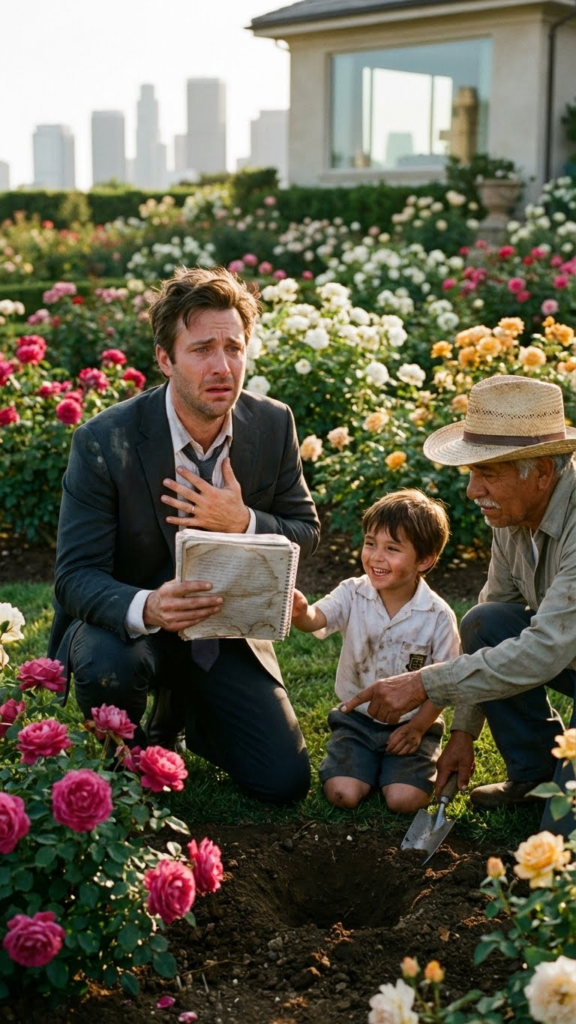
I stood at my office window on the 47th floor, watching my eight-year-old son do something I hadn’t seen in two years—smile.
Not just a polite smile. A real, genuine, face-transforming smile that reached his eyes and made him look like the happy child he’d been before his mother died.
He was kneeling in our estate’s rose garden with Miguel, our 68-year-old gardener, both of them bent over something hidden in the bushes. From this distance, I couldn’t see what they were looking at, but I could see my son’s body language—animated, excited, alive in a way he hadn’t been since the accident.
My assistant knocked on my door. “Mr. Thornton, your 3 PM is here.”
I ignored her. Couldn’t take my eyes off the scene below. Two years. Twenty-four months of child psychologists, grief counselors, medications, specialists. Twenty-four months of watching my son retreat further into himself, becoming a ghost in his own life. Twenty-four months of guilt crushing me because I’d been at the office when his mother crashed her car. Because I’d missed the funeral planning while closing a merger. Because I’d chosen work over presence so many times that when tragedy struck, I didn’t know how to reach my own child.
The board wanted to promote me to global CEO. They said I was the perfect candidate—driven, focused, willing to sacrifice everything for success. They didn’t know the sacrifice had already cost me my son.
Ethan hadn’t spoken more than necessary in two years. Hadn’t laughed. Hadn’t cried, actually, which the therapists said was worse. He’d just become this quiet, polite, empty shell who went through motions but never really lived.
Until three weeks ago, when Miguel started working here.
I’d hired him from a temp agency after my previous landscaping company screwed up the rose garden—my late wife’s pride and joy. Miguel was overqualified for basic gardening work. In his intake interview, he’d mentioned being a former horticulture professor in Mexico before immigrating. But he needed the job, and I needed someone who could restore Catherine’s roses.
What I didn’t expect was for Ethan to become fascinated with him.
Every day after school, Ethan would go straight to the garden. Would sit and watch Miguel work. Miguel never pushed conversation, never tried too hard. He’d just talk softly about the plants, the soil, the seasons. And slowly, Ethan started responding. Started asking questions. Started helping.
Now, watching them together, I saw Miguel pull something from the bushes. Something small that he placed carefully in Ethan’s hands. My son’s face lit up with wonder.
Then Miguel looked directly up at my window. Even from 47 floors away, I felt his gaze. He mouthed something I couldn’t hear but somehow understood: “Come down. Now.”
Something in his expression sent chills down my spine. This wasn’t about gardening. This wasn’t about roses.
I grabbed my phone and headed for the elevator, my heart pounding. Took the longest seven minutes of my life to get from my office to the estate. Ran across the lawn like my life depended on it.
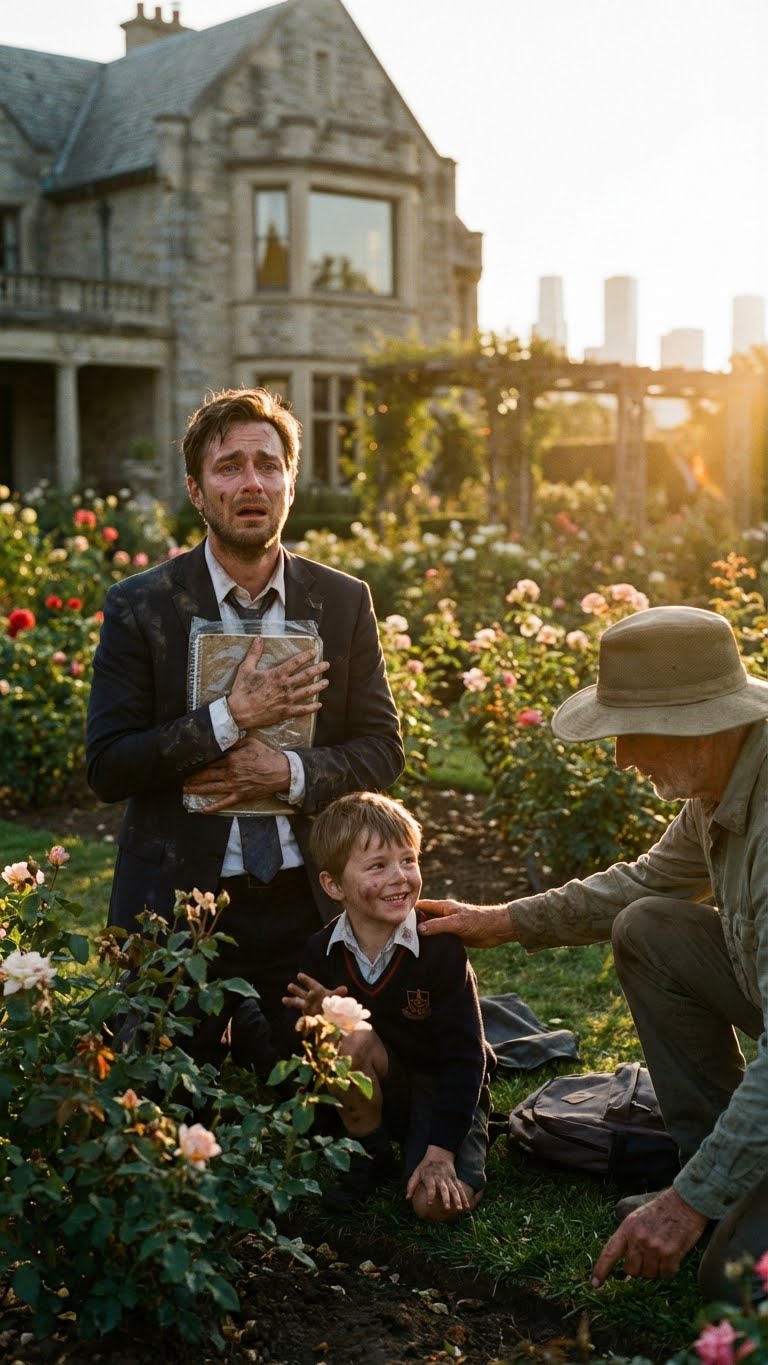
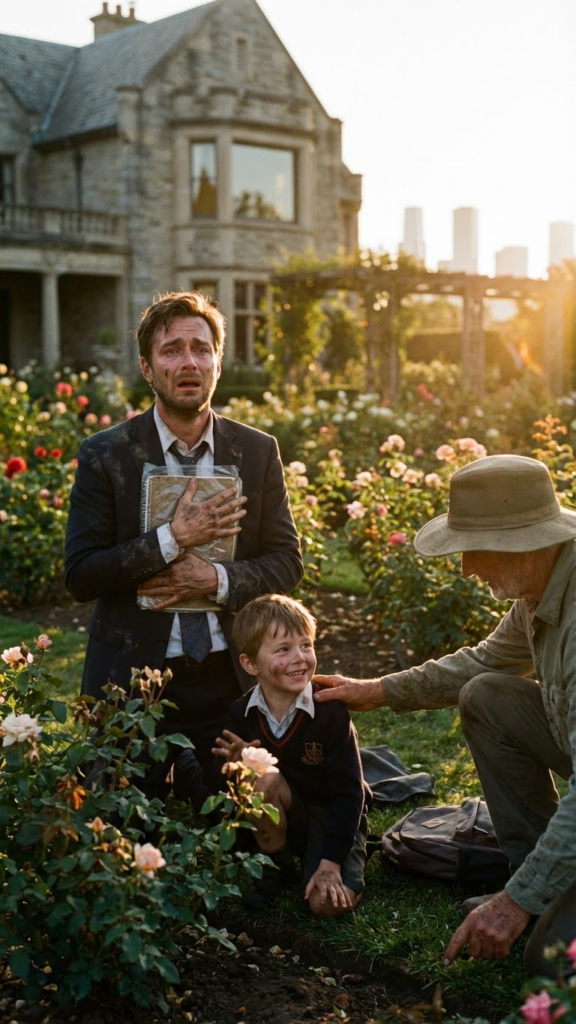
Miguel and Ethan were still in the rose garden, but now they were both looking at me with expressions I couldn’t read. Miguel held out what Ethan had been holding—a small, weathered notebook wrapped in plastic.
“Mr. Thornton,” Miguel said quietly, “your son and I found something in the roses. Something your wife hid there. Something that changes everything about her accident.”
My blood ran cold. Catherine’s accident had been ruled driver error. She’d been going too fast on a wet road, lost control, hit a tree. No other vehicles involved. No witnesses. Just a tragic mistake that left Ethan motherless and me drowning in guilt and grief.
“What did you find?” I asked, my voice barely above a whisper.
“Proof,” Miguel said. “Proof that someone tampered with her car. And proof of who did it. Your wife knew someone was trying to kill her. She documented everything. She hid this notebook in the roses—in the one place she knew you’d eventually look, because you’d want to keep her garden alive.”
Ethan spoke for the first time, his small voice clear and strong. “Dad, the bad people killed Mom. But she left us clues. Miguel says we can catch them now. That’s why I’m smiling. Because Mom was smart. And she’s still helping us.”
I took the notebook with shaking hands. Opened to the first page. Saw Catherine’s handwriting—neat, precise, terrified.
“If you’re reading this, I’m probably dead. Richard has been threatening me for months. He knows I discovered what he’s been doing. The embezzlement. The fraud. The offshore accounts. He said if I tell anyone, he’ll make it look like an accident. I have evidence hidden in my safety deposit box. The key is in the rose garden, buried where I planted the new hybrids. Please, whoever finds this—protect Ethan. And stop Richard before he hurts anyone else.”
Richard. My CFO. My trusted partner for fifteen years. Catherine’s godfather to our son.
The Two Years of Grief and Guilt
To understand what that notebook meant, you need to understand what the two years since Catherine’s death had been like.
The accident happened on a Thursday evening in March. Catherine had been driving home from her book club, a route she’d taken hundreds of times. According to the police report, she’d been going 65 in a 45 mph zone on a rain-slicked road. Lost control on a curve, hit a tree, died on impact.
The guilt nearly destroyed me.
If I’d been home instead of at the office, she wouldn’t have been driving. If I’d paid more attention to her, I would have noticed she seemed distracted lately. If I’d been a better husband, a more present father, maybe everything would have been different.
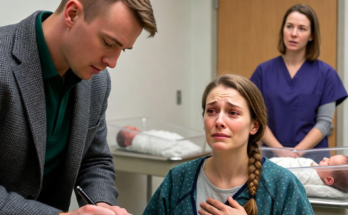
Ethan had been home with our nanny when it happened. I’d been in a board meeting. Got the call from the police at 9:47 PM. Arrived at the hospital to find my wife already gone and my son sitting in the waiting room, quiet and still, like he’d already retreated inside himself.
The funeral was a blur. I was running on autopilot, managing logistics while drowning internally. Richard handled most of the arrangements—he’d always been more Catherine’s friend than mine, actually. They’d grown up together, been close since childhood. He’d introduced us at a charity event twelve years ago.
Richard gave a beautiful eulogy. Talked about Catherine’s kindness, her love of gardening, her dedication to family. He cried. I didn’t—couldn’t, somehow. Too numb.
After the funeral, I threw myself into work even harder. It was easier than facing the empty house, the silent son, the crushing awareness that I’d failed my family. The board appreciated my dedication. Promoted me to Chief Operating Officer. Started grooming me for the CEO position.
Ethan spiraled. Started failing classes he’d once aced. Stopped playing with friends. Stopped doing anything except existing. The therapists diagnosed complicated grief. Prescribed medications. Recommended intensive therapy. Nothing worked.
I hired the best caregivers money could buy. Made sure Ethan had everything he needed. But I didn’t know how to reach him. Didn’t know how to be present when presence felt like drowning. So I worked. And Ethan disappeared further into himself.
Until Miguel arrived and somehow, mysteriously, started bringing my son back to life.
The Gardener Who Saw Too Much
Miguel had seemed almost too perfect when he applied for the gardening position. In his late sixties, dignified despite worn clothing, speaking English with a precise accent that suggested education. His resume showed he’d been a horticulture professor at Universidad Autónoma de Chapingo before immigrating to the US five years ago.
“Why did you leave Mexico?” I’d asked during the interview.
“Family circumstances,” he’d said simply. “My daughter married an American. I wanted to be near my grandchildren. But my credentials don’t transfer easily. So I do what I know—I work with plants.”
He’d started the next week. Within days, the rose garden that three companies had failed to properly maintain was flourishing under his care. He had an almost supernatural understanding of what each plant needed.
But more than that, he had patience with Ethan.
The first day, my son had wandered into the garden after school and just stood there, watching Miguel work. Most adults would have tried to engage him, asked questions, pushed for conversation. Miguel did none of that. He just acknowledged Ethan with a nod and continued pruning.
Ethan came back the next day. And the next. By the end of the first week, he was sitting on the garden bench, still silent but present in a way he hadn’t been with anyone else.
By week two, Miguel started talking to him—not at him, but to him. Explaining what he was doing. “These roses, they need very specific care. Your mother knew that. She chose varieties that require attention. That’s how you know someone truly loved something—they chose the difficult version because the beauty was worth the effort.”
Ethan had nodded. Actually nodded, engaged.
By week three, Ethan was helping. Handing Miguel tools. Watering specific plants. Asking the occasional question.
I’d watched this transformation from my office window, grateful but mystified. Who was this man who could reach my son when therapists couldn’t?
Then today, I’d seen Ethan smile. And Miguel had summoned me. And now I held proof that my wife had been murdered.
The Notebook’s Contents
We moved inside—me, Ethan, and Miguel—to my study. I told my assistant to cancel all my appointments and hold all calls. Then I read Catherine’s notebook while Ethan sat close to me and Miguel stood near the window, watching.
The entries spanned four months before her death. They started innocently enough—Catherine noting irregularities in the company’s financial reports. She’d been doing freelance financial consulting from home, had access to our systems because she sometimes helped with analysis.
She’d noticed money moving in patterns that didn’t make sense. Transfers that weren’t properly documented. Expenses that seemed inflated. She’d mentioned it to Richard first—he was CFO, after all. Asked if there was an explanation.
That’s when things got dark.
Richard had told her to stop looking. Said she was misunderstanding the reports. When she pressed, he’d gotten aggressive. Told her she was jeopardizing the company with her questions. Threatened to have her consulting access revoked.
Catherine had backed off publicly but continued investigating privately. Found offshore accounts. Shell companies. A systematic embezzlement scheme that had been running for at least three years. Richard had stolen approximately $47 million from the company—from me—and hidden it so well that our auditors had never caught it.
She’d documented everything. Dates, amounts, account numbers. Planned to give it to the FBI.
Then the threats started.
“March 3rd: Richard called me today. Said I needed to think about Ethan. About what would happen to him if I destroyed his godfather’s life. Said accidents happen to people who don’t mind their own business.”
“March 10th: Someone was following me today. Black sedan. When I tried to get the license plate, they drove off.”
“March 15th: Richard cornered me at the grocery store. Said he knew about the evidence I’d collected. Said I had two choices—forget everything, or have an ‘unfortunate accident.’ He was smiling when he said it.”
“March 22nd: I’m scared. I’ve hidden copies of everything in my safety deposit box. The key is buried in the rose garden, under the new David Austin hybrid I planted last month—the one James hates because he says the pink is too bright. If something happens to me, that’s where the evidence is. Richard knows I’ve been working in the garden a lot. He won’t think to look there.”
The final entry was dated March 28th—the day before she died.
“I’m going to the FBI tomorrow. I can’t live like this anymore, constantly afraid. Richard called again tonight. Said this was my last chance to back down. I didn’t tell him I’d already made copies of everything. Didn’t tell him I had a meeting scheduled. If I don’t survive tomorrow, please—someone—protect Ethan. And stop Richard. He’s not who anyone thinks he is.”
She hadn’t made it to the FBI. Had died in a “single-vehicle accident” that had never been properly investigated because there was no reason to suspect foul play.
Until now.
Miguel’s Real Identity
I looked up from the notebook, my hands shaking. “How did you know where to look?”
Miguel met my eyes. “Because I’m not just a gardener, Mr. Thornton. My full name is Miguel Ángel Fuentes. I was a horticulture professor, yes. But I was also a forensic botanist. I consulted with Mexican police on cases involving plants—poisonings, environmental crimes, evidence found in gardens.”
“Why are you here?” I asked.
“Because my daughter married Richard’s nephew,” Miguel said quietly. “Five years ago, when Richard visited them in Mexico, he told a story at dinner. About having to ‘handle’ a problem with a business partner’s wife who’d gotten too curious. He laughed about it. Said the brake line cut was so clean the mechanics never even looked twice.”
Miguel’s expression darkened. “I didn’t know who he was talking about then. Didn’t know the name. But I remembered. And when my daughter’s marriage fell apart and we moved to the US to help her, I started researching Richard Hayes. Found the story about your wife’s accident. Found that the timing matched his visit to Mexico. Found that he was CFO of a company where you were the majority owner.”
“You’ve been investigating Richard for five years?” I asked, incredulous.
“I’ve been trying to prove it for five years,” Miguel corrected. “But I had no evidence. No proof. Just a story told by a drunk man at a dinner party. So when I saw the gardening position advertised for this estate, I applied. Thought maybe I could find something. Anything.”
“And you did,” I whispered.
“Your wife left a road map,” Miguel said. “The roses. She chose specific varieties, planted them in specific places. The David Austin hybrid she mentioned—the pink one you hate—she planted it in a grid pattern with exactly 18 inches between each plant. I’m a horticulture professor. That spacing makes no sense for that variety. But 18 is a meaningful number. She planted 18 roses.”
“Eighteen,” I repeated. “Why would—”
“The 18th rose,” Miguel said. “That’s where I found the key buried. She left a pattern, Mr. Thornton. A code hidden in her garden for someone who understood plants to find. She knew you’d eventually hire someone to restore her roses. She was counting on it.”
The Safety Deposit Box
Two hours later, we were at Catherine’s bank. I hadn’t opened her safety deposit box since her death—hadn’t been able to face going through her personal things. Now I used the key Miguel had excavated from the rose garden, hands still shaking.
Inside was everything Catherine had promised. Flash drives with financial data. Printed bank statements from the offshore accounts. Emails between Richard and the shell companies. A timeline documenting the embezzlement. And a video file.
We watched the video on the bank’s private viewing computer. It was Catherine, recorded two days before her death, speaking directly to the camera.
“My name is Catherine Marie Thornton. It’s March 27th, 2024. If you’re watching this, I’m probably dead, and Richard Hayes probably killed me. I discovered that Richard has been embezzling from Thornton Industries for at least three years. I have documented proof. He’s threatened me multiple times, said he’d make my death look like an accident. I’m taking this evidence to the FBI tomorrow. If I don’t make it, please—investigate my accident. Check my brake lines. Richard told me he knows how to cut them so perfectly that mechanics won’t catch it. He’s done it before. Don’t let him get away with this. And please, please protect my son Ethan. Tell my husband I love him. Tell him I’m sorry I didn’t come to him first, but Richard made it clear that James would be implicated if I went to him directly. This was the only way to keep my family safe.”
I had to stop the video. Couldn’t breathe. Catherine had known she was going to die. Had tried to protect us. Had left evidence so meticulous that a forensic botanist could find it in her garden.
And I’d spent two years thinking it was an accident. Thinking she’d been careless. Thinking if I’d just been home—
“Mr. Thornton,” Miguel said gently. “This isn’t your fault. Your wife was brilliant and brave. She protected you and Ethan the only way she could.”
The Confrontation
We went straight to the police with everything. The notebook, the safety deposit box contents, the video. They reopened Catherine’s case immediately. Requested the original accident report. Sent investigators to examine what remained of her car in the police impound yard.
The brake line had been cut. Expertly, almost invisibly. But under proper forensic examination, it was obvious. Deliberate sabotage.
They arrested Richard that evening. Brought him in for questioning. I watched from behind the two-way mirror as they confronted him with the evidence.
Richard denied everything at first. Said Catherine had been paranoid. Said the financial irregularities could be explained. Said the brake line probably corroded naturally.
Then they showed him Catherine’s video. Showed him her documentation. Showed him the offshore account records with his signatures.
He broke. Confessed to the embezzlement. Confessed to the threats. And finally, after six hours of interrogation, confessed to cutting Catherine’s brake lines.
“She was going to destroy everything,” he said, his voice flat. “I’d worked too hard, built too much. I couldn’t let her ruin it over some money that nobody would even miss.”
Some money. $47 million. And my wife’s life.
Richard was charged with first-degree murder, embezzlement, and fraud. The evidence was overwhelming. He pleaded guilty to avoid the death penalty. Got life without parole.
The company recovered most of the stolen money from the offshore accounts. I stepped down as COO—couldn’t stomach staying in a place where my wife had been murdered. Sold my shares, took Ethan, and left.
The Healing
We moved to a smaller house in Connecticut. One with a garden. I hired Miguel full-time as our gardener, but he became so much more than that. Became family. The grandfather Ethan needed.
Miguel taught us both about plants. About patience. About how growth happens slowly, imperceptibly, until one day you look up and realize everything has changed.
Ethan started talking more. Started smiling regularly. Started healing. We found a trauma therapist who specialized in children who’d lost parents to violence. It was hard, painful work. But Ethan was strong. Like his mother.
One day, six months after Richard’s arrest, Ethan and I were planting roses in our new garden. Miguel was supervising, offering guidance but letting us do the work.
“Dad,” Ethan said quietly. “Miguel says Mom left us the clues because she knew we’d find them eventually. That she trusted us to be smart enough and strong enough to see the truth.”
“She did,” I said.
“I’m glad we found them,” Ethan said. “I’m glad the bad man is in jail. But I’m also glad Miguel came. Because he helped us understand Mom’s message.”
“What message?” I asked.
“That love leaves evidence,” Ethan said simply. “That if you love someone, you don’t just go away. You leave pieces of yourself behind. Mom left us the roses. And the clues. And the truth. That’s how we know she loved us—she made sure we’d be okay even after she was gone.”
I had to stop digging. Had to put down the trowel and pull my son into a hug while I cried. Miguel stood nearby, respectfully giving us space but staying close enough that we knew we weren’t alone.
The Garden Today
Three years later, our garden is extraordinary. Miguel has taught us everything—Ethan and me both. We know about soil composition, pruning techniques, companion planting. We know which roses need more water, which prefer shade, which thrive on neglect.
Ethan is eleven now. Doing well in school. Has friends. Talks about becoming a botanist like Miguel. Smiles often. Laughs. Lives.
We visit Catherine’s grave every month, always bringing roses from our garden. Ethan talks to her, tells her about his life, updates her on which varieties are blooming. I thank her for being brave enough to leave us the truth.
Miguel is 71 now. Still working in the garden every day, though I’ve told him repeatedly he doesn’t need to. “I work because I want to,” he says. “Because this garden is my masterpiece. Your wife started it. We’re just helping it become what she envisioned.”
The company Thornton Industries has recovered. New leadership, new ethics. I serve on the board as an advisor but I’m not involved in daily operations. Don’t want to be. Found that there are more important things than business success.
Like being present for my son. Like understanding that wealth means nothing if you sacrifice the people you love to acquire it. Like learning that sometimes the most important people in your life come from unexpected places—like an overqualified gardener who noticed patterns in roses.
The Legacy
Last month, Ethan asked me something while we were working in the garden.
“Dad, why do you think Mom chose roses to hide her clues?”
I thought about it. “Because roses were her passion. She knew I’d keep the garden alive because it was hers. And she knew that anyone who truly understood plants would see the patterns she’d created.”
“But there’s more than that,” Ethan said thoughtfully. “Roses have thorns. They’re beautiful but they can hurt you if you’re not careful. Mom was showing us that beautiful things sometimes hide sharp truths. And that we needed someone who understood both—the beauty and the danger.”
My eleven-year-old son, philosopher gardener.
“She was brilliant,” I agreed. “Is brilliant. Her love is still protecting us.”
Miguel joined us, holding a new hybrid he’d been cultivating. “I’ve been working on this for three years,” he said. “Trying to create something special. Something worthy of Catherine’s garden.”
The rose was extraordinary—deep pink petals with golden edges, powerful fragrance, perfect form.
“I’m calling it the Catherine’s Truth rose,” Miguel said. “Because she taught us that truth, like beauty, is worth cultivating. Even when it’s difficult. Even when it hurts. Even when it costs everything.”
He planted it in the center of the garden, in the spot where Catherine had hidden her most important clue. Ethan and I helped firm the soil, water it in, mark it with a special label.
That rose is thriving now. Blooms more prolifically than any other variety in the garden. People ask where we got it, how they can buy one. Miguel says it’s not for sale—it’s a memorial, a reminder, a testament to the woman who turned her garden into a message that saved her family.
The Real Treasure
People ask me sometimes about the money we recovered from Richard. $47 million that came back to us after his conviction. What did we do with it?
We started the Catherine Thornton Foundation for Women’s Safety. It funds programs that help women document abuse, escape dangerous situations, and get legal representation. It supports forensic investigation into suspicious “accidents” involving women who’d reported threats. It trains law enforcement to look deeper at deaths that seem too convenient.
Because Catherine wasn’t the first woman Richard threatened. She was just the first one brave enough to document everything. The FBI found evidence linking him to two other “accidents”—women who’d crossed him in business deals, who’d died in circumstances that seemed suspicious but were never properly investigated.
How many others like Catherine have died in “accidents” because no one looked closely enough? How many women have tried to leave evidence that no one found?
We’re trying to change that. One case at a time. One investigation at a time. One truth at a time.
Ethan helps with the foundation now. At eleven, he can’t do much, but he speaks at events sometimes. Tells Catherine’s story. Reminds people that children know when something is wrong, even when adults try to hide it. Encourages other kids to speak up if they see or hear things that seem off.
“My mom was a hero,” he always says. “Not because she fought someone. Because she left us a way to fight for her after she was gone. And because she chose to hide her clues in a garden—something beautiful and growing and alive. She could have put everything in a safe deposit box and left it there. But she didn’t. She made it a puzzle, a treasure hunt, something that would bring her family together and teach us to pay attention to the world around us.”
He’s right. The roses weren’t just hiding evidence. They were Catherine’s final gift to us—a reason to slow down, look closely, work together, and learn that truth grows in unexpected places.
The Full Circle
This morning, I woke early and went to the garden before work. Found Miguel already there, as always, tending the roses in the soft dawn light.
“She’d be proud of you both,” he said without looking up. “Of how you’ve honored her memory. Of the garden you’ve grown—both this one and the one you’ve planted in the world through the foundation.”
“We couldn’t have done any of it without you,” I said. “If you hadn’t recognized the patterns in the roses, if you hadn’t known to look for meaning in their placement—”
“Someone would have found it eventually,” Miguel interrupted gently. “Catherine left too many clues for them all to be missed. Maybe it would have taken longer. Maybe years. But the truth has a way of blooming when it’s ready.”
He stood, brushed soil from his knees. “The question is—are you ready for what I’m about to show you?”
My heart skipped. “Show me what?”
He led me to a section of the garden I rarely visited—wild roses near the back fence. Pointed to a specific plant that looked unremarkable.
“This rose wasn’t here when Catherine died,” Miguel said. “It appeared about three months after. I didn’t plant it. You didn’t plant it. Yet here it is—growing from a seed that must have been dormant in the soil.”
“So?” I asked.
“So I had it analyzed,” Miguel said. “This variety doesn’t exist in any database. It’s not a known hybrid. It’s completely unique. And its genetic markers suggest it’s somehow related to all the other roses Catherine planted—like it’s a child of the garden, combining traits from multiple parent plants in a way that shouldn’t naturally occur.”
I stared at the rose. At its unusual coloring—pink and white and gold all at once. At its perfect form.
“What are you saying?” I whispered.
“I’m saying your wife was a better gardener than even I realized,” Miguel said softly. “I think she bred this rose. Created something new. And planted its seed in a place where it would grow after she was gone. One last gift. One last message.”
He handed me a small envelope. “I found this buried next to the rose last week. I wanted to wait until the right moment to give it to you.”
Inside was a note in Catherine’s handwriting. Dated the day before she died.
“My dearest James and Ethan—If you’re reading this, my roses have bloomed. The garden has grown. And you’ve found the truth I left behind. I’m so proud of you both. This rose is called Hope’s Garden. I created it myself, bred it from all the others, planted it where it would grow after I was gone. It represents what I want for you—beauty that emerges from darkness, strength that comes from adversity, and new life that blooms even when we think all is lost. Take care of each other. Teach Ethan about plants. They’ll teach him about life—about patience, about growth, about the fact that endings are really just beginnings in disguise. I love you both more than roses love sunlight. And like the garden, that love will never stop growing. Forever yours, Catherine”
I couldn’t read the last part out loud. Couldn’t see through my tears. Miguel took the note gently, finished reading it, then pulled me into a hug while I finally, fully grieved.
Ethan found us there twenty minutes later. Read his mother’s note. Cried with us. Then smiled through his tears.
“She’s still here,” he said simply. “In every rose. In every bloom. In everything we plant. She’s still teaching us. Still loving us. Still showing us how to grow.”
He was right.
Catherine hadn’t just left us evidence. She’d left us a garden—literal and metaphorical—that would keep teaching us, keep growing, keep blooming long after she was gone.
That’s love. Not the grand gestures or the dramatic declarations. But the quiet, patient work of planting seeds that will bloom in their own time. Of leaving patterns for people to find. Of trusting that even in death, your love will guide the people you left behind toward truth, toward justice, toward healing.
Toward Hope’s Garden, where beauty grows from tragedy and life continues despite loss.
That’s what Miguel showed my son hidden in the rose bushes—not just evidence of a crime, but proof of love that transcends death. And that’s why Ethan smiled for the first time in two years.
Because he finally understood what his mother had been trying to tell us all along: Love, like roses, never truly dies. It just waits for the right season to bloom again.