The Children the Hospital Bought
When a File Fights Back
The lab smelled like old paper and burnt dust.
I’d been staring at grayscale faces for ten hours straight, scanning, tagging, and feeding them to a machine that didn’t care if its subjects had ever screamed. To the software, they were vectors and ratios, nose widths and eye angles. To me, they were the reason I hadn’t quit this job yet.
Someone had to look back.
I was a forensic archivist on a special project none of us were allowed to talk about in elevators: a joint task force between law enforcement and a private genealogy company, created to test whether modern facial recognition could close century‑old missing children cases.
Most days, the answer was no. Poor lighting. Motion blur. Damage. Faces were ghosts more often than not.
The 1927 photo came from a mislabeled box in a decommissioned hospital’s basement—St. Augustine Teaching Hospital, a once‑prestigious East Coast institution that now existed mostly as a charitable foundation and a wing on other people’s buildings. The box had been stamped “orphans – medical charity” in block letters that tried too hard.
Inside: two dozen photographs, all variations on the same theme. Children on beds. Children in lines. Children with blank faces and strange apparatus on their legs, arms, heads. The kind of images that made archivists use neutral words like “historically troubling” while their stomachs turned.
Protocol said we digitize, catalog, move on.
My supervisor, Sam, slid the top photo out of the stack and grimaced. “Do one or two for the test, then call it a night,” he said. “No need to traumatize yourself on overtime.”
He went upstairs.
I didn’t go home.
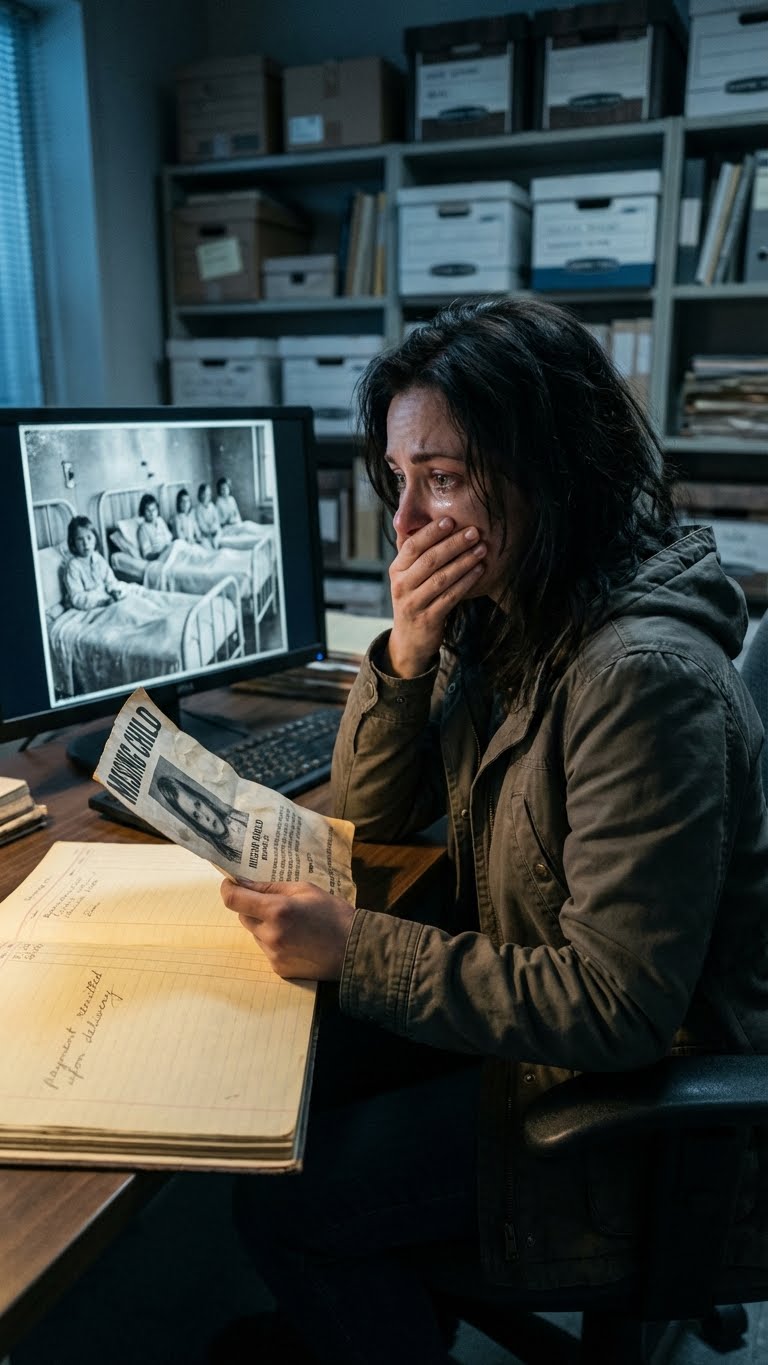
The photo I picked showed ten children in hospital gowns on metal beds, lined up like specimens. Each had a tag around their wrist with a number, not a name. Their heads were shaved in patches. Some had restraints on their ankles.
The caption read, in careful ink: “Orphan subjects, neurological study cohort B, 1927.”
Subjects.
Not patients.
I scanned the photo, cleaned up the dust, and sent it through the facial recognition model, not expecting much. The software whirred, indexed, cross‑checked with our internal database of historical images, then jumped to our external missing children registry—the one that stretched, in some cases, all the way back to the 1800s where descriptions were vague and photos rare.
The hits began almost immediately.
MATCH CONFIDENCE: 94.1%.
MATCH CONFIDENCE: 92.7%.
MATCH CONFIDENCE: 96.4%.
The first match pulled up a sepia portrait: a smiling five‑year‑old girl in a white dress clutching a doll. EMILY HARPER. Missing: 1926. Last seen in a Boston park. Case status: Unsolved. Family line: Extinct—no surviving siblings.
In the hospital photo, “Subject #4” sat on the edge of a bed, legs swaddled in bandages. Her hair was shorter, her cheeks thinner, but the curve of her jaw, the way her left eye drooped slightly when she stared at the camera—it was Emily.
The second match: JACOB REILLY, age 7, vanished from a Philadelphia street in 1925. “Subject #7” stared back at me from the 1927 photo with the same dark irises, the same chipped front tooth visible through parted lips.
It kept going.
Twins Thomas and Matthew Cooper, missing from Chicago in 1924, matched two boys at the far end of the row—“Subject #9” and “Subject #10”—their hands clenched on the bed rails.
Seven out of ten “orphans” tagged in the 1927 hospital photo matched missing children reports from within a three‑year window.
Statistically, that’s not an overlap.
That’s a pattern.
I zoomed in on the original scan, hunting for context. At the bottom edge, partly cut off, was the corner of a clipboard resting on a nurse’s lap. I boosted the contrast, sharpened the image, whispered a silent prayer to every software engineer who’d ever added an “enhance” feature, and watched faded pencil marks resolve into words.
“Children acquired from external supplier. Payment remitted upon delivery. Confirm no family contact. All records to refer to subjects as ‘orphans.’”
It was written so casually, like ordering lab mice.
My hands went cold.
I dug into the digital copy of the 1927 intake ledger from St. Augustine, the one another archivist had scanned years ago and tagged as “charity ward – pediatric.” Each child in the photo had a corresponding entry.
Emily Harper’s line didn’t say Emily, of course. It said “Subject #4, female, approx. 5 yrs, no known relatives.” In the margin next to it, someone had scrawled initials and a number: “$75 – OK.”
Next to Jacob’s entry: “$60 – partial payment remitted.”
The Coopers: “TWINS – $150 – bonus for matched pair.”
Even if you spend your days buried in humanity’s worst paperwork, there are moments that knock the air out of you.
Hospitals weren’t just experimenting on orphans.
They were buying kidnapped children.
And the foundation that grew from that hospital’s money still had its name on pediatric research grants and children’s wings across the country.
You learn in this line of work that dead crimes still have living lawyers.
The right thing to do was obvious: escalate.
So I printed everything—the photo, the ledger extracts, the match reports—and headed for my supervisor’s office.
That’s when I heard voices through the door.
“…if anything connects St. Augustine to those cases, we’re talking class‑action nightmares,” an unfamiliar male voice was saying. “The foundation will come down on this unit like a hammer.”
Sam, my supervisor, answered, sounding exhausted. “We can’t just bury it. This isn’t misplaced billing codes. These are kids.”
“Kids who have been dead for a century,” the other man snapped. “We focus on solvable crimes. The living. You understand that, right?”
I stepped closer, heart pounding.
“We’re not burning anything,” Sam said. “But we can… control the rollout. Flag it as unverified. Slow‑walk any external disclosure until the legal department—”
My stomach dropped.
They already knew.
They weren’t racing to call families.
They were racing to call lawyers.
That was the breaking point.
Everything after that was choice.
Why This Was Personal
People always assume the first time you see a dead child’s picture is when you lose your innocence.
They’re wrong.
My innocence disappeared in 2001, when my little sister Mia was taken from our front yard while my mother carried in groceries. Broad daylight. Quiet street. No witnesses who remembered anything useful.
I was eight. She was five. Her face ended up on mailers, milk cartons, local news. My father put her school photo on the dashboard of his car and wore the edges down with his thumb, tracing her smile every time he hit a red light.
We never found her. Not a shoe, not a button.
My mother stopped going into Mia’s room. My father started sleeping in it. Eventually, he stopped sleeping at all.
The police did what they could with what they had. Which, in 2001, wasn’t much.
By the time I was old enough to pick a career, I knew exactly what I wanted: to be the person who could bring someone else’s Mia home, even if “home” was just a proper line on a death certificate.
I studied information science and forensic analysis, specialized in historical records and biometric matching. Everyone else wanted cutting‑edge FBI stuff. I wanted cold case files, unsolved, gathering dust.
I never imagined my worst case would be a hundred years old—and that the villain wouldn’t be one man in a van, but an institution wearing a white coat.
St. Augustine Teaching Hospital meant nothing to most people under sixty. To archivists, it was infamous.
Whispers about “unethical studies” in the 1920s and ’30s. Rumors of a quiet settlement in the ’70s. Nothing ever proven in court, nothing ever fully documented. The hospital shut down, rebranded its assets into a foundation, and slapped its name onto children’s cancer centers and scholarships.
Legacy laundering.
When I got assigned to the St. Augustine materials, my boss warned me it could get “dark.” I thought he meant syphilis experiments and forced sterilizations, the kind of horror that at least stayed inside the bounds of the institution’s walls.
Kidnapping was another level.
Especially because:
One of the missing children the system cross‑matched to the 1927 photo wasn’t just another cold file.
He was in my father’s box.
After hearing Sam’s conversation with the foundation’s fixer, I didn’t go in, didn’t knock, didn’t show my hand.
I went back to my desk and pulled up the case list again, scrolling through the matches.
Emily Harper. No living descendants.
Jacob Reilly. One grand‑nephew in Pennsylvania who’d uploaded his DNA to our partner site.
The Cooper twins. A grand‑niece in California, searching for “great‑uncles who disappeared as children.”
And then, at the very bottom, a match the system had flagged as “medium confidence” because of the age gap but which my gut recognized instantly:
MICHAEL JAMES O’CONNOR, missing 1926, last seen outside a charity hospital in New York.
Michael O’Connor was the name my dad whispered in his sleep when he wasn’t calling for Mia.
His great‑uncle. The family ghost. The reason my grandmother triple‑locked every door and still flinched at the sound of an ice cream truck.
Michael disappeared in 1926 when he was six, taken while walking home from school. My great‑grandmother never forgave herself. She died believing he’d been grabbed by a stranger and thrown into a ditch.
Now, in a 1927 photo from a hospital two states away, “Subject #3” stared at me with the same ears my father has. The same eyebrows I see in the mirror.
St. Augustine hadn’t just bought children.
They’d bought mine.
Suddenly, this wasn’t just history.
This was family.
Blowing It Up
There are rules for how evidence is supposed to move in a building like mine.
Chain of custody. Documentation. Clearance.
There are no rules for what you do when you realize the people who control the documents are already figuring out how to bury them.
I had ninety minutes before Sam’s meeting upstairs ended and he came looking for progress.
In that time, I did three things.
First, I dumped everything I had into an encrypted drive: the photo, the ledger scans, the match reports, the foundation’s donations to our department, the internal memos about “sensitivity” around St. Augustine collections. I added the O’Connor case file from the public database and my family’s old paper copy for good measure.
Second, I printed one extra set of everything and slipped it into a plain manila folder labeled “Inventory Anomalies – 1920s.”
Third, I called my father.
“Dad, do you have that picture of Uncle Michael?” I asked, skipping hello.
He was quiet. “You know I do.”
“Can you send me a scan? Full resolution.”
“You find something?” Hope and fear, braided.
“I think I did,” I said. “But I need you to promise me you won’t call anyone about it yet. Not the local cops, not the press. Not until I tell you.”
“That bad?”
“That big,” I said.
He scanned it while I held my breath. The moment his file hit my inbox, I ran it through the model.
MATCH CONFIDENCE: 89.3% – Subject #3, St. Augustine Hospital, 1927.
It wasn’t perfect—different angle, one year older—but combined with the ledger, the payment notes, and the missing persons report, it was enough.
Enough for me, anyway.
Sam came back down an hour later, dark circles under his eyes. He closed my office door behind him, a bad sign.
“How’s the test going?” he asked, not quite meeting my eyes.
I slid the manila folder across the desk.
“You tell me,” I said.
He opened it.
I watched his face go from tired to alarmed to something like despair.
“You shouldn’t have heard that conversation,” he said eventually.
“That’s what you’re leading with?”
He pressed his fingers into his eyes. “You know how this works. The foundation funds half our budget. They fund the cold case lab. If this blows up wrong, the program dies. We lose all of it. Not just St. Augustine, everything.”
“And if it doesn’t blow up at all?” I shot back. “We keep taking their money while we sit on proof they bought kidnapped children for experiments?”
“They’re dead,” he said, but there was no conviction in it. “The people who did this are dead.”
“The people who inherited the money aren’t,” I said. “The families who lost those kids aren’t. My family isn’t.”
That landed.
He blinked. “Your family?”
I pulled out one more sheet: Uncle Michael’s missing poster next to Subject #3.
He studied it. His shoulders sagged.
“Jesus,” he whispered.
“So here’s what’s going to happen,” I said, the plan solidifying as I spoke. “You’re going to log this as a confirmed historical match in the system. You are not going to reclassify it as ‘sensitive,’ ‘unverified,’ or ‘internal only.’ It will be visible to the account holders linked to those cases.”
“You know what the legal team will—”
“I don’t care what they’ll say,” I cut in. “The second those matches are visible to the families, any attempt to bury this becomes destruction of evidence. We both know how that plays in court.”
He stared at me, measuring the risk.
“They’ll shut us down,” he said quietly. “Maybe not today, but soon.”
“Then they shut us down with the truth out,” I said. “Instead of with this photo still sitting in a box, waiting for someone more obedient to mislabel it again.”
“Revenge won’t bring those kids back,” he said.
“This isn’t revenge,” I said. “This is justice with a really long lag time.”
He laughed once, bitterly. “The foundation’s fixer told me you were idealistic. I told him you were just thorough.”
“I’m both,” I said. “Pick a side, Sam.”
He sat there for a long time.
Then he opened the internal case management system, attached the photo and ledger to all seven matching missing children files, checked the boxes for “Release to related accounts,” and hit save.
Somewhere in Boston, a great‑grandniece of Emily Harper got a notification on her genealogy app: “New historical photo match found for your relative.”
In California, a woman curious about her twin great‑uncles got the same ping.
In my father’s house three miles away, his phone buzzed with a message: “We may have found Michael.”
Sam leaned back, exhaled.
“You just made my life very complicated,” he said.
“Join the club,” I replied.
We both knew what was coming.
The foundation would call.
The legal department would freak out.
The agency would panic.
What we didn’t know was how fast the families would move—or how loud.
Answer: very.
Within 24 hours, screenshots of the 1927 photo were circulating in private Facebook groups for families of long‑term missing children. Within 48, an investigative reporter who covered medical ethics scandals had emailed me from a burner address with a subject line that simply read: “St. Augustine. Talk?”
I hadn’t contacted her.
But someone had.
Probably one of the families the system had pinged.
Good.
Let them be the storm.
If the institution wouldn’t do right voluntarily, it could do right in court.
Justice, a Century Late
The foundation’s first move was predictable.
They issued a statement.
“Alleged historical abuses not reflective of our values.”
“Committed to transparency.”
“No evidence our current operations are implicated.”
Behind the scenes, they were less polished.
Their lawyer showed up at our office with a folder of NDAs and a tight smile. “We’re all on the same side here,” she said, which is how you know you’re not.
Sam sat through the throat‑clearing, the threats dressed as concerns. I spent that week doing something they hadn’t anticipated.
I called the families.
Not as an employee. As someone’s daughter.
I met Emily Harper’s grand‑niece, Claire, over video. She sat at her kitchen table with the missing poster on one side and the 1927 photo on the other.
“She’s wearing a hospital gown,” Claire said, voice shaking. “They said she must have wandered off and drowned. They searched the river for weeks.”
“They lied,” I said. “Or they were wrong. Either way, she ended up in St. Augustine.”
“What did they do to her?” she whispered.
“We don’t know everything yet,” I said honestly. “Only that cohort B was used in neurological experiments without consent. Restraints. Injections. Maybe surgery. The records are… fragmentary.”
“Are there graves?” she asked.
“Yes,” I said. “Unmarked, but they exist. And if this goes the way I think it will, we can get them named.”
We filed FOIA requests, pushed for court orders, watched as a trickle of declassified documents became a stream: budgets listing “acquisition fees,” correspondence between hospital administrators and “child relocation services” that were clearly covers for traffickers, internal memos warning staff not to “discuss the source of pediatric subjects.”
Public outrage did what quiet ethics never could.
The state attorney general opened an investigation into the foundation’s predecessor entity. A coalition of families filed a class‑action suit, not to send anyone to prison—those people were dust—but to force the foundation to fund memorials, scholarships, and a full public accounting under oath.
Under pressure, the foundation’s board folded faster than expected.
They released their internal archives.
They pledged a restitution fund.
They agreed to rename every building that bore St. Augustine’s logo, replacing it with something the families chose.
The name they picked for the main children’s research wing?
The Harper‑Reilly‑Cooper Center for Ethical Pediatrics.
Every time a researcher walks into that building now, they see an enormous plaque in the lobby with ten names:
Emily Harper.
Jacob Reilly.
Thomas Cooper.
Matthew Cooper.
Michael O’Connor.
And five others we’re still chasing, still matching, still talking to descendants about.
Underneath, in metal letters: “Children taken. Children never forgotten.”
At the opening ceremony, Claire asked me to stand next to her. My father came too, clutching a small bouquet he didn’t know what to do with.
When the ribbon was cut, he pressed his hand against Uncle Michael’s name and closed his eyes.
“We thought he was in a ditch,” he said quietly. “All these years. I don’t know if this is better.”
“It’s true,” I said. “It’s something solid to stand on.”
He nodded.
After the speeches, a reporter cornered me.
“You were the one who ran the facial recognition, right?” she asked. “The one who found the first matches?”
“Yes,” I said.
“What made you push it?” she asked. “Most people would have accepted their boss’s warning and stayed quiet.”
I thought of my grandmother triple‑locking doors. Of my father tracing his sister’s face on a photo. Of a ledger line that turned children into invoices. Of a hospital that built an empire on the bodies of kids no one was supposed to miss.
“Someone already chose silence once,” I said. “In 1927. I wasn’t about to help them do it again.”
She scribbled that down.
Online, the story became one more viral thread in the tapestry of “horrors of the past finally exposed.” People were furious for a week, then moved on to the next thing.
That’s how the internet works.
But in the genealogy forums, in the private groups for families of the missing, something else happened.
People started scanning their own boxes.
Uploading their own old photos.
Asking, “Can you run this?”
We built a separate program for them, off the foundation’s grid, funded by small donors and quiet grants. We trained local volunteers to digitize their archives, to feed the machine with faces and names and hope.
We won’t catch everything. There are crimes too old, photos too burned, ledgers too eaten by mold.
But sometimes, on my screen, a face lights up green.
MATCH FOUND.
And I get to send an email that begins with: “I think we found where your story went dark.”
The last unsolved case tied to the 1927 St. Augustine photo is still open.
“Subject #5,” a boy with solemn eyes and a scar on his chin.
No match yet.
I keep his face pinned above my desk, next to Mia’s.
When people ask why, I tell them the truth:
Because institutions forget by design.
Families forget by exhaustion.
But photos and code and stubborn archivists can be very bad at letting go.
A 1927 hospital photograph shows “orphan children” used for medical testing.
In 2025, facial recognition matched them to missing children cases, proving the hospital was buying kidnapped kids for experiments.
And in 2026, we made sure the only thing that stayed buried was the lie.