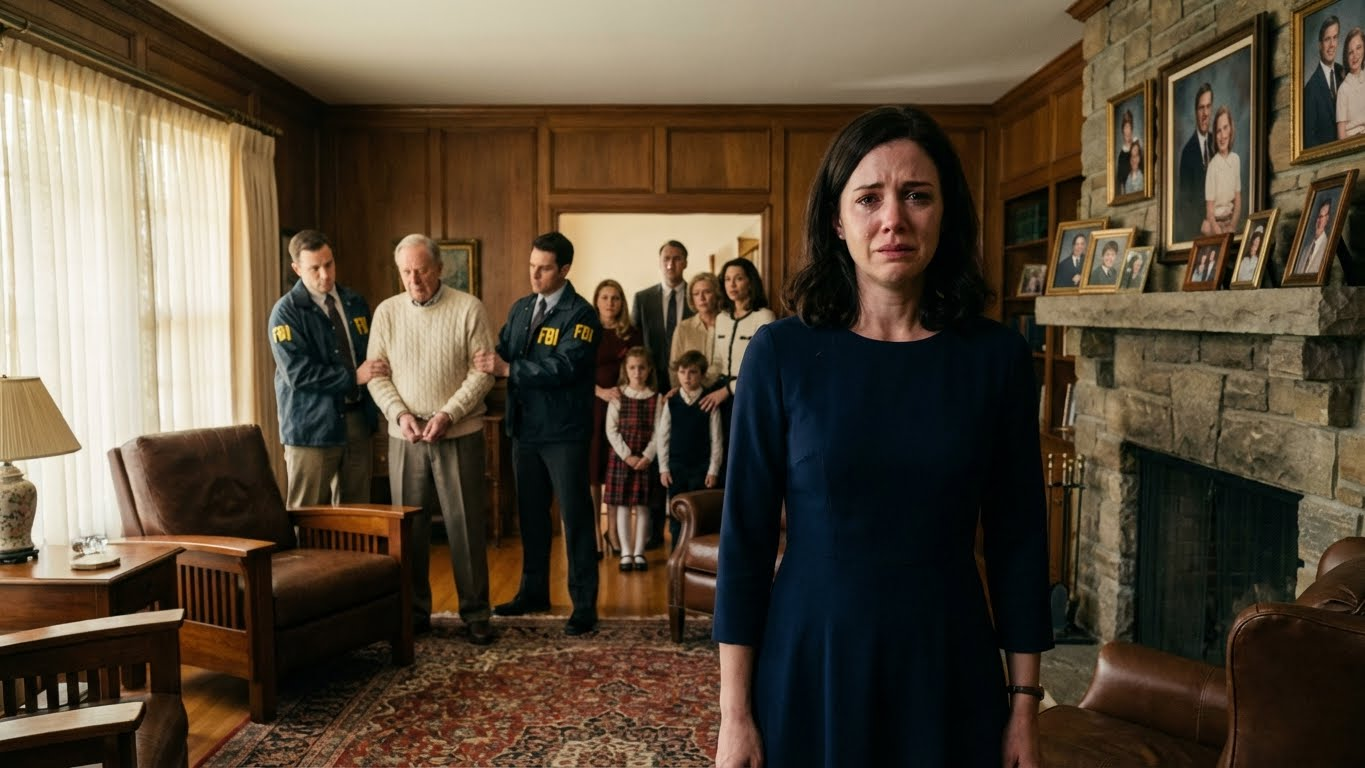
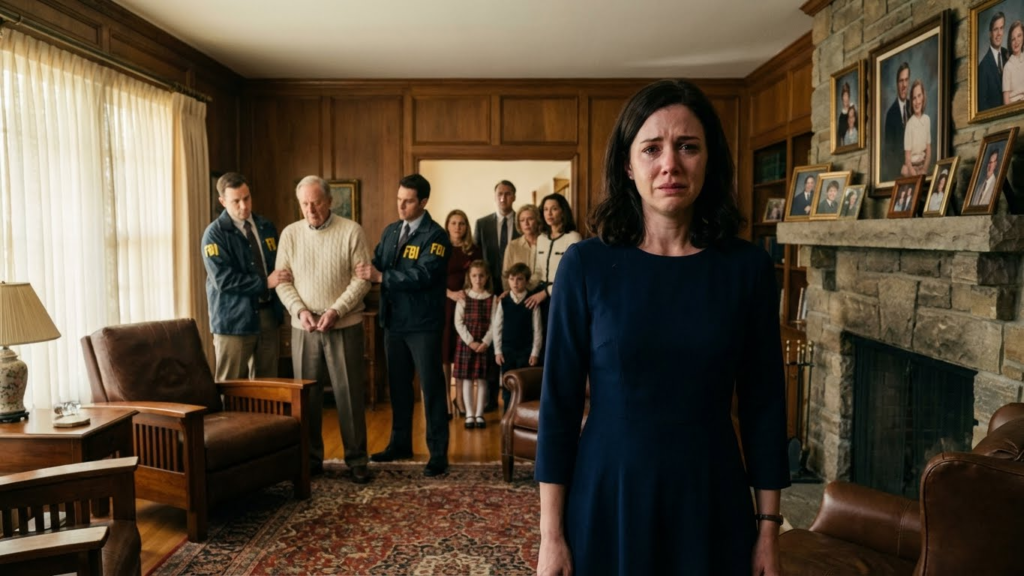
I was standing in my childhood living room, surrounded by fifteen of my relatives, when the FBI agent read my father’s name out loud from the warrant.
“Mr. Richard Coleman, you are under arrest for conspiracy to commit fraud, wire fraud, and money laundering.”
My mother lunged forward, her perfectly manicured nails reaching for the agent’s sleeve. “You can’t do this! We’re pillars of this community! Richard serves on the church board!”
The agent, a woman in her forties with steel-gray eyes, didn’t even blink. “Ma’am, I need you to step back now.”
I stood frozen near the fireplace, the same fireplace where family photos documented decades of Coleman “perfection”—award ceremonies, charity galas, church fundraisers. Every frame a lie.
I should have felt vindicated. For three years, these people had made my life a living hell. When I filed for divorce from my cheating husband Blake, they didn’t just take his side—they declared war on me. At family dinners, they called me a “marriage destroyer” and a “quitter.” At church, they whispered that I was “breaking God’s covenant” and “tearing apart a good Christian family.” My aunt Patricia literally stood up at Easter dinner, wine glass in hand, and announced to everyone: “Divorce is a sin. You’re going to hell, and you’re taking our family’s reputation with you.”
My crime? I had discovered Blake in our bed with his dental hygienist and refused to “work it out” like my mother suggested.
But here’s what they didn’t know: I had been quietly gathering evidence for eight months. Evidence that would destroy every single one of them.
It started six months into my divorce proceedings. Blake had been fighting me on every asset, every piece of furniture, every shared bank account. His lawyer was brutal, painting me as a gold-digger who had contributed nothing to our eight-year marriage—despite the fact that I had put him through dental school while working two jobs.
Then, on a rainy Tuesday in March, Blake made a critical mistake.
He accidentally forwarded me an email chain that wasn’t meant for my eyes. I was at my tiny rental apartment—the one I could barely afford after being forced out of the house I had helped pay for—when the notification popped up.
Subject line: “Family Investment Update – Q3 Distributions.”
I almost deleted it. I assumed it was another one of Blake’s attempts to hide assets. But something made me open it.
That’s when I saw it.
The email was from my father to a distribution list that included my uncle Gerald, my cousins Marcus and Steven, Blake, and my brother David. They were discussing quarterly returns from something called “Coleman Holdings LLC.” The numbers were staggering—distributions of $45,000, $67,000, $93,000.
My father, who had always claimed the family business was “modest” and “just getting by,” was moving hundreds of thousands of dollars.
I scrolled further. There were references to “client accounts,” “offshore transfers,” and “maintaining discretion.” One line from my uncle Gerald made my blood run cold: “We need to be more careful about the withdrawal patterns. The Hendersons are asking questions about their statement.”
I spent the entire night reading. By sunrise, I had pieced together enough to understand: my family was running some kind of investment scheme.
I couldn’t go to the police. Not yet. I had no proof beyond a forwarded email that Blake could claim was fake or taken out of context. So I did what any scorned woman with nothing left to lose would do—I hired a forensic accountant.
Her name was Michelle Torres, and she came highly recommended by my divorce lawyer. She was expensive, but I had one asset Blake didn’t know about: my grandmother’s inheritance, $35,000 that had been sitting in a separate account since before we married.
I spent every penny of it.
Michelle worked for three months. What she uncovered was beyond anything I had imagined.
Coleman Holdings LLC was an investment fund that my father and uncle had been operating for twelve years. They promised clients—mostly elderly retirees from our church and community—conservative returns of 8-10% annually. They showed impressive statements. They hosted elegant client dinners.
But the investments didn’t exist.
It was a Ponzi scheme. They were paying old investors with new investors’ money. When people withdrew funds, they covered it with fresh deposits from new victims. Over a decade, they had stolen $4.3 million from seventy-three people.
And every male member of my family was involved.
My father was the mastermind. Uncle Gerald managed the fake paperwork. My cousins recruited new investors through their social networks. Blake, with his respectable dental practice and church connections, was the “face”—the trustworthy young professional who vouched for the fund’s legitimacy.
And my brother David? He was the enforcer. When clients got suspicious, David—a lawyer—would intimidate them with legal jargon and veiled threats about “defamation” and “damaging the Coleman family’s reputation.”
The same reputation they accused me of destroying when I divorced Blake.
Michelle laid out everything in a hundred-page report with bank records, email trails, and recorded phone calls. “This is federal,” she said, sliding the binder across her desk. “Wire fraud, mail fraud, conspiracy. We’re talking decades in prison.”
I had two choices: I could turn them in immediately, or I could wait.
I waited.
I timed it perfectly. I knew the family had planned a massive gathering for my grandfather’s 80th birthday. Everyone would be there—all the conspirators in one room, celebrating, unsuspecting.
Three days before the party, I contacted the FBI. I handed over everything Michelle had compiled. The agent I spoke with, Special Agent Rebecca Mills, actually gasped when she saw the scope.
“This is one of the most well-documented cases I’ve seen from a civilian,” she said. “Ms. Coleman, you’ve just handed us a slam dunk.”
“I want to be there when you arrest them,” I said.
She hesitated. “That’s… unusual.”
“They destroyed my life because I left a cheating husband. I want to watch their world collapse.”
She made it happen.
The party was supposed to start at 2 PM. The FBI arrived at 2:47 PM, just after the champagne toast.
I had positioned myself near the fireplace, watching everyone laugh and clink glasses. Blake was there with his new girlfriend—yes, the dental hygienist. My father was holding court, telling stories about “building wealth through smart investments.”
When the first agent walked through the door, my aunt Patricia gasped. “What on earth—”
Then five more agents followed.
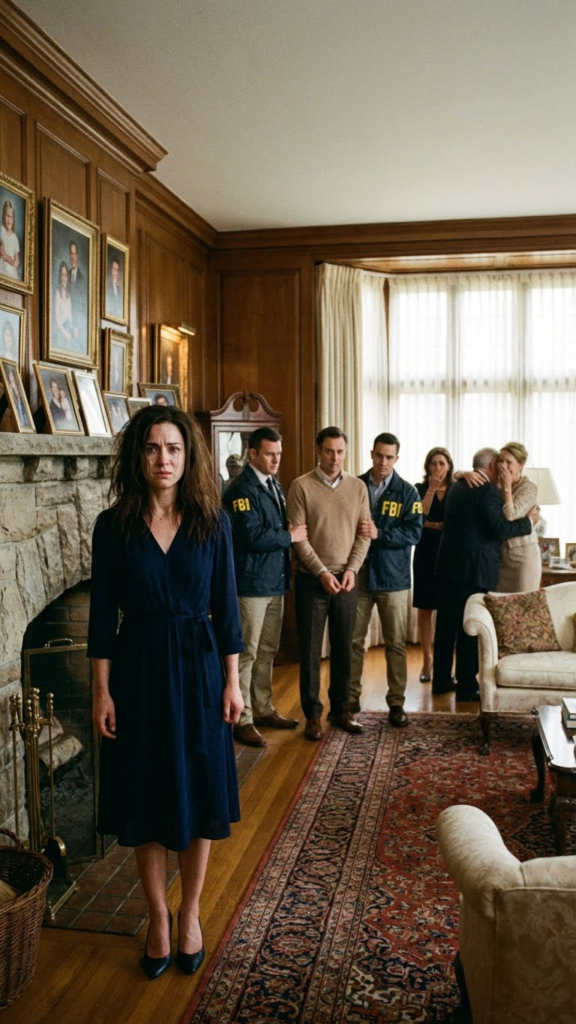
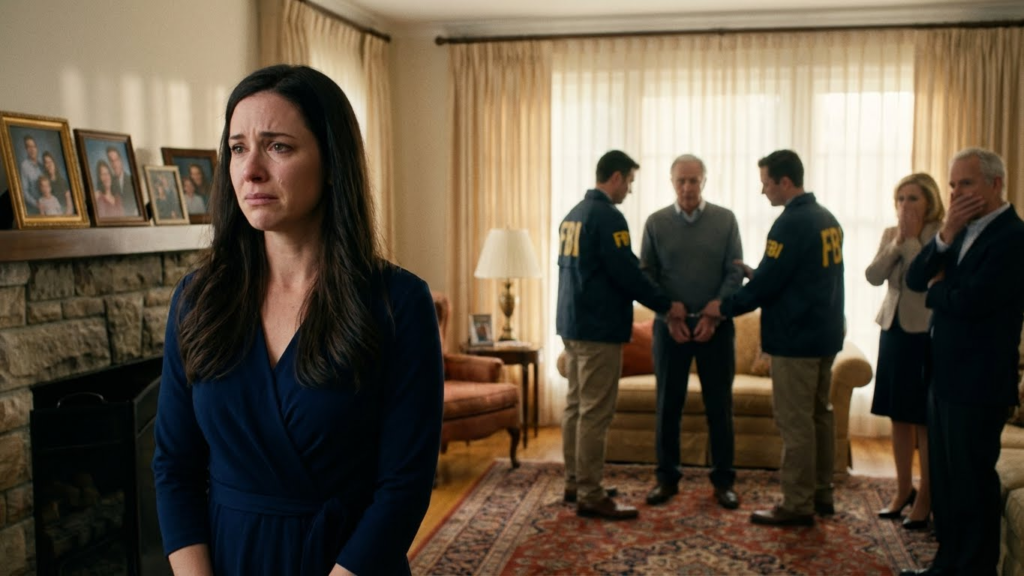
“Nobody move,” Agent Mills announced. “We have warrants for the arrest of Richard Coleman, Gerald Coleman, Blake Morrison, Marcus Coleman, Steven Coleman, and David Coleman.”
The room exploded into chaos.
My mother screamed. My grandfather demanded to know what was happening. Blake went pale and started backing toward the kitchen.
“Blake Morrison, don’t move,” an agent barked.
That’s when everyone turned to look at me.
My father’s eyes locked onto mine. For the first time in three years, I saw something other than disappointment in his face. I saw fear. And recognition.
“You,” he whispered. “You did this.”
“No, Dad,” I said, my voice steady. “You did this. I just made sure everyone found out.”
As the agents read Miranda rights and clicked handcuffs onto wrists that had once pointed accusingly at me, my phone buzzed.
It was Blake’s lawyer: “We need to talk. Urgently. Blake wants to settle the divorce immediately. Whatever you want.”
I actually laughed out loud.
For three years, Blake had fought me on every single thing. He claimed I deserved nothing. He told the court I was vindictive and mentally unstable. His lawyer argued I had contributed nothing to our marriage.
Now, facing decades in federal prison, he wanted to settle.
I texted back: “Too late. See you in court. Both courts.”
The arrests made national news. “Prominent Family’s Investment Scheme Defrauds Elderly Victims” ran in papers across three states. The irony wasn’t lost on anyone—the family that had publicly shamed me for violating the “sanctity of marriage” had been violating the law for over a decade.
The victims’ stories came out. Mrs. Henderson, 76, who lost her entire retirement savings. Mr. and Mrs. Patel, who had trusted my father with the money meant for their granddaughter’s medical treatments. The Johnsons, who had to sell their home.
All while my family lived in luxury, drove expensive cars, and lectured me about morality.
The trial took eighteen months. All six men were convicted. My father received 15 years. Uncle Gerald got 12. Blake got 8 years—he cooperated and testified against the others, which reduced his sentence. My cousins each got 5 years. My brother David, the lawyer who should have known better, got 10.
During the sentencing, the judge said something I’ll never forget: “You didn’t just steal money. You stole trust, security, and dignity from people who could least afford to lose it. And you did it while presenting yourselves as pillars of morality.”
My mother never apologized to me. Neither did my aunts. They blamed me for “destroying the family.” Even after everything came out, even after the victims testified about losing their homes and their retirements, they still found a way to make me the villain.
But I didn’t need their apologies anymore.
I used the settlement from my divorce—Blake gave me everything in exchange for me not testifying about his role in recruiting church members as victims—to start a nonprofit. It’s called “Second Chapter,” and we help women rebuild their lives after divorce, especially women who’ve been financially abused or isolated by their families.
Ironically, my grandmother’s inheritance—the money that paid for the investigation—was the best investment I ever made. It bought me freedom, justice, and peace.
Last month, I received a letter from Mrs. Henderson. The restitution process had begun, and she was getting some of her money back. She wrote: “Thank you for having the courage to do what was right, even when it cost you your family. You saved us.”
I keep that letter on my desk.
Sometimes people ask me if I regret it. If I wish I had just moved on, let sleeping dogs lie, avoided the drama.
I tell them the truth: The family that shamed me for divorcing had already torn themselves apart. They had already committed crimes that would catch up with them eventually. They had already hurt innocent people.
I didn’t destroy my family.
I just made sure they couldn’t destroy anyone else.
And honestly? Watching my father get handcuffed in the same living room where he once told me I was “dead to him” for leaving a cheating husband?
That was the most satisfying moment of my life.