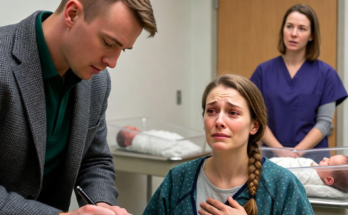
“Can you make her stop? Some of us are trying to think in here.”
The voice was like gravel grinding on glass. It cut through the sterile hum of the hospital ventilation and the rhythmic beeping of monitors in the distance. I looked up from the stack of rejection letters in my lap, my eyes burning from forty-eight hours without sleep.
We were in the ICU waiting room at St. Jude’s at 3:17 AM. My seven-year-old sister, Lily, was sitting on the cold linoleum floor in her oversized hospital gown, playing with a loose thread on her sock and quietly humming “You Are My Sunshine.” It was the only thing that kept her calm when the pressure in her chest got bad. It was the song our mother used to sing before the accident that took her away from us.
The man who spoke was sitting in the corner, isolated in a pool of shadow. He was older, maybe sixty, wearing a charcoal suit that looked tailored and expensive, though it was rumpled as if he’d been sleeping in it. He was scowling at his phone, radiating a dark, prickly energy. He looked like he hated the world, and in that moment, specifically us.
“I’m sorry,” I whispered, my voice cracking under the weight of exhaustion. “She’s just trying to be brave. The doctors said…” I couldn’t finish the sentence.
The words stuck in my throat like jagged stones. The doctors had said that without the valve replacement surgery by Friday, Lily’s heart wouldn’t hold out. Her condition was deteriorating faster than predicted. And two hours ago, the insurance company had denied the claim for the third time, citing a “pre-existing condition clause” buried in the fine print.
“Well, tell her to be brave quietly,” the man snapped, turning his back to us, shielding himself with his briefcase.
I felt a hot tear roll down my cheek. I wanted to scream at him. I wanted to throw the denial letters in his face and tell him that my little sister was dying, that I was twenty-three years old and drowning in responsibility, and that I was failing the one person I promised to protect.
But I didn’t. I just pulled Lily into my lap and buried my face in her strawberry-blonde hair, smelling the antiseptic soap they used.
But Lily? She didn’t cry. She wiggled out of my grip.
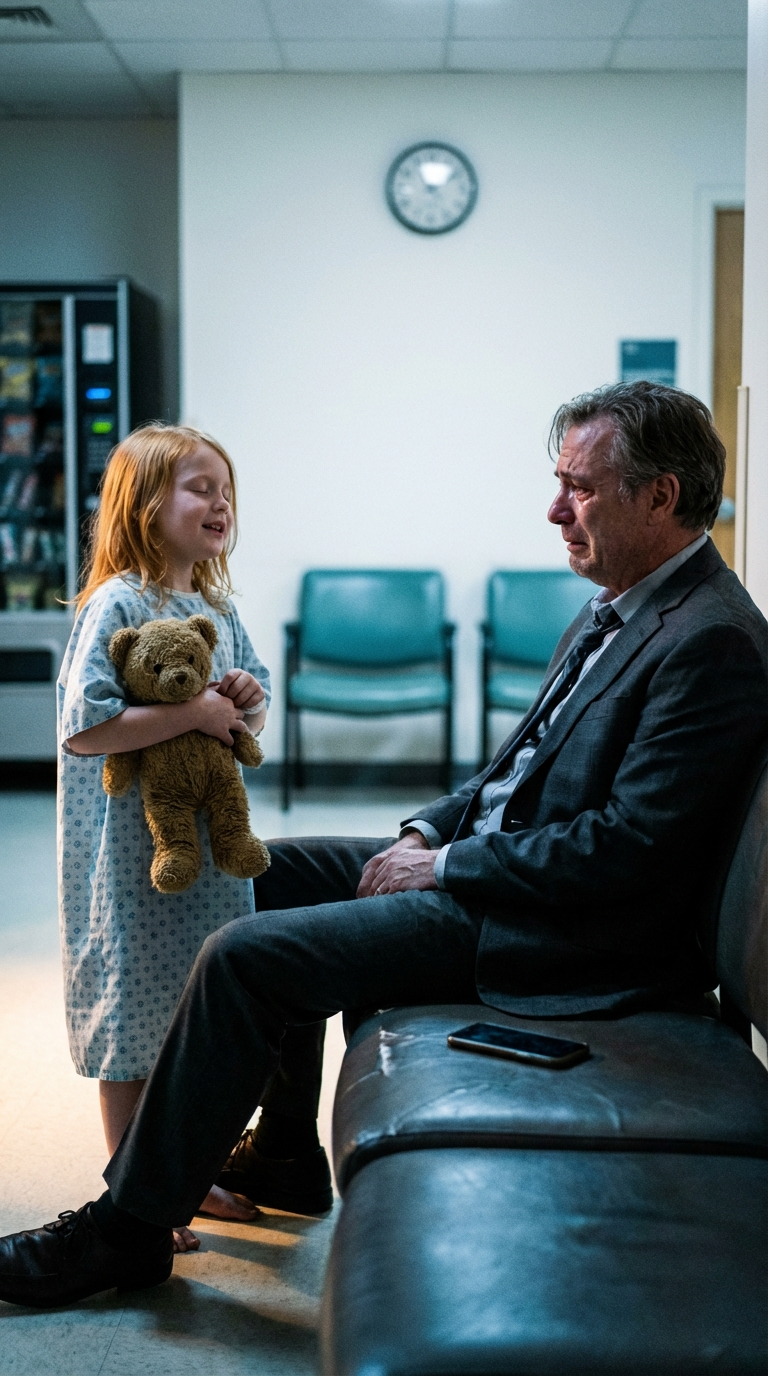
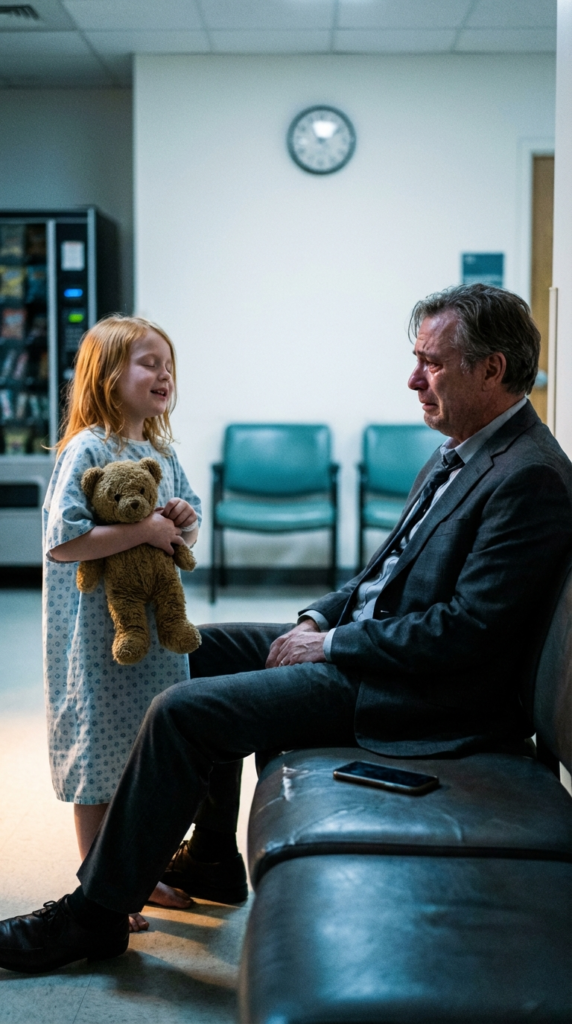
She walked right up to the grumpy man. She stood by his knee, clutching her worn-out teddy bear, Mr. Buttons, who was missing an eye.
“Mister?” she said, her voice tiny and breathless.
The man stiffened. He didn’t look up.
“Mister, you look like you have the ‘Big Sads,'” she said. “My mommy used to sing to me when I had the Sads. Do you want me to sing for you?”
The man froze. He slowly lowered his phone. He turned his head and looked at my dying sister. His face was hard, lined with deep grooves of stress, but his eyes… there was something broken in them.
“Go away, kid,” he mumbled, but his voice shook. It lacked the venom from before.
Lily didn’t leave. She took a shallow breath—all her lungs could manage—closed her eyes, and started to sing.
“You are my sunshine, my only sunshine… You make me happy, when skies are grey…”
Her voice was weak, reedy, and slightly off-key, but it was pure. It filled the empty, hopeless waiting room.
The man stared at her. His hand trembled violently. He looked at her like he was seeing a ghost.
As she hit the chorus, the man abruptly stood up. His chair scraped loudly against the floor. He threw his phone into his briefcase, snapped it shut, and stormed out of the waiting room without a word. The heavy double doors swung shut behind him.
I let out a breath I didn’t know I was holding. “Come here, Lily,” I said, pulling her back. “We shouldn’t bother people.”
I thought he was going to complain to the staff. I thought security was going to come and tell us we were being too loud. I sat there, hugging her, waiting for the other shoe to drop.
Ten minutes later, the double doors opened.
It wasn’t security. It was Dr. Aris, the Head of Cardiology. He looked confused, disheveled, and wide awake. He was holding a piece of paper.
“Miss Miller?” he asked, scanning the room.
I stood up, panic gripping my chest. “Is she okay? Did her vitals drop?”
“No, no,” Dr. Aris said, walking over to us. He looked at the paper, then at me. “I don’t know how you did this… or who you know… but prepare Lily. We’re operating in an hour.”
I stared at him. “What? But the insurance… the deposit… I don’t have the $150,000.”
Dr. Aris handed me the paper. It was a receipt.
“It’s been paid,” he said. “In full. Plus post-op care and rehabilitation.”
I looked at the receipt. At the bottom, in jagged, hurried handwriting, was a note: For the Sunshine.
To understand the weight of that moment, you have to understand the last three years of my life.
When our parents died on that icy highway, I was a sophomore in college. I dropped out the next day. I went from studying literature to scrubbing floors and waiting tables to keep the lights on for Lily.
Lily was born with a defect. Her heart was a ticking clock. I spent my nights fighting with bureaucrats and my days counting tips in a jar. I was invisible to the world—just another struggling girl in a city that didn’t care.
I had become bitter. I assumed the rich and powerful were all like the insurance adjusters who denied my claims: heartless algorithms in human suits.
When that man stormed out, I thought he was just another one of them. Another person inconvenienced by our tragedy.
The surgery took six hours. They were the longest six hours of my life. I paced the hallway until my shoes wore thin.
When Dr. Aris finally came out, he was smiling. “She’s going to be okay, Clara. The valve is perfect. Her heart is strong.”
I collapsed into a chair and wept.
Two days later, Lily was in recovery, eating blue Jell-O and watching cartoons. I needed coffee. I walked down to the hospital cafeteria.
On the television mounted in the corner, the local news was playing. A picture flashed on the screen.
It was the man. The grumpy man from the waiting room.
“Breaking News,” the anchor said. “Industrial tycoon Arthur Sterling has announced a surprise retirement today, handing over his multi-billion dollar empire to a charitable trust.”
Arthur Sterling. The “Steel King.” He was known for being ruthless. He fired people for smiling. He was a corporate shark who had allegedly shut down three factories last year to save a percentage point on his stock.
But then the news anchor said something else.
“This comes on the five-year anniversary of the tragic passing of Sterling’s own granddaughter, who died of a rare cardiac condition at the age of seven.”
I froze, my coffee cup hovering halfway to my mouth.
They showed a picture of his granddaughter. She had strawberry-blonde hair. She was holding a teddy bear.
The realization hit me like a physical blow.
He wasn’t sitting in that waiting room at 3 AM because he was working. He was sitting there because it was the anniversary. He was sitting there haunting the halls where he couldn’t save his own sunshine.
When Lily sang to him… she didn’t just annoy a grumpy stranger. She broke through five years of concrete that he had built around his heart.
I didn’t leave it there. I couldn’t.
A week later, Lily was discharged. Before we went home, I asked the nurse for an envelope. Lily drew a picture. It was a stick figure of a girl singing to a stick figure of a man in a suit, with a giant yellow sun filling the page.
Underneath, I wrote: Thank you for giving her a future. She would love to sing for you again.
I mailed it to the corporate headquarters of Sterling Industries. I didn’t expect a reply.
Three days later, a black town car pulled up to our crumbling apartment complex. A driver stepped out and handed me a letter on thick, cream-colored stationery.
Inside was a handwritten note.
Clara,
For five years, the silence in my life has been deafening. I thought money was the only way to control the world, but money couldn’t save my Sarah. I became angry at the universe. I hated seeing joy because I didn’t have any.
When your sister sang, I wanted to run away. It hurt too much. But then I realized… the song wasn’t for me. It was for her. She was fighting the darkness with the only weapon she had.
She saved me that night. Paying for her surgery was the least I could do. It was the first time my money has actually bought something valuable.
I have set up a trust in Lily’s name to cover her education. All of it. College, medical school, whatever she wants. And there is a job waiting for you in my foundation, starting Monday. You don’t have to scrub floors anymore. You have a sister to raise.
— Arthur
The Resolution
That was two years ago.
Today, Lily is nine. She runs on the soccer team. She gets out of breath sometimes, but she laughs, and her heart beats strong and steady—a rhythm paid for by a stranger’s grief.
I work as the Director of the Sarah Sterling Heart Foundation. We help families who are stuck in that same waiting room, fighting the same battles with insurance companies.
Arthur comes over for dinner on Sundays. He doesn’t wear suits anymore. He wears cardigans. He’s still a little grumpy about politics or the weather, but when Lily walks into the room, he lights up.
Last week, we were sitting on the porch. Lily was humming a Taylor Swift song, dancing around the yard.
Arthur watched her, sipping his tea.
“She has a terrible voice,” he grumbled, trying to hide a smile.
“The worst,” I agreed, squeezing his hand.
“But,” he whispered, wiping a speck of dust from his eye, “it’s the most beautiful sound I’ve ever heard.”
We live in a world that tells us to be hard. To be efficient. To keep our heads down. But sometimes, the most powerful thing you can do is look a stranger in the eye and sing, even when your voice is shaking.
Because you never know who is listening in the dark, just waiting for a little bit of sunshine.