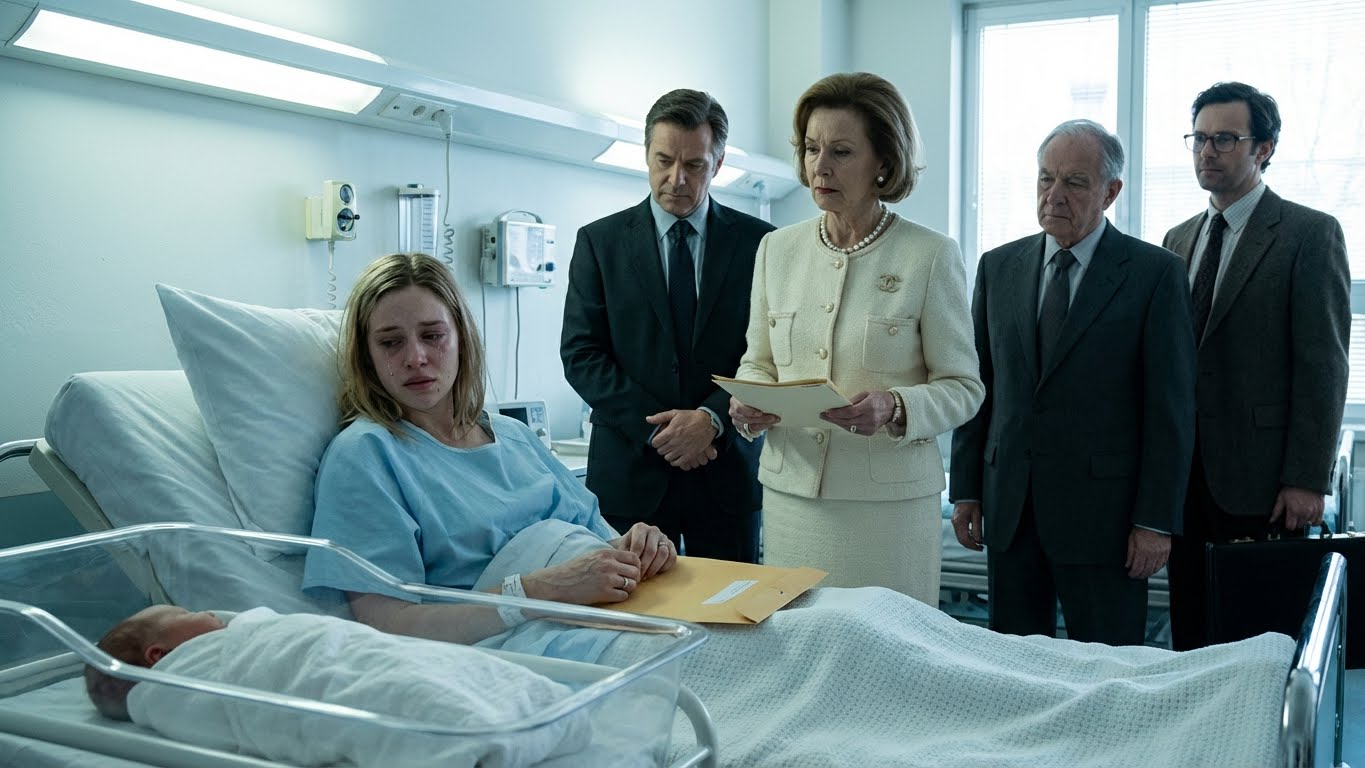
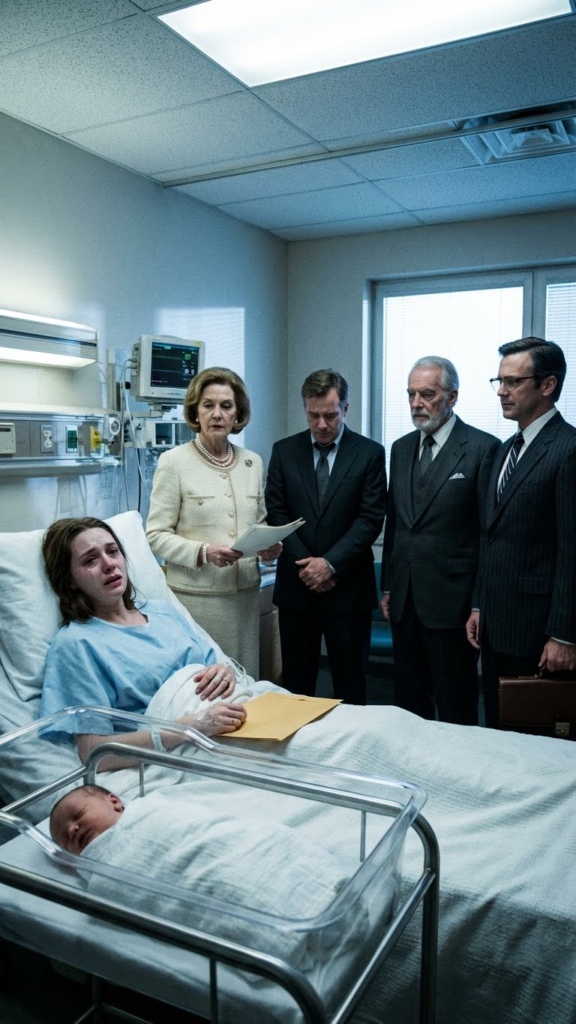
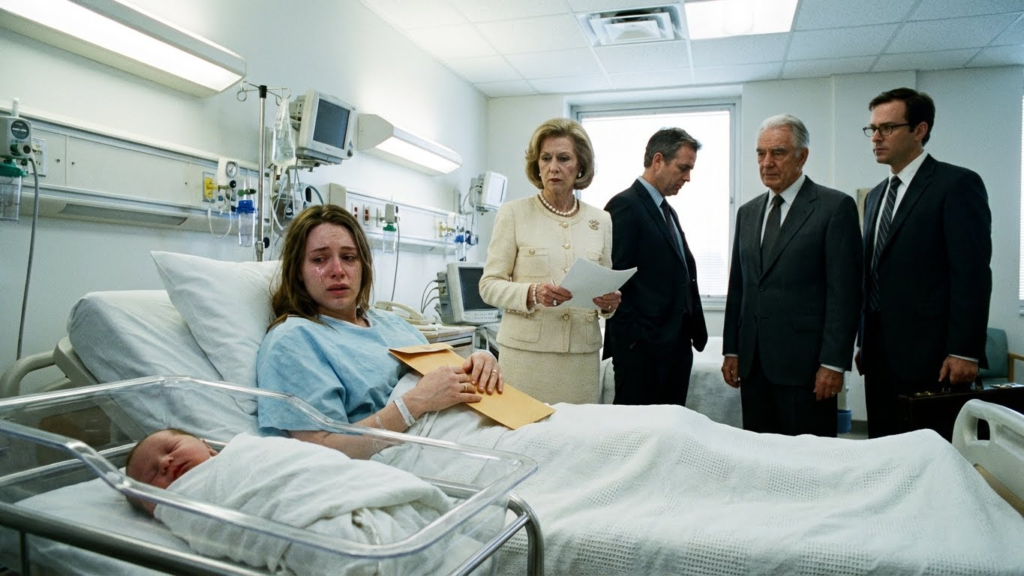
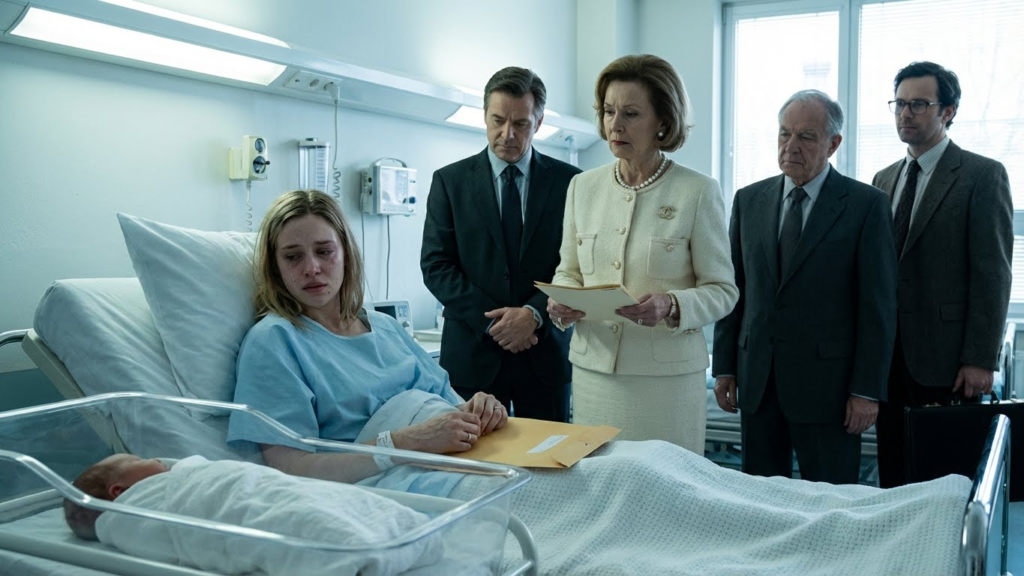
I was lying in the hospital bed, still shaking from delivery, when my mother-in-law walked into the room holding a manila envelope instead of flowers.
My daughter was only twenty minutes old. Twenty minutes. She was still doing her newborn screening tests down the hall. I could barely feel my legs. There was blood on my gown that the nurses hadn’t cleaned up yet. And Margaret—my husband’s mother—stood at the foot of my bed in her cream Chanel suit, perfectly pressed, with that look on her face. The one I’d seen a hundred times before. Cold. Calculating. Victorious.
“We need to discuss something important, Claire,” she said, her voice sharp enough to cut through my exhaustion.
My husband David was supposed to be getting me ice chips. Instead, he walked in behind his mother, followed by his father Richard, and—I felt my stomach drop—a man in a charcoal suit carrying a leather briefcase.
“What’s going on?” I whispered, my voice still hoarse from screaming during labor.
Margaret didn’t answer. She just slid the envelope across the blanket toward me. I stared at it like it was a snake.
“Open it,” she said.
My hands were trembling as I picked it up. The paper was heavy, expensive. Official. I looked at David, searching his face for some explanation, some reassurance. But he wouldn’t meet my eyes. He was staring at the floor like a guilty child.
The man in the suit cleared his throat. “Mrs. Whitmore, I’m Leonard Hastings, representing the Whitmore family trust. Those are divorce papers. We’re prepared to offer you a settlement if you sign today.”
The room tilted. I couldn’t breathe.
“You have thirty minutes to review the terms,” Margaret added, checking her Cartier watch. “After that, the offer decreases significantly.”
I looked down at the first page. The words blurred through my tears, but I caught fragments: “irreconcilable differences,” “waiver of spousal support,” “relinquishment of all claims to Whitmore estate assets.”
“David?” My voice cracked. “What is this?”
He finally looked at me, and what I saw in his eyes wasn’t love or regret. It was relief. Like he’d been waiting for someone else to do his dirty work.
“It’s better this way, Claire,” he said softly. “For everyone.”
That’s when I understood. This wasn’t a sudden decision. This was planned. Calculated. They’d been waiting for this moment—when I was at my most vulnerable, exhausted, drugged, still bleeding—to corner me into signing away my rights.
But what they didn’t know was that I’d been planning too.
I should explain how I ended up married to David Whitmore in the first place.
Three years ago, I was a 26-year-old paralegal working at a mid-sized law firm in Boston. I wasn’t wealthy, but I was independent, smart, and building a good life for myself. My parents had died in a car accident when I was nineteen, leaving me with nothing but student loans and the ability to survive on my own.
David walked into my firm one afternoon looking like he’d stepped out of a Ralph Lauren catalog. Tall, handsome, charming in that effortless way rich people are when they’ve never had to try. He was there to sign trust documents for his family’s real estate empire. The Whitmores owned half of Beacon Hill and had their fingers in everything from shipping to pharmaceuticals.
He asked me to dinner that night. Then another dinner. Then weekends in Martha’s Vineyard. Within six months, he proposed with his grandmother’s five-carat diamond ring.
I was in love. Stupidly, blindly in love.
Margaret hated me from day one. At our first family dinner, she asked me where I “summered” and looked horrified when I said I’d worked retail jobs every summer since I was sixteen. She made comments about my clothes, my education, my “limited social connections.” She once told David—right in front of me—that he should “consider all his options before making permanent decisions.”
But David defended me. Or so I thought. He’d squeeze my hand under the table and tell me not to worry about his mother. “She’ll come around,” he’d promise. “She just needs time.”
I believed him. I believed all of it.
The wedding was beautiful—a sprawling affair at the family estate with four hundred guests. Margaret insisted on controlling every detail, from the flowers to the guest list to my dress. I felt like a prop in someone else’s production, but I told myself it was worth it. I was marrying the man I loved.
The cracks started showing during our honeymoon in Santorini. David spent most of it on his phone, taking calls from his mother about “urgent family matters.” When I asked what was so important, he snapped at me for the first time. “You wouldn’t understand the complexity of managing family assets,” he said coldly.
After we returned, things got worse. David worked longer hours. Margaret inserted herself into every aspect of our lives—she had opinions about where we should live, what charities I should support, even when we should start having children. And David never pushed back. He just nodded and agreed while I felt myself disappearing into the role of “acceptable Whitmore wife.”
Then I got pregnant.
Margaret’s face when we told her was a mask of polite horror. “How wonderful,” she said, her voice dripping with false enthusiasm. “Though we weren’t expecting this quite so soon.”
David’s father Richard didn’t even pretend. “We’ll need to update the trust documents,” he said immediately. “Make sure everything is properly structured.”
I should have seen it then. The way they looked at each other. The private conversations that stopped when I entered rooms. The sudden interest in having me sign “routine paperwork” that David’s lawyer needed to review.
But I was focused on the pregnancy, on preparing for our daughter, on believing that a baby would bring us closer together.
I was so naive.
Back in that delivery room, I stared at the divorce papers while Margaret tapped her manicured nails against the bed rail.
“The settlement is quite generous,” Leonard Hastings said, adjusting his glasses. “Two hundred fifty thousand dollars in exchange for a clean separation. No custody battles, no drawn-out litigation. You sign today, and we’ll have a cashier’s check delivered within forty-eight hours.”
“My daughter is twenty minutes old,” I said, my voice shaking with rage I didn’t know I had. “And you’re offering me money to disappear?”
“It’s a fair offer considering the circumstances,” Margaret said coolly. “You’re young. You can start over. Find someone more… suitable to your background.”
“Circumstances?” I looked at David. “What circumstances?”
He shifted uncomfortably. “Claire, you have to understand. The family has concerns about—”
“About what? About me not being rich enough? Not having the right last name?”
“About compatibility,” Richard interjected, speaking for the first time. His voice was flat, businesslike. “David has responsibilities to the family legacy. Children complicate estate planning. We need clear boundaries.”
That’s when it clicked. The baby. They saw my daughter as a threat to their precious fortune. A mixed-class grandchild who might have claims to the Whitmore empire. They wanted me gone before I could establish any legal rights.
“You planned this,” I whispered, looking at David. “You knew. You knew they were going to do this.”
He had the decency to look ashamed. “I’m sorry, Claire. I tried to find another way, but—”
“But what? But you’re too much of a coward to stand up to your mother?”
Margaret’s expression hardened. “I would watch your tone, dear. You’re in no position to make demands.”
“Get out,” I said quietly.
“Excuse me?”
“GET OUT!” I screamed it this time, loud enough that a nurse came running.
“Ma’am, is everything okay?” The nurse—a kind-looking woman in her fifties named Sharon—looked between me and the Whitmore family with growing alarm.
“No,” I said, tears streaming down my face. “These people are harassing me. I just gave birth and they’re trying to force me to sign legal documents. I want them removed from my room. Now.”
Sharon’s expression shifted from concerned to protective. “I’m going to have to ask you all to leave. The patient needs rest.”
“We’re family,” Margaret protested.
“I don’t care if you’re the Queen of England,” Sharon said firmly. “Hospital policy is clear. The mother’s wishes come first. You need to leave immediately or I’ll call security.”
Leonard Hastings gathered his briefcase. “Mrs. Whitmore, you have my card. When you’re ready to discuss this rationally—”
“I’ll never be ready,” I said. “And I’m not signing anything.”
After they left, Sharon sat on the edge of my bed and held my hand while I sobbed. “Honey,” she said gently, “do you have anyone you can call? Family? A friend?”
I shook my head. I had colleagues, acquaintances, but David’s world had consumed mine. I’d lost touch with most of my old friends during the whirlwind courtship and marriage.
“What about a lawyer?” Sharon asked.
A lawyer. Of course.
I’d been a paralegal for five years before marrying David. I’d worked on divorce cases, custody battles, asset disputes. I knew exactly how these things worked. And more importantly, I knew something the Whitmores didn’t.
Three months earlier, when Margaret had insisted I sign “routine estate planning documents,” I’d been suspicious. David had brushed it off as standard procedure, but my paralegal instincts had kicked in. I’d made copies of everything before signing and sent them to my former boss, Kate Morrison, asking her to review them.
Kate had called me immediately. “Claire, these aren’t standard documents. These are designed to waive your marital property rights and establish the baby as outside the primary trust inheritance. You need your own lawyer.”
I’d been too scared to confront David then, too worried about causing problems. But I’d followed Kate’s advice and hired a family law attorney named Patricia Chen—quietly, using money from my old savings account that the Whitmores didn’t know existed.
Patricia had been building my case for months.
I called Patricia from my hospital bed.
“They did what?” she said, her voice sharp with professional outrage. “Claire, that’s coercion. Potentially criminal coercion. We’re going to bury them.”
“What do I do?” I asked, watching my daughter sleep in the hospital bassinet. She was perfect. Tiny fists, button nose, completely oblivious to the war being waged around her.
“First, don’t sign anything. Second, I’m filing an emergency restraining order tonight. Third, we’re going after everything.”
“Everything?”
“Massachusetts is an equitable distribution state. You’re entitled to a fair share of all marital assets acquired during the marriage. And that baby? She’s a Whitmore heir whether Margaret likes it or not. We’re going to make sure she’s protected.”
Patricia arrived at the hospital within two hours, armed with paperwork and a plan. We spent the evening going through everything—bank statements, property deeds, trust documents, emails. Every piece of evidence that showed the Whitmores’ pattern of control and manipulation.
The next morning, David returned to my room alone. He looked terrible—haggard, unshaven, like he hadn’t slept.
“Claire, please,” he started. “Can we talk?”
“Through lawyers,” I said coldly. “That’s what your family wanted, right? A clean, business-like transaction?”
“My mother went too far. I know that now. I should have stopped her.”
“You should have stopped her three years ago when she started treating me like I was beneath you. You should have stopped her when she made me feel small and worthless at every family gathering. You should have stopped her when she tried to manipulate me into signing away my rights.” I paused, looking him directly in the eyes. “But mostly, you should have stopped her from walking into my delivery room with divorce papers while I was still bleeding from giving birth to your child.”
He flinched. “I love you, Claire. I never wanted this.”
“You let it happen. That’s the same thing.”
“What do you want?” he asked quietly.
“I want my daughter to grow up knowing her father chose his mother’s money over his own family. I want you to live with that.”
David left without another word.
The divorce took eight months to finalize. It was brutal, public, and everything the Whitmore family had tried to avoid.
Patricia was ruthless. She subpoenaed every financial record, exposed every trust structure, and demonstrated a clear pattern of financial abuse and coercion. The media loved it—”Old Money Family Ambushes New Mother” was a headline that wrote itself.
Margaret tried to paint me as a gold digger, but Patricia had evidence of every insult, every instance of her trying to control my life, every document I’d been pressured to sign under false pretenses. The judge was not impressed with the Whitmore family tactics.
In the end, I received a settlement of four million dollars, full custody of my daughter Emma with generous child support, and her guaranteed inheritance rights in the family trust. The court also ordered Margaret and Richard to have no unsupervised contact with Emma until she was old enough to decide for herself.
David got weekend visitation, though he rarely used it. He remarried within a year—a woman from another old Boston family that Margaret approved of. I heard they’re expecting a baby of their own.
I don’t care anymore.
I used the settlement money wisely. I bought a beautiful house in Cambridge—nothing ostentatious, just a real home with a yard where Emma can play. I went back to school and finished my law degree. I’m now a family law attorney myself, specializing in cases of financial coercion and abuse.
Emma is three years old now. She’s smart, funny, and completely unaware of the drama that surrounded her birth. She knows her father, sees him occasionally, but our life doesn’t revolve around the Whitmore family anymore.
Sometimes I drive past the Beacon Hill estate where I once thought I’d raise my children. It looks exactly the same—imposing, cold, perfect on the outside. I don’t feel sad anymore. I feel grateful.
Because that day in the delivery room, when Margaret handed me those divorce papers, she accidentally gave me the greatest gift: she showed me exactly who they were. And more importantly, she gave me the motivation to fight back.
I was twenty-six when I married into the Whitmore family, believing love could overcome anything. I was twenty-nine when I divorced out of it, having learned that sometimes the best revenge is simply refusing to disappear.
Margaret Whitmore wanted me gone. Instead, I became the lawyer who helps other women escape families just like hers.
And every time I win one of those cases, I think about that manila envelope sliding across my hospital bed. I think about the thirty-minute deadline and the cashier’s check they thought would make me vanish.
I think about how close I came to signing.
And then I look at my daughter, playing in our sunlit living room, free from all of it.
That’s the real victory.
Not the money or the settlement or the headlines. It’s the fact that Emma will grow up knowing her mother didn’t break when they tried to break her. She’ll know that sometimes the bravest thing you can do is refuse to accept the life other people have planned for you.
The Whitmores wanted a quiet, controllable daughter-in-law who would fade into the background of their dynasty.
Instead, they got me.
And I’m still here.