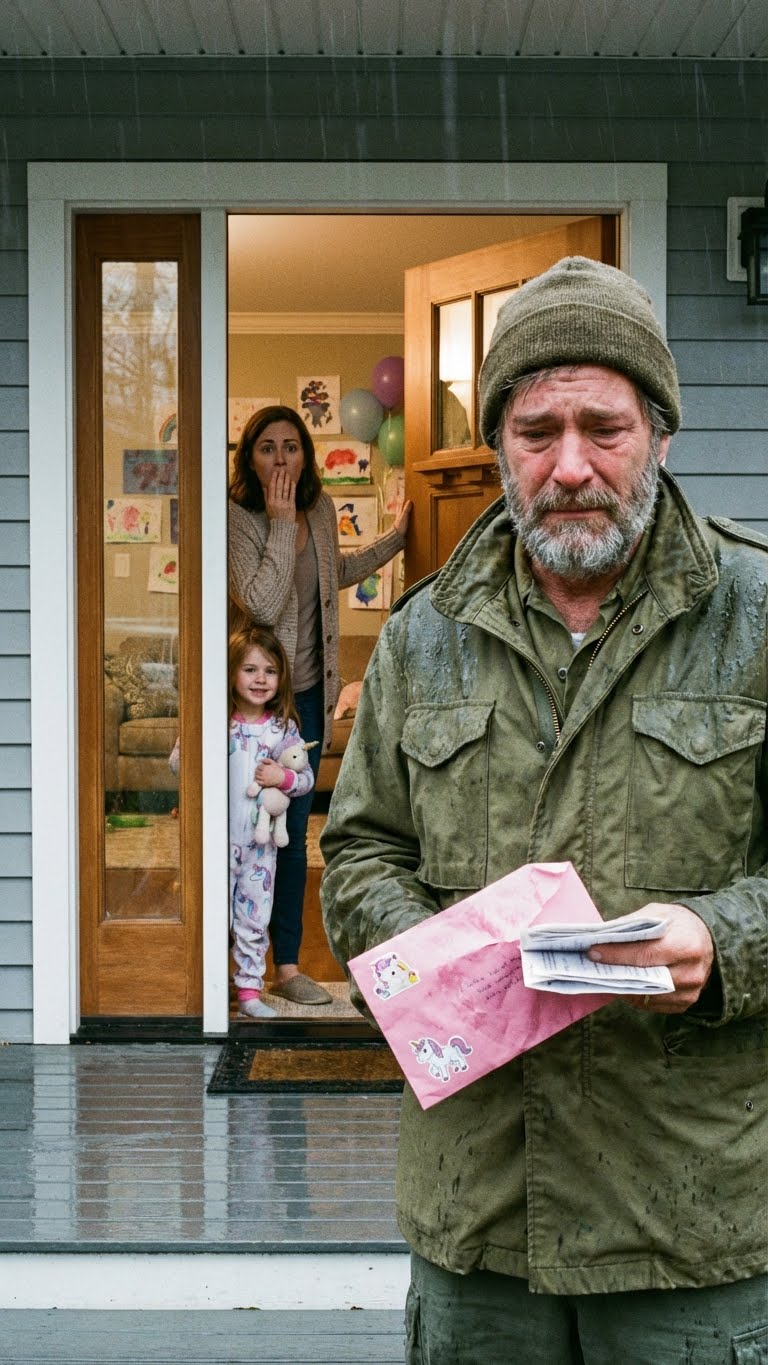
The Man on the Porch
He was standing on my porch in the pouring rain, holding a crumpled pink envelope with my daughter’s name on it.
“Ma’am… I think this belongs to your little girl,” he said quietly.
Behind me, a few sagging balloons still hung from the staircase—leftovers from Lily’s sixth birthday three months earlier. The house smelled faintly of vanilla frosting and the lemon cleaner I always used on Fridays. On the TV in the living room, cartoon voices echoed, bright and oblivious.
My husband, Mark, hovered on the stairs, jaw clenched. He’d recognized the man instantly. I could see it on his face.
The same homeless man from the grocery store parking lot.
The same man our daughter had given every last dollar of her birthday money to.
The same man Mark had spent three weeks mocking, calling him “a leech,” “a manipulator,” “a perfect example of why this country is falling apart.”
And now he was here, on our front porch, water pooling at his feet, holding Lily’s pink unicorn envelope like it was the most precious thing in the world.
“I told you this would happen,” Mark hissed near my ear. “You give a guy like that money, he smells weakness. Now he’s at our house. This is why you can’t keep doing this bleeding-heart stuff, Anna.”
But when I looked at the man’s face, all I saw was fear. His eyes kept darting to the street, to the windows, to Lily’s shoes near the door like he was afraid someone would punish him just for standing there.
“I’m sorry,” he said again, his voice rough. “I know this is weird. I just… your daughter. She said something to me that night. And I promised her I’d come back. I promised I’d show her what she did for me. And I need to tell you something before it’s too late.”
Then Lily’s small voice floated from behind me. “Mom? Who’s at the door?”
By the time I turned around, she’d already squeezed past my side, curly hair messy, unicorn pajamas rumpled, stuffed animal dragging on the floor.
She saw him and froze.
Then she smiled.
“It’s you,” she whispered. “You came back.”
And that was the moment my life began to split into “before” and “after.”
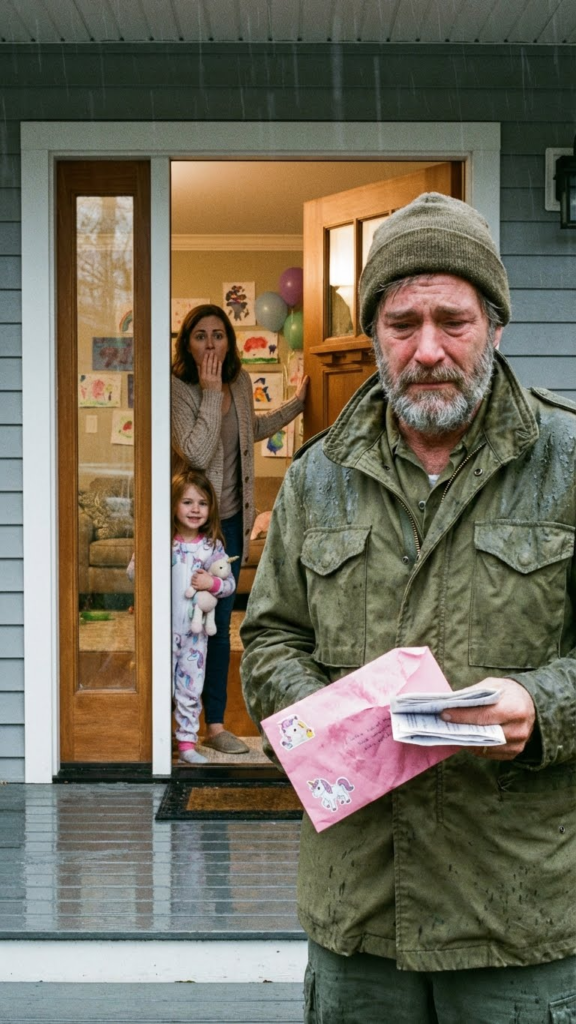
Before: The Grocery Store Parking Lot
Three months earlier, the day of Lily’s sixth birthday, I’d been running late. I was juggling cupcakes, party favors, and a last-minute grocery trip because Mark had “forgotten” to pick up the juice boxes he’d promised to grab.
It was cold. One of those gray March afternoons where the wind felt like it went straight through your coat. Lily was bouncing beside the cart, chattering about her birthday wishes, her two front teeth missing when she smiled.
Then she saw him.
He was sitting on the curb near the cart corral. Jacket too thin, hood pulled up, hands tucked under his arms for warmth. His cardboard sign was simple: “Just hungry. Anything helps. God bless.”
“Mom,” Lily said, tugging my sleeve. “That man is shivering.”
“I know, baby,” I said, my brain already spinning with party logistics. “We don’t have any cash right now.”
“That’s not true,” she said matter-of-factly. “I have my birthday money.”
She said it so loudly that the man looked up.
His eyes were startlingly blue, bloodshot but clear. He gave a little nod like he was apologizing for existing.
“Hi,” Lily said, already letting go of the cart. “My name’s Lily. Are you hungry?”
“Lily,” I hissed, grabbing her arm. “Sweetie, we don’t go up to strangers, okay? It’s not safe.”
“He’s not a stranger,” she said, completely calm. “He’s a person.”
That sentence stopped me cold.
We’d given Lily fifty dollars in small bills that morning, tucked into a pink envelope covered in glitter unicorn stickers. “For your birthday,” we’d said. “You can spend it on anything you want.”
She reached into her little crossbody bag, pulled out the envelope, and marched up to the man before I could stop her.
“Here,” she said, holding it out. “It’s my birthday money. You can have it.”
His hands hovered in midair. “Oh, sweetie, I… I can’t take all that,” he stammered. “Keep it for yourself, okay? Buy something fun.”
“It’s okay,” she said. “I already got presents. And grown-ups always say money is for important things. You look like you have more important things than me. Like food. And a house. And a… hot bath.” She wrinkled her nose. “You smell like my wet dog.”
Her brutal honesty made my face burn, but the man laughed. A broken, surprised sound.
“That’s fair,” he said. “I probably do.”
I finally caught up, pulling Lily back gently. “I’m so sorry,” I blurted. “She’s… we’re in a hurry. She doesn’t understand—”
“She understands more than most,” he said quietly.
He looked at me, really looked at me, and there was something almost familiar in his gaze. Not like we’d met before, but like he knew my type. The type that gave uncomfortable smiles and said “sorry, I don’t have cash” even when there was a five tucked in their wallet.
“I can’t take her birthday money,” he repeated.
“You can,” Lily insisted, stepping forward again. “Because my mom says when you give someone something and it hurts a little, that means it was important.”
I had said that. Once. When we donated toys for a Christmas drive.
The man’s eyes filled with tears. He took the envelope with both hands like it was glass.
“Thank you,” he whispered. “I… I promise, I’ll make this matter. I promise, I’ll come back one day and show you what you did for me.”
Mark, when he heard about it, did not find it touching.
“You gave a random guy fifty bucks?” he snapped that night after the party, when the kids were gone and the house was finally quiet. “Are you insane, Anna? That’s not generosity, that’s stupidity.”
“It was Lily’s choice,” I said. “And he tried to refuse it.”
“He’s a professional manipulator,” Mark shot back. “That’s how they work. ‘Oh, I promise I’ll come back.’ Please. He’s probably already high somewhere.”
I winced. “You didn’t see him.”
“I saw enough,” Mark said. “If he shows up again, we’re calling the cops. I’m not letting some drug addict stalk our daughter because you needed a charity moment.”
It turned into one of those fights where we weren’t just arguing about the homeless man. We were arguing about everything.
About how Mark worked 60 hours a week in sales and came home exhausted and mean. About how he’d started criticizing everything I did—from how I packed Lily’s lunch to how I stacked the dishwasher. About how he’d stopped touching me like a husband and started talking to me like an employee who never quite met her quota.
We went to bed angry. We didn’t talk about it again.
But Lily did.
“Do you think he found a house?” she asked me a week later while we were coloring.
“I don’t know, baby,” I said. “I hope so.”
“I asked God,” she said casually. “I said, ‘Please make my money turn into a house for him.’ Do you think God heard?”
I swallowed past the lump in my throat. “I think God listens when little girls ask for things for other people.”
“Then I think He’ll do it,” she said, and went back to coloring.
I wanted to believe her.
The Marriage Behind the Door
If you saw our house from the outside, you’d think we were fine.
We had the white siding, the black shutters, the neat little lawn. We had the SUV in the driveway and the seasonal wreath on the door. We had framed photos from Disney and Christmas and Lily’s preschool graduation lining the stairs.
What you wouldn’t see were the cracks.
Mark and I met in college. He was charming then. Funny, ambitious, the kind of guy who could talk his way into and out of anything. I loved that about him at first.
I didn’t realize that one day he’d use that same talent to talk me out of trusting my own eyes, my own gut, my own daughter.
When Lily was born, something shifted. Mark threw himself into work. “For us,” he said. “So you don’t have to worry.”
But somewhere along the line, “for us” became “for me,” and “I’m doing this to provide” became “I’m allowed to be a monster because I pay the mortgage.”
The bullying started small.
“Do you really think that shirt fits you?”
“You’re home all day and somehow the house still looks like this?”
“Lily’s getting too soft. You baby her.”
When I suggested therapy, he laughed. “I don’t need therapy,” he said. “I’m not the one crying over strangers in parking lots.”
He hated that I volunteered at the shelter twice a month. He called it “your guilt hobby.”
“It’s not guilt,” I said. “It’s empathy.”
“Same thing,” he shrugged.
I’d grown up in a family where you helped people when you could. My parents weren’t rich, but my mom always had a spare casserole in the freezer for a neighbor in trouble. My dad would stop to help anyone with a broken-down car. They were far from perfect, but they believed in kindness.
Mark believed in merit.
“If people wanted a better life, they’d work for it,” he said. “I did.”
He didn’t see how much support he’d had. Scholarships. Parents who helped with his first apartment. Friends who helped him network. A wife who picked up every slack at home so he could stay late and schmooze.
When I pointed that out, he accused me of being ungrateful.
By the time Lily turned six, our marriage looked fine in photos. It did not feel fine in my bones.
The Man Returns
Three months after Lily handed her birthday money to the homeless man, it was raining again.
One of those summer storms that come out of nowhere, dark clouds rolling in over the neat little subdivision, wind whipping the trees. Mark had just texted that he’d be “late, again,” something about drinks with clients.
Lily and I were in the kitchen making grilled cheese. She’d drawn a picture of the man in the parking lot a few days earlier. She’d given him a big smile and a little house with smoke coming out of the chimney.
“I think he has a house now,” she told me. “I can feel it.”
That’s when the doorbell rang.
Our doorbell hardly ever rang. Our friends texted. Our parents called. Doorbells were for Amazon packages and political canvassers.
Lily darted toward the hallway. “I’ll get it!”
“Wait—” I called, wiping my hands. “Check who it is first!”
By the time I rounded the corner, she’d already pulled the door open.
He stood there, dripping.
Same worn jacket. Same tired eyes. But something was different. His shoulders were straighter. His beard was trimmed. His hands were clean.
He held out the pink envelope with careful fingers.
“Hi, Lily,” he said softly. “You remember me?”
Her face lit up in this way I hadn’t seen in a long time. Like life was a movie and the best part had just walked back on screen.
“I told you,” she breathed. “Mom, I told you he’d come back.”
I stepped between them on instinct, shielding her without even thinking.
Mark thundered down the stairs. He must have seen the man through the window.
“What the hell are you doing here?” he snapped before I could say anything. “I told you, if you ever—”
“I’m not here for money,” the man said quickly, hands up like he was under arrest. “I swear. I’m not here to cause trouble. I’m here because I made her a promise. And because there’s something you need to know.”
“Anna, take Lily upstairs,” Mark barked. “Now.”
Lily clutched my leg. “No, Mommy. Please. He’s nice.”
There was a moment where everything hung in the balance. The rain pounding on the roof. The TV still playing in the background. The man shaking on the porch. Mark vibrating with anger.
That’s when the man said it.
“Ma’am… my name is Daniel,” he said, looking at me with an intensity that made my chest tight. “Your daughter saved my life. But your husband—”
He hesitated.
“Your husband tried to make sure I never got one.”
The Secret in the Files
We ended up in the living room.
I made Lily go upstairs with a promise she could meet Daniel later. Mark wanted him gone. I insisted we hear him out. It turned into a standoff.
“If he doesn’t leave, I’m calling the cops,” Mark said, arms crossed.
“If you call the cops on him, I’m calling a lawyer,” I said, surprising even myself.
Power shifted in the room. Just a little. A crack in the pattern.
“Five minutes,” I told Daniel. “You have five minutes. Then I decide what happens next.”
He nodded, clutching the envelope.
“Three months ago,” he began, “your daughter gave me this.” He held up the pink unicorn envelope.
“I took it because… well, I was starving. I’d been on the street for a year. Lost my job after a back injury. Insurance didn’t cover everything. Savings dried up. One bad month turned into six, turned into sleeping behind dumpsters and hoping nobody set me on fire for fun.”
My stomach twisted. I’d heard versions of this story at the shelter.
“But nobody,” he continued, “had ever given me something like this. Not just the money. The way she did it. Like I was a person. Like I deserved a birthday gift too.”
He smiled faintly. “So I went to the shelter downtown. I knew they had a program that helps people get back on their feet. Housing, job training, all that. Problem is, there’s a waitlist a mile long.”
I nodded. “I know. I volunteer there sometimes.”
His eyes flicked to me with recognition. “Yeah. I thought you looked familiar.”
Mark snorted. “Of course you do.”
“The woman at the desk told me something,” Daniel said, ignoring him. “She said, ‘You were supposed to be in our program months ago. We had a sponsor already lined up. Corporate partnership. We were told someone backed out last minute and cut your slot.’”
I frowned. “What? Why would that happen?”
He looked straight at Mark.
“She showed me the file,” he said. “I wasn’t supposed to see it. But she was pissed. Your name was blacked out, but she remembered it. Sales director at NorthGate Automotive. Big donor. Big talker.”
Mark stiffened. “She’s lying. They make stuff up all the time to guilt people into more donations.”
Daniel shook his head. “I never forgot a name that was tied to a bed I didn’t get. A shower I didn’t get. A job counselor I didn’t get. A shot at not freezing to death that I didn’t get.”
He reached into his jacket and pulled out a folded piece of paper—worn, but legible.
It was a printed email.
To: Director, Haven House Shelter
From: m.carter@northgateauto.com
Subject: Sponsorship Removal
“…after observing the ungrateful behavior of your residents and seeing one of them loitering near my wife and daughter at the grocery store, I no longer feel comfortable attaching our company’s name or my personal funds to enable this kind of dependency…”
My breath caught. My eyes went to the signature.
Mark Carter.
My husband.
“I didn’t know they were going to tell him that,” Mark said quickly. “It’s a business decision. They’re always trying to upsell. I never signed anything.”
Daniel’s voice cracked. “You told them ‘one of them’ bothered your wife and daughter. That was me. I remembered your face. I remembered your car. I remembered your jacket. I didn’t go near you. I was twenty feet away. You just didn’t like seeing me.”
My mouth went dry.
“Mark?” I said slowly. “Is this real?”
He rolled his eyes. “Anna, don’t be dramatic. I pulled a corporate sponsorship. That’s all. They probably gave the spot to someone else. It’s not like I personally killed him.”
Daniel’s hands were shaking now. He set the envelope on the coffee table.
“A month after you pulled that sponsorship,” he said quietly, “I almost died. Hypothermia. I woke up in a hospital. No ID. They almost shipped me off to a state facility. I heard a nurse say, ‘We found him in the alley behind that big dealership on 5th.’”
He looked at Mark. “Your dealership.”
The room felt like it was shrinking.
“I got out,” Daniel went on. “Barely. I went back to the shelter. Begged. The director recognized me. She’d gotten another small grant. One bed. One more slot. She said, ‘You’re lucky.’”
He smiled bitterly. “It wasn’t luck. It was her bending rules and pulling strings. She got me into the program. I got sober. Got a part-time job at a warehouse. Got a room. A shower. A second chance. All of it funded by that ‘dependency’ money you didn’t think we deserved.”
He pushed the envelope toward me.
“I kept this,” he said. “Every day. I wouldn’t spend it. Not a cent. I told myself I’d come back and show Lily what she really bought.”
My voice came out in a whisper. “What did she buy?”
He opened the envelope slowly.
Inside was a stack of papers. Not cash.
Employment contract. ID badge copy. Apartment lease. A photo of Daniel in a shelter graduation ceremony, holding a certificate. A printed bank statement showing a modest but real savings account.
“She bought me this,” he said. “A life. I used her fifty to pay for the bus to the shelter every day when I was too tired to walk. I used it to print my resume. To buy a shirt from Goodwill so I didn’t smell during interviews. I told every person in that building about a little girl who gave away her birthday money and made me promise I’d do something important with it.”
He looked at Mark again.
“And I came back,” he said. “Because she kept her promise. And you broke yours.”
The Breaking Point
It wasn’t just the email.
It was everything that came with it. The way Mark’s face twisted when he was caught. The way he minimized it all. The way he looked at Daniel like he was a problem, not a person.
“You can’t blame me for whatever happened to you,” Mark snapped. “You people always want someone to blame. I pulled a sponsorship. That’s all. The world doesn’t revolve around you.”
“The world where you sleep in a bed doesn’t revolve around me,” Daniel said. “The world where I was trying not to die in an alley definitely revolved around that bed I didn’t get.”
I felt something snap inside me.
Not a loud crack. More like a quiet thread finally giving way after years of weight.
“How could you not tell me?” I asked Mark. “You knew I volunteered there. You knew how much that place mattered to me. You pulled funding because you didn’t like seeing a homeless man near your car?”
He threw his hands up. “I pulled funding because I’m tired of being scammed! They stand outside our store, they scare customers, and then people like you feel bad and hand over money. It’s bad optics, it’s bad business, and it enables them to stay stuck.”
“Enables us to stay alive,” Daniel muttered.
“You didn’t see what I saw,” Mark continued, undeterred. “You saw one sad guy. I saw an army of freeloaders. I saw a liability. It’s my job to protect my family. I won’t apologize for that.”
Protect.
Is that what he thought he’d been doing all these years? Protecting us by hardening himself to everyone else?
“Mom?” Lily’s small voice floated from the stairs. “Are you mad?”
We all looked up.
She was sitting on the bottom step, hugging her unicorn, eyes huge. She’d heard everything.
“Baby,” I started, heart dropping into my stomach. “You were supposed to—”
“I heard you,” she said. “Daddy said he didn’t want to help him. But I did. So… is it my fault he got sick?”
The look on Mark’s face was pure discomfort. He hated conversations like this. He hated feelings that couldn’t be shut down with a joke or a lecture.
“Lily, it’s not that simple,” he said. “Grown-up decisions are complicated.”
“No, they’re not,” she said. “Mom says you help when you can. You could. You didn’t.”
Out of the mouths of babes.
Mark turned on me. “This is what you’ve done,” he snapped. “You’ve filled her head with this bleeding-heart nonsense. Now she thinks I’m the bad guy because I’m realistic.”
Daniel took a breath.
“Can I show her something?” he asked softly.
Mark started to say no. I beat him.
“Yes,” I said. “You can.”
Daniel knelt down slowly, so he was at Lily’s eye level.
“Remember when you gave me your birthday money?” he asked.
She nodded. “You were shaking. And you said you were tired.”
“I was,” he said. “But after that day, I got less tired. Because of you.”
He laid out the papers on the coffee table, one by one, like a magic trick.
“This is my job now,” he said. “I work at a warehouse. They pay me money every week. This is my apartment. See? That’s my name. That’s my room. It has a bed. And a shower. And a kitchen. I can make grilled cheese now, just like your mom.”
Her eyes flicked to each paper, absorbing it with that intense child focus.
“You did that,” he said. “You helped me get these. Your money didn’t just disappear. It turned into something else. It turned into chances. That’s what happens when you give like you did.”
He glanced up at me, eyes wet.
“And your mom’s right,” he added. “It only really matters when it hurts a little.”
Lily smiled, small and proud.
Then she looked at Mark.
“Did you help him?” she asked.
He hesitated. “Not… directly.”
“Did you hurt him?” she asked.
Silence.
Daniel saved him from answering.
“It’s okay, Lily,” he said. “Your dad made a choice. I made some bad choices, too. A lot of them. That’s how I ended up where I was. But we can all make better ones now.”
He stood up, suddenly awkward.
“I didn’t come here to blow up your family,” he said. “I came here because I made a promise to your daughter. And because… she reminded me of someone.”
He reached into his wallet and pulled out a worn photo.
A little girl, maybe six. Same curly hair. Same gap-toothed smile.
“My daughter,” he said. “From before. I haven’t seen her in years. Drugs. Prison. Shame. I missed everything. When Lily gave me that envelope, it felt like… like I got a second chance to be the kind of dad I should’ve been.”
He swallowed hard.
“I wanted you to know that, Lily,” he said. “You didn’t just give money. You gave me a reason to be someone again.”
The Decision
When Daniel left, it was still raining. But the house felt different.
He’d refused to stay for dinner, even though Lily begged. He’d given her the pink envelope back with a crisp twenty inside.
“Interest,” he’d joked. “First of many paybacks I owe you.”
Mark rolled his eyes. “You see?” he said as soon as the door closed. “He’s using her. Emotional manipulation 101. He found our address, he showed up uninvited, he dumped his trauma on our kid. That’s not gratitude. That’s boundary issues.”
“He found our address because you gave yours to the shelter,” I said quietly. “It was on the sponsorship paperwork.”
“That’s not the point.”
“It is exactly the point.”
We stood in the hallway, the air thick with everything that had just happened and everything that had been brewing for years.
“You lied to me,” I said. “You made decisions that went against everything I believe in and you hid them. You pulled a sponsorship from a place that literally saves lives because you felt… uncomfortable.”
“I’m not obligated to fund your savior complexes,” he shot back. “I’m obligated to take care of my family.”
“Then why don’t you?” I snapped.
The words surprised both of us.
“You take care of your ego,” I continued, the dam finally breaking. “You take care of your image. Your ‘numbers,’ your ‘performance,’ your ‘reputation.’ You don’t take care of us. You come home angry and tired and you treat me like your employee and you treat Lily like she’s a problem to manage.”
His face hardened. “You’re overreacting.”
“I’m underreacting,” I said. “I’ve been underreacting for years.”
Lily reappeared at the stairs, sensing the storm.
“Mom?” she whispered. “Are you gonna be mad forever?”
I knelt down, pulling her into a hug.
“No, baby,” I said, my voice shaking. “I’m going to be brave for a little while. Then things are going to get better.”
“How?” she asked.
I didn’t answer her.
I looked at Mark instead.
“I want a separation,” I said.
He stared at me like I’d spoken another language. “You’re not serious.”
“I am,” I said. “You don’t have to believe in what I believe. But I won’t have you quietly undermining it while our daughter watches. I won’t have you teaching her that empathy is weakness and money matters more than people.”
“This is about some homeless guy?” he scoffed. “You’re nuking our marriage over a bum with a sob story and a printout?”
“No,” I said quietly. “I’m ending a marriage over a pattern. He just held up the mirror.”
Six Months Later
Mark didn’t leave easily.
There were lawyers. There were shouting matches. There was the night he tried to make Lily choose who she wanted to live with and she burst into tears so hard she vomited, and I thought, This ends now.
He moved into a furnished apartment near his dealership. He got weekend visitation. He complained to anyone who would listen that his wife had “lost her mind” over “a hobo.”
I started working more hours at the shelter.
Not just as a volunteer.
As staff.
The director—Maria—asked me to come on part-time to help with community outreach. “You have a gift,” she said. “You make people listen without making them feel attacked.”
I wasn’t sure about that, but I tried.
I told Daniel’s story (with his permission, changing identifying details) at churches, schools, board meetings. I talked about how one little girl’s birthday money did more good than one grown man’s corporate withdrawal.
People listened.
Some didn’t. But enough did.
We got new sponsors. Small businesses. A retired teacher who donated her inheritance. A high school that made us their annual fundraiser.
Daniel kept coming by.
Sometimes for coffee. Sometimes to drop off donations. Sometimes just to say hi to Lily.
He never crossed a line. Never asked for more. He stayed respectful, aware of the complicated history.
Lily adored him.
“This is my friend Daniel,” she told her classmates once. “I bought him a life.”
I corrected her gently. “You helped him get one,” I said. “He did a lot of the work himself.”
She nodded solemnly. “We did it together.”
Mark hated that Daniel was still in the picture.
“You’re replacing me with some washed-up junkie,” he spat during one argument.
“I’m not replacing you,” I said. “I’m supplementing what you refuse to be.”
The court didn’t care much about moral arguments. They cared about logistics. Income. Stability.
I got primary custody.
Mark got alternate weekends.
Justice, Not Revenge
The revenge in this story wasn’t someone getting dragged away in handcuffs.
It wasn’t Mark losing his job or his car or his perfect hair.
The revenge was quieter.
It was Lily growing up knowing that the parent she lived with chose compassion over convenience.
It was the dealership quietly losing business when the story of the pulled sponsorship leaked through the grapevine. Maria never named names in public. She didn’t have to. People talk.
It was Mark sitting alone in his nice apartment on the nights he didn’t have Lily, scrolling through pictures of her at shelter events with me and Daniel and Maria, realizing that the family he thought he controlled had built a life without him.
The justice was this:
A man who nearly died in an alley because people like Mark saw him as “liability” now runs the warehouse division at a local company. He hires people straight out of the shelter program. He’s become the kind of person who changes other people’s lives in the same way Lily changed his.
He found his daughter again, too.
It took time. Sobriety. Letters returned. Therapy. Boundaries. But last month, she came to his one-year sobriety chip ceremony. They cried. They hugged. They started over.
Lily was there, holding his other hand.
After the ceremony, she looked up at me and said, “This is better than a birthday party.”
And she was right.
As for me?
I’m not perfect. I still struggle. There are nights I miss the illusion of security Mark’s salary gave us. There are nights I lie awake worrying.
But there are more nights now where I fall asleep knowing I chose a path I can explain to my daughter without flinching.
I chose inconvenient kindness.
I chose the messy, complicated, exhausting work of seeing people as human when the world profits from pretending they’re not.
And it all started with a six-year-old girl standing in a grocery store parking lot, handing a stranger her birthday money and saying, “You have more important things than me.”
She was wrong about one thing, though.
She is the most important thing of all.
And I will spend the rest of my life making sure the world she grows up in sees people the way she does—before the world tries to train it out of her.
The Real Ending
People always ask me, “Aren’t you worried she’ll get hurt, being so open-hearted?”
Of course I am.
But I’m more worried about what happens if she doesn’t.
If she becomes another adult who crosses the street when they see someone struggling. Another adult who pulls funding because discomfort feels like an attack. Another adult who teaches their children to look away.
I’d rather raise a girl whose heart gets bruised and heals softer than a girl whose heart calcifies into something unrecognizable.
So when she asks to make extra sandwiches for “the guys at the shelter,” we do.
When she wants to donate half her Christmas money, we let her.
And every year on her birthday, we drive by the old grocery store.
Sometimes Daniel comes with us.
We park, and Lily points to the spot where she first saw him.
“That’s where I bought a life,” she says.
And I always answer the same way.
“That’s where you bought ours, too.”
Because that day didn’t just save Daniel.
It saved me from a life of quiet complicity. It saved Lily from growing up thinking her mother’s values were negotiable. It even, in a strange way, gave Mark a chance to face himself.
Whether he takes it is his story now.
Ours is still being written.
But if you ask me where it really began, I’ll tell you:
It began with a pink envelope, a cardboard sign, and a six-year-old girl who refused to believe that “people like that” were anything less than people.