The severance check slid across the polished Italian marble desk with a whisper that sounded like a guillotine falling. Five figures. It was an objectively large amount of money, enough to change someone’s life. But as I stared at it, all I saw was hush money for a broken heart.
“It’s nothing personal, Elena,” Alistair Sterling said. He didn’t look up from the glowing screens of his Bloomberg terminal. He adjusted the cuffs of a charcoal suit that cost more than the student loans I was still paying off. “We just feel your methods are… antiquated. You’re creating dependency.”
Dependency. That’s the word he used.
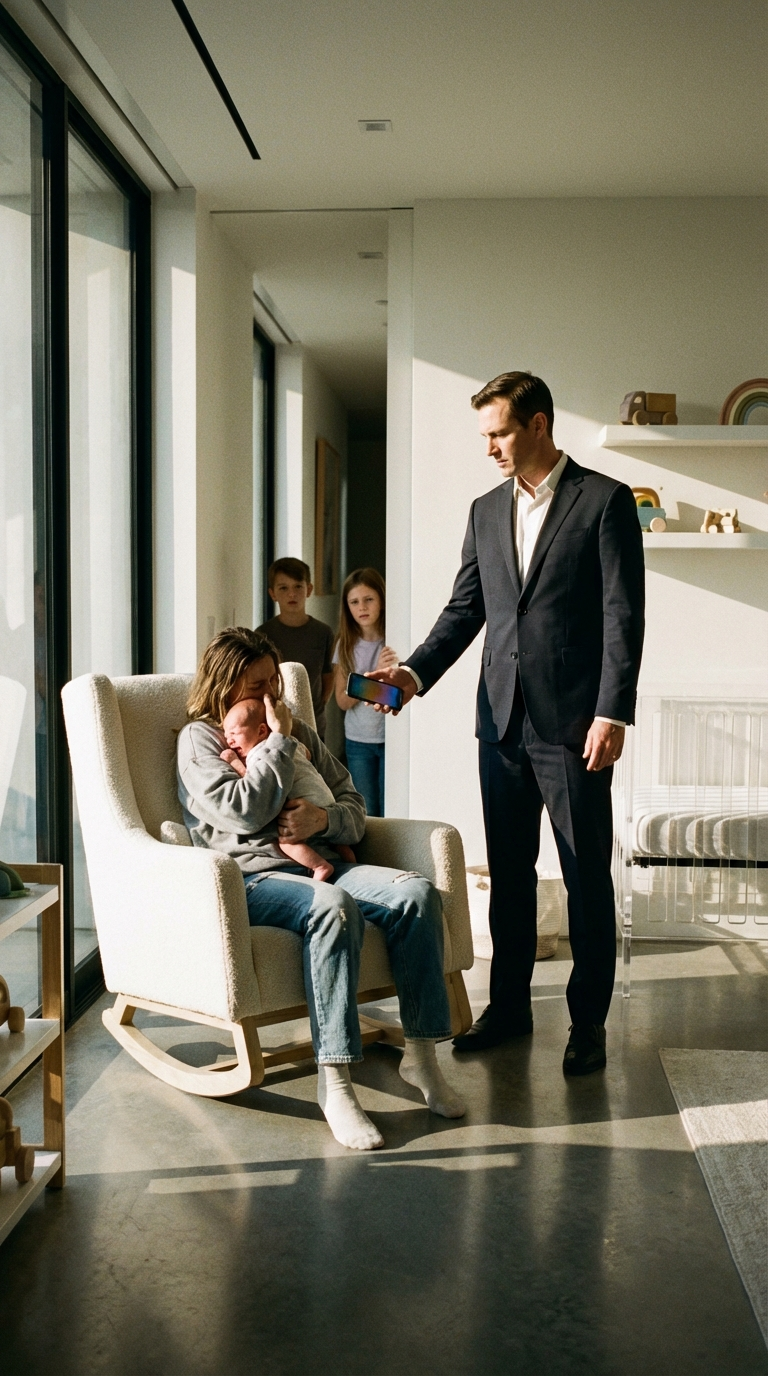
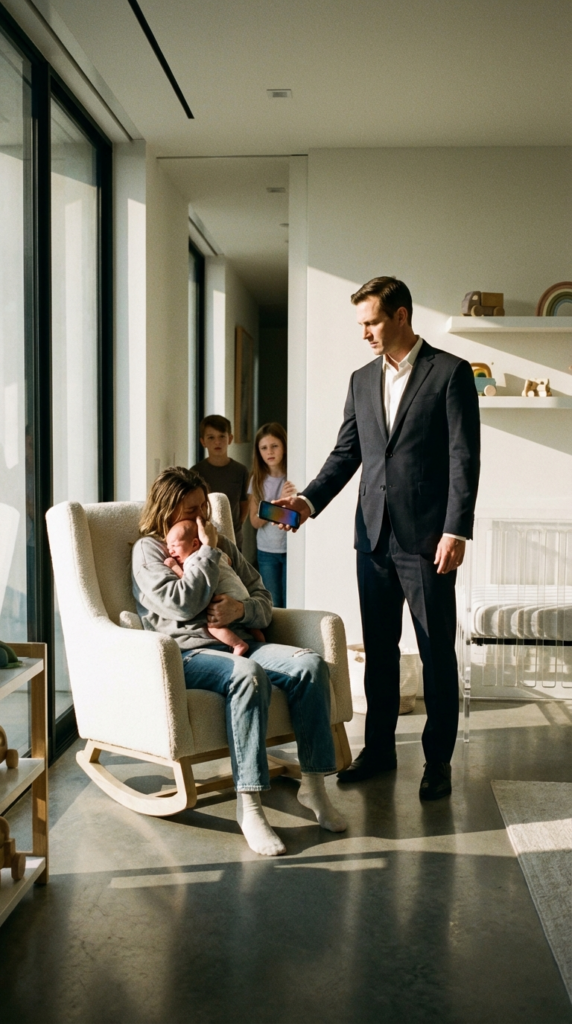
An hour earlier, the incident that sealed my fate had occurred. Alistair had made an unexpected appearance at the penthouse in the middle of a Tuesday afternoon. He walked into the nursery and found me in the rocking chair, holding six-month-old Leo against my chest. Leo had been teething, his gums swollen and angry, screaming with a raw pain that vibrated through his tiny body.
I was humming “Claire de Lune”—the same melody I had used to soothe Alistair’s older children, Maya and Sam, for the last five years.
Alistair, it turned out, had recently read an article by a Silicon Valley bio-hacker guru about “infant self-soothing protocols” and “sleep efficiency.” Apparently, comforting a screaming infant was inefficient. It was “coddling.” It was interfering with the baby’s ability to “optimize emotional regulation.”
“Put him in the crib, Elena,” Alistair had commanded from the doorway, his voice devoid of any paternal warmth. “He needs to learn to self-terminate the crying cycle.”
I had looked at him, aghast, the sobbing baby clinging to my shirt. “Mr. Sterling, he’s in pain. He just needs comfort.”
“He needs structure. You are terminated, effective immediately. Pack your things. Security will escort you out in an hour.”
Now, standing in his cavernous home office, the transaction was complete. I took the check. My hands were numb.
“Goodbye, Mr. Sterling,” I whispered.
He didn’t respond. He was already on a call to Tokyo.
I went upstairs to pack my life into two suitcases. But the hardest part wasn’t leaving the staggering luxury I’d lived adjacent to for half a decade. It was walking past the closed doors of Maya’s (10) and Sam’s (8) rooms.
They were still at their private school. They didn’t know yet. They didn’t know that when they came home today, the person who checked their homework, who sat up with them through fevers when their mother was “away,” and who chased away the monsters under their beds while their father chased his next billion on another continent, would have vanished into thin air.
I was the only stability those children had ever known. And Alistair Sterling just fired me for the crime of loving his baby too much.
To understand the magnitude of what Alistair had just done, you have to understand the ecosystem of the Sterling household. It was a beautiful, terrified place.
I was hired five years ago, shortly after the first nanny quit in a flurry of tears and NDA signatures. Back then, it was just Maya and Sam. Their mother, Cassandra, was technically present, but she was a ghost in her own home—a fragile socialite consuming a cocktail of white wine and anti-anxiety meds to cope with Alistair’s frigid demands.
Two years ago, Cassandra finally broke. She packed a Louis Vuitton weekend bag and left for a “wellness retreat” in Bali. She never came back. The divorce was quiet, expensive, and brutal.
Alistair barely broke stride. He treated his family like a subsidiary division that was slightly underperforming. He hired staff to manage the logistics of his children’s lives, but he outsourced the emotional labor to me.
I became the keeper of secrets and the dryer of tears. I knew that Maya acted out in math class only when her dad missed a promised phone call. I knew Sam needed the hallway light dimmed to exactly 30% or he’d have nightmares about being abandoned. I was the one who bought their birthday presents and signed Alistair’s name to the cards.
I was a salaried mother.
Then came Leo. He was a surprise—a surrogate pregnancy Alistair had arranged, almost as an afterthought, perhaps to prove his virility after the divorce. When they brought Leo home from the hospital, Alistair looked at the baby like it was a complex piece of new hardware he hadn’t read the manual for. He handed Leo to me and went to a board meeting.
For six months, Leo spent more time in my arms than anyone else’s. I was his universe.
And Alistair had just shattered it because I didn’t fit his optimization algorithm.
The fallout was slow at first, then instantaneous.
I moved back into a cramped studio apartment across the city. For the first three days, I stared at my phone, willing it to ring. I missed the smell of Leo’s talcum powder. I missed Sam’s rambling stories about Minecraft. I missed Maya’s cynical pre-teen observations.
I found out later what happened in the penthouse during that week. It came to me in fragmented text messages from Maria, the housekeeper, who risked her job to keep me updated.
“It is bad, Elena. Very bad. The new nanny, Miss Gretchen, she is like a robot. The baby screams for hours. Mr. Sterling is furious about the noise.”
Alistair had hired an “elite governance professional” from a high-end agency. Gretchen wore severe black suits, carried a clipboard, and adhered strictly to the cry-it-out method.
Leo stopped sleeping. He lost weight. Maya and Sam retreated into themselves. They stopped eating Maria’s cooking. They stopped talking.
The climax arrived on Friday night. Alistair was hosting a crucial dinner party for potential investors in his new AI venture. He needed his home to present the image of perfect, prosperous domestic bliss.
He ordered the children to be present for appetizers, dressed in their Sunday best, to perform like trained seals for his guests.
According to Maria, it started when Sam spilled a sparkling water on an investor’s Italian loafers. The man laughed it off, but Alistair’s eyes turned to ice. He snapped his fingers at Sam—a gesture he usually reserved for waiters.
“Samuel. Upstairs. Now.”
Sam froze. He was eight years old, terrified of his own father. He started to tremble.
That’s when Maya, quiet, watchful ten-year-old Maya, stood up.
“No,” she said.
The dining room went deathly silent. The clinking of silver forks against china stopped. Alistair looked at his daughter as if she had grown a second head.
“Excuse me?” Alistair said, his voice dangerously low.
“He’s not going upstairs to be alone,” Maya said, her voice shaking but gaining strength. “He’s scared. But you don’t know that, because you don’t know him.”
“Maya, go to your room,” Alistair commanded, his face reddening.
“Where’s Elena?” Sam suddenly burst out, tears finally spilling over. “I want Elena! She promised she’d read the next chapter tonight!”
Alistair tried to smooth it over for his guests. “Our former nanny is no longer with us. We have upgraded to a more professional standard.”
Maya laughed. It was a brittle, adult sound that didn’t belong in a ten-year-old’s throat.
“Upgraded?” Maya looked at the room full of billionaires and captains of industry. Then she looked her father dead in the eye. “Elena wasn’t a nanny, Dad. She was the one who remembered I hated peanut butter. She was the one who held Sam when Mom left. She was the one holding Leo because he was crying for the mother he doesn’t have.”
She took a breath, delivering the final blow that shattered the facade Alistair had carefully constructed.
“You didn’t fire an employee because she held a baby too much. You fired the only mother we had left.”
Maya grabbed Sam’s hand and dragged him out of the dining room. The silence they left behind was suffocating. The investors looked at their plates. The dinner party was over.
My phone rang at 11:45 PM that night. It wasn’t Maria.
“Elena.”
It was Alistair. His voice sounded unrecognizable—hollowed out, stripped of its usual arrogance. He sounded like a man standing in the ruins of his own life.
“Mr. Sterling,” I said, keeping my voice neutral, though my heart hammered.
“They won’t stop crying,” he said. It was a confession. “Leo has been screaming for two hours. Gretchen tried to implement the protocol, but… Maya threw a vase at her. Gretchen quit.”
I said nothing. I let the silence stretch, forcing him to fill the void.
“I need you to come back,” he finally said. It wasn’t a command this time. It was a plea.
“No,” I said gently.
A pause. I could hear his shock. “I’ll double your salary. Triple it. Name your price, Elena.”
“You still don’t get it, Alistair,” I used his first name for the first time. “You think this is a transaction. You think you can buy the love I gave them.”
“I don’t know what else to do,” he whispered, and for a fleeting second, I felt pity for this Master of the Universe who was completely powerless in his own home.
“If I come back,” I said slowly, “things change. Completely.”
“Anything.”
“First, Gretchen’s ‘protocols’ go in the trash. I raise Leo my way. With affection. With contact. If I need to hold him for three hours because he’s teething, I hold him.”
“Agreed.”
“Second, you are going to be home for dinner three nights a week. No phone. No Bloomberg terminal. You are going to sit at a table and talk to Maya and Sam. And I’m not going to facilitate it. You have to learn how to know them.”
There was a long hesitation. This was harder for him than triple the salary. “Okay. Three nights.”
“And finally,” I said, looking around my tiny apartment, knowing I held all the cards. “I am not just ‘staff’ anymore. I am their primary caregiver. You will treat me with the respect due to the person raising your children. If you ever undermine me in front of them again, I walk, and I won’t come back.”
“I understand,” he said. He sounded defeated, but also, strangely, relieved.
“Send the car,” I said.
When I walked back into the penthouse forty minutes later, the atmosphere was thick with tension. Alistair was sitting on the stairs, head in his hands.
I didn’t stop to talk to him. I went straight upstairs.
I found Sam and Maya huddled together in Maya’s bed, wide awake, their eyes red and swollen. When they saw me in the doorway, Sam launched himself across the room like a cannonball, burying his face in my stomach. Maya followed more slowly, clinging to my arm, silent tears wetting my sleeve.
I held them for a long time. Then, I detached myself gently. “I have to go get your brother.”
I went into the nursery. Leo was in his crib, exhausted from screaming, whimpering softly. I picked him up. He smelled sour with sweat and tears. The moment he felt my heartbeat against his, his little body uncoiled. He let out a shuddering sigh and melted into my shoulder.
I sat in the rocking chair—the scene of my “crime”—and began to hum “Claire de Lune.”
Alistair appeared in the doorway. He looked at the four of us—the family he had bought and paid for, but had never actually earned. He looked at the peace that had returned to the room the moment I entered it.
He didn’t say anything about efficiency. He just watched for a moment, a stranger looking in on a world he didn’t understand, then silently turned and walked away into the shadows of his enormous, empty house.
He had his billions. But as I rocked his sleeping son, with his older children curled up on the rug at my feet, we both knew who the richest person in the house really was.