The Call That Changed Everything
The phone rang at 11:47 PM. Unknown number. My husband was already asleep, and I almost didn’t answer. But something made me pick up.
“Is this Mrs. Caroline Harper?” A woman’s voice. Professional. Serious.
“Yes, who is this?”
“My name is Dr. Elizabeth Chen. I’m calling from St. Mary’s Hospital. I need to speak with you about an incident that occurred this afternoon involving your son, Ethan.”
My blood turned to ice. “What happened? Is he okay?”
“Your son is fine, Mrs. Harper. But there’s something you need to know. Something… extraordinary.”
Six hours earlier, I’d been furious with my eight-year-old son. It was his birthday—we’d just had his party at the park with his friends. After everyone left, I gave him his birthday money from his grandparents. Two hundred dollars in a card. Money he’d been talking about for weeks, planning to buy that gaming console he’d been begging for.
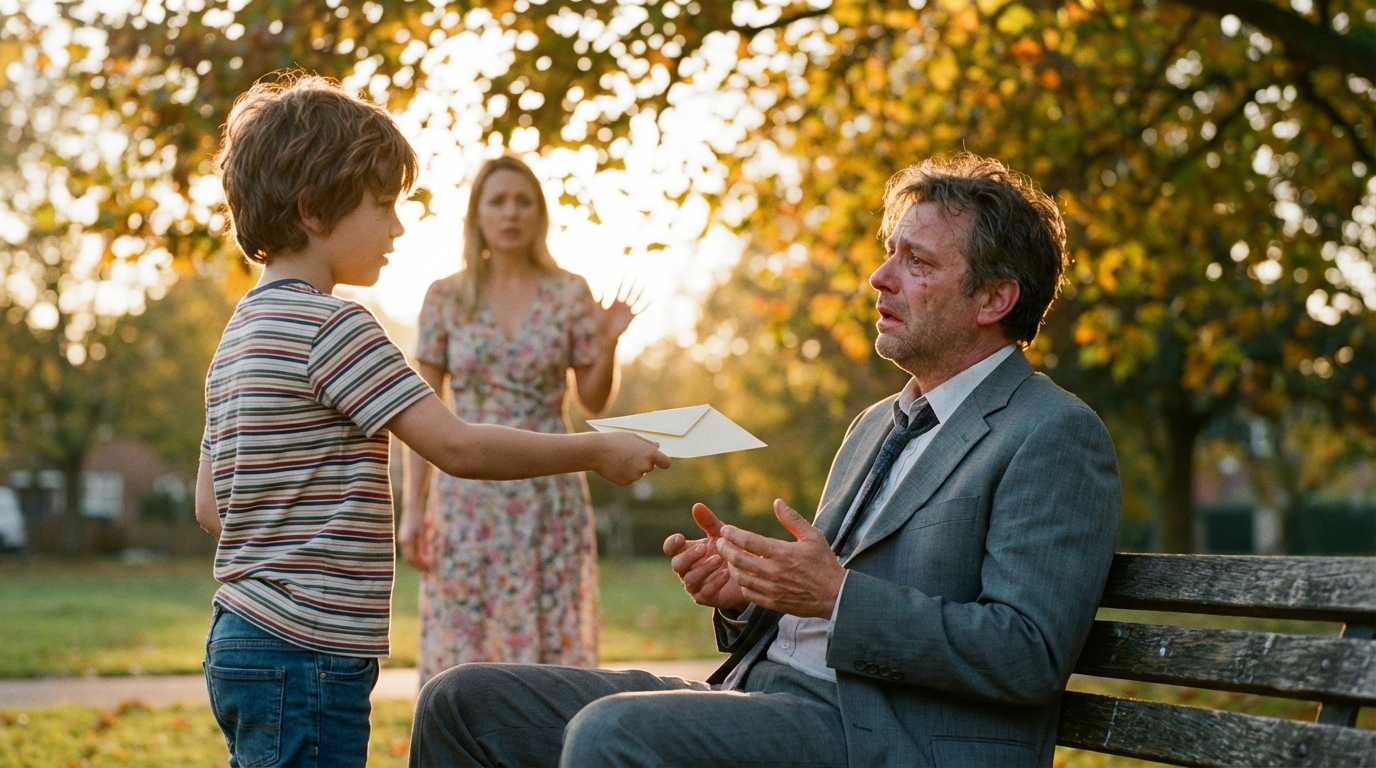
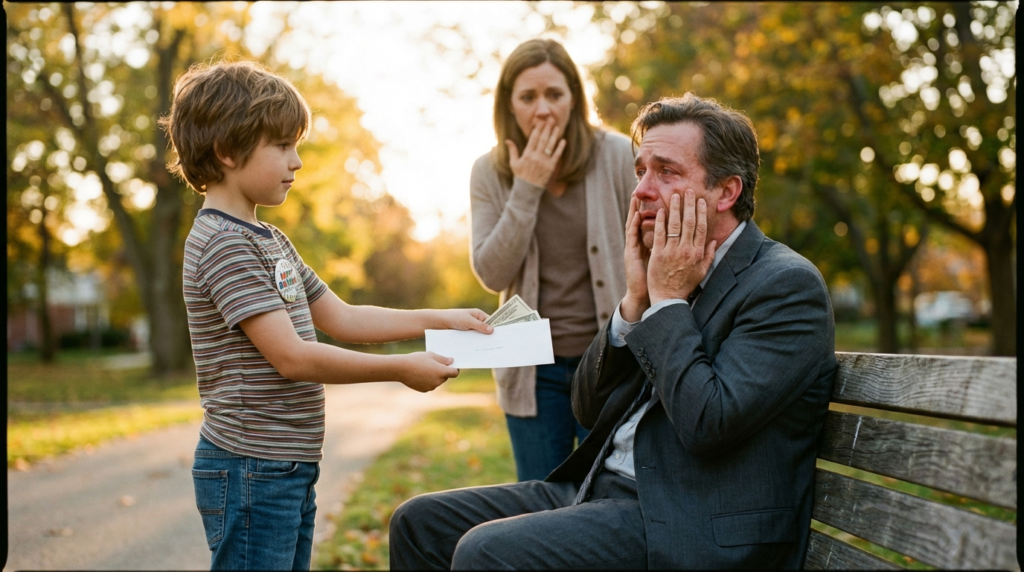
We were walking to the car when Ethan suddenly stopped. There was a man sitting on a bench about fifty feet away. Middle-aged, wearing a wrinkled suit, his head in his hands. He was crying. Not quiet tears—deep, body-shaking sobs.
Before I could say anything, Ethan walked over to him.
“Ethan, no—” I started, but he was already there.
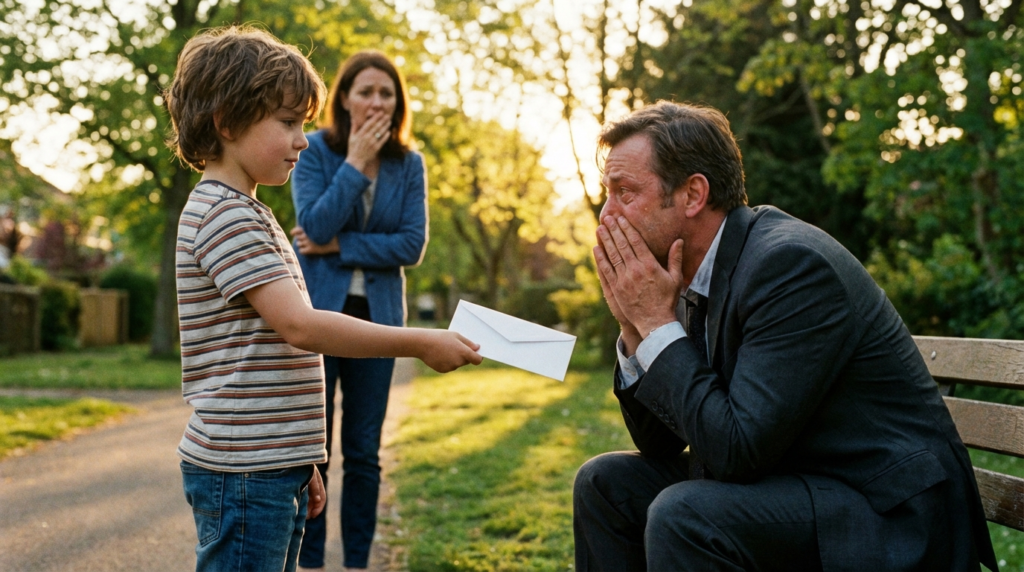
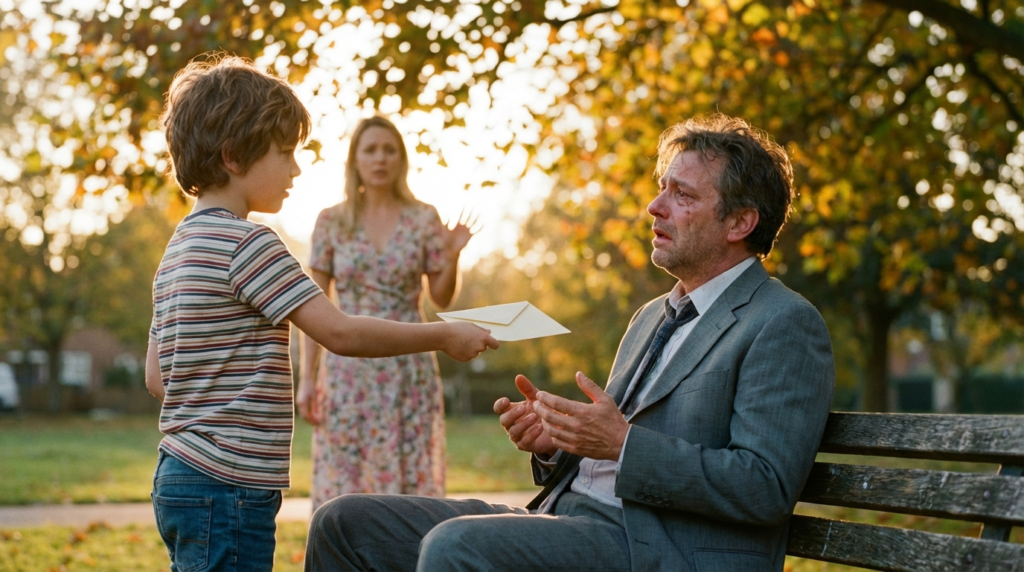
I watched my son stand in front of this stranger for a moment. Then he did something that made my heart stop. He pulled out that birthday card—all two hundred dollars—and held it out to the man.
“I think you need this more than I need a PlayStation,” I heard him say.
The man looked up, confused, tears streaming down his face. “Son, I can’t—”
“Please,” Ethan insisted. “It’s my birthday. I want to give it to you.”
I was about to march over there and stop this—we didn’t know this man, and two hundred dollars was two hundred dollars. But something about the way the man looked at my son stopped me cold.
He took the money with shaking hands. “Thank you,” he whispered. “You have no idea what you just did.”
We left. I lectured Ethan the whole way home about stranger danger and being smart with money. He just nodded quietly, and I thought that was the end of it.
Until that phone call at 11:47 PM.
“Mrs. Harper,” Dr. Chen said, “the man your son gave money to this afternoon… he came to our emergency room two hours ago. And what he told us—what your son prevented—you need to come to the hospital. Now.”
I woke my husband, David, and we drove to St. Mary’s in silence. My mind was racing with possibilities, none of them making sense. Why would a doctor call us about a stranger Ethan helped? What could possibly be so urgent that we needed to come to the hospital at midnight?
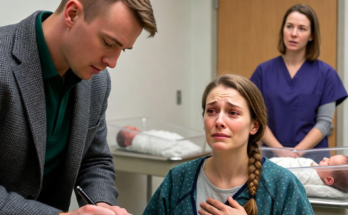
Dr. Chen met us in the waiting room. She was a small woman in her forties with kind eyes that looked exhausted.
“Thank you for coming so quickly,” she said. “I know this is unusual. But James—the man your son helped—he insisted we contact you. He’s in room 304. He’s stable now, but…” She paused, choosing her words carefully. “He wants to tell you himself what happened. What your son’s kindness meant.”
She led us down a sterile hallway to a private room. Inside, the man from the park was lying in a hospital bed, connected to an IV. He looked different now—cleaner, calmer, but his eyes were red from crying.
“Mrs. Harper,” he said when he saw me, his voice breaking. “Please, sit down. I need you to understand what your son did today.”
His name was James Mitchell. Forty-three years old. Senior accountant at a mid-sized firm downtown. Married for fifteen years. Two daughters, ages twelve and nine.
Three months ago, his wife, Rachel, was diagnosed with stage three breast cancer.
“The treatment was aggressive,” James said, his hands gripping the hospital blanket. “Chemo, radiation, the works. Insurance covered most of it, but there were gaps. Co-pays. Experimental drugs they wouldn’t approve. Special treatments that might help but weren’t ‘medically necessary’ according to the insurance company.”
He’d maxed out their credit cards. Taken out a second mortgage. Borrowed from his retirement fund. His daughters didn’t know how bad things were—he and Rachel had agreed to keep them innocent as long as possible.
“Then last week, Rachel got worse. The cancer spread to her lymph nodes. The doctors said there was a new treatment—immunotherapy combined with targeted radiation. It could work. It could save her. But insurance denied it. Called it experimental.” His voice was hollow. “The out-of-pocket cost was $47,000. We had until Monday to decide if we wanted to proceed.”
James had exactly $847 in their checking account. No way to get that kind of money in time.
“I’ve been a good man my whole life,” he said, looking at his hands. “Never broke the law. Paid my taxes. Went to church. Worked hard. And I couldn’t save my wife. I couldn’t protect my family.”
That afternoon, James had made a decision. He was going to rob the QuickStop on Elm Street. He’d never done anything like it in his life, but desperation makes you do unthinkable things. He’d been sitting in his car in the parking lot for two hours, working up the courage, when he realized he couldn’t do it.
Not because he was scared of getting caught. Because if he got caught, his daughters would lose both parents. Rachel to cancer, and him to prison.
So he drove to the park instead. The park where he’d proposed to Rachel eighteen years ago. And he sat on that bench and cried because he was out of options and out of hope.
“I was praying for a sign,” James said, tears streaming down his face. “Asking God if there was any point in going on. If I should just end it all so Rachel could get my life insurance and afford the treatment.”
That’s when Ethan walked up to him.
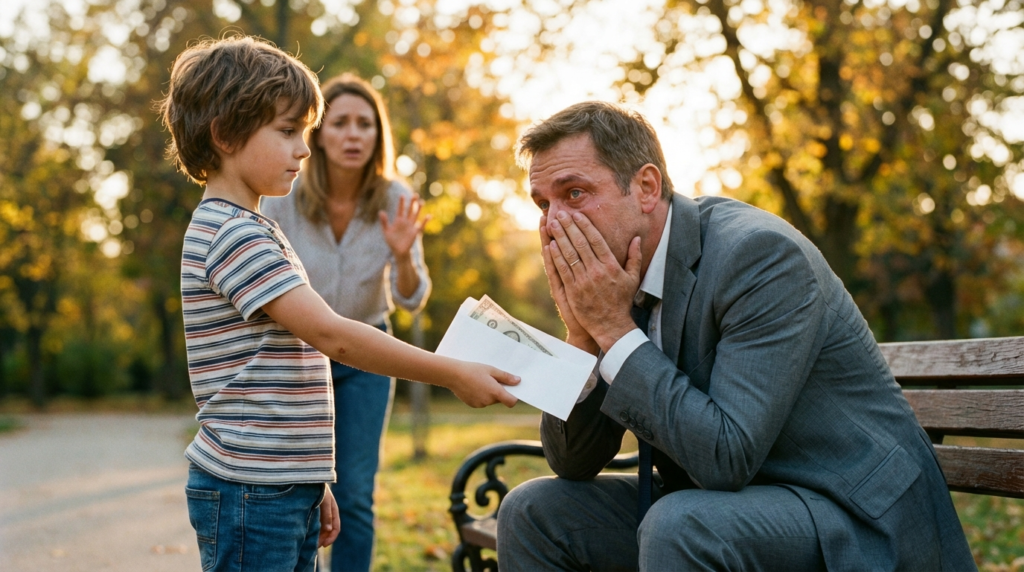
“This little boy—your son—he stood in front of me with this money in his hand,” James continued. “And he said something I’ll never forget. He said, ‘I think you need this more than I need a PlayStation. It’s my birthday, and I want to give it to you.'”
James had tried to refuse. But Ethan insisted with such pure, innocent conviction that James finally accepted it.
“Two hundred dollars,” James said, his voice breaking. “It wasn’t enough to save Rachel. It wasn’t enough to fix everything. But in that moment, it saved me. Because your son reminded me that there’s still goodness in this world. That people still care. That I wasn’t alone.”
He’d gone home with that money. Held his wife. Told her what happened. And instead of despairing about the $47,000 they didn’t have, they decided to try something they’d been too proud to do before.
They posted their story on a medical fundraising website.
James showed us his phone. In six hours, their GoFundMe had raised $63,000. Complete strangers—hundreds of them—donating $10, $50, $100. Sharing their story. Sending messages of hope.
“Your son’s $200 didn’t just give me money,” James said. “It gave me hope. It reminded me that people are fundamentally good. That kindness exists. And that hope gave me the courage to ask for help instead of—” His voice cracked completely. “Instead of what I was going to do.”
Dr. Chen stepped forward. “James came to the ER tonight because he wanted to start treatment immediately. The fundraiser reached their goal. Rachel starts immunotherapy tomorrow.”
I couldn’t speak. My throat had closed completely.
I’d been angry at Ethan. On the drive home from the park, I’d lectured him about being careless with money. About how $200 was a lot of money. About how he needed to learn the value of saving and planning.
“That man probably spent it on alcohol,” I’d said. “Or drugs. You can’t just give money to strangers, Ethan. The world doesn’t work that way.”
Ethan had been quiet in the backseat. When we got home, he’d gone straight to his room. I thought I’d taught him an important lesson about the real world.
Now, sitting in this hospital room, I realized I’d almost crushed the best part of my son. The part that saw someone in pain and responded with pure, uncomplicating kindness. The part that hadn’t yet learned to be cynical and suspicious and protective of what’s “mine.”
“Can I meet him?” James asked quietly. “Your son. I know it’s late, but I need to thank him properly. To tell him what he did.”
We went home and woke Ethan. He was confused and sleepy, but when we explained where we were going, his eyes went wide.
“Is the man okay?” he asked immediately. “Did I do something wrong?”
My heart broke. “No, baby. You did something very, very right.”
Back at the hospital, James was sitting up in bed when we arrived. When Ethan walked in, still in his dinosaur pajamas, James started crying again.
“Hey, buddy,” James said softly. “Come here.”
Ethan walked over shyly. James took his small hand in both of his.
“Do you know what you did for me today?” James asked.
Ethan shook his head.
“You saved my life. Not with the money—though that helped start something amazing. You saved me because you reminded me what matters. You showed me that even on the darkest day, there’s still light in the world. And that light is people like you who choose to be kind even when no one’s watching.”
James pulled an envelope from his bedside table. “I can’t give you your $200 back yet—we need it for my wife’s treatment. But I wrote you a letter. And I promise you, when things get better, I’m going to pay it forward a hundred times over. Because of you.”
Ethan took the letter, but he was focused on James. “Is your wife going to be okay?”
“I think so,” James said, his voice thick. “Thanks to you, she’s got a fighting chance.”
“Good,” Ethan said simply. Then he smiled. “I didn’t really need a PlayStation anyway. Mom says I play too many video games.”
James laughed through his tears. So did Dr. Chen. So did David and I.
“You’re going to do amazing things in your life, Ethan,” James said. “Never let anyone tell you that kindness is weakness. What you did today was the strongest, bravest thing I’ve seen in my entire life.”
I’m writing this from the park where it all happened. James texted me this morning asking if we could meet here, and I knew something significant was happening.
Rachel is in remission. The immunotherapy worked better than anyone expected. She’s back at work part-time, her hair growing back, her smile bright and real.
James has started a nonprofit. It’s called “Ethan’s Gift”—with our permission—and it helps families facing medical bankruptcy get the resources and support they need. The GoFundMe that started with Ethan’s $200 raised over $200,000 total, and after Rachel’s treatment, they used the extra to launch the foundation.
But that’s not why we’re meeting today.
James is standing by the same bench where Ethan found him six months ago. Rachel is with him, glowing with health and life. And between them are their two daughters, holding a large wrapped box.
“Ethan,” James says when we arrive, “we wanted to give you something. Not because you need it or asked for it, but because some things need to be celebrated.”
The girls hand Ethan the box. He opens it carefully. Inside is a PlayStation 5—the one he’d wanted—with a note that reads: “For the boy who taught us that some gifts are worth giving up everything for. Thank you for giving us everything. Love, The Mitchell Family.”
But there’s more. Underneath the gaming console is a college fund bankbook. James and Rachel have started a fund in Ethan’s name. Every person who donated to their campaign was asked if they’d contribute one additional dollar to “pay forward the kindness of a boy who gave up his birthday wish.” Over 3,000 people said yes.
“It’s not much yet,” Rachel says, kneeling to Ethan’s level. “But by the time you’re eighteen, this will help you pursue whatever dreams you have. Because you gave us back our dreams.”
Ethan is crying now. So am I. So is everyone.
“I just wanted to help,” Ethan says, his voice small.
“And you did,” James says. “More than you’ll ever know.”
I think about that day constantly. About how close I came to stopping Ethan. About how I almost taught my son to be protective and suspicious instead of generous and kind.
I was wrong. I was so wrong.
The world had taught me to be cynical. To assume the worst. To protect what’s mine because resources are scarce and people are selfish. And I was passing that worldview on to my son like it was wisdom instead of fear.
But Ethan saw something I’d forgotten. He saw a person in pain and responded with his whole heart. No calculation. No suspicion. Just pure, unfiltered compassion.
And that compassion saved a life. Started a movement. Changed everything.
The letter James wrote to Ethan that night—we’ve framed it in Ethan’s room. It reads:
“Dear Ethan, Today you taught me that the size of a gift isn’t measured in dollars, but in the size of the heart that gives it. Your heart is enormous. Never let the world make it smaller. Thank you for saving my life. Thank you for reminding me what matters. Thank you for being you. Your friend forever, James.”
Ethan reads it every night before bed.
I’ve changed too. I volunteer with “Ethan’s Gift” now, helping families navigate the nightmare of medical debt and insurance denials. David and I have restructured our budget to give more to causes that matter. Not because we have to, but because Ethan showed us what’s possible when you choose to see people’s pain instead of looking away.
Last week, Ethan gave away his allowance to a homeless woman outside the grocery store. My first instinct was to lecture him again. But then I remembered James. Rachel. The butterfly effect of one child’s kindness.
So instead I said, “I’m proud of you, buddy.”
He looked up at me with those bright, innocent eyes. “She looked sad, Mom. Like Mr. James did. I wanted to help.”
“You always want to help,” I said. “Don’t ever stop.”
The story spread. Local news picked it up. Then national news. James and Rachel appeared on morning talk shows, telling their story, promoting the foundation. Every time, they talked about the eight-year-old boy who gave up his birthday money and started a chain reaction of kindness.
We’ve received letters from across the country. People telling us how Ethan’s story inspired them to be more generous. To see the people they usually walk past. To give when they have the opportunity instead of making excuses.
One woman wrote that she’d been about to throw away her ex-husband’s old clothes, but Ethan’s story made her donate them to a homeless shelter instead. The man who received the winter coat wrote his own letter—he’d been sleeping outside, and that coat saved him from hypothermia during a cold snap. He’s now in transitional housing and has a job interview next week.
Another family wrote that their teenage daughter had been saving for concert tickets when she heard Ethan’s story. She donated the money to “Ethan’s Gift” instead. That donation, combined with others, paid for a single mother’s insulin for three months.
The ripples keep spreading. All from $200 and an eight-year-old’s instinct to help someone who was hurting.
I used to think kindness was nice but impractical. That you had to be strategic about generosity. That the world was too harsh and resources too limited to just give without careful consideration.
Ethan proved me wrong.
Kindness isn’t impractical. It’s the most powerful force in the world. It saves lives. Changes trajectories. Reminds people of their humanity when they’re about to lose it.
And it costs so little. $200. A moment of attention. The willingness to see someone else’s pain and respond.
James tells people that Ethan saved his life that day in the park. But Ethan saved mine too. He saved me from becoming the kind of person who teaches their child that self-protection matters more than compassion. That “being smart” means being suspicious.
He reminded me that children see the world more clearly than adults. They haven’t yet learned to complicate simple truths. Someone is hurting. Help them. It’s not more complex than that.
Unless we make it complex. Unless we add layers of cynicism and suspicion and fear that keep us from doing the most human thing possible: caring about each other.
I’m grateful every day that Ethan didn’t listen to my lecture on the drive home. That he kept his generous heart despite my attempt to make it smaller. That he trusted his instinct to help over my “wisdom” about the real world.
Because his version of the real world—where people help each other, where kindness ripples outward, where $200 can save multiple lives—that’s the world I want to live in.
That’s the world he’s building, one act of compassion at a time.
And I’m honored to be his mother and to finally, finally be learning from him instead of the other way around.
James was right that day in the hospital. Ethan is going to do amazing things in his life.
But he’s already done the most amazing thing possible: He reminded us all what it means to be human.