I thought the hardest part of becoming a father again at forty-two would be the sleepless nights.
I was wrong.
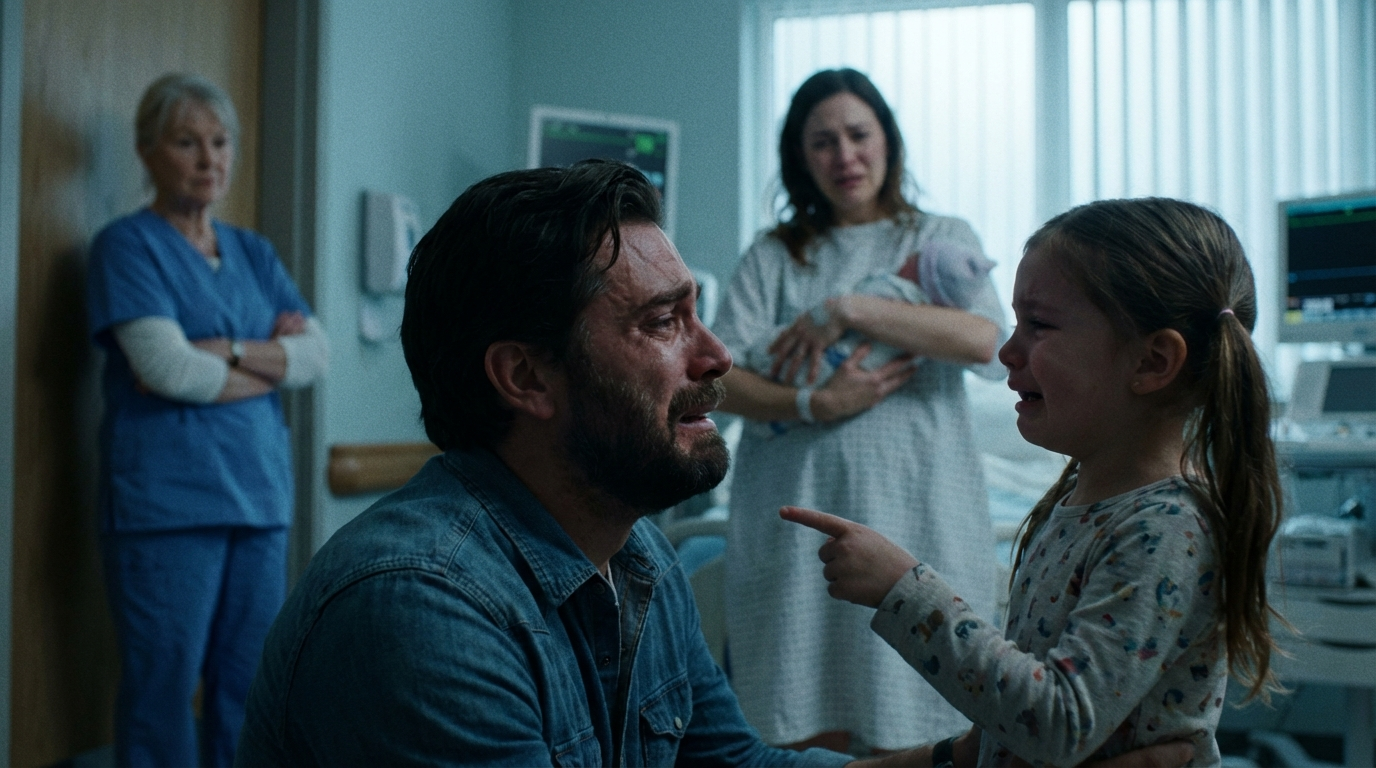
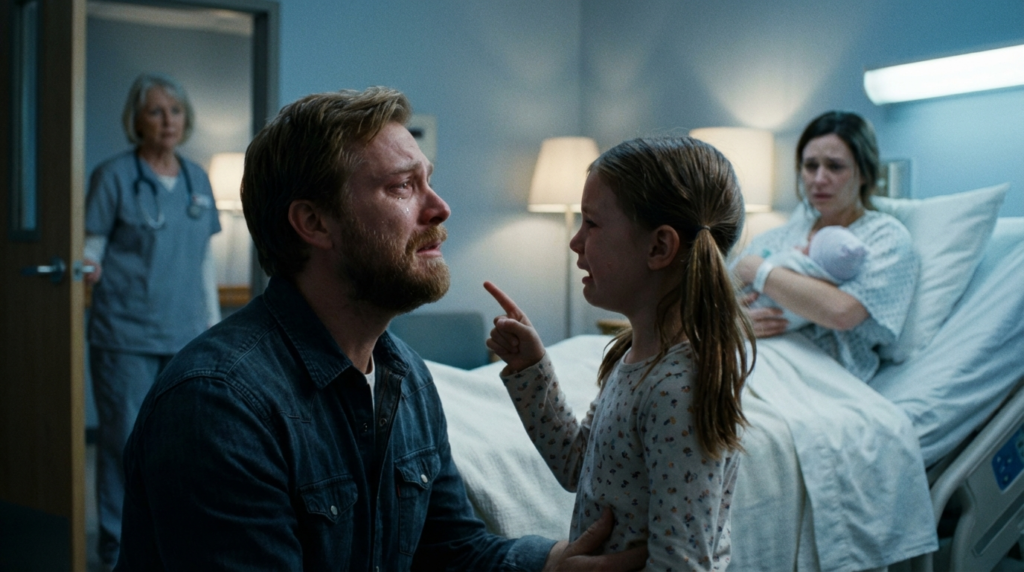
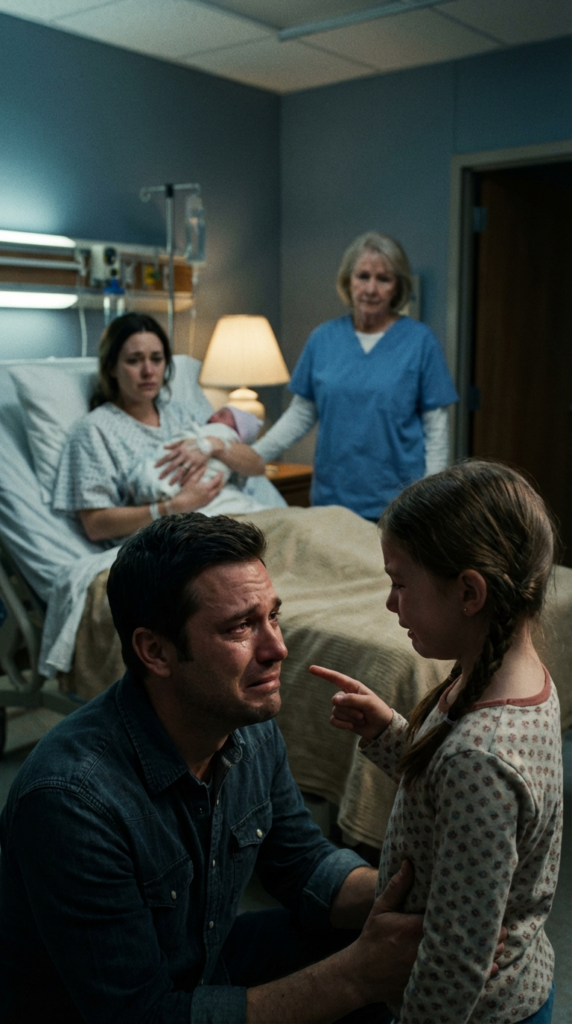
The hardest part was standing in that delivery room, holding my newborn daughter, while my eight-year-old Emma pointed at me with tears streaming down her face and said the words that shattered my entire world.
“You’re never home anymore! You don’t even love us!”
My wife Sarah was exhausted in the hospital bed, and I was trying to be present, trying to do everything right this time. But Emma’s face—God, the pain in her eyes—it was like looking into a mirror that showed me all my failures as a father.
“Emma, sweetie, that’s not true—”
“It IS true!” she sobbed. “You missed my school play. You forgot my birthday dinner. You promised we’d go to the zoo and you NEVER came home!”
The nurse in the corner shifted uncomfortably. Sarah reached out to Emma, but our daughter pulled away.
“I don’t want a new sister! I want my dad back!”
That’s when it hit me. Really hit me. I’d been so focused on providing—on building my business, on making money for our future, on being the “good provider”—that I’d stopped being a father to the daughter I already had.
I’d missed months of her life. Maybe years.
And now she was standing there, eight years old, crying so hard she could barely breathe, telling me she felt abandoned. Replaced.
“Emma, I’m so sorry—”
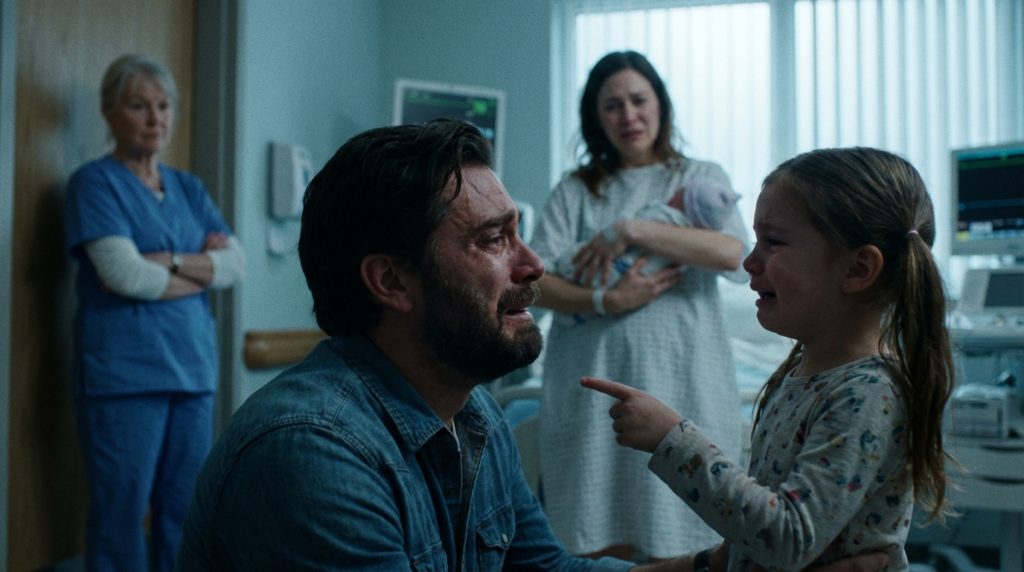
“You’re always sorry!” She was screaming now. “But you never CHANGE! You’re going to forget about me now that you have a new baby!”
I handed the newborn to Sarah. I knelt down in front of Emma, and she tried to push me away, but I pulled her into a hug anyway.
She fought me. She pounded on my chest. She cried and screamed that she hated me.
And I deserved every word.
My name is Michael, and I used to think I had it all figured out.
I grew up poor. Really poor. Government cheese and powdered milk poor. My dad worked three jobs and still couldn’t make ends meet. I watched him age twenty years in ten, watched the stress kill him at fifty-three.
I swore I’d never put my family through that.
So when I started my construction company at twenty-eight, I worked like a man possessed. Sixteen-hour days. Seven days a week. Every project I could get my hands on.
By the time Emma was born, I’d built something successful. We had a nice house. Good cars. I could afford dance lessons and private school. Everything my parents couldn’t give me.
But somewhere along the way, I forgot why I was doing it.
Sarah would ask me to come home early. I’d say, “Just one more project, honey. This client is huge—it could set us up for years.”
Emma would ask me to read her bedtime stories. I’d say, “Daddy’s tired, sweetie. Tomorrow, I promise.”
Tomorrow became next week. Next week became next month.
I missed her first day of kindergarten because of a site inspection. Missed her first lost tooth because of a business dinner. Missed her winning the school spelling bee because I was in another city looking at a commercial property deal.
Each time, I told myself it was temporary. That once the business was stable, I’d slow down. I’d be there more.
But the business was never stable enough. There was always another goal, another milestone, another client that could take us to the next level.
Sarah stopped asking me to come home. Emma stopped asking me to play. They adapted to my absence like it was just how life was supposed to be.
And I told myself they understood. That they knew I was doing this for them.
Last October, Emma had a school play. She was the lead—Dorothy in The Wizard of Oz. She’d been practicing for months, walking around the house singing “Somewhere Over the Rainbow.”
She made me promise I’d be there. She even made me pinky swear.
The day of the play, I got a call from a major client. They wanted to meet—right now—about a million-dollar project. It was the kind of opportunity that could change everything.
I took the meeting.
I told myself I’d make the second show. There were two performances.
But the meeting ran long. Then there was dinner. Then drinks. By the time I got home, it was past midnight.
Emma’s bedroom door was closed. A hand-drawn program from the play was on the kitchen counter with a note in Sarah’s handwriting: “She cried for two hours waiting for you.”
I stood there in my expensive suit, in my expensive house, holding that program, and I felt… nothing. Just numb.
I told myself she’d understand when she was older. That she’d appreciate everything I’d sacrificed.
Two weeks later was Emma’s eighth birthday. I’d promised to take her and her friends to the arcade.
I got stuck at a job site. A worker got injured—not seriously, but there was paperwork, insurance calls, making sure he was okay. By the time I handled everything, the party was over.
Sarah didn’t yell. She just looked at me with this tired, sad expression and said, “She asked me if you still loved her, Michael.”
“Of course I love her.”
“Then maybe you should try showing up.”
But I didn’t change. I kept telling myself next time would be different.
When Sarah told me she was pregnant again, I cried. Happy tears. A second chance, I thought. I could do it right this time.
I didn’t notice how quiet Emma got when we talked about the baby. How she’d leave the room when Sarah asked her to help pick out nursery colors.
I was too busy working. Because now I had two children to provide for. The pressure was bigger. The stakes were higher.
I worked harder than ever.
The day Sarah went into labor, I rushed from a job site still covered in sawdust. I was in the delivery room, and for those few hours, nothing else existed. Just my wife, and this new little person coming into the world.
When they handed me my daughter—when I looked at her tiny face—I felt this overwhelming love. This promise to myself that I’d be better. That I’d be present.
And then Emma walked in from the waiting room where she’d been with Sarah’s mom.
One look at her face, and I knew something was deeply wrong.
Her eyes were red from crying. Her little hands were balled into fists. She looked at the baby, then at me, and I saw something that made my heart stop.
She looked betrayed. Abandoned. Terrified.
“Emma, come meet your sister—”
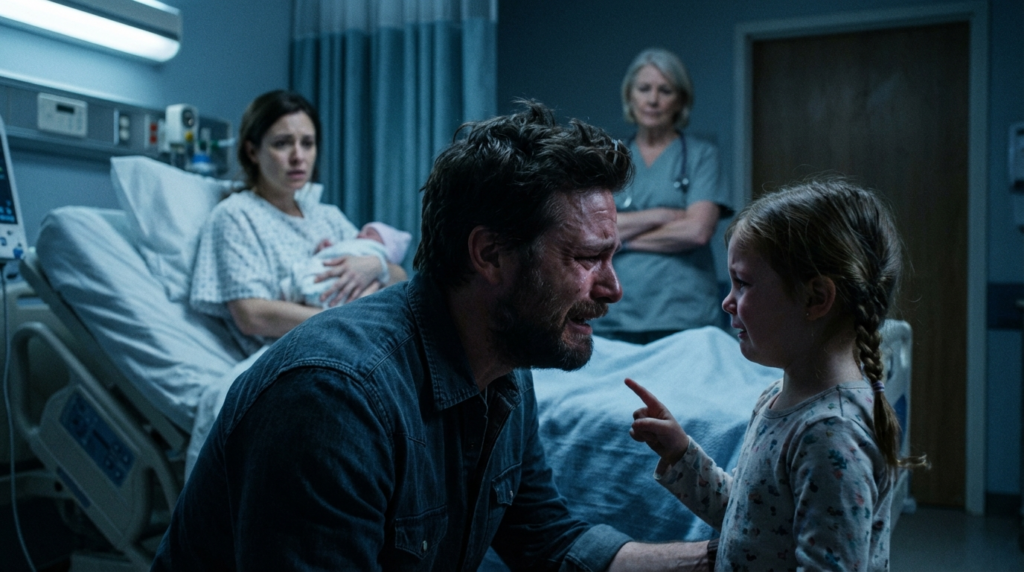
That’s when she exploded. When all those months of disappointment and loneliness came pouring out. When she told me, in front of everyone, that I was a terrible father. That I’d abandoned her. That she didn’t matter anymore.
Every word was a knife. Because every word was true.
Emma was sobbing in my arms, fighting me, and I didn’t know what to do. I’d built buildings and managed hundreds of workers, but I had no idea how to fix what I’d broken with my own daughter.
The nurse—her name tag said Margaret—stepped forward. She was older, maybe in her sixties, with kind eyes and gray hair pulled back in a bun.
“Mr. Thompson, can I speak with you for a moment?” Her voice was gentle but firm. “In the hall?”
I didn’t want to leave Emma, but Sarah nodded. “Go. I’ve got her.”
In the hallway, Margaret led me to a small waiting area. We sat down.
“I’ve been a nurse for thirty-eight years,” she said. “And I’ve seen a lot of fathers in delivery rooms. You want to know what I see when I look at you?”
I didn’t answer.
“I see a man who loves his family so much that he’s killing himself to provide for them. I see someone who thinks love is measured in dollars and square footage.” She paused. “My husband was like you.”
“Was?”
“He died of a heart attack at forty-nine. Worked himself to death trying to give us everything.” Her eyes were sad. “You know what my kids remember about him? That he wasn’t there. They’d trade every toy, every vacation, every material thing for just one more day where he actually showed up.”
I felt something crack inside my chest.
“My Emma—”
“Your Emma doesn’t need you to be rich. She needs you to be present. She needs you to choose her over a meeting. Over a deal. Over whatever excuse you’ve been telling yourself justifies missing her life.”
“I’m trying to give them a good life.”
“You’re trying to give them the life YOU didn’t have,” Margaret said gently. “But Michael, they don’t need what you didn’t have. They need what you DO have—time. Attention. Presence.”
“I don’t know how to fix this.”
“Yes, you do. You just have to choose to do it.” She stood up. “I’m going to tell you what I wish someone had told my husband: Your children are only little once. You can’t get this time back. No amount of money will ever replace it. And if you keep going the way you’re going, you won’t just lose time with them. You’ll lose them completely.”
I sat in that hallway for twenty minutes after Margaret left.
I thought about my dad, working himself to death. I’d spent my whole life trying not to be him—trying to give my family more.
But I’d become him anyway. Just in a different way.
I pulled out my phone. I had seventeen missed calls from the office. Six emails marked urgent. A text from my foreman about a crisis on a job site.
I turned my phone off.
Then I walked back into that delivery room.
Emma was sitting in a chair, her face still red and puffy. Sarah was holding the baby, watching me with careful eyes.
I knelt down in front of Emma again. This time, she didn’t fight me.
“You’re right,” I said quietly. “About all of it. I have been a terrible dad lately.”
She sniffled.
“I thought I was showing you I loved you by working hard. By giving you things. But that’s not what you needed.” I wiped her tears with my thumbs. “You needed me to show up. And I didn’t. And I’m so, so sorry.”
“You always say that.”
“I know. But this time, I’m going to prove it.” I took a deep breath. “Starting right now. I’m not going back to work for a month.”
Sarah’s eyes widened. “Michael—”
“A month,” I repeated. “I have a good foreman. I have employees I trust. They can handle things. Because right now, my family needs me more than my business does.”
“What about the Miller project?” Sarah asked.
“Tom can manage it. And if the client doesn’t like that, they can find another contractor.” I looked at Emma. “No more broken promises. No more ‘I’ll be there next time.’ I’m going to be here. Every day. Every night. Every moment I can.”
Emma’s lip trembled. “Really?”
“Really. In fact, you know what we’re going to do tomorrow?”
“What?”
“We’re going to that zoo I promised you. Just you and me. All day. No phone. No interruptions.”
Her eyes lit up. “Just us?”
“Just us. And then next week, you can help me figure out how to be a better dad. Deal?”
She threw her arms around my neck. “Deal.”
I wish I could say it was easy. It wasn’t.
The first week, my phone rang constantly. I ignored it. Clients complained. A few walked. My revenue took a hit.
But you know what I got instead?
I got to wake up with Emma every morning and make her pancakes. I got to help with homework. I got to hear about her day—really hear it, not just the highlights while I checked emails.
We went to the zoo. She held my hand the whole time and told me about every animal. She was so happy, she practically glowed.
We went to her dance recital. I sat in the front row, and when she spotted me, her face lit up like I’d given her the moon.
I read her bedtime stories every single night. Sometimes the same book three times in a row because it was her favorite.
I learned that her best friend was named Sophia, not Sophie. That her favorite color had changed from pink to purple. That she was afraid of thunderstorms but loved rain. That she wanted to be a veterinarian when she grew up.
How had I not known any of this?
With the new baby—we named her Grace—I was there for every middle-of-the-night feeding. Every diaper change. Every moment.
Sarah cried one night after I’d rocked Grace to sleep. “You’re different,” she said. “I have my husband back.”
“I’m sorry it took me so long.”
“You’re here now. That’s what matters.”
After a month, I did go back to work. But everything was different.
I cut my hours to forty a week. Fired clients who demanded I be available 24/7. Hired another foreman to share the load.
My revenue dropped by about thirty percent that first year.
But I was there when Emma got her first A on a spelling test. When she learned to ride a bike. When she had her first crush and needed to talk about it.
I was there when Grace took her first steps. Said her first word (it was “Dada,” and I sobbed like a baby).
I started a new tradition: every Saturday was “Emma Day.” Just the two of us. Sometimes we’d do something big, like go to an amusement park. Sometimes we’d just get ice cream and talk.
She started trusting me again. Started believing my promises. Started looking at me like I was her hero again instead of a stranger who slept in her house.
Margaret, the nurse, became a family friend. She’d check on us every few months. She told me I’d made the right choice.
“Your bank account might be smaller,” she said. “But your life is richer. That’s the trade-off nobody talks about.”
Emma is twelve now. Grace is four.
Last week, Emma’s school had a career day. They asked parents to come talk about their jobs.
I almost said no. Old habits die hard. There was a big meeting that day.
But then I looked at the invitation Emma had made by hand, with drawings of hard hats and construction equipment, and at the top it said: “My Dad: The Best Builder in the World.”
I rescheduled the meeting.
When I walked into her classroom, Emma’s face lit up. After my presentation, she hugged me in front of all her friends and whispered, “Thanks for coming, Dad.”
That moment was worth more than every client I ever lost.
I’ve learned that being a good father isn’t about how much money you make. It’s about how much time you give.
I’ve learned that kids spell love T-I-M-E.
I’ve learned that the business will survive without you, but your children won’t wait.
And I’ve learned that sometimes, it takes a child’s tears and a stranger’s kindness to show you what really matters.
My company is smaller now. But my life is fuller.
Emma and Grace adore each other. They play together every day. And when people ask Emma what her dad does for a living, she doesn’t say “construction.”
She says, “He’s my dad. He shows up.”
That’s the only title I need anymore.
Last month was Emma’s twelfth birthday. I’d been planning for weeks—a surprise party, all her friends, the works.
But three days before, she came to me and said, “Dad, can we cancel the party? Can we just have a day, you and me? Like we used to?”
“You don’t want the party?”
“I want time with you more.”
So we did. We went to the beach, just the two of us. Built sandcastles. Talked about everything and nothing. Watched the sunset.
As we were leaving, she took my hand and said, “This is the best birthday I’ve ever had.”
No expensive gifts. No big production. Just time.
That’s when I knew—really knew—that I’d made the right choice four years ago in that hospital room.
Margaret was right. My kids are only little once. And I almost missed it.
But I didn’t. Because my daughter’s tears showed me the truth, and a stranger’s kindness showed me the way forward.
Now I’m showing up. Every single day.
And it turns out, that’s all they ever wanted.